"Moshiach is ready to come now-our part is to increase in acts of goodness and kindness" -The Rebbe

Wednesday, June 6, 2012

Educating for Yiddishkeit by Raising Leaders

Educating for Yiddishkeit by Raising Leaders

Rabbi Y. Oliver

We live in an age and culture in which, for better or worse, the average young person has an independent streak that makes it harder for him or her to obediently follow the example of the older generation. They feel a strong need to forge their own path, to individuate from their parents and elders. How are we to handle this phenomenon, which seems to be at odds with the fundamental goal of chinuch—passing on the timeless beliefs and practices of Torah observance to our offspring?

The Rebbe answers: Use this independent streak to raise children from the earliest years with the goal of being leaders, and encourage them to assume this role wherever and whenever possible.

In the words of the Rebbe:
... There has been a lack of attention given to educating the young generation. And even those who have been involved, wanted to educate the young generation “from above to below”—in other words, to have the youth look up to the elders, who are experienced, and learn from them. The young generation finds this unacceptable, because they want to be independent.

How, indeed, can we influence the young generation? By educating them from early childhood, and also by striving that at a later point, they too will become educators themselves. This is the way to conquer the young generation, and also the middle-aged generation.

This is one of the main purposes of yeshivos. In yeshivos, the students aren’t only taught on the individual level. Rather, the main goal is to imbue in the student the awareness that he has to influence his entire sphere of influence—at first, only a limited circle, and later on, a larger circle—to draw them close to Judaism, to the extent that they not only do they fight a defensive war, but an offensive war; i.e., they too will fight for Judaism.

This is especially prominent in Lubavitcher yeshivos. Lubavitcher yeshivos don’t just teach their students to be frum in their relationship with Hashem and with their fellow Jew. Rather, they teach the students that even while still in yeshivah, they must make use of their talents and opportunities to influence others, and serve as leaders.

Thus, a gathering to support a Chabad yeshivah entails more than supporting a particular group or movement. Everyone who joins in by donating to the yeshivah takes part in supporting Judaism overall, because the students of the yeshivah will develop into warriors for Judaism and leaders of the Jewish people—in New York, in the entire United States, and even overseas.

The students of the yeshivah are the soldiers who will go out to the front of the war for Judaism. Thus, one who supports the yeshivah and enables it to accept additional students, takes part in the war for Judaism in New York, in the United States, and in the entire world.

Adapted from Toras Menachem, Vol. 10, p. 147. Cf. Igros Kodesh, Vol. 19, p. 373.
In my own words, with a bit of explanation:

Practically speaking, in our times, raising children to be G–d-fearing means raising them to lead. Of course, parents should send their children to a proper Jewish school, make sure to provide a home atmosphere permeated with Yiddishkeit, love and fear of Hashem and His Torah, learn with each child one-on-one, and the like. Yet in addition to all these efforts, parents should actively encourage children and teenagers to exert a positive influence on their less-observant peers in an appropriate manner, make sure they take part in outreach activities (mivtzo’im) as much as possible, and imbue in their hearts the aspiration to one day assume a leadership role of some kind themselves.

In addition to the benefit for others, this focus will in itself enable the child to be proud and independent in a positive, constructive way, while at the same time remain humble before Hashem and His Torah, and protected from detrimental outside influences.

In addition to the parents’ own efforts in this direction, it is of crucial importance that they send their children to a school that shares the awareness of the crucial role that making leaders plays in educating children and youth in our time. The most suitable school and yeshivah for this purpose is a Lubavitcher one.

Moreover, it deserves to be emphasized that this instruction applies not only to children and teenagers, but also to those who are in mid-life, and whose devotion to Torah observance unfortunately leaves something to be desired. Their Torah observance can be rejuvenated and filled with new meaning and purpose by their taking an active role in activities of Jewish outreach.

_________________________________________
Dedicated by Reb Yisrael Meir Rafael and family.


Dedicated in the merit of a speedy release for the captives Yonasan ben Malka (Jonathan Pollard), Sholom Mordechai Halevi ben Rivka (Sholom Rubashkin), and Zeva Rochel bas Chaya (Wendy Weiner Runge).

Like what you read? The articles I write take a lot of time and effort. Please contact me to sponsor an article for (at least) $36 in honor of the birthday, wedding anniversary, or yarhtzeit of a loved one, or for a refuah shleimah or the like. Also, see here concerning the tremendous merit of supporting the dissemination of Chassidus, and the blessings that one receives for doing so.

Monday, June 4, 2012

The weekdays and Shabbos—two levels of the heart

The weekdays and Shabbos—two levels of the heart

Rabbi Y. Oliver

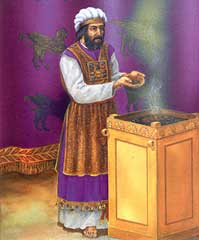
The altar represents the Jew’s process of “sacrificing” his or her inner self to Hashem. Thus, the Mishkan contained two altars, the outer and inner altar, representing the two general stages in the Jew’s service of Hashem.

On the outer altar, the Jew would offer up animal sacrifices. This represents the refinement of the Bestial Soul, and in our divine service, this corresponds to the Jew’s divine mission during the weekdays—to refine the body and the Bestial Soul. This gives Hashem pleasure, which is referred to anthropomorphically as “a pleasant fragrance.”[1]

The part of the heart that descends to vest itself in terms that will influence the Bestial Soul is merely the heart’s lower level, known as chitzoniyus ha’lev, the external aspect of the heart. This is the significance of the outer altar.

However, the inner altar was used only for incense offerings, for incense represents a higher form of divine service than animal sacrifices.

The purpose of incense is to produce a pleasant fragrance. We can understand the significance of fragrance from the Talmud: “Which is the thing that the soul enjoys, but the body does not enjoy? Fragrance.”[2] This represents a deeper form of divine service, one that involves the penimiyus ha’lev, the inner dimension of the heart. Of this it is written, “May the entire soul praise Hashem.”[3] This refers to the efforts of the soul itself to rise up to connect to Hashem, without having to lower itself to influence the body, the Bestial Soul, and its worldly environment.

Here the goal is not to refine the body and Bestial Soul, but for the Yechidah, the Neshamah’s essence, to bond and unite with the Essence of Hashem.

Although the animal sacrifices on the outer altar also produced a fragrance that brought pleasure to Hashem, as it were, this fragrance did not compare to that produced by the incense on the inner altar, for just as the entire purpose of the incense is to emit physical fragrance, so does it bring a much more sublime fragrance to Hashem.

This is the difference between the way we serve Hashem in the weekdays, and on Shabbos. On the weekdays (see also here) we refine the Bestial Soul through the chitzoniyus ha’lev, while on Shabbos, we transcend all involvement with the physical (which is the reason for the prohibitions of the thirty-nine categories of work on Shabbos) in order to reach a sublime unity of the penimiyus ha’lev and the Yechidah with Hashem's very Essence (see also here).

This is the deeper significance of the concept that the weekdays act as a preparation for Shabbos, for the more successful one is at refining the Bestial Soul through the chitzoniyus ha’lev during the weekdays, the higher the level of revelation of the penimiyus ha’lev that one merits on Shabbos.

Ma’amarei Admur HaEmtza’i, Shemos, Vol. 2, p. 674 ff.
________________
[1] Vayikra 6:14.
[2] Berachos 43b.
[3] Tehillim 150:6.

Dedicated by Reb Yisrael Meir Rafael and family.


Dedicated in the merit of a speedy release for the captives Yonasan ben Malka (Jonathan Pollard), Sholom Mordechai Halevi ben Rivka (Sholom Rubashkin), and Zeva Rochel bas Chaya (Wendy Weiner Runge).

Like what you read? The articles I write take a lot of time and effort. Please contact me to sponsor an article for (at least) $36 in honor of the birthday, wedding anniversary, or yarhtzeit of a loved one, or for a refuah shleimah or the like. Also, see here concerning the tremendous merit of supporting the dissemination of Chassidus, and the blessings that one receives for doing so.

Thursday, May 31, 2012

Why work?

Why work?
Or: The Deeper Significance of the Weekdays

Rabbi Yehoishophot Oliver

When we examine our mundane lives, it seems that the true spiritual experience is to be had on Shabbos, when we are able to withdraw from our mundane concerns and devote ourselves to Torah study and prayer. After all, what could be spiritual about the rat race of pursuing a livelihood and the numerous tasks of cooking, cleaning, and the like necessary to maintain a household?

Yet Chassidus, known as the “inner dimension of the Torah”, sheds light on this aspect of the inner dimension of our mundane lives. It explains that in fact, everything we do during the week, even the most mundane activity, has an underlying spiritual purpose.

The main purpose of our divine service during the weekdays is to create a birur, a spiritual separation and refinement, of the impure spiritual energy that permeates the physical world known as kelipas nogah. The Jew accomplishes this goal through engaging in various kinds of work, which are encompassed by the thirty-nine categories of work forbidden on Shabbos, known as melachos.

The melachos are closely related to eating, for, among other things, they encompass all the stages necessary in the process of preparing food—from the earliest stage of sowing the seeds, to the final stage of baking or cooking. And since the goal of all the efforts necessary to prepare the food is that it be eaten, eating food is the culmination of this step in refining Kelipas Nogah (albeit only the first stage; see below).

This parallels the process of refinement that takes place during physical eating, in which the stomach and the liver process the food. The higher-quality nutrients are extracted from the food’s inferior aspects and are absorbed into the body, even rising up to the level of the superior faculties of the mind and heart. The inferior aspects, however, are eliminated.

Likewise, when one eats in the proper way, the sparks of holiness that lie in the physical are extracted from the “shell” of the forces of the Kelipah, which is rejected.

The above is the first stage in the weekday birur of Kelipas Nogah. However, a further birur of Kelipas Nogah occurs when one uses the energy from the food one eats[1] to recite the weekday prayers.

Prayer is compared to eating, for just as eating involves birur, so does prayer.

The highlight of Tefillah is the Shema, in which one declares Hashem’s absolute unity, and that one is willing to give up one’s life for it.[2]

This creates a birur comparable to that of eating:

When the heart and mind of the Jew become inspired with the desire to become subsumed in the sublime G–dliness that lies at the source of the Jew’s soul,[3] this parallels the way that the energy of the food becomes absorbed in the body’s higher organs.

Likewise, Tefillah draws one closer to Hashem, and this experience humbles the person and impresses upon him just how distant he is from Hashem during the rest of the day. This realization crushes his ego and eliminates a significant amount of the Kelipas Nogah within his Bestial Soul.

This is the reason that Tachanun follows the earlier parts of the Tefillah, for once one has reached the sublime spiritual heights, he senses his lowliness all the more, and turns to Hashem and begs for forgiveness.

We can carry the comparison to digestion further. The more thoroughly the food is digested, the more nutrients are separated from the food for constructive use, and the more the waste matter that is eliminated is truly bereft of any beneficial components. Likewise, the more attention one devotes to Tefillah, the more one’s intellect and emotions become inspired to submit to Hashem, and the more one comes to realize one’s lowliness before Hashem.

This is the meaning of “The belly of the wicked is lacking”[4]: “The wicked” refers to the forces of Kelipah, which are “lacking” the sparks of holiness that were extracted through the Jew’s efforts to accomplish the weekday birurim.

Sefer HaLikkutim, Shin, pp. 93-94.
__________________________________________________
[1] Cf. Tanya, beg. ch. 8, “be’ko’ach achilah ha’hi.”
[2] In the original, “limsor nafsho be’echad.”
[3] In the original, “le’ishto’avo begufa de’Malko.”
[4] Mishlei 13:25.


Dedicated by Reb Yisrael Meir Rafael and family.

Like what you read? The articles I write take a lot of time and effort. Please contact me to sponsor an article for (at least) $36 in honor of the birthday, wedding anniversary, or yarhtzeit of a loved one, or for a refuah shleimah or the like. Also, see here concerning the tremendous merit of supporting the dissemination of Chassidus, and the blessings that one receives for doing so.

Thursday, May 24, 2012

Jews and Non-Jews: Complementary Missions Given at Sinai

Jews and Non-Jews:
Complementary Missions Given at Sinai

Rabbi Yehoishophot Oliver

It may come as a surprise, but according to many opinions,[1] before the giving of the Torah at Sinai, the Jewish people had the halachic status of non-Jews. Their basic philosophical beliefs about the oneness of Hashem, His providence, and so on, were no different from those that Jews believe in today (on the contrary, we are continuing the mission to carry on these sacred beliefs, with the help of Hashem). Moreover, the Jewish people existed as a separate nation ever since the time of Yaakov, all of whose sons were Jews. We even knew Torah, for all the forefathers sat and studied Torah,[2] and passed it on to future generations. And yet the Torah tells us that they were not real Jews until much later on, when the Torah was given at Sinai. Why?

When Hashem chose us as a nation, He separated us from the nations around us by giving us the Torah and its Mitzvos.In other words, a Jew then ceased being merely a person—in essence, a non-Jew—with a belief system and practices (along with the distinguished lineage of the forefathers) that differed from those of the rest of mankind. The Jew’s fundamental being, core, and every aspect of his or her life, became irrevocably transformed.

Now, at first glance, some (especially those with, through no fault of their own, little Torah-true Jewish education, which is accompanied by the tendency to view everything in Judaism through the critical lens of the values and yardsticks of modern secular culture) may interpret this chosenness as somehow belittling non-Jews. As implying that they are somehow second-rate, unimportant, and even subhuman. As being what in our modern world is a cardinal sin—racist. But this is simply not so.

Let’s explain.[3] The natural order—and not only our physical world, but even the higher spiritual worlds—receive their sustenance from the divine name of Elokim. Thus, our sages say, “The name of Elokim is mentioned thirty-two times in the account of Bereshis (creation).” Now, this includes not only mankind, but even the awesome system of the sun, planets, and stars, which all possess intelligence and rotate constantly out of their excitement in singing the praise of Hashem—they too derive their existence from the name of Elokim. Even the incredibly pure and sublime beings known as angels, which reside in the higher spiritual realms—and not only the lower angels, such as the Ofanim, but even the highest of all, the Seraphim (see here)—they, too, derive their existence from the name of Elokim.

Then there is the name of Havayeh,[4] which represents a level of G–dliness that is supernatural and otherworldly. This is a level so lofty that until the Torah was given, no one had any access to it.[5] Until the giving of the Torah. At this unspeakably awesome, one-time occasion, Hashem chose to infuse the sublime level of Havayeh within every Jew.[6]

(This is the meaning of the Jew’s additional soul, the Nefesh HoElokis, the divine soul.[7] One might ask: Why is this soul is called a divine soul; after all, everything that exists has a soul that is divine, for Hashem created (and continually recreates) everything in existence? The answer is that the soul in all other beings comes from the name of Elokim, while the Jew possesses an additional soul that completely transcends the natural order, one that flows from Havayeh—the divine soul.)

However, this was only the beginning. Hashem then gave us a mission, a mission of the most unparalleled cosmic proportions. He charged us with the task of bridging the cosmic divide between Havayeh and Elokim, by revealing the name of Havayeh in the world.

To this end, He gave us the Torah, which is specifically called the Torah of Havayeh, and the Mitzvos, which are specifically called the Mitzvos of Havayeh. When we study the Torah and adhere to the Mitzvos, we reveal this level in the world around us, and to the gentile nations as well. This was in fact Hashem’s ultimate intent in creation, also known as “making a dwelling place for Hashem,”[8] for Havayeh, in the world and among the gentile nations, who stem from Elokim.

Since this is the ultimate purpose of creation, this mission carries the utmost responsibility and requires the utmost devotion and sacrifice. This is the meaning of Hashem’s statement that He made us “A kingdom of priests and a holy nation.”[9]

A Kohen, a priest, represents someone whose entire life, and every minute aspect of his life, is different from those of others. It is consecrated to Hashem.

And so Hashem gave us the Torah, which is related to the world hora’ah, guidance, for every single minute aspect of a Jew’s life, from the cradle to the grave, is guided by Torah. There is no area of life where Hashem does not provide guidance to his priests, the Jewish people, in His Torah.

This surely applies to the home, which the Jew is charged with making a Mikdash (sanctuary) for Hashem, regardless of where—in the kitchen, the living room, the bathroom, and the bedroom—the Torah guides the Jew how to bring the divine presence into all these places.

And it applies no less to the workplace, where a Jew is charged with the mission of setting an example of scrupulous honesty and integrity, and influencing his environment in a pleasant, peaceful manner, for of the Torah it is written, “Its ways are ways of pleasantness, and all its paths are peace.”[10] He should influence the Jews around him to adopt Torah observance, and the non-Jews around him[11] to believe in Hashem and Torah, and follow the Noahide Code—the eternal laws and principles of basic morality and decency incumbent upon all mankind.

This is not to say that non-Jews can’t connect to Hashem; on the contrary, they can and must, especially in light of the fact that they are created “in the image of Hashem.” However, the focus of their G–d-given mission is to abide by their Mitzvos, whose fundamental purpose is “yishuv ha’olam”—civilizing society, to settle the world physically and maintain a cohesive, peaceful, just, G–d-fearing social order, as it is written, “Not for chaos did He create it [the world, but rather] He formed it to be settled.”[12] It is this vital role for which non-Jews were assigned. Thus, non-Jews’ mission is related to the natural order, which stems from the name of Elokim, and this is the reason that the Noahide laws are rational laws that stem from the natural world. Thus, in order to accomplish this goal, non-Jews need not perform any of the Mitzvos specifically commanded to Jews.[13]

So Jews have a role—to reveal the name of Havayeh, and non-Jews have a very different role—to ensure the appropriate expression of the name of Elokim, through ensuring that the natural order follows the wishes of Hashem in His Torah.

Is this in a certain sense a lower mission than the mission given to the Jews? Yes. But so what—Hashem can do as He wishes—His will need not conform to the passing whims of the philosophical fads of mortals.

Moreover, every individual has a personal mission, one that differs from that of everyone else. Of these, Hashem clearly assigns different missions to different people—some receive more advanced, risky, responsible missions, and others, less challenging, more everyday ones.

Likewise, we find that only a Levi may sing in the Holy Temple, and only a Kohen may serve in it. I myself, for example, am not a Kohen, and as such I am barred from entering certain parts of the Holy Temple, and not allowed various Kohen privileges. But I am not bothered by that fact one bit, because since Hashem made me a non-Kohen, that role is clearly not what Hashem wants of me, and so I have been deprived of nothing.

Racism, in contrast, means refusing to treat someone with proper decency and respect simply because they belong to a group that one has some kind of animosity towards. However, the “Torah of light”[14] instructs clearly how one should view non-Jews: “Beloved is man, for he was created in the image [of Hashem].”[15] All mankind must be treated with the utmost respect, for they are beloved to Hashem by virtue of their special human intellect, which resembles the divine.

When a Jew assumes his role uncompromisingly and proudly, in addition to the inherent worth of this behavior, he also does a tremendous service for the world and all the gentile nations. He performs his role as priest, role model, and teacher to the nations, to illuminate and uplift them with the sublime spirituality of Havayeh for which he serves as a channel.

However, if the Jew chooses, may Hashem save us, to compromise his Torah observance and behave in inappropriate ways that conflict with Torah, behaviors typical of the secular culture, then not only does he harm himself grievously, but he also does a disservice to the nations by abdicating and thereby withholding from them his holy example, guidance, and the awesome revelation of Havayeh that they could have received through his unswerving allegiance to Torah.

____________________________________________________
[1] See at length Parashas Derachim, Rabbi Yehuda Rosanes.
[2] Yoma 48b.
[3] Cf. Likkutei Sichos, Vol. 25, pp. 186-192.
[4] Hashem has other names, but these are the primary ones, and the main ones relevant to this discussion.
[5] With some notable exceptions, such as Avraham, on a lower level, and Moshe, on a higher level. Further discussion of this is beyond the scope of this article.
[6] Likkutei Torah, Bamidbar 16d.
[7] See Tanya ch. 2, beg.
[8] Midrash Tanchuma, Naso 16. Explained in Tanya ch. 36.
[9] Shemos 19:6.
[10] Mishlei 3:17.
[11] As per Moshe Rabeinu’s instruction to the Jewish people at Sinai. Mishneh Torah, Laws of Kings, 8:10.
[12] Yeshayah 45:18.
[13] However, it is praiseworthy for non-Jews to adopt certain Jewish practices on a voluntary basis, such as daily prayer, blessings on food, and so on, while other Mitzvos, which were meant exclusively for Jews and would therefore be spiritually harmful for non-Jews, are therefore forbidden for them, such as observing the Shabbos (Cf. Mishneh Torah, Laws of Kings, 10:9. As explained in The Divine Code, Vol. I, Part I, Chapter 3, on “The Prohibition Against Making a New Religion or Adding a Commandment.”)
[14] Mishlei 6:23.
[15] Avos 3:14.


Like what you read? The articles I write take a lot of time and effort. Please contact me to sponsor an article for (at least) $36 in honor of the birthday, wedding anniversary, or yarhtzeit of a loved one, or for a refuah shleimah or the like. Also, see here concerning the tremendous merit of supporting the dissemination of Chassidus, and the blessings that one receives for doing so.

Monday, May 21, 2012

Listening to the Spiritual Health Experts


Health experts are constantly coming out with new “revelations.” They reveal to the undiscerning masses of laypeople how many foods that seem harmless are in fact poisonous or at least very unhealthy.

The same goes for spiritual health. What to the less spiritually attuned may seem harmless at first glance may contain elements that, even if not outright forbidden, are inappropriate and spiritually unhealthy and damaging; what’s more, often these things are outright forbidden!

The proper gauge to assess such matters, and to find out which apparently harmless things might in fact be inappropriate or even prohibited, is to delve into Torah. There Hashem expresses His will, and instructs us not only in what is permitted and forbidden, but also in the importance of going beyond the letter of the law, and avoiding the inappropriate and unworthy.

And just as it would be presumptuous of a dabbler in physical health to come out and declare that a practice that experts deem damaging to one’s health, e.g., smoking, is in fact harmless and even healthy, based on whatever “proofs” might seem logical to him or her, so would it be presumptuous of someone whose knowledge of Torah is only on a beginners level to make such critical decisions for him or herself or family without first consulting, without preconceived notions, with Torah texts and with a Torah sage—one who has devoted his life with self-sacrifice to rigorous Torah study with the goal of attaining the expertise in Torah necessary to accurately transmit the word of Hashem to the community.

This is all the more so considering that our sages rule that even a rabbi with full rabbinic ordination (“semichah for dayonus”) and training (“shimush”) who becomes a businessman is thereby disqualified from sitting on a rabbinic court and issuing rabbinic decisions, despite his being an indisputably G–d-fearing Jew.[1] Only a full-time practicing rabbi may issue halachic rulings, because involvement in the business world taints the purity of the person’s judgment on holy matters. How much more so does an ignoramus have no business making such weighty decisions for him or herself, and thereby aggrandize the mantle of halachic authority!

The same goes for matters that are not strictly halachic, but are in one way or another related to questions of what behavior is appropriate for a Jew in his or her individual circumstances. In these matters one should consult with one’s personal asei lecha rav or mashpia (see here) as appropriate, in accordance with the Rebbe’s instructions.

And if the above caution is even true of physical health, although we find that the health experts often change their minds, how much more so when it comes to spiritual health, the conditions for which are taught in our timeless, perfect, immutable Torah. And if this caution is even true of physical health, although the body is temporary and secondary to the soul, it surely applies to spiritual health associated with the soul, which is eternal and primary, and whose health is also the key to material blessings, health, and prosperity.

______________________________________________
[1] Shulchan Aruch, Choshen Mishpat, 3:13, S’meh. Cited in Igros Kodesh, Vol. 26, p. 345-346. Toras Menachem 5720, Vol. 27, p. 223. Toras Menachem 5720, Vol. 23 p. 164 ff.

Dedicated by Chana Hawkins in honor of John Wilson.

Like what you read? The articles I write take a lot of time and effort. Please contact me to sponsor an article for (at least) $36 in honor of the birthday, wedding anniversary, or yarhtzeit of a loved one, or for a refuah shleimah or the like. Also, see here concerning the tremendous merit of supporting the dissemination of Chassidus, and the blessings that one receives for doing so.

Friday, May 18, 2012

Reciprocating for the Rebbe's blessings

Reciprocating for the blessings
Rabbi Yehoishophot Oliver

A chossid once wrote a letter to the Previous Rebbe, eagerly conveying the good tidings that the Previous Rebbe’s blessings to a whole list of people had been fulfilled. The Previous Rebbe replied with a demand:
In response to your second letter, in which you convey at length all those whom Hashem helped, and for whom the replies [of blessing from the Previous Rebbe] brought them success, and the blessings were fulfilled; our great, honorable, and holy Rebbe[1] stated clearly in words of the holy of holies in his holy letters concerning requests for advice in worldly matters.[2] The honorable and holy Tzaddik, Rabbi Menachem Mendel of Horodok, of blessed memory, once replied to one of his chassidim who asked him for a blessing for children, that in reward for his faith in Tzaddikim, he deserved the blessing of Heaven for healthy children.

The success of the responses and the fulfillment of the blessings that, with Hashem’s help, and in the merit of our holy ancestors, we [the Rebbes] respond to those who ask, and that we bless them, depends upon the hiskashrus [bond with the Rebbe whom they consult] and personal conduct of those who present the request, and upon their faith—a skilled faith[3]—in the words of our holy Rebbes, of blessed memory.

Faith in the words of Tzaddikim and hiskashrus with them cannot be merely verbal, or an emotional resolve, to declare, “I am a chossid, I am a mekushar [one bound with the Rebbe].” It must express itself in one’s actions, every man and woman according to their abilities and character, by fixing times for Torah study, caution in observing Shabbos, family purity, educating one’s sons and daughters, and the like.

This was the way of the original chassidim. Yes, they would encourage their acquaintances to become chassidim, but they would also encourage them to consistent good deeds, for on this account, those who would present requests [for blessing] would merit that Hashem assist them and grant their wishes. And as a result of Hashem granting their wishes, they increased further in their striving for fine conduct.

I greatly enjoyed your letter, in which you wrote in detail about those whom Hashem blessed, and their every request was fulfilled. However, I would like to know, also in detail, how each and every man and woman, may Hashem bless them, whose requests were granted—how did they express their gratitude to Hashem by increasing their efforts in their divine service in order to repay Hashem?

Igros Kodesh Admur HaRayatz, Vol. 17, pp. 201-202.
____________________
[1] I.e., the Alter Rebbe.
[2] Tanya, Iggeres HaKodesh ch. 22.
[3] In the original, “be’emunas eimun.” See Tanya ch. 42:
“.'וזה נכלל ג"כ בלשון אמונה שהוא לשון רגילות שמרגיל האדם את עצמו כמו אומן המאמן ידיו וכו”
In my own words:


1. True, an essential part of being a chossid is simply identifying as a chossid within oneself and to others. This identification is essentially a public declaration of one’s faith in the Tzaddik and of one’s commitment to follow that Tzaddik’s guidance, and this is all very worthy and noble. However, this identification is only the beginning; in order to be meaningful, it must be accompanied by an appropriate change in behavior.

2. Likewise, when one lovingly encourages a fellow Jew to enter into the relationship of a chossid of the Rebbe—among many other reasons, due to the tremendous spiritual and material benefits that this relationship stands to bring him or her—one must stress (along the lines, perhaps, of the way one would speak to a prospective convert) that this also includes undertaking a great responsibility, for becoming a chossid means genuinely committing to follow a higher standard of behavior, and in an ever-increasing manner.

3. When one approaches a Tzaddik and requests a brachah, its fulfillment depends largely upon the efforts and spiritual state of the one approaching the Tzaddik. Through deep faith in the Tzaddik and consistent adherence to the commandments of Torah in general, and the Tzaddik’s instructions in particular, the brachah has the vessel for fulfillment. (On this topic, see also here and here.)

4. After the brachah that one received comes to fruition, with Hashem’s help, it behooves one to reciprocate for the blessing by “giving back” to Hashem and the Rebbe, by increasing still further in good deeds. One should also encourage others who have seen Hashem’s blessings in general, and the fulfillment of the blessings of the Tzaddik in particular, to reciprocate in this manner, and also report these extra good deeds to the Tzaddik who blessed them.

5. Now, too, after Gimmel Tammuz, nothing has changed. Chassidim or non-chassidim can and do write to the Rebbe—whether by sending the letter to the Ohel, placing it inside one of his holy books, or the like—and receive his blessings in accordance with the efforts they make to be worthy of those blessings. And once the requests for blessing have been fulfilled, one should reciprocate by intensifying still more one’s efforts in Torah and Mitzvos in general, and one’s fulfillment of the Rebbe’s directives in particular.

___________________________________
Like what you read? The articles I write take a lot of time and effort. Please contact me to sponsor an article for (at least) $36 in honor of the birthday, wedding anniversary, or yarhtzeit of a loved one, or for a refuah shleimah or the like. Also, see here concerning the tremendous merit of supporting the dissemination of Chassidus, and the blessings that one receives for doing so.

Monday, May 14, 2012

Spiritual Sickness


Spiritual Sickness

Rabbi Y. Oliver


During the weekday Amidah prayer, over the course of twelve blessings the Jew beseeches Hashem for his needs. This request presupposes a strong awareness that one is lacking and needy, and totally dependent upon Hashem to provide for one’s every need.


Moreover, in addition to the literal meaning of the requests, there is also a spiritual meaning.


For instance, in the Amidah prayer, we ask Hashem to heal the sick. Now, what is the true root of sickness? The frustration from unfulfilled expectations. This sickness can manifest itself both in unholiness and in holiness.


When one is lacking in “holy fire,” in passion in serving Hashem, he eventually becomes consumed with a “foreign fire”—a negative, self-destructive spiritual energy, that saps the person of refinement and spirituality and excites him or her with a craving for materialistic and forbidden pleasures, may G–d save us.


This then “weakens G–d,”[1] as it were, for it diminishes the divine revelation in one’s soul, and then in the cosmos in general.[2]


So when we beseech Hashem to heal the sick, we also mean to ask that He heal those who are spiritually sick by contamination with impure and unholy materialistic desires.


But then there is a positive, holy kind of sickness, of which it is written, “I am lovesick.”[3] This refers to a powerful, unconsummated love for Hashem.


To explain, there are fifty “gates of divine understanding.” Once one has climbed ever higher in levels of holiness until he has reached the forty-ninth level, he senses the intensity of the fiftieth and highest level, and aches and yearns to attain it, but he lacks the tools to do so. Thus, the Hebrew word choleh, sick person, has the numerical value of forty-nine,[4] alluding to the one who is lovesick for Hashem.


This is the second meaning of our plea to Hashem to heal the sick—that He heal those who are lovesick for Him by granting them the revelation for which they yearn.


These two kinds of yearning are extremes. They represent the two general categories of intense yearnings: for the spiritual and for the materialistic. We may all suffer from one of these at times, albeit to a lesser degree. May Hashem help us to be healed from the state of suffering or even being susceptible to the first kind of sickness, and merit to attain the second kind—along with its cure.


Adapted from Sefer HaMa’amarim 5713, p. 124 ff.


_______________________________
[1] Cf. Devarim 32:18.
[2] Cf. Eichah Rabbah 1:33.
[3] Shir HaShirim 2:5.
[4] Ta’amei HaMitzvos LehoArizal, Vayera. Likkutei Torah, Berachah 97b.


Like what you read? The articles I write take a lot of time and effort. Please contact me to sponsor an article for (at least) $36 in honor of the birthday, wedding anniversary, or yarhtzeit of a loved one, or for a refuah shleimah or the like. Also, see here concerning the tremendous merit of supporting the dissemination of Chassidus, and the blessings that one receives for doing so.

Thursday, May 10, 2012

Shabbos: Utterly transcending the world

Shabbos: Transcending the world
Rabbi Yehoishophot Oliver


Our sages say, “He who toils before Shabbos, will eat on Shabbos.”[1] On the simple level, this means that in order to eat a ready meal on Shabbos, one should toil to prepare the food before Shabbos. But on the deeper level, this alludes to the relationship between the divine service of the weekdays and of Shabbos. During the week we prepare ourselves spiritually for Shabbos, and so the more one toils to accomplish the divine service required during the week, the higher the level of the Shabbos experience that follows it.


The main theme of Shabbos is menuchah, rest, as our sages say, “What was the world lacking [after the completion of the six days of creation]? Menuchah. When Shabbos came, menuchah came.”[2] Thus, the verse tells us, “And Hashem completed [His work of creating the world] on the seventh day.”[3] But didn’t He complete the creation on the sixth day, as it states concerning the sixth day in the previous verse, “And He completed the heavens, the earth, and all their hosts”? No, for in a sense, Hashem did create something on Shabbos—menuchah.


This is related to the intense divine revelation on Shabbos, for Hashem is called menuchah.[4]


To explain, everything in the world is in a state of constant movement, for it is fundamentally bound by the limitations of time and space. Time is constantly changing—the future is becoming the present, and the present is becoming the past.[5] And space too, which is fundamentally intertwined with time, also involves movement.[6]


Hashem, however, is infinite, and so He completely transcends space—He does not move from one place to another—and He transcends time, a construct that He created. Thus, Hashem is called menuchah, for in His Essence, He is utterly unchanging—the epitome of true menuchah.


We mentioned the verse, “And He completed [“vayechulu”] the heavens, the earth, and all their hosts.” Vayechulu can also imply kilayon, yearning,[7] for after He finished creating the world, on the first Shabbos, Hashem revealed the level of menuchah associated with His Essence, and this inspired all His creations with a yearning to rise up and reach this level of menuchah.


This also explains the deeper meaning of the weekly cycle.[8] In the daily Shacharis liturgy, we speak of Sunday as being the “first day.”[9] Since everything in Torah is precise, if so much time has passed since the first day of Creation, why don’t we count by the number of days since creation, or use some other more precise phrase when counting?


The answer is that since on Shabbos the level of Hashem’s very Essence shines, this elevates the world completely beyond its mundane state. Thus, on the following Sunday, the mundane world is indeed new, both in space and time, and so we start the count anew.


Likewise, on every Shabbos, the Jew who keeps Shabbos as is required is given the privilege to “eat on Shabbos”—to personally experience a special revelation from Atzmus, Hashem’s very Essence. This comes as a reward for his or her divine service during the week—“He who toils before Shabbos,” and renews and invigorates him physically and spiritually in preparation for the coming week.


Based on Sefer HaMa’amarim 5722, s.v. Basi LeGani, pp. 132-133. 


______________________________________________________________________
[1] Avoda Zara 3a.
[2] Bereshis 2:2, Rashi.
[3] Bereshis ibid.
[4] Kesser Shem Tov §400-401. Likewise, Hashem is called Shabbos (Zohar 2:88b).
[5] Sha’ar HaYichud VehaEmunah ch. 7. Likkutei Torah, Berachah 98a.
[6] This is all the more so according to modern science, which teaches that nothing is truly stationary; everything in the universe is moving. Likewise, all matter consists of atoms and molecules that are in constant motion.
[7] Ohr HaTorah Bereshis 42b ff.
[8] Likkutei Torah, Shir HaShirim 25a. Ohr HaTorah, Berachah, p. 1891. ibid., p. 1897 ff.
[9] “Hayom yom rishon laShabbos.”


Like what you read? The articles I write take a lot of time and effort. Please contact me to sponsor an article for (at least) $36 in honor of the birthday, wedding anniversary, or yarhtzeit of a loved one, or for a refuah shleimah or the like. Also, see here concerning the tremendous merit of supporting the dissemination of Chassidus, and the blessings that one receives for doing so.

Tuesday, May 8, 2012

Two categories of physicality

Two categories of physicality
Rabbi Yehoishophot Oliver

Chassidus differentiates between two general categories of the physical: gashmiyus—“physicality” and chumriyus—“coarseness.” The term gashmiyus refers to something that is physical, but not animalistic or coarse per se. To be sure, everything physical conceals the absolute reality of Hashem, and even the higher spiritual worlds, and is undesirable in that sense. However, gashmiyus refers to physicality of a kind that does not actively entice one to sin or otherwise behave inappropriately in any way. For instance, an ordinary table is a physical, mundane item; although it conceals the divine life force that sustains it; however, it contains no further inappropriate element.

Then there is chumriyus, which is coarse gashmiyus. This refers not only to worldly objects related to sin (which are obviously coarse), but also to objects that have some kind of inappropriate or crass element that is liable to desensitize the person and bring one to decline spiritually until he or she ultimately falls into sin.

Of this, our sages teach:[1] “Such are the wiles of the evil inclination: Today he says to him, ‘Do this’; tomorrow he tells him, ‘Do that,’ until he tells him, ‘Go and serve idols,’ and he goes and serves [them].”[2]

The challenge of gashmiyus is to fulfill the Torah’s instructions, “All your actions should be for the sake of Heaven,”[3] and “In all your ways, know Him.”[4] Not only should gashmiyus not be used for sin, G–d forbid, but it should not even be used for personal benefit alone.[5] Rather, all one’s gashmiyus should be used for the sake of serving Hashem, and only then does one rectify it and elevate it.

In contrast, one should in general[6] abstain from chumriyus, and in that way one rectifies it.

As mentioned, Tefillah is “a ladder fixed in the earth” whose “head reaches the heavens.” “Earth—aretz” refers specifically to gashmiyus, not chumriyus. Thus, as a preparation to Tefillah, we must reject chumriyus from our lives.

Then Tefillah acts as a two-way ladder connecting the “earth,” the gashmiyus, with “the heavens,” the spiritual. It functions “from below to above,” by elevating the physical to the spiritual, and “from above to below,” by bringing the spiritual down into the physical.

Based on Likkutei Dibburim, Vol. 3, p. 497.

_________________________________________
[1] Shabbos 105b.
[2] See Kuntres Uma’ayan, p. 66.
[3] Avos 2:12.
[4] Mishlei 3:6.
[5] Cf. Tanya ch. 6.
[6] An exception might be when one assesses that permitted chumriyus is necessary in order to save one from sin. An example of this may be the concept of the eishes yefas to’ar (Devarim 21:11), the beautiful gentile woman whom the Jewish soldier lusts after in war, whom the Torah permits the soldier to marry, albeit with certain conditions, in order to save him from marrying her in sin.

This post was dedicated by Rochel'e and Sholom Ber Odze in honor of the birthday of Yitzchak Aizik bas Rochel on 18 Nissan.


Like what you read? The articles I write take a lot of time and effort. Please contact me to sponsor an article for (at least) $36 in honor of the birthday, wedding anniversary, or yarhtzeit of a loved one, or for a refuah shleimah or the like. Also, see here concerning the tremendous merit of supporting the dissemination of Chassidus, and the blessings that one receives for doing so.

Thursday, April 19, 2012

Chof-Ches Nissan: Do Everything You Can!


Today is Chof-ches Nissan, the day that the Rebbe delivered the famous sicha in which he charged us with our core mission after Gimmel Tammuz. See my former posts on the significance of this day here, here, and here. Moshiach now, and lechaim!

Wednesday, March 21, 2012

Matan Torah: Compelling Love


Matan Torah: Compelling Love

Rabbi Yehoishophot Oliver

The Divine Presence rests only in a place that is in a state of bittul, submission and self-nullification, to Hashem.[1]

This is true of any divine revelation, and so it applies all the more to the Giving of the Torah, which was the greatest divine revelation in history. In order to receive the Torah, the Jewish people had to be in a state of total bittul to Hashem.

Now, on one level, this bittul was accomplished through the suffering that the Jewish people underwent in the Egyptian exile, for suffering crushes a person’s ego, making him a vessel for Hashem’s infinite light.[2]

Likewise, we find that immediately before receiving the Torah, the Jewish people cried out collectively, “we will do.”[3] With this they dedicated themselves to Hashem from the very core of their beings, committing to obey Him regardless of what He might command (which they did not yet know, for He had not yet issued the Ten Commandments). They rose to a level of devotion and love for Hashem so intense and sublime that it was as if they had no wish of their own, for their only wish became to fulfill Hashem’s wish.

This is the level of bittul expressed in the analogy to an eved, a servant, who has no independent existence; his entire existence is devoted to obeying everything that his master commands him.[4]

After they reached the level of “we will do,” they merited “we will hear”—to “hear” and absorb the revelation of Hashem’s infinite light.

But how were the Jewish people able to attain such a lofty level of love for Hashem? Had they not only recently been delivered from Egypt, where they had in many respects assimilated with the Egyptians, and sunken to appalling depths of impurity? Indeed, the Zohar states[5] that they had sunken to the forty-ninth gate of impurity, and that when they were redeemed, they were on the brink of falling to the fiftieth and lowest gate of impurity, at which point they would have been irredeemable. At this point they were at the lowest level of divine service, and in a very spiritually immature state (see here concerning “mochin dekatnus”). How could they then “jump” spiritually from such depravity to such heights?

Moreover, how does the above explanation of “we will do” as meaning that the Jewish people received the Torah with total, unreserved eagerness fit with the Talmud’s statement that Hashem “forced the mountain upon their heads like a tub” and insisted that they accept the Torah?[6]

Chassidus reveals that although Hashem “forced” the Jewish people to receive the Torah, they did so not out of fear, but out of love.

Human nature is that “as water reflects a face to a face, so is one’s heart reflected back to him by another.”[7] The way feelings work is that we naturally reciprocate a feeling expressed to us.

Now, the more intense the feeling expressed, the harder it is to express a contrary feeling in return. This explains why an intense expression of love is usually reciprocated. However, at times one may express profound, heartfelt love to another, but still finds that it is rejected, or not sufficiently reciprocated. The reason for this is that for whatever reason, a certain part of the giver, and thus also of the recipient, was not involved in the love. However, if the expression of love is total and uncompromising, then it will be so powerful that it will “compel” the recipient to accept it, for it encompasses the recipient so utterly that he or she “cannot” reject it.

This might also be observed physically, when the one expressing love is overwhelmed with emotion to the point that he hugs his loved one so tightly that his entire back is embraced, and so the recipient of the hug is pinned in place, unable to move and turn his or her back to the lover.

This is the deeper meaning of the Talmud’s statement that Hashem “forced” the Jewish people to receive the Torah. Thus, of the Giving of the Torah it is written, “his right hand embraces me.”[8] Hashem “hugged” the Jewish people so tightly, as it were, that they could not turn their back to Him and reject Him. He revealed Himself to them with an ahavah rabah, a “great love”—a love so passionate that they were “forced” to respond in kind.

How did they respond in kind? They declared “we will do,” and thereby surrendered to Hashem with an absolute commitment, as explained.

This also explains how they could have “jumped” from the depths of impurity to the heights of holiness. As sublime as their love for Hashem was, it came through a revelation from Above, and not through their own efforts and merit. And so it didn’t matter that they had just emerged from Egypt; as they were, on their degenerate level, Hashem expressed His “great love” for them, and thereby elevated them to a sublime level of love towards Him.

Based on Torah Ohr, s.v. Chayav inish libsumi.

_________________________
[1] Tanya ch. 6; cf. ibid. ch. 35.
[2] Cf. Torah Ohr, Yisro 74a-b.
[3] See Shemos 24:7
[4] Tanya ch. 41 (57a).
[5] Zohar Chadash, Yisro, beg.
[6] Shabbos 88a.
[7] Mishlei 27:19.
[8] Shir HaShirim 2:6, 8:3.


This post is dedicated by Reb Kasriel Oliver and family as a merit for Rivka Reizel bas Hinda Zelda Bracha Tsap.


Like what you read? The articles I write take a lot of time and effort. Please contact me to sponsor an article for (at least) $36 in honor of the birthday, wedding anniversary, or yarhtzeit of a loved one, or for a refuah shleimah or the like. Also, see here concerning the tremendous merit of supporting the dissemination of Chassidus, and the blessings that one receives for doing so.

27 Adar

See my post: 27 Adar: Now it's our job

Tuesday, March 13, 2012

Purim: Seeing Through the Facade


Purim: Seeing Through the Facade

Rabbi Yehoishophot Oliver

On Purim, we celebrate a very special kind of miracle. A “miracle vested in nature”.

“Normal” miracles jump in your face and jar you out of your sense of self and your default approach to the world. Normally, the external natural world cries out “I exist,” and only allows us to connect with the level of G–dliness that is vested within nature, which stems from the divine name of Elokim. Open miracles, however, virtually “force” us to acknowledge that right behind the Elokim-generated forces of nature lie the name of Havayeh, a level of G–dliness so sublime that it utterly transcends nature, and it even transcends the fundamental parameters of time and space.

(Of course, a true skeptic—one filled with blind faith in the powers of his puny intellect, and a passionate desire to reject anything and everything beyond it at all costs—will find a way to deny, dismiss, and belittle anything and everything that transcends nature. But “we are not speaking of fools.”[1])

Then there is a miracle that
can be easily denied, or not noticed to begin with. One could fail to realize that this event involved divine intervention in the “normal” process of nature. This kind of miracle truly tests our faith, our inner bond with Hashem, our power to sense the absolute truth of G–dliness.

This is the lesson of the story of Purim. No dramatic splitting of the sea, flame without oil, or Golem here. Just a series of apparently fortuitous coincidences, any one of which alone might seem surprising, but still well within the realm of statistical probability.

And yet since the Jew’s special Neshamah stems from the name of Havayeh,[2] he has the power, if he so chooses, to see through the façade of Elokim, to see how in fact these were no natural events—this was the handiwork of Havayeh alone.

And this is what we celebrate on Purim—the Jew’s ability to see through the mask of nature[3] and see Hashem’s constant guiding hand. And not only in grand events of national significance, but even in his very own personal life—if he truly wants, he has the power to see how Hashem has guided him every step of the way, and how in fact, every single event in his life is truly from Hashem—and not only from Elokim, but from Havayeh.[4]

Certainly, when the Jew sees in his personal life a “coincidence” that some might attribute to chance, citing the all-knowing professors of statistics as their supposedly unimpeachable source, or at least to the cyclical rhythms of Elokim, the Jew knows the truth—that every single event in his life occurs by Divine Providence alone, and stems (not only from Elokim, but on a deeper level) from Havayeh.

So why did he, let’s just say, receive an e-mail from an old friend he had fallen out of touch with for years soon after he spent five minutes consciously thinking about this person for no apparent reason (as actually happened to me just last night)? The Jew knows that this was no fluke. Hashem wanted to show him a little glimpse of His Personal Providence by slightly removing the façade of nature for a brief while.

Then this experience shows him tangibly how mikreh—chance is rak meiHashem—only from Hashem.[5] His eyes are opened up (and perhaps this is one of the meanings of the Rebbe’s exhortation that we “open our eyes”) to see Hashem’s hand in every aspect of his life. And the more he searches earnestly for Hashem, the more he truly sees Him.

This endows him with the encouragement to approach even his daily mundane, apparently banal routine duties with joy and inspiration, knowing that Hashem—including the lofty level of Havayeh—goes with him always, even in the apparently negative events in his life (may Hashem spare us), and that only Hashem gives him the strength to perform acts of might.[6] And through this faith, “everything will become good on a revealed level as well.”[7] Kein tihiyeh lanu!

_____________________________________
[1] Bava Kama 85a.
[2] See the explanation and sources quoted here.
[3] This is one of the reasons for the custom to dress up in costume on Purim (Rabbi Moshe Chagiz, Eileh Hamitzvos, p. 293).
[4] Cf. Tanya, Iggeres HaKodesh ch. 11.
[5] Sfas Emes, Parshas Zachor, 5632.
[6] Cf.
Devarim 8:14-18.
[7] Tanya ibid.


This article is dedicated by Sholom Ber and Rochel'e Odze, l'ilui nishmas Yaakov ben Moshe (Jack Muchnik) a"h.


Like what you read? The articles I write take a lot of time and effort. Please contact me to sponsor an article for (at least) $36 in honor of the birthday, wedding anniversary, or yarhtzeit of a loved one, or for a refuah shleimah or the like. Also, see here concerning the tremendous merit of supporting the dissemination of Chassidus, and the blessings that one receives for doing so.

Sunday, February 12, 2012

Conversion and Birth

Conversion and Birth

Rabbi Yehoishophot Oliver

Our Sages say: “A convert is like a newborn child.”[1] At first glance, this analogy comes to describe the utter transformation that the convert undergoes upon conversion. He becomes a new being, like a newly born child.

However, if this is the purpose of the comparison, it seems lacking. After all, even a newborn child exists before its birth—and fully formed, with all its organs in place. All that occurs at birth is that the child’s hidden existence becomes manifest, and it functions (albeit only on the basic level) independently in the outside world. Why isn’t conversion described with another analogy, one that truly implies a complete metamorphosis?

The answer: Indeed, the process of conversion is directly comparable to physical birth, for the convert’s special Jewish Neshamah existed even before conversion, just as a baby exists before birth. 

In fact, just as the Neshamos of all unborn Jews were present when the Torah was given, so were the Neshamos of converts.[2] This is comparable to the way that an unborn child is taught the entire Torah,[3] just as the entire Torah was given to every single Jew at Sinai.

However, although the convert’s Neshamah exists, it is hidden, like an embryo in the womb, and it has no impact on “the outside world”—our physical world. But when the conversion occurs, the convert’s Neshamah is “born”—it emerges and begins to exert its impact upon the outside world.

Thus, we find that our Sages refer to a convert using the apparently odd phrase, “ger shenisgayeir—a convert who converts.” Shouldn’t it refer to “goy shenisgayeir—a non-Jew who converts,” along the lines of the standard Talmudic expression, “katan shehigdil—a minor who becomes an adult”?

Rather, ger shenisgayeir alludes to the spark of a holy Jewish soul that lay hidden within the convert even before conversion.[4] 

Moreover, this Jewish soul existed in the non-Jew from his physical birth.

To explain, the Talmud says, “The son of David [Moshiach] will not come until all the souls in a body have been exhausted.”[5] This means that Moshiach’s coming depends upon a certain number of Jewish people being born. But if it is talking about the souls descending into bodies, why is the singular word “guf/body” used?

Rashi there explains that every Neshamah that will ever be placed in a Jew awaits in a heavenly storehouse called “Guf.” 

It is quoted in the name of Rabbi Yehuda HaChassid[6] that the angel appointed over birth takes the Neshamah from that storehouse and implants it inside the embryo in the mother’s womb.

However, sometimes the angel puts a Jewish Neshamah in the embryo of the womb of a non-Jewish mother, and that child ends up becoming a convert.

In conclusion, conversion doesn’t create something new; it reveals what was always meant to be.

Based on the Rebbe’s Hisva’aduyos 5743, vol. 2, p. 925. Likutei Sichos, vol. 38, pp. 44-45, fn. 41*.

__________________________
[1] Yevamos 62b.
[2] Pirkei DeRebbi Elazar ch. 41.
[3] Niddah 30b.
[4] Chida, Midbar Kedeimos, Maareches Gimmel, Ois Gimmel.
[5] Yevamos 62a.
[6] Teshuvos Baalei HaTosafos, p. 286, sec. 19, quoting Rabbi Meir of Rotenburg, in the name of Rabbi Yehuda HaChassid.


This post is dedicated to all the righteous converts; may they be blessed begashmiyus and beruchniyus!


~~~~~~~~~~

Like what you read? The articles I write take a lot of time and effort. Please contact me to sponsor an article for (at least) $36 in honor of the birthday, wedding anniversary, or yarhtzeit of a loved one, or for a refuah sheleimah or the like. Also, see here concerning the tremendous merit of supporting the dissemination of Chassidus, and the blessings that one receives for doing so.

Sunday, January 29, 2012

Tefillah: Rising up from the lowest levels


The verse states concerning Yaakov: “And he dreamed, and behold, a ladder was fixed in the earth, and its head reached the heavens.” This alludes to Tefillah, which is called a ladder. The Jew starts at the lowest rung of the ladder of Tefillah—“the earth”—and rises ever higher, until he can reach the most sublime spiritual heights—“the heavens.”


The above-mentioned verse uses the word artzah for earth, although it is usually spelled aretz. Artzah, with an additional hei, alludes to the very lowest level in the earth.


This teaches us that even when the Jew is struggling not only with the standard natural state of animalistic selfishness that most of us feel upon waking, but with sins that have caused him to sink to a nadir of spiritual degeneracy, may G–d save us, Tefillah has the power to pull him out and elevate him to the most sublime spiritual level.


Nevertheless, Tefillah can only raise the person up if he is inspired to invest the effort that Tefillah requires. But if he is on a low level, how can he reach the state of yearning for G–dliness that will inspire him to climb up the rungs of Tefillah?


The solution is for one to reflect upon this very fact—that he is on a low level, both with regard to his thought, speech, and action, and with regard to his intellect and emotions. Even the essence of his soul may be trapped in the forces of impurity. This realization transforms him into a vessel for change, inspiring him with a yearning to invest the effort to rise up the ladder of Tefillah.


Adapted from Sefer HaMa’amarim Melukat—Nissan, pp. 181-182.

Like what you read? The articles I write take a lot of time and effort. Please contact me to sponsor an article for (at least) $36 in honor of the birthday, wedding anniversary, or yarhtzeit of a loved one, or for a refuah shleimah or the like. Also, see here concerning the tremendous merit of supporting the dissemination of Chassidus, and the blessings that one receives for doing so.
Saturday, January 21, 2012

Sin Detracts from Our Bond with Hashem

Sin Detracts from Our Bond with Hashem

Rabbi Y. Oliver

(This is a continuation from the previous post.)

In addition to the specific kind of wicked deed that each of the negative emotions entices one to commit, all negative emotions seek to make the Jew susceptible to sin in general, for, as our sages say “A person does not sin unless possessed by a spirit of foolishness.”[1] This “spirit of foolishness” comprises the negative emotions within the Bestial Soul, which are “foolish”—they seek to entice the person to sin by concealing from him the truth of the nature of sin.

The “spirit of foolishness” uses falsehood to entice the person to sin in many ways. One of its prime ruses is the claim: “Sin will not impinge upon your bond with Hashem.”[2]

Every Jew possesses an innate love and yearning for Hashem (the ahavah mesuteres[3]) that makes it intolerable for him to allow his bond with Hashem to be weakened, never mind severed, G–d forbid. In the words of the Alter Rebbe, “A Jew doesn’t want to, and cannot, become separated from G–dliness.”[4] And since “Your sins separate between you and Hashem, your G–d,”[5] by nature, a Jew cannot bring himself to commit a sin and thereby sever his connection with Hashem.

Yet this only means that the Jew cannot bring himself to knowingly sever his connection with Hashem. However, the Evil Inclination, called “the sly one,”[6] can delude him into imagining that sin will not detract from his bond with Hashem, and it is this outlook that makes him capable of sin.

One with this belief has entered a state of spiritual delusion, and this enables him to fall into a vicious cycle of sin without concern for the spiritual repercussions. After all, he is a Jew regardless, he tells himself, and so he can still perform Mitzvos. Despite what happened, he will still come to shul the next morning, don his Tallis and Tefillin, and davven. His relationship with Hashem will not be affected.[7] 

On a more severe level, and often as a tragic result of not having received a proper Jewish education, this spiritual denial may also be accompanied by various foolish heretical rationalizations. He doesn’t keep kosher, he claims, because “Kosher was only necessary in the past for health reasons, but now that we have advanced in our medical knowledge, it is no longer necessary,” G–d forbid, and the like. The main thing, he declares, is “to be a Jew in your heart,” or simply a “good person”—according to whatever that means by the currently popular definition of secular society, of course. And yet at the same time, he identifies as Jewish, often proudly; he affiliates himself with certain “Jewish” causes and groups; and he adheres to certain Mitzvos and age-old Jewish customs.

In any case, it is indeed true that “Even one who has sinned remains a Jew,”[8] and since Jewishness means possessing a Jewish Neshamah, even a sinner has a Neshamah. However, it is only the Neshamah’s essence (also known as the soul-level of Yechidah) that remains completely unaffected by sin;[9] its lower levels, however, are severely damaged by sin[10], may G–d save us. (Concerning the levels of the Neshamah, see here).

In fact, at the time that one commits a sin—even a relatively minor rabbinic prohibition—these lower levels of the Neshamah become completely severed from G–dliness, and even more distant from Hashem than the forces of Kelipah, may G–d save us.[11] And even afterwards they remain stained and wounded, and the process of cleansing and healing them thoroughly through Teshuvah (repentance) may be long and arduous.

Since one connects to Hashem on the conscious level through the revealed parts of the Neshamah, the damage done to these parts of the Neshamah is indeed very detrimental to one’s relationship with Hashem, and keeping this in mind is one method of overcoming the temptation to sin.

May we all recognize, each one of us on his or her own level, that any deviation at all from the will of Hashem will detrimentally affect our relationship with Him, and may this recognition give us the inspiration to commit ourselves to obeying His will without compromise.

Based on Toras Menachem 5718, Vol. 22, pp. 88-89.

___________________________________________
[1] Sotah 3a.
[2] Tanya ch. 14. Cf. ibid. chs. 24, 25.
[3] Ibid. chs. 18, 19.
[4] Hayom Yom 25 Tammuz. Cf. ibid. 21 Sivan.
[5] Yeshaya 59:2.
[6] Cf. Hayom Yom 23 Sivan.
[7] Sefer HaMa’amarim Toras Shmuel 5640, Vol. 2, p. 369.
[8] Sanhedrin 44a.
[9] Cf. Hayom Yom 11 Shevat: “He may be missing in one area or another, but the Modeh Ani [i.e., the essence of the Neshamah] of a Jew [always] remains whole.”
[10] Cf. Sefer HaMa’amarim Melukat, Vol. 1, p. 151 ff.
[11] Tanya ch. 24.


This post was dedicated in honor of my dear father, tzu langer yoren, Reb Kasriel ben Yehudis Oliver, as a merit for success in his personal life.


Like what you read? The articles I write take a lot of time and effort. Please contact me to sponsor an article for (at least) $36 in honor of the birthday, wedding anniversary, or yarhtzeit of a loved one, or for a refuah shleimah or the like. Also, see here concerning the tremendous merit of supporting the dissemination of Chassidus, and the blessings that one receives for doing so.

Tuesday, January 17, 2012

On Developing Positive Emotions


On Developing Positive Emotions 

Rabbi Y. Oliver

Everyone possesses both good and bad middos, emotional character traits. Some exist innately, from birth, while others are learnt from others, whether by direct inculcation, or by example.

Moreover, “Hashem made this one”—the side of impurity—“opposite this one”[1]—the side of holiness. So not only do both kinds of emotions exist, but they parallel one another. For example, although kindness is typically positive, it can also take on an evil form. Strictness is often negative, but it can also come out positive—and so on (see here).

Altogether, every person possesses seven emotional traits: The seven positive traits, which correspond to the seven branches of the Menorah in the Beis Hamikdash,[2] and their seven negative counterpart emotions, which correspond to the seven wicked nations that inhabited the land of Canaan until the Jews conquered it.

Actions are dictated by emotions. Intellectual awareness alone will not bring forth a commensurate action. Emotions constitute the energy and drive that bring intellectual convictions down into action.

Thus, one’s emotions are very important: By developing positive, holy emotions, one spurs oneself to good actions: Love of Hashem inspires one to perform positive Mitzvos, while fear of Hashem inspires one to refrain from violating negative Mitzvos.[3]

Conversely, negative emotions naturally draw the person to commit wicked deeds—sins—or permitted deeds with only selfish intent, without the desire to serve Hashem. Likewise, they entice the person to be idle and not exert oneself to perform Mitzvos to the extent of one’s capabilities. And just as we were commanded to expel the seven nations from the Land, so are we commanded to banish our negative emotions from within, so that they not lead us to sin. Then we can truly “settle the Land” within by cultivating positive and even holy emotions.

May Hashem grant us much inner strength to overcome and banish the negative and selfish emotions within, and develop and ingrain within ourselves positive and holy emotions. This effects an “inner redemption” which hastens the coming of the true and complete redemption through our righteous Moshiach—may he come to redeem us today!

Based on the Rebbe's Toras Menachem 5718, Vol. 22, p. 88 ff.
See continuation of this essay here.

___________________
[1] Koheles 7:14.
[2] Torah Ohr 32b.
[3] Tanya beg. ch. 4.


This post was dedicated by Shmuli Markel and family (Shmuel Leib ben Esther and Sara Rochel bas Chaya Nechomoh), and by Yisroel Meir Raphael and family.


~~~~~~~~~~~~~~~~
Like what you read? The articles I write take a lot of time and effort. Please contact me to sponsor an article for (at least) $36 in honor of the birthday, wedding anniversary, or yarhtzeit of a loved one, or for a refuah shleimah or the like. Also, see here concerning the tremendous merit of supporting the dissemination of Chassidus, and the blessings that one receives for doing so.
Thursday, January 12, 2012

Where does our heart lie? II


(The following post was continued from an earlier post on this topic here.)

When the Jew channels all his desires to serving Hashem, he becomes a vessel for G–dliness to enter him. Moreover, he also becomes a vessel for material prosperity, which also comes only from Hashem’s blessings. As our sages say, “An empty vessel holds.”[1]

However, our sages continue, “a full vessel does not hold.” This means that when the person is full of desires for physical pleasures and indulgences for their own sake, rather than to connect to G–dliness, he is “full,” for he desires to receive from Kelipah. Thus, he is not a vessel to receive blessings from Hashem.

Rather, one should work at refining oneself so that he does not desire worldly pleasures. He accomplishes this by reflecting upon how these desires have distanced him from G–dliness. Moreover, he should reflect upon the fact that his craving for the physical reflects a certain sense of entitlement. He thinks, perhaps subconsciously, that he somehow deserves to indulge all his desires. But when he reminds himself that he has not served Hashem as expected, he realizes that he deserves nothing. These thoughts lead him to a broken heart, and this breaks his desires for physical pleasures.

Through this, he makes himself a vessel for Hashem’s blessings in all areas, material and spiritual.
___________________________________
[1] Berachos 40a.

Based on Sefer HaMa’amarim 5714, Tonu Rabonon, p. 299.