"Moshiach is ready to come now-our part is to increase in acts of goodness and kindness" -The Rebbe

Showing posts with label divine names. Show all posts

Tuesday, March 10, 2020

The Victory of Purim Through Yaakov’s Havayeh Powers


Wiki Commons: Tomb of Esther and Mordecai - Hamadan - Western Iran – 02 Uploaded by mrjohncummings
Tomb of Esther and Mordechai - Hamadan, Western Iran

The Victory of Purim Through Yaakov’s Havayeh Powers

Rabbi Yehoishophot Oliver


Mordechai and Esther correspond to Avraham and Sarah, respectively. 

The Medrash[1] teaches us about the parallel between Mordechai and Avraham:
[The Scroll of Esther describes Mordechai as] “ish Yehudi” (lit. a man of Judea) for he was equal to Avraham in his generation. Just as Avraham our forefather hurled himself into the fiery furnace and went around bringing people to recognize Hashem’s greatness, as it is written, “and the soul that they made in Charan”[2], so, too, Mordechai in his days brought the people to recognize Hashem’s greatness, as it is written, “and many of the nations of the land became Jews”[3] and he declared the unity of Hashem’s Name and he sanctified it. Therefore, he is called “Yehudi”, as it is written, “ish Yehudi”; do not read “Yehudi”, but “yechidi” [literally, “the man of the Unique One”, for he publicized Hashem’s unity].
On the other hand, Haman’s spiritual opposite is Avraham. This is the reason that the mothers of Mordechai and Haman shared the same name, Amtilai.[4]

Since Haman is the spiritual opposite of Avraham and Mordechai parallels Avraham, Haman is also the opposite of Mordechai.

Likewise, we see the parallel between Esther and Sarah in the teaching of Rabbi Akiva[5] that just as Sarah passed away at 127, so did Esther merit to rule over 127 countries.[6]

Thus, we see how Mordechai and Esther are spirituality connected to Avraham and Sarah.

However, there is a difference between them, and this is expressed in the gematria, the numerical value, of their names.

The gematria of Mordechai (מרדכי) is 274 and of Avraham אברהם) 248). The difference between them is 26, which is the same value as the holiest of Hashem’s names, the four-letter name referred to in Kabbalistic literature as Havayeh (הויה).

Likewise, the gematria of Sarah (שרה) is 505 and of Esther, אסתר) 661), with a difference of 156, which is six times Havayeh (26).

26 and 156 add up to 182, which is seven times Havayeh.

182 is also the numerical value of the name of Yaakov. The reason for this is that the key to defeating Haman is the spiritual energy of Yaakov. Haman was descended from Esav,[7] who was also descended from Avraham and Sarah.[8]

It was the fact that Mordechai and Esther were descended from Yaakov that granted them the power to defeat Haman. This is related to Hashem’s promise to Avraham, “for your seed shall be called be’Yitzchak—with Yitzchak”.[9] Our Sages explain this odd expression as being exclusionary: “with Yitzchak, but not all of Yitzchak”, for Esav is not considered the true seed of Avraham.

Therefore, Esther and Mordechai were endowed with an additional seven times the name of Havayeh, to allude to their inheritance of a unique spiritual strength from their ancestor, Yaakov, with which they were able to defeat Haman. Yaakov’s ability to overcome Esav enabled them, in turn, to overcome Esav’s descendant, Haman.

The Zohar explains[10] that Yaakov overcame Esav by bowing down to Hashem seven times while in Esav’s presence: “And he went ahead of them and he prostrated himself to the ground seven times, until he came close to his brother [Esav]”.[11] The Zohar explains that “And he went ahead of them” refers to a revelation of the Divine Presence, which went before Yaakov in order to protect him. When Yaakov saw this, he bowed down. Indeed, the verse doesn’t say that he bowed down to Esav but simply that he bowed down.

This relates to the gematrias of Yitzchak and Esav. The gematria of Yitzchak is 8 times Havayeh (26)—208.

Yitzchak split his amount of this revelation between his sons. He bequeathed seven portions of Havayeh to Yaakov, and one to Esav. It is on account of this one portion of Havayeh within Esav that he is considered a brother to Yaakov, as it is written, “isn’t Esav the brother of Yaakov?”[12]

But the gematria of Esav (עשו) is 376. The remainder of Esav consists of the exact opposite of Havayeh, tamei (טמא), which means impure and has a gematria of 50. This is the dominant aspect of Esav, and therefore, he contained it seven times: 7x50=350. (So in total, 350+26=376.)

The seven times tamei within Esav are the direct antithesis of the seven times Havayeh within Yaakov. This is the reason that Esav so despised Yaakov, on account of the seven times Havayeh within him.

But through Yaakov’s act of bowing down to Hashem seven times in Esav’s presence, the seven times Havayeh within Yaakov removed the seven times tamei within Esav. Once this was complete, the one time Havayeh, the good aspect hidden within Esav (which was swallowed up in the seven times tamei), was revealed, and therefore Esav “embraced him [Yaakov] and kissed him”. According to the Rashbi,[13] Esav did so with all his heart.

Yaakov’s victory granted his descendants, Mordechai and Esther, the power to defeat Esav’s descendant, Haman. This is apparent in the above Medrash where it says that Mordechai’s title ish Yehudi could also be read ish yechidi, which means “the man of the Unique One”, for Mordechai publicized Hashem’s absolute unity.

The lesson for our time is that the forces of impurity and evil related to the spiritual energies of Esav and Haman are still in existence. We overcome them by increasing in our faith and submission to Hashem as He reveals Himself in the name of Havayeh, which represents G-dliness that transcends nature. We accomplish this through increasing in our observance of Torah and Mitzvos in general, and specifically through studying the teachings of Chassidus.

Based on the teachings of the Rebbe’s father, Rabbi Levi Yitzchak Schneersohn,
in Toras Levi Yitzchak, Chidushim U’biurim Be’shas, pp. 97, 214.


_____________________________
[1] Esther Rabbah 6:2.
[2] Bereshis 12:5.
[3] Esther 8:17. This could mean that they converted to Judaism (as Rashi explains), but in the context of this Medrash, it appears to mean that they accepted the faith in one G-d, just as Avraham’s “converts” didn’t literally convert.
[4] Avraham’s mother was Amtilai the daughter of Carnevo, while Haman’s mother was Amtilai the daughter of Urvesa—Bava Basra 91a.
[5] Bereshis Rabbah 48:3.
[6] Esther 1:1.
[7] Haman was descended from Amalek. Amalek’s father was Elifaz, whose father was Esav.
[8] Esav was the son of Yitzchak, who was the son of Avraham and Sarah.
[9] Bereshis 21:12.
[10] Bereshis 171b.
[11] Ibid. 33:3.
[12] Malachi 1:2.
[13] Sifri Behaaloscha 59.

~~~~~~~
Like what you read? The articles I write take a lot of time and effort. Please contact me to sponsor an article for (at least) $36 in honor of the birthday, wedding anniversary, or yarhtzeit of a loved one, or for a refuah shleimah or the like. Also, see here concerning the tremendous merit of supporting the dissemination of Chassidus, and the blessings that one receives for doing so.

Wednesday, July 22, 2015

The Different Origins of Bodies and Souls


The Different Origins of Bodies and Souls

Rabbi Yehoishophot Oliver

The body and the soul—not only those of medaber, but of domem, tzomei’ach, and chai as well—stem from completely different levels in the supernal realms.

Chomer vs. tzurah

Some necessary background: Everything that exists possesses both chomer and tzurah. chomer, “matter,” is the raw substance of the entity, while tzurah, “form,” refers to the specific shape and properties that the chomer assumes.

In terms of the relationship between body and soul, chomer corresponds to the body, while tzurah corresponds to the soul.

Memalei vs. Sovev

Memalei Kol Almin:  This is the G–dliness that sustains Seder Hishtalshelus. The energy of Memalei descends in a gradual, systematic manner known as “ilah ve’alul”—“cause and effect.” The cause begets the effect, which in turn acts as the cause to a level further down, and so on.

The tzurah, the individual properties of each and every level within Seder Hishtalshelus, stems from the life-force of Memalei.

Sovev Kol Almin:  Also referred to as Ohr Ein Sof, Hashem’s infinite light. This kind of G–dliness completely transcends the vast, complex series of limited levels in Seder Hishtalshelus.

Sovev is endowed with the power to create “yesh mei’ayin”—ex nihilo. In Chassidus, creation ex nihilo does not mean that the created being came literally from nowhere, for Hashem is the source of everything. Rather, it stands in contradistinction to ilah ve’alul, where it is obvious how the effect evolves from the cause. In the case of yesh mei’ayin, however, one sees no comparison whatsoever between the level below and the level above it, and thus no way in which the lower level could have emerged from the higher one.

The reason that Sovev is the only force with the power to create something from nothing is that Hashem’s very Essence is vested in it. As the Alter Rebbe famously states, only Hashem’s very Essence, which has no previous cause, can create physicality, an entity that feels as if it has no previous cause.

The chomer, the raw matter of all the levels within Seder Hishtalshelus, was created yesh mei’ayin from Sovev.

Memalei: The source of souls

All souls stems from Memalei, and more specifically, from the four “faces” of the Divine Chariot,[1] located in the world of Beriyah. Each “face” is the origin of a different kind of soul in our world: [2]

  • “The face of the ox, to the left”[3]: The origin of the souls of all domesticated animals. Like oxen, domesticated animals possess the quality of raw strength, and so “Much grain [can be produced] with the power of an ox.”[4] However, domesticated animals may lack the quality of agility and keenness that wild animals possess. This is also the source of the Jew’s Nefesh HaBehamis.
  • “The face of the lion, to the right”[5]: The origin of the souls of all wild animals. Like lions, wild animals in general have the quality of zerizus—they are much more energetic. This is the reason that wild animals are called chayos, which is related to the word chayus, vitality and energy.[6] However, wild animals may lack the quality of raw strength that domesticated animals possess.
  • “The face of the eagle”: The origin of the souls of all fowl.
  • “The face of the man”: The origin of the souls of all humans, i.e., the Nefesh HaSichlis, the intellectual soul that both Jews and non-Jews possess.

Above them is the “man” who is “sitting” astride the “chariot”: “On the likeness of the throne was the form of the likeness of a man.”[7] This level is the origin of the Nefesh HoElokis. Thus it is written, “You are man,”[8] which is interpreted to mean “You [the Jewish people] are called man”[9]—“because you resemble the Supernal Man”[10]—the “Supernal Man” that sits astride the Divine Chariot.

The Jew’s 248 limbs correspond to the 248 “limbs” of the Supernal Man from whence his soul is derived. He connects his limbs to the G–dliness within the 248 “limbs” of the Supernal Man by observing the 248 Positive Mitzvos of the Torah, which are also compared to a man—“This is the Torah of man.”[11]

Sovev: The source of bodies

The above describes the origin of the souls within our world. However, bodies cannot stem from the higher spiritual realms in Seder Hishtalshelus.

To explain this, we must define the difference between the physical and the spiritual: In the higher spiritual realms, one naturally senses the presence of a Higher Force to which one must submit to some degree. In the physical world, however, one does not sense this reality naturally and automatically; only through inquiry and contemplation can one reach that awareness (as in the famous story of Avraham, who deduced logically at age three that a single Creator must exist).

This fundamental difference between the physical and the spiritual makes the gap between them so vast that no matter how far down spiritual levels evolve and descend in a manner of ilah ve’alul, they can never develop into a physical entity, even an exceedingly refined one. A spiritual entity can only ever beget another spiritual entity.

This gap between the physical world and the higher spiritual realms means that the former can only come forth from the latter by a process of yesh mei’ayin. As we explained, it is the G–dliness of Sovev that brings something forth yesh mei’ayin.

So since souls are spiritual entities, the souls in this world can descend in a systematic, gradual manner from higher spiritual levels. The bodies, however, since they are physical, cannot, and they must be formed yesh mei’ayin from the spiritual.

Since the neshamah stems from the divine energy of Memalei, while the body stems from that of Sovev, and Sovev is higher than Memalei, it emerges that although in our world, the soul is higher than the body, in the higher realms, it is the reverse.

The power of food

Since body and soul are so different, they need an external force to bring them to unite, to join the physical and the spiritual. This is known as “the power that performs wonders,”[12] and this is the power vested in food.

The main purpose of food in joining body and soul is not to give vitality to the soul per se, but to enable the soul to give vitality to the body. The soul has vitality independently, for before the soul becomes vested in the body, it exists in the higher spiritual realms in a constant state of love and fear of Hashem. This is alluded to in the verse, “By the life of Havayeh, the G–d of Yisrael in front of Whom I stood,”[13] and “standing indicates prayer.”[14] This alludes to the way that the neshamah prayed to Hashem Above, before it descended into a body. Likewise, when the soul departs from the body, it rises to Gan Eden and takes delight in the G–dliness that it evoked through its Torah study in this world.

Since the soul can exist without the body, while the body depends totally upon the soul, the main purpose of food in binding body and soul together is for the body’s sake.

The reason for this is that both the body and the food (i.e., the physical matter of the food) stem from Sovev.

But how then can the food help the body, if their source is identical? Because although they both stem from Sovev, there are numerous levels within Sovev, and food stems from an even more sublime level in Sovev than that from which the body stems.

This also explains the fact that food must lose its life before it may be eaten—an animal must be slaughtered and a plant must be severed from the soil. For it is the raw chomer of the food that holds the Sovev energy that combines the physical and the spiritual; in order to reveal this Sovev energy, the external Memalei energy of the animal soul in the animal, or the plant soul in the plant, must first be removed.


Toras Menachem, Vol. 33, p. 372 ff.

[1] Rav Chaim Vital, Ta’amei HaMitzvos, Vayikra s.v. Mitzvas korbanos.
[2] Sefer HaMa’amarim Admur HaZakein 5566, p. 395.
[3] Yechezkel 1:10.
[4] Mishlei 14:4.
[5] Yechezkel 1:10.
[6] Ohr HaTorah Devarim, Vol. 5, p. 2131.
[7] Yechezkel 1:26.
[8] Ibid. 34:31.
[9] Yevamos 61a, beg.
[10] Asarah Ma’amaros, sec. eim kol chai, 2:33.
[11] Bamidbar 19:14.
[12] In Hebrew, “ko’ach hamafli la’asos.” Based on the Asher Yatzar prayer. Cf. Ramo on Shulchan Aruch, Orach Chaim 6:1. Cf. Sefer HaMa’amarim 5649, p. 233.
[13] I Melachim 17:1.
[14] Berachos 6b.


Dedicated by Zvi Rona and family l'ilui nishmas Shlomo ben Pesach, whose yahrtzeit was on 8 Tammuz.

Dedicated in the merit of a speedy release for Yonasan ben Malka (Jonathan Pollard) and Sholom Mordechai Halevi ben Rivka (Sholom Rubashkin).


~~~~~~~
Like what you read? The articles I write take a lot of time and effort. Please contact me to sponsor an article for (at least) $36 in honor of the birthday, wedding anniversary, or yarhtzeit of a loved one, or for a refuah shleimah or the like. Also, see here concerning the tremendous merit of supporting the dissemination of Chassidus, and the blessings that one receives for doing so.

Thursday, January 17, 2013

Modeh Ani: Inviolate and ineffable

Modeh Ani: Inviolate and ineffable

Rabbi Yehoishophot Oliver

As mentioned in a previous article, in Modeh Ani, the Neshamah’s essence—“ani”—becomes manifest. This is the soul-level of Yechidah, the Pinteleh Yid, the essential Jewishness within every Jew (for more on the Yechidah, see here). This level of the Neshamah is so pure and transcendent that it cannot ever become blemished or defiled, G–d forbid.

This also explains why Modeh Ani is said before we wash our hands with neggel vasser, when they are still ritually impure, for as the Previous Rebbe stated, “All the impurities in the world cannot contaminate the Modeh Ani of a Jew. He may be lacking in one area or another, but his Modeh Ani remains whole.”[1]

In the recital of Modeh Ani, the Yechidah is manifest, elevating the Jew above all the world’s temptations, sorrows, and impurities.

This[2] is the reason that no divine names are mentioned in Modeh Ani. It is not because Modeh Ani is less than other prayers, as one might have thought. On the contrary, in Modeh Ani we acknowledge and connect with Hashem’s very Essence, which is so sublime that it utterly transcends all limitations and cannot be “grasped” and revealed to us through any name.[3]

_____________________________________________________
[1] Sefer HaSichos 5703, p. 7. Hayom Yom, 11 Shevat.
[2] See Kuntres Inyanah Shel Toras HaChassidus, sec. 11, fn. 78.
[3] Likkutei Torah, Pinchas 80b. Cf. Zohar 3:257b.


Dedicated by Shmuel and Sara Rochel Markel in honor of the birth of their daughter, Yehudis bas Shmuel Leib. Yegadluha leTorah, lechuppah, ulemaasim tovim mitoch harchavah!


Dedicated in the merit of a speedy release for the captives Yonasan ben Malka (Jonathan Pollard), Alan Gross (Aba Chonah ben Chava Chana), Sholom Mordechai Halevi ben Rivka (Sholom Rubashkin), and Zeva Rochel bas Chaya (Wendy Weiner Runge).


~~~~~~~~~~~~~~~~~~~~

Like what you read? The articles I write take a lot of time and effort. Please contact me to sponsor an article for (at least) $36 in honor of the birthday, wedding anniversary, or yarhtzeit of a loved one, or for a refuah shleimah or the like. Also, see here concerning the tremendous merit of supporting the dissemination of Chassidus, and the blessings that one receives for doing so.

Thursday, July 12, 2012

Avodah: A Tough Job


Avodah: A Tough Job
Rabbi Yehoishophot Oliver

The purpose of a Jew’s life is avodas Hashem. The word avodah has multiple meanings. The most basic meaning is sheirus, to serve Hashem like a servant serves and prepares things for his master, similar to the expression, “I was created to serve my Maker.”[1] Thus, the word avodah means service.[2]

However,[3] the Hebrew word avodah also has a different but related connotation. It is etymologically related to the word ibud, “processing.” This involves taking a coarse, unusable substance, and treating it in various ways until it is refined and usable.

The classic example of this is taking a smelly, foul hide of an animal, and investing the tremendous effort necessary to treat it using many and various treatments until it is converted into leather. Then not only can it be used for constructive mundane purposes, it can even be used for holy purposes, such as parchment for Tefillin and the like.

Likewise, the Jew must engage in avodah in the sense of processing a coarse substance—taking the gashmiyus and the chumriyus (see here) of his body, his Bestial Soul, and the world around him, and fighting and struggling with herculean strength, even in the face of tremendous adversity, to reject the chumriyus and refine and transform the gashmiyus into a vessel for spirituality and G–dliness.[4]

The[5] extent and nature of the effort required to accomplish this transformation varies greatly, depending upon the person’s individual level and life circumstances.

Just[6] as processing hides involves transforming a substance from one extreme to another, so are we to transform the Bestial Soul from a desire for worldly pleasures to the other extreme—love of Hashem.[7]

Furthermore,[8] the hide resists being changed into leather, because one wants to change it into a state completely different from its natural state. So, too, the Bestial Soul naturally resist one’s efforts to transform it, and this necessitates avodah—tremendous effort to go against one’s nature.[9] And yet this resistance is in fact positive, because otherwise we would not need avodah—toil to change the Bestial Soul, and Hashem wants this task to require effort.

This[10] analogy, which emphasizes the need for toil, also implies that it is insufficient to serve Hashem out of fear alone; fear of Hashem does not necessarily require toil, for some people possess a natural fear of Hashem.[11] In contrast, love of Hashem always requires effort to evoke;[12] thus, true self-refinement requires developing both fear and love of Hashem.

Moreover, the hide is hard, and so processing it involves crushing it in order to soften it, and then it can become leather. Likewise, a Jew should engage in Iskafya, lit. “subduing”—going against his nature and crushing it.[13] This softens his personality, fulfilling the directive of our sages, “One should always be soft like a reed, and not hard like cedar.”[14]

This[15] analogy also expresses to the emotional difficulty involved, for the task of processing hides is degrading. Thus, we find that “One may not appoint a king or a high priest who was a tanner [one who processes hides]; since this task is degrading, the people will deride them.”[16] Likewise, the task of transforming the body, the Bestial Soul, and the outside world, will involve enduring unpleasantness and degradation.

A[17] Jew who struggles to overcome his nature is called an oved Elokim, a servant of Hashem. The use of the word oved in present tense implies that this expression refers to one engaged in a constant, lifelong battle with the evil inclination.

Why[18] is the specific name of Elokim used in this context? Because Elokim, which has the numerical value of hateva, nature,[19] is the divine name that creates the natural order. And when a Jew toils to change his own nature within, this has an impact upon the cosmos in general, such that he “processes” and refines the natural order as a whole, which stems from the divine name of Elokim.[20]

Moreover,[21] ultimately, investing the tremendous effort required to refine the physical elevates the Jew to a state of bittul bimetzius, complete submission to Hashem. This means that not only the Neshamah, but even the Bestial Soul and the body reach a state of bittul bimetzius, such that their entire being exists only to fulfill Hashem’s will. May we all merit to reach this level!


_______________________________________________________
[1] Kiddushin 82b.
[2] Hemshech Mayim Rabim 5636, p. 91.
[3] Torah Ohr, Bereshis 5b; ibid., Mishpatim 76a. Likkutei Torah, Vayikra 2d.
[4] Hayom Yom, 17 Sivan.
[5] Toras Menachem 5718, Vol. 22, p. 39.
[6] Ma’amarei Admur HaTzemach Tzedek, 5615, p. 266.
[7] Cf. Tanya ch. 17.
[8] Toras Menachem 5711, Vol. 3, p. 152.
[9] Tanya 118a.
[10] Toras Menachem 5712, Vol. 4, p. 329.
[11] Kuntres HoAvodah, chs. 1-3.
[12] Of course, some may have to exert more effort than others—cf. Tanya ch. 42.
[13] Ma’amarim Melukatim, Vol. 2, p. 361.
[14] Ta’anis 20a.
[15] Sefer HaSichos 5751, Vol. 1, p. 158.
[16] Kiddushin 82a. Mishneh Torah, Laws of Kings, 1:6.
[17] Tanya ch. 15.
[18] Toras Menachem 5712, Vol. 5, p. 138.
[19] Ramak, Pardes 12:2. Reishis Chochmah, Sha’ar HaTeshuvah, ch. 6, s.v. vehamargil.
[20] Cf. Likkutei Torah, Balak 73d.
[21] Sefer HaMa’amarim 5733, p. 377.


Dedicated in the merit of a speedy release for the captives 
Yonasan ben Malka (Jonathan Pollard), Sholom Mordechai Halevi ben Rivka (Sholom Rubashkin), and Zeva Rochel bas Chaya (Wendy Weiner Runge).


Dedicated by the Weinberger family in honor of the yahrtzeit of Melech ben Sara Masha a"h on 19 Tammuz.

Like what you read? The articles I write take a lot of time and effort. Please contact me to sponsor an article for (at least) $36 in honor of the birthday, wedding anniversary, or yarhtzeit of a loved one, or for a refuah shleimah or the like. Also, see here concerning the tremendous merit of supporting the dissemination of Chassidus, and the blessings that one receives for doing so.

Thursday, May 24, 2012

Jews and Non-Jews: Complementary Missions Given at Sinai

Jews and Non-Jews:
Complementary Missions Given at Sinai

Rabbi Yehoishophot Oliver

It may come as a surprise, but according to many opinions,[1] before the giving of the Torah at Sinai, the Jewish people had the halachic status of non-Jews. Their basic philosophical beliefs about the oneness of Hashem, His providence, and so on, were no different from those that Jews believe in today (on the contrary, we are continuing the mission to carry on these sacred beliefs, with the help of Hashem). Moreover, the Jewish people existed as a separate nation ever since the time of Yaakov, all of whose sons were Jews. We even knew Torah, for all the forefathers sat and studied Torah,[2] and passed it on to future generations. And yet the Torah tells us that they were not real Jews until much later on, when the Torah was given at Sinai. Why?

When Hashem chose us as a nation, He separated us from the nations around us by giving us the Torah and its Mitzvos.In other words, a Jew then ceased being merely a person—in essence, a non-Jew—with a belief system and practices (along with the distinguished lineage of the forefathers) that differed from those of the rest of mankind. The Jew’s fundamental being, core, and every aspect of his or her life, became irrevocably transformed.

Now, at first glance, some (especially those with, through no fault of their own, little Torah-true Jewish education, which is accompanied by the tendency to view everything in Judaism through the critical lens of the values and yardsticks of modern secular culture) may interpret this chosenness as somehow belittling non-Jews. As implying that they are somehow second-rate, unimportant, and even subhuman. As being what in our modern world is a cardinal sin—racist. But this is simply not so.

Let’s explain.[3] The natural order—and not only our physical world, but even the higher spiritual worlds—receive their sustenance from the divine name of Elokim. Thus, our sages say, “The name of Elokim is mentioned thirty-two times in the account of Bereshis (creation).” Now, this includes not only mankind, but even the awesome system of the sun, planets, and stars, which all possess intelligence and rotate constantly out of their excitement in singing the praise of Hashem—they too derive their existence from the name of Elokim. Even the incredibly pure and sublime beings known as angels, which reside in the higher spiritual realms—and not only the lower angels, such as the Ofanim, but even the highest of all, the Seraphim (see here)—they, too, derive their existence from the name of Elokim.

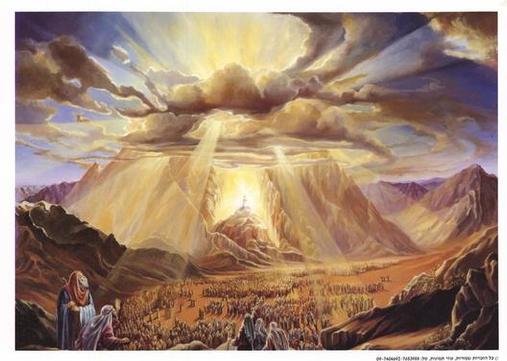
Then there is the name of Havayeh,[4] which represents a level of G–dliness that is supernatural and otherworldly. This is a level so lofty that until the Torah was given, no one had any access to it.[5] Until the giving of the Torah. At this unspeakably awesome, one-time occasion, Hashem chose to infuse the sublime level of Havayeh within every Jew.[6]

(This is the meaning of the Jew’s additional soul, the Nefesh HoElokis, the divine soul.[7] One might ask: Why is this soul is called a divine soul; after all, everything that exists has a soul that is divine, for Hashem created (and continually recreates) everything in existence? The answer is that the soul in all other beings comes from the name of Elokim, while the Jew possesses an additional soul that completely transcends the natural order, one that flows from Havayeh—the divine soul.)

However, this was only the beginning. Hashem then gave us a mission, a mission of the most unparalleled cosmic proportions. He charged us with the task of bridging the cosmic divide between Havayeh and Elokim, by revealing the name of Havayeh in the world.

To this end, He gave us the Torah, which is specifically called the Torah of Havayeh, and the Mitzvos, which are specifically called the Mitzvos of Havayeh. When we study the Torah and adhere to the Mitzvos, we reveal this level in the world around us, and to the gentile nations as well. This was in fact Hashem’s ultimate intent in creation, also known as “making a dwelling place for Hashem,”[8] for Havayeh, in the world and among the gentile nations, who stem from Elokim.

Since this is the ultimate purpose of creation, this mission carries the utmost responsibility and requires the utmost devotion and sacrifice. This is the meaning of Hashem’s statement that He made us “A kingdom of priests and a holy nation.”[9]

A Kohen, a priest, represents someone whose entire life, and every minute aspect of his life, is different from those of others. It is consecrated to Hashem.

And so Hashem gave us the Torah, which is related to the world hora’ah, guidance, for every single minute aspect of a Jew’s life, from the cradle to the grave, is guided by Torah. There is no area of life where Hashem does not provide guidance to his priests, the Jewish people, in His Torah.

This surely applies to the home, which the Jew is charged with making a Mikdash (sanctuary) for Hashem, regardless of where—in the kitchen, the living room, the bathroom, and the bedroom—the Torah guides the Jew how to bring the divine presence into all these places.

And it applies no less to the workplace, where a Jew is charged with the mission of setting an example of scrupulous honesty and integrity, and influencing his environment in a pleasant, peaceful manner, for of the Torah it is written, “Its ways are ways of pleasantness, and all its paths are peace.”[10] He should influence the Jews around him to adopt Torah observance, and the non-Jews around him[11] to believe in Hashem and Torah, and follow the Noahide Code—the eternal laws and principles of basic morality and decency incumbent upon all mankind.

This is not to say that non-Jews can’t connect to Hashem; on the contrary, they can and must, especially in light of the fact that they are created “in the image of Hashem.” However, the focus of their G–d-given mission is to abide by their Mitzvos, whose fundamental purpose is “yishuv ha’olam”—civilizing society, to settle the world physically and maintain a cohesive, peaceful, just, G–d-fearing social order, as it is written, “Not for chaos did He create it [the world, but rather] He formed it to be settled.”[12] It is this vital role for which non-Jews were assigned. Thus, non-Jews’ mission is related to the natural order, which stems from the name of Elokim, and this is the reason that the Noahide laws are rational laws that stem from the natural world. Thus, in order to accomplish this goal, non-Jews need not perform any of the Mitzvos specifically commanded to Jews.[13]

So Jews have a role—to reveal the name of Havayeh, and non-Jews have a very different role—to ensure the appropriate expression of the name of Elokim, through ensuring that the natural order follows the wishes of Hashem in His Torah.

Is this in a certain sense a lower mission than the mission given to the Jews? Yes. But so what—Hashem can do as He wishes—His will need not conform to the passing whims of the philosophical fads of mortals.

Moreover, every individual has a personal mission, one that differs from that of everyone else. Of these, Hashem clearly assigns different missions to different people—some receive more advanced, risky, responsible missions, and others, less challenging, more everyday ones.

Likewise, we find that only a Levi may sing in the Holy Temple, and only a Kohen may serve in it. I myself, for example, am not a Kohen, and as such I am barred from entering certain parts of the Holy Temple, and not allowed various Kohen privileges. But I am not bothered by that fact one bit, because since Hashem made me a non-Kohen, that role is clearly not what Hashem wants of me, and so I have been deprived of nothing.

Racism, in contrast, means refusing to treat someone with proper decency and respect simply because they belong to a group that one has some kind of animosity towards. However, the “Torah of light”[14] instructs clearly how one should view non-Jews: “Beloved is man, for he was created in the image [of Hashem].”[15] All mankind must be treated with the utmost respect, for they are beloved to Hashem by virtue of their special human intellect, which resembles the divine.

When a Jew assumes his role uncompromisingly and proudly, in addition to the inherent worth of this behavior, he also does a tremendous service for the world and all the gentile nations. He performs his role as priest, role model, and teacher to the nations, to illuminate and uplift them with the sublime spirituality of Havayeh for which he serves as a channel.

However, if the Jew chooses, may Hashem save us, to compromise his Torah observance and behave in inappropriate ways that conflict with Torah, behaviors typical of the secular culture, then not only does he harm himself grievously, but he also does a disservice to the nations by abdicating and thereby withholding from them his holy example, guidance, and the awesome revelation of Havayeh that they could have received through his unswerving allegiance to Torah.

____________________________________________________
[1] See at length Parashas Derachim, Rabbi Yehuda Rosanes.
[2] Yoma 48b.
[3] Cf. Likkutei Sichos, Vol. 25, pp. 186-192.
[4] Hashem has other names, but these are the primary ones, and the main ones relevant to this discussion.
[5] With some notable exceptions, such as Avraham, on a lower level, and Moshe, on a higher level. Further discussion of this is beyond the scope of this article.
[6] Likkutei Torah, Bamidbar 16d.
[7] See Tanya ch. 2, beg.
[8] Midrash Tanchuma, Naso 16. Explained in Tanya ch. 36.
[9] Shemos 19:6.
[10] Mishlei 3:17.
[11] As per Moshe Rabeinu’s instruction to the Jewish people at Sinai. Mishneh Torah, Laws of Kings, 8:10.
[12] Yeshayah 45:18.
[13] However, it is praiseworthy for non-Jews to adopt certain Jewish practices on a voluntary basis, such as daily prayer, blessings on food, and so on, while other Mitzvos, which were meant exclusively for Jews and would therefore be spiritually harmful for non-Jews, are therefore forbidden for them, such as observing the Shabbos (Cf. Mishneh Torah, Laws of Kings, 10:9. As explained in The Divine Code, Vol. I, Part I, Chapter 3, on “The Prohibition Against Making a New Religion or Adding a Commandment.”)
[14] Mishlei 6:23.
[15] Avos 3:14.


Like what you read? The articles I write take a lot of time and effort. Please contact me to sponsor an article for (at least) $36 in honor of the birthday, wedding anniversary, or yarhtzeit of a loved one, or for a refuah shleimah or the like. Also, see here concerning the tremendous merit of supporting the dissemination of Chassidus, and the blessings that one receives for doing so.

Tuesday, March 13, 2012

Purim: Seeing Through the Facade


Purim: Seeing Through the Facade

Rabbi Yehoishophot Oliver

On Purim, we celebrate a very special kind of miracle. A “miracle vested in nature”.

“Normal” miracles jump in your face and jar you out of your sense of self and your default approach to the world. Normally, the external natural world cries out “I exist,” and only allows us to connect with the level of G–dliness that is vested within nature, which stems from the divine name of Elokim. Open miracles, however, virtually “force” us to acknowledge that right behind the Elokim-generated forces of nature lie the name of Havayeh, a level of G–dliness so sublime that it utterly transcends nature, and it even transcends the fundamental parameters of time and space.

(Of course, a true skeptic—one filled with blind faith in the powers of his puny intellect, and a passionate desire to reject anything and everything beyond it at all costs—will find a way to deny, dismiss, and belittle anything and everything that transcends nature. But “we are not speaking of fools.”[1])

Then there is a miracle that
can be easily denied, or not noticed to begin with. One could fail to realize that this event involved divine intervention in the “normal” process of nature. This kind of miracle truly tests our faith, our inner bond with Hashem, our power to sense the absolute truth of G–dliness.

This is the lesson of the story of Purim. No dramatic splitting of the sea, flame without oil, or Golem here. Just a series of apparently fortuitous coincidences, any one of which alone might seem surprising, but still well within the realm of statistical probability.

And yet since the Jew’s special Neshamah stems from the name of Havayeh,[2] he has the power, if he so chooses, to see through the façade of Elokim, to see how in fact these were no natural events—this was the handiwork of Havayeh alone.

And this is what we celebrate on Purim—the Jew’s ability to see through the mask of nature[3] and see Hashem’s constant guiding hand. And not only in grand events of national significance, but even in his very own personal life—if he truly wants, he has the power to see how Hashem has guided him every step of the way, and how in fact, every single event in his life is truly from Hashem—and not only from Elokim, but from Havayeh.[4]

Certainly, when the Jew sees in his personal life a “coincidence” that some might attribute to chance, citing the all-knowing professors of statistics as their supposedly unimpeachable source, or at least to the cyclical rhythms of Elokim, the Jew knows the truth—that every single event in his life occurs by Divine Providence alone, and stems (not only from Elokim, but on a deeper level) from Havayeh.

So why did he, let’s just say, receive an e-mail from an old friend he had fallen out of touch with for years soon after he spent five minutes consciously thinking about this person for no apparent reason (as actually happened to me just last night)? The Jew knows that this was no fluke. Hashem wanted to show him a little glimpse of His Personal Providence by slightly removing the façade of nature for a brief while.

Then this experience shows him tangibly how mikreh—chance is rak meiHashem—only from Hashem.[5] His eyes are opened up (and perhaps this is one of the meanings of the Rebbe’s exhortation that we “open our eyes”) to see Hashem’s hand in every aspect of his life. And the more he searches earnestly for Hashem, the more he truly sees Him.

This endows him with the encouragement to approach even his daily mundane, apparently banal routine duties with joy and inspiration, knowing that Hashem—including the lofty level of Havayeh—goes with him always, even in the apparently negative events in his life (may Hashem spare us), and that only Hashem gives him the strength to perform acts of might.[6] And through this faith, “everything will become good on a revealed level as well.”[7] Kein tihiyeh lanu!

_____________________________________
[1] Bava Kama 85a.
[2] See the explanation and sources quoted here.
[3] This is one of the reasons for the custom to dress up in costume on Purim (Rabbi Moshe Chagiz, Eileh Hamitzvos, p. 293).
[4] Cf. Tanya, Iggeres HaKodesh ch. 11.
[5] Sfas Emes, Parshas Zachor, 5632.
[6] Cf.
Devarim 8:14-18.
[7] Tanya ibid.


This article is dedicated by Sholom Ber and Rochel'e Odze, l'ilui nishmas Yaakov ben Moshe (Jack Muchnik) a"h.


Like what you read? The articles I write take a lot of time and effort. Please contact me to sponsor an article for (at least) $36 in honor of the birthday, wedding anniversary, or yarhtzeit of a loved one, or for a refuah shleimah or the like. Also, see here concerning the tremendous merit of supporting the dissemination of Chassidus, and the blessings that one receives for doing so.

Monday, October 31, 2011

Modeh Ani: Essence facing Essence

Modeh Ani: Essence facing Essence

Rabbi Y. Oliver

The very first thing that a Jew does in the day is to recite Modeh ani:I gratefully thank You, living and eternal King, for You have returned my soul within me with compassion—abundant is Your faithfulness!

Although the word modeh can mean to thank, it can also mean to acknowledge. When a Jew declares Modeh ani, he says: “Hashem, I acknowledge You!”

At first glance, this acknowledgment lacks any depth. After all, the Jew has only just woken up; he’s still shaking the sleep out of his eyes and coming to his wits; he has not yet had the chance to reflect, understand, feel, and internalize anything at all. When a Jew recites Modeh ani, his lack of development and comprehension is akin to that of a newborn child.

This begs the question: Of what value is an acknowledgment when submitted in such a lowly state?

However, Chassidus explains that the opposite is the case: Because it does not involve intellectual comprehension, in a sense, Modeh ani is the highest prayer of all.

There are two levels to the Jew’s soul: its essence, and its manifestations. Corresponding to this, there are two levels of acknowledgment of Hashem: One that stems from the soul’s very essence, and another that stems from its manifestations.

There is a principle in Chassidus that “the manifestations hide the essence.” When you see the superficial aspect of a thing, you lose sight of its very core. For example, when reading words on a page—the “manifestations”—one can come to forget that one is actually staring at ink—the “essence.”

Likewise, as soon as the Jew has reached a certain level of understanding, he can no longer submit to Hashem (at least, not on a conscious level) from the very essence of his soul; his submission must stem from his understanding. He does not submit naturally, because of the essential bond between a Jew and Hashem’s very Essence. Rather, he submits because he understands that he should. He understands Hashem to a certain degree, and yet he also understands that certain things are beyond his comprehension, and so he acknowledges them.

This is the difference between the acknowledgement of Modeh ani and of Hodu laHavayeh, which is the start of Shacharis, the morning prayer.

In Modeh ani, the essence of the soul, “ani,” submits “lefonecho,” “before You”—before Hashem’s very Essence. Because the Jew doesn’t understand anything, his mind and heart do not “get in the way” of the revelation of the soul’s essence. And since the soul’s very essence is manifest, as it were, it connects the Jew with Hashem’s very essence.

In contrast, at the beginning of Shacharis, we recite, “Acknowledge Havayeh, and call out in His name.” “His name” refers to the level of G–dliness that enters nature (which stems from the divine names of Ad-nai and Elokim). So we need to “call,” i.e. summon down into our world this level of G–dliness, so that it can constantly create the world. In contrast, with respect to Havayeh, a level that transcends time and space and is therefore completely beyond us, we must simply acknowledge and accept without understanding.

Yet although one acknowledges, since his acknowledgement actually stems from his understanding—his understanding of the limits of his intellect—it does not permeate his entire being, and thus it only connects him with levels that transcend intellect, but not with Hashem’s very Essence, as when one recites Modeh ani.

Based on the Rebbe's Sefer HaMa’amarim 5714-5716, pp. 337-338


This post was dedicated by Reb Yisroel Meir Rafael and family.


~~~~~~~~~~~~~~~
Like what you read? The articles I write take a lot of time and effort. Please contact me to sponsor an article for $36 in honor of the birthday, wedding anniversary, or yarhtzeit of a loved one, or for a refuah shleimah or the like. Also, see here concerning the tremendous merit of supporting the dissemination of Chassidus, and the blessings that one receives for doing so.