"Moshiach is ready to come now-our part is to increase in acts of goodness and kindness" -The Rebbe

Showing posts with label terror. Show all posts

Monday, November 19, 2012

Chilling "coincidence": A sign from Above

Chilling “Coincidence”:
A Sign from Above

Rabbi Y. Oliver

This is a glaring, chilling “coincidence.”

On Rosh Chodesh Kislev 5769, Gavriel Holtzberg and his pregnant wife, Rivkah, shluchim to India, were slain by terrorists and died al kiddush Hashem, along with others. May their blood be avenged.

Just now, on the very same day in 5773, four years later, Mira Sharf, shluchah to India, also pregnant, was slain by terrorists and died al kiddush Hashem, along with others. May their blood be avenged. (Her husband Shmuel, yibadel lechaim tovim, shliach to India, was critically injured, but survived, as did her children. May they have a full recovery and be comforted.)

Our first response should be to cry out, “Hashem, ad mosai?!” Enough suffering in golus!

But then we must take notice. This is an open sign of Hashem’s hashgachah, His direct involvement in our lives. What is He trying to tell us, the worldwide community of chassidei Chabad in particular?

I don’t presume to know for certain what the lesson might be. But Chazal say, “If one sees suffering coming upon himself, he should inspect his deeds.”[1] He should make a cheshbon nefesh, and see if he can find any sins that might have caused this misfortune, and do teshuvah for them.

This applies not only to the Jew as an individual, but also to the Jew’s community, as the Rambam rules:[2]
It is a positive obligation stated in the Torah to cry out to Hashem in prayer whenever a great calamity should befall the community. … This is counted among the paths of repentance, that when a calamity arrives and people cry out and sound the Shofar, everyone will know that it was because of their wrongdoing that this evil befell them … and this will cause the calamity to be removed from them. If, however, they do not cry out … arguing instead that this event happened to us as part of the natural way of the world and that the calamity happened by chance, this approach is cruel, because it causes people to persist in their wrongdoing and thus brings about further disasters … . Moreover, the Sages ordained that people should fast over every calamity that overtakes the community, until Heaven shows them compassion.
So when tragedy befalls a community, it’s the fault of the entire community, and the community must know that. (It’s certainly not the fault of any non-Jew, although that evil scum will certainly get his just deserts, for no non-Jew has the power to harm any Jew unless Hashem so decreed it. As the Gemara states,[3] the Beis HaMikdash would not have been destroyed unless “their Mighty One had given them over, and Hashem had trapped them.”[4])

This is true of any tragedy in the community (as I write here), but all the more so when it occurs in a way in which we see Hashem’s hashgachah so openly, as is the case here, Rachmana litzlan.

So let us not let this tragedy pass us by, in effect treating it as if, chas vesholom, “the calamity happened by chance.” Let us search within, consult with our friends, and turn to our venerated Rabbonim and Mashpi’im in earnest: What can we do to improve as chassidim? Are there areas in which we are falling short, and even going against what the teachings of Chassidus demand of us, Rachmana litzlan? In which areas are we not devoting ourselves to do perform good deeds—and and the hora’os of Chassidus and the Rebbe in general, and his call to spread Yiddishkeit and Chassidus far and wide in particular—as much as we could? And let us make good resolutions to change, and follow them through, with the help of Hashem.

This is the true Jewish response to suffering. Let’s do it, and may Hashem see our sincere teshuvah, have mercy upon us, spare us from all future harm and sorrow, and send Moshiach now.

_____________________________________
[1] Berachos 5a.
[2] Mishneh Torah, Hilchos Taaniyos, 1:1-4.
[3] Gittin 55b-56b.
[4] Devarim 32:30.


Like what you read? The articles I write take a lot of time and effort. Please contact me to sponsor an article for (at least) $36 in honor of the birthday, wedding anniversary, or yarhtzeit of a loved one, or for a refuah shleimah or the like. Also, see here concerning the tremendous merit of supporting the dissemination of Chassidus, and the blessings that one receives for doing so.

Wednesday, November 18, 2009

Moshe Holtzberg's message

The news of the capture of Gavriel and Rivka Holtzberg’s child, Moshe, and then his miraculous rescue, was particularly poignant for my family, for we too have a Moishe’le (an affectionate way of saying Moshe), and in fact, he is only around seven months older. He too has brownish hair and looks, well, cute. It was all so real.

As a survivor of terror, Moshe Holtzberg is unfortunately not unique. However, his case is unusual in that his dramatic liberation was widely publicized by all the major media outlets, making him perhaps the most famous child victim of terror in history. Likewise, his heartrending cries for his mother at the commemoration service for his parents in the
Shul in Mumbai were captured on video and publicized on prime-time news. ­­­­This made him the poster child for child victims of terror worldwide, and a prominent reminder of the reality of their plight.

What does this mean for those of us who live so comfortably in the western world, where terrorism is generally something we read about in the news, and not an immediate concern?

Of course, those in a position to provide any assistance to such orphans should do so.

Beyond that, let us derive from this the importance of cultivating the quality of gratitude to G–d in our personal lives, and for our most precious possession—our children. Never should we take them for granted.

G–d has entrusted us with them, and we ought to fulfill our duty to Him and them faithfully. Let us value them, and make them feel valued.

Not only should we realize how blessed we are to have children, we should also realize how blessed our children are to have parents. For even more than parents need children, children need parents. Let us strive to be the best parents that we can.

First and foremost, this involves setting a sterling example of the noble values and refined lifestyle that we preach to them.

On a more direct level this involves spending more time with our children, making them feel loved and special, and guiding them gently but firmly on the proper path of fear of Hashem. This is the true victory over the terrorists and their ilk.

Moreover, as King Dovid, the sweet singer of the Jewish people, declared: “Out of the mouths of babes and infants you have found strength to destroy the enemy and avenger” (
Tehillim 8:2). It is through raising Jewish children as the Torah teaches that the Jewish people prevail over their enemies.

Monday, November 16, 2009

The Mumbai Chabad House massacre: A Jewish response

It has been a year since our brethren were slain in Mumbai. So how should we, as Jews, respond to the Mumbai attacks, considering the fact that they deliberately targeted Jews? A natural response is one of fear. Fear that perhaps it could happen again. And who knows where ... ? G–d forbid.

However, although fear may seem logical, it must be quashed at all costs, for this is exactly what the terrorists want. Their goal is to strike fear and terror into our hearts, so we think that they have power over us. Then they will have won.

However, the key to overcoming this fear is to recognize that the terrorists’ arrogant show of power is a sham, and they are powerless. Hashem runs the world, and every minute aspect of it. This massacre happened because He willed it so, for reasons that we do not understand. These monstrous brutes do not control the world; only Hashem controls it, and therefore it is wrong to fear any man.

So we must mourn, and yet we must not allow ourselves to become weakened and discouraged. Rather, we should turn mourning into resolute action. But what sort of action? For that, we turn to the Torah, for, as the Rebbe taught us countless times, the Torah is a
Toras chaim, a “Torah of life” that provides us with guidance in our daily lives. We must seek a Jewish response. It would also be fitting to seek this response in the Torah portion of Toldos, which was read when the attack occurred.

In that Torah portion we find it written, “The voice is the voice of Yaakov, but the hands are the hands of Eisav” (
Bereishis 27:22). The Midrash Rabba (Eicha 2; cf. Zohar 1:171a) interprets this to mean that when Yaakov, i.e., the Jewish people, use their voices to study Torah in the study hall and pray in the synagogues, the hands of Eisav, our enemies, have no power. However, when Yaakov does not use his voice to study Torah, the hands of Eisav are empowered to attack us. Along these lines, the Gemoro says, “Get up early and leave late against them to the study hall, and they will perish of their own” (Gittin 7a).

Of course, those who are able to influence governments and law enforcement agencies to crack down on terrorism should surely do so, because Hashem also requires us to make a vessel for safety according to the natural order. When the lives of our fellow Jews are taken or in danger, those in a position to do so must ensure that everything possible is done to thwart the enemy’s designs. However, the primary Jewish response to the Nazis, PLO, Hamas, and the Mumbai murderers, may all their names be blotted out, is the same: To increase in Torah study oneself, and in disseminating Torah knowledge and its observance to others.

This would be the appropriate response to any such tragedy. However, it is an especially relevant response in this case, considering the holy mission to which the Holtzbergs had selflessly devoted their lives: Spreading Torah and
Mitzvos, and the wellsprings of Chassidus. This is surely their legacy to us.

May our increase in learning and disseminating Torah bring merit to their souls, and bring
Moshiach now.

Sunday, October 18, 2009

Bridging the chasm between us

Many of us are so “stuck” in ourselves—in our routines, our personal lives, our family, and our immediate daily concerns—that, as legitimate and even necessary as it may be for us to pursue these things, they naturally become a rut from which we can barely see out of. We have boxed ourselves into ourselves, and we have great difficulty simply relating to others who are not part of our little world.

The Alter Rebbe addresses this concern in the book of
Tanya, chapter 32, the chapter famously devoted to explaining the Mitzvah of ahavas Yisrael, loving one’s fellow Jew. There it states that at the core all Jews are one, and yet “the bodies are separate”: The body and the concomitant drive to satisfy one’s selfish material needs (never mind controlling or channeling the urge to indulge one’s more sensual desires) create a tremendous division between us.

The Mitzvah of
ahavas Yisrael obligates us to engage in the lifelong struggle to overcome this distance. This begins with striving for inner self-improvement, by curbing one’s material passions and thereby transcending one’s bodily limitations. In this way one makes the Neshama and its interests and aspirations dominant in one’s life, which sensitizes one to the souls of fellow Jews regardless of the bodily separation.

But how can one tell whether efforts at sensitizing oneself have borne fruit, and have produced a feeling of true love for one’s fellow Jew? Practically speaking, one way of measuring how far one has progressed is to consider whether one eagerly fulfils the Mitzvah to rejoice in the celebrations of fellow Jews, and whether one is genuinely pained when other Jews are in distress or grieving. As
Rabeinu Yona writes:
If your fellow is in distress, feel pained for them ... and rejoice in their prosperity. If you hear about the distress of Jews who live far away, groan and pray for them, and all the more so for those who are close.

Sefer Ha’yira l’Rabeinu Yona, sec. beg. ve’im yovo’u.
Thus, not only should we share in the joys and sorrows of a member of our own community, but those of every single Jew in the world that comes to our knowledge.

It sounds noble and holy, but sadly, if we are to be honest with ourselves, it is very far from reality. When we hear of a child born, how much do we rejoice? When we hear of the passing of an elderly Jew, how much do we mourn? When we hear of a Jew losing his job, how much is our compassion and concern aroused? Indeed, these are very sobering questions.

Nowhere are the material pains of our fellow Jews as obvious as they are today in
Eretz Yisroel, where Jews suffer from rockets, suicide bombings, kidnappings, sniper fire, and the trauma of constant fear of such attacks.

Then there is the perhaps even more painful phenomenon of Jew against Jew:
  • Jews knowingly endangering Jews by handing over guns, land, and money to our sworn enemies (as in Oslo and its follow-up deals), by removing checkpoints, by releasing terrorists with blood on their hands, or who wanted to have blood on their hands, in ridiculous exchanges, and so on;
  • Jews expelling Jews from their homes—“because they had no choice but to follow orders” (as in Gush Katif and Northern Shomron, and more recently in Chevron and other places);
  • Jews mercilessly beating those who simply protest against destruction of Jewish property (as in Amonah, and on other occasions);
  • Jews preventing Jews from building their property, forcing them to live in ghetto-like conditions (as is currently the case in Yehuda and Shomron);
  • ... and the list goes on.
When we hear that our fellow Jews are abused, discriminated against, victimized, demonized, expelled, dispossessed, betrayed, traumatized, injured, or slain, by strangers and even by brothers, it ought to make a difference to us. Not only should we not come up with transparent, pathetic excuses to look the other way (such as “we don’t get involved in politics” or “people will be turned off if we speak about such topics”), but it ought to matter to us, bother us, shake us up, outrage us.

As the Rebbe said many times concerning such events, “When it hurts, you scream!” If we’re not screaming, then it means we’re not hurting. If we’re not hurting, then our love for our fellow Jew is clearly lacking. And this stems from the fact that we fall short spiritually. Although we davven with a Minyan, study Torah, and so on, our heart is not in it. It’s difficult to say it, but we’ve succumbed to a self-centered lifestyle.

Perhaps we need to review
Tanya, chapter 32, and reflect upon its message persistently. Until, with the help of Hashem, it truly sinks in.

Wednesday, March 25, 2009

Looking forward to judgement day


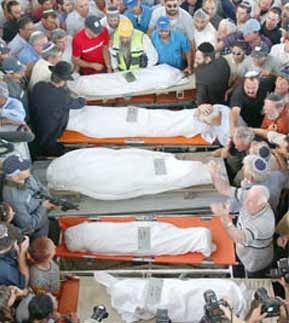
Mourners surround the corpses of Tali Hatuel, 34, who was eight months pregnant, center, and her four daughters, aged two to 11, at their funeral.

Mourners at the funeral of the Merkaz HaRav Yeshiva students.

Mourners surround the corpses of Gabi and Rivkah Holtzberg.
Their orphaned son, Moishe (inset), cries in pain.


Today we marking the commemoration of a year since the brutal slaying of the Merkaz HaRav Yeshivah students while studying the holy Torah. And yet again I am reminded of other massacres, of other names, of so many names, so many shattered lives, that I am overwhelmed at the thought of it.
I’m looking forward to the day of judgment.
I want to see justice. Justice for every Jew slain. For every Jew maimed, injured, disfigured, handicapped. For every Jew who was physically harmed in any way. For every Jew put in fear, traumatized. For every Jew whose family life or whose mental health was affected. For every Jew bereaved, mourning, hurting—which, in a broader sense, means justice for every single Jew. Justice for the Jewish people, whom they intend to attack by attacking individual Jews. And justice for Hashem, Whose people they dared to harm.
It’s not that I like seeing people in pain—I don’t. But I like seeing justice carried out against the enemies of Hashem and the Jewish people. “When the wicked are destroyed, there is joy” (Mishlei 11:10). And I want it to be justice “measure for measure” (Sanhedrin 90a).
When we refer to a Jew who has been murdered because he was a Jew, we call him a kodosh, a “holy one,” and we say “may Hashem avenge his blood.” I’m looking forward to the fulfillment of this. To the day when the true value of the Jewish people will be revealed, that they are Hashem’s Chosen, and all the scum who dared to harm them will receive their just desserts in a most public manner, for all the world to see. And we will see the final fulfillment of Torah’s words “Sing aloud, nations, of His people; for He does avenge the blood of His servants, and does render vengeance to His adversaries” (Devarim 32:43). May it happen today, with the coming of Moshiach.