"Moshiach is ready to come now-our part is to increase in acts of goodness and kindness" -The Rebbe

Showing posts with label Mumbai massacre Hy"d. Show all posts

Wednesday, November 18, 2009

Moshe Holtzberg's message

The news of the capture of Gavriel and Rivka Holtzberg’s child, Moshe, and then his miraculous rescue, was particularly poignant for my family, for we too have a Moishe’le (an affectionate way of saying Moshe), and in fact, he is only around seven months older. He too has brownish hair and looks, well, cute. It was all so real.

As a survivor of terror, Moshe Holtzberg is unfortunately not unique. However, his case is unusual in that his dramatic liberation was widely publicized by all the major media outlets, making him perhaps the most famous child victim of terror in history. Likewise, his heartrending cries for his mother at the commemoration service for his parents in the
Shul in Mumbai were captured on video and publicized on prime-time news. ­­­­This made him the poster child for child victims of terror worldwide, and a prominent reminder of the reality of their plight.

What does this mean for those of us who live so comfortably in the western world, where terrorism is generally something we read about in the news, and not an immediate concern?

Of course, those in a position to provide any assistance to such orphans should do so.

Beyond that, let us derive from this the importance of cultivating the quality of gratitude to G–d in our personal lives, and for our most precious possession—our children. Never should we take them for granted.

G–d has entrusted us with them, and we ought to fulfill our duty to Him and them faithfully. Let us value them, and make them feel valued.

Not only should we realize how blessed we are to have children, we should also realize how blessed our children are to have parents. For even more than parents need children, children need parents. Let us strive to be the best parents that we can.

First and foremost, this involves setting a sterling example of the noble values and refined lifestyle that we preach to them.

On a more direct level this involves spending more time with our children, making them feel loved and special, and guiding them gently but firmly on the proper path of fear of Hashem. This is the true victory over the terrorists and their ilk.

Moreover, as King Dovid, the sweet singer of the Jewish people, declared: “Out of the mouths of babes and infants you have found strength to destroy the enemy and avenger” (
Tehillim 8:2). It is through raising Jewish children as the Torah teaches that the Jewish people prevail over their enemies.

Monday, November 16, 2009

The Mumbai Chabad House massacre: A Jewish response

It has been a year since our brethren were slain in Mumbai. So how should we, as Jews, respond to the Mumbai attacks, considering the fact that they deliberately targeted Jews? A natural response is one of fear. Fear that perhaps it could happen again. And who knows where ... ? G–d forbid.

However, although fear may seem logical, it must be quashed at all costs, for this is exactly what the terrorists want. Their goal is to strike fear and terror into our hearts, so we think that they have power over us. Then they will have won.

However, the key to overcoming this fear is to recognize that the terrorists’ arrogant show of power is a sham, and they are powerless. Hashem runs the world, and every minute aspect of it. This massacre happened because He willed it so, for reasons that we do not understand. These monstrous brutes do not control the world; only Hashem controls it, and therefore it is wrong to fear any man.

So we must mourn, and yet we must not allow ourselves to become weakened and discouraged. Rather, we should turn mourning into resolute action. But what sort of action? For that, we turn to the Torah, for, as the Rebbe taught us countless times, the Torah is a
Toras chaim, a “Torah of life” that provides us with guidance in our daily lives. We must seek a Jewish response. It would also be fitting to seek this response in the Torah portion of Toldos, which was read when the attack occurred.

In that Torah portion we find it written, “The voice is the voice of Yaakov, but the hands are the hands of Eisav” (
Bereishis 27:22). The Midrash Rabba (Eicha 2; cf. Zohar 1:171a) interprets this to mean that when Yaakov, i.e., the Jewish people, use their voices to study Torah in the study hall and pray in the synagogues, the hands of Eisav, our enemies, have no power. However, when Yaakov does not use his voice to study Torah, the hands of Eisav are empowered to attack us. Along these lines, the Gemoro says, “Get up early and leave late against them to the study hall, and they will perish of their own” (Gittin 7a).

Of course, those who are able to influence governments and law enforcement agencies to crack down on terrorism should surely do so, because Hashem also requires us to make a vessel for safety according to the natural order. When the lives of our fellow Jews are taken or in danger, those in a position to do so must ensure that everything possible is done to thwart the enemy’s designs. However, the primary Jewish response to the Nazis, PLO, Hamas, and the Mumbai murderers, may all their names be blotted out, is the same: To increase in Torah study oneself, and in disseminating Torah knowledge and its observance to others.

This would be the appropriate response to any such tragedy. However, it is an especially relevant response in this case, considering the holy mission to which the Holtzbergs had selflessly devoted their lives: Spreading Torah and
Mitzvos, and the wellsprings of Chassidus. This is surely their legacy to us.

May our increase in learning and disseminating Torah bring merit to their souls, and bring
Moshiach now.

Sunday, November 15, 2009

The Holtzbergs: Kiddush Hashem in life and in death


We are nearing the first yahrtzeit of Rabbi Gavriel and Rebbetzin Rivkah Holtzberg, who were cruelly slain by vile terrorists almost a year ago.


By devoting their lives to spreading Yiddishkeit and Chassidus, the Holtzbergs made a kiddush Hashem, a sanctification of G–d’s Name.


In their death too, they made a kiddush Hashem, for whenever Jews are murdered simply because they are Jews, they are said to have died al kiddush Hashem, for the sanctification of G–d’s Name. And clearly, the terrorists’ intent was to attack Jews. The Chabad House was the most prominent Jewish target in the city of Mumbai, for although there are other shules, they are rarely visited. The main Jewish center in the city, with a rabbi and thriving activities, was the Chabad House. Even the terrorists knew this, so in their craven, obscene desire for barbaric bloodshed, the Chabad House was the place that they targeted.


But the Holtzbergs sanctified G–d’s Name in their death in another very significant sense. On account of them the entire world came to know what is a Chabad House. It is a place where Shluchim, emissaries of the Rebbe, devote their lives to helping Jews materially and spiritually, even in the most poor conditions, and the most far-flung and unholy places. I think it can be said with certainty that the work of the Shluchim had never received anywhere near this degree of publicity. Over the course of the Mumbai attack virtually every single media outlet in the world discussed, whether briefly or at greater length, who the Holtzbergs were and the noble life that they had lived. Of the outreach rabbi and his wife who devoted their lives to help others in such a remote location. Of the work of the Shluchim worldwide. This is surely a tremendous privilege for them, and brings tremendous elevation to their souls.


May their blood be avenged.

Wednesday, July 29, 2009

Painful silence

I recently visited 770 and saw an old friend, Reb Nachman Holtzberg. I never had the good fortune to meet his son Gaby (may his blood be avenged), but as a student in 770 some seven years ago, I was friendly with Reb Nachman. He invited me over to his house for Shabbos meals several times, helped me a bit in seeking a shidduch, and we would chat from time to time. I don’t think I’d spoken to him for a number of years, being that I have lived abroad.

When I saw Reb Nachman, I felt that I should approach him, but ... I hesitated. What would I say? What could I say? I couldn’t think of anything at all to say. So I didn’t approach him. I didn’t decide that I wouldn’t. I just didn’t feel that I was ready.

But he noticed me, approached me, greeted me, and inquired how my life is going. We exchanged pleasantries. And then ... there was an awkward, painful pause. I looked at his face, into his face, and saw a person totally broken. I was supposed to comfort him, I knew. I searched frantically in my mind for something to say, anything, but nothing I thought of could begin to do justice to his suffering. Those few seconds were interminable. Finally, after an eternity, I eked out a pathetic “men zol heren besuros tovos”—“may we hear good news.”

I had failed. He threw up his hands as if to say “what will that help?”—or so I interpreted it.

After he bid me farewell, I rebuked myself. How could I have had nothing to say?! Why did I feel I needed hours of preparation before consoling a fellow Jew? I know that (like countless others) I was deeply affected by the murder of Gaby, his wife Rivka, and the other Jews in the Chabad House of Mumbai (as
my blog posts of that time attest). So why couldn’t I speak? Where was the sensitivity and love I should display toward my fellow Jew?

Or perhaps it is the other way around. Maybe I couldn’t speak
because I cared so much. I don’t know.

Wednesday, March 25, 2009

Looking forward to judgement day


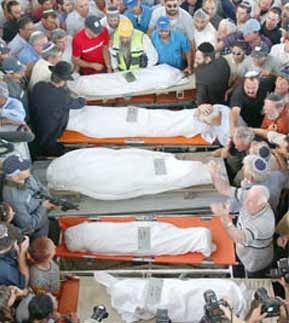
Mourners surround the corpses of Tali Hatuel, 34, who was eight months pregnant, center, and her four daughters, aged two to 11, at their funeral.

Mourners at the funeral of the Merkaz HaRav Yeshiva students.

Mourners surround the corpses of Gabi and Rivkah Holtzberg.
Their orphaned son, Moishe (inset), cries in pain.


Today we marking the commemoration of a year since the brutal slaying of the Merkaz HaRav Yeshivah students while studying the holy Torah. And yet again I am reminded of other massacres, of other names, of so many names, so many shattered lives, that I am overwhelmed at the thought of it.
I’m looking forward to the day of judgment.
I want to see justice. Justice for every Jew slain. For every Jew maimed, injured, disfigured, handicapped. For every Jew who was physically harmed in any way. For every Jew put in fear, traumatized. For every Jew whose family life or whose mental health was affected. For every Jew bereaved, mourning, hurting—which, in a broader sense, means justice for every single Jew. Justice for the Jewish people, whom they intend to attack by attacking individual Jews. And justice for Hashem, Whose people they dared to harm.
It’s not that I like seeing people in pain—I don’t. But I like seeing justice carried out against the enemies of Hashem and the Jewish people. “When the wicked are destroyed, there is joy” (Mishlei 11:10). And I want it to be justice “measure for measure” (Sanhedrin 90a).
When we refer to a Jew who has been murdered because he was a Jew, we call him a kodosh, a “holy one,” and we say “may Hashem avenge his blood.” I’m looking forward to the fulfillment of this. To the day when the true value of the Jewish people will be revealed, that they are Hashem’s Chosen, and all the scum who dared to harm them will receive their just desserts in a most public manner, for all the world to see. And we will see the final fulfillment of Torah’s words “Sing aloud, nations, of His people; for He does avenge the blood of His servants, and does render vengeance to His adversaries” (Devarim 32:43). May it happen today, with the coming of Moshiach.

Sunday, December 7, 2008

What should Chassidim be doing now?

Chassidim are like one family; the Rebbe is the father of all Chassidim, and Chassidim are his children (and this relationship exists all the more with the Shluchim, with whom the Rebbe has an extra close and personal relationship).

Thus, the Rebbe is sitting shivah now, and all Chassidim should be sitting shivah now.* So to all Chassidim, and to the Rebbe, I say:

Hamokom yenacheim eschem besoich shaiar avelei tziyon ve’Yerushalayim.”


*Just to clarify for those inclined to interpret things too literally, I mean that in one’s heart, that is how one should feel.

Tuesday, December 2, 2008

The Mumbai pogrom: Where was G–d?

At the news of the horrific slaughter in Mumbai one spontaneously cries out the question, “Where was G–d; how could He have allowed this?!”

I recall it said of the Holocaust that the above question is not correct. G–d was present in the death camps, for many people were saved in completely miraculous, inexplicable ways. Thus, their survival was clearly the Hand of G–d. This does not answer the question concerning how G–d enabled the Nazi monsters to commit their despicable acts, but it shows that although we cannot explain it, we know that G–d was right there.

The same thing occurred in the Chabad House of Mumbai. The horrific tragedy is unfathomable, yet G–d showed us that he was there. The rescue of the Holtzberg’s child, Moishe’le, was mind-bogglingly miraculous. It is not clear why Moishe’le was not killed.

Some have suggested that he had been asleep and had just woken up when the nanny heard him, but others pointed out that the bruise marks on his back suggest that he had been found and abused by the terrorists. Even if he had been asleep and never seen by the terrorists, they could easily have found and killed him, and if the terrorists had seen him, there is no logical reason that they would have spared him.

The nanny could have been already dead, or she could have escaped from the building and thus not been in a position to save Moishe’le; instead, she was still in the building nearby.

The terrorists could have been in the room where Moishe’le was crying. Miraculously, at that moment none of them were there.

The nanny could have chosen not to risk her life when she heard the child’s cry, and no one would have had any complaints; instead, she rescued him.

The nanny’s heroic rescue was thus a clear sign of G–d’s presence right in the midst of the carnage.

So in addition to everything else that Moishe’le Holtzberg represents, he represents the testimony that even as G–d hides Himself, He is right here.

May we no longer suffer any “hiding of G–d’s Face” in the future, with the coming of Moshiach now.

Sunday, November 30, 2008

The sicha for Mrs. LaPine Hy"d

The Rebbe’s sicha after the brutal slaying of Mrs. LaPine, may her blood be avenged, is tragically of timely relevance. Here is the audio of it, for those who understand Yiddish, courtesy of WLCC. Ad mosai!

A kasheh of a child

A kasheh (challenging question) of a child:

I was glued to my laptop, reading articles and watching clips about the tragedy. My two sons, 4 and 2, came over and looked at the screen. I pointed to the picture of the Holtzbergs, and I said to them (in Yiddish, the language I speak with them): “Ir zet di gute Yidden, Chassidim, vos di shlechteh goyim hobn geharget?” “Do you see the good Jews, the Chassidim, whom the evil goyim murdered?” and I broke out in tears. My older son, Shneur Zalman, was confused; my younger son, Moshe, didn’t begin to understand.

My older son asked, “Why are there bad goyim?” “Ich vais nisht”—“I don’t know,” I answered, weeping even more.