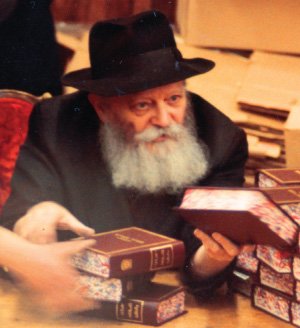
"Moshiach is ready to come now-our part is to increase in acts of goodness and kindness" -The Rebbe

Showing posts with label Moshiach. Show all posts

Sunday, July 13, 2014

On Marital Harmony II


On Marital Harmony II

(See On Marital Harmony I here)

Impact of Awareness of the Imminence 
of Moshiach on Relating to One’s Wife

When one considers the fact that we find ourselves at the end of the age of exile, close to the true and complete redemption (may it happen speedily in our days) when the feminine aspect will be dominant over the masculine, this very awareness fosters respect and care towards one’s wife.

Igros Kodesh, Vol. 6, p. 202.

Exerting a Positive Influence on One’s Husband

When it seems—sometimes perhaps with justification—that one’s husband could be “on a higher level,” one should take into consideration that Hashem has already decided upon this match long ago. Thus, just as when one detects a fault in oneself, the solution is not to cause oneself pain, but to seek painless ways to rectify the fault, so should it be—and to an even greater degree—between husband and wife. For ultimately it is hard to know what the other person is going through, and the difficulties that he went through in past years.

However, when he sees his wife’s softness and firm sense of trust in Hashem, the husband will then regard the entire world in a different light, and see that Hashem is the master of the entire world, and of their personal home in particular, and its environs. This will then put one in a good, joyful mood.

Experience shows how worthwhile this approach would be even for your own sake, for this approach brings warmth and calmness to a degree that far outweighs the effort required to compromise and forgive. 

Igros Kodesh, Vol. 9, pp. 119-120.

Torah Observance Bolsters Peace in the Home

You must found your home on true foundations of Torah. This is not only important for the neshamah to succeed, but also for the body to succeed, and it makes no difference whether you understand this. This is comparable to one who obeys the directives of a great professor, and the person benefits from doing so even if he doesn’t know the reason behind the directives. This applies all the more to instructions from the Creator, Who is the Healer of all flesh.  ... You should not forget the main point—that you must bring peace between the soul and the body, for this will immensely facilitate peace in the home.

Igros Kodesh, Vol. 5, p. 224-225.


Differences of Opinion between Husband and Wife

Our sages say that everyone has a different way of thinking.[1] This implies that despite this, true peace is attainable and necessary between every single Jew, and all the more so between husband and wife, for when they act according to Torah and mitzvos, our sages say that the Divine Presence rests in their midst.[2]

Only after the couple is blessed with children who reach the age of education does the concern that the couple may disagree about how best to educate their children become practically relevant—in other words, only after a number of years. But by this time their opinions will certainly have changed. Likewise, children bring tremendous emotional intimacy between their parents, and one cannot know at the outset the nature of this change and the extent of this intimacy. Based on our faith, one should harbor strong hope that this intimacy will occur to a great degree. Even if differences of opinion remain, they can reach a compromise between themselves, and their house will be an “everlasting edifice.”

Likkutei Sichos, Vol. 24, p. 467.

Conditions for Proper Family Life

A proper family life demands from the man, and even more so from the woman, more attention to be devoted and refined, which most cost much time and energy. ...

A proper family life according to Torah requires understanding, effort, devotion, patience, a good heart, cleanliness, calmness, an orderly appearance, a happy mood, a smiling face and friendly behavior. This is the way that both the husband and wife should behave, but in the majority of cases, this depends upon the woman, for “The wisdom of women built her home”[3]—the woman builds the home.

Igros Kodesh Admur HaRayatz, Vol. 5, pp. 57-59.


Willingness to Compromise

We find that Rochel was ready to compromise [and give up being buried with Yaakov Avinu in the Me’aras Hamachpelah] in order to be of assistance to her children. This is the main quality that every proper Jewish woman should have, whose role is to serve as the “main part of the home.”

Likkutei Sichos, Vol. 30, p. 239.

One Who Encounters Many Obstacles Knows: 
This is One of His Main Tasks

The very fact that you encounter so many obstacles to maintaining peace in the home demonstrates that this is one of your main tasks in life. It is implicit in the words of the Arizal, and explained in Chassidus, that the souls of these generations were already in this world, and they are coming back in a reincarnation, with the main purpose of rectifying areas that were lacking in the observance of the 613 mitzvos in previous incarnations.

Obviously, these souls are also obligated to follow all the 613 mitzvos, even those in which they did not fall short in a previous incarnation. The difference is that when it comes to mitzvos in which they did not fall short the previous time, the evil inclination does not mount as much opposition. It only presents enough difficulties so that free choice will remain, for in these matters, the person has already been refined in previous incarnations. In contrast, in areas in which they were lacking on previous occasions—i.e., in which their portion in this world and in the part of the soul connected to these worldly matters was not refined—the evil inclination fights with maximum force.

Igros Kodesh, Vol. 5, p. 39.

Considering the Similarity of One’s
Wife to the Jewish People

When one thinks about one’s wife, one should always keep in mind that the entire Jewish people and every individual Jew is referred to as the wife of the King of all kings, the Holy One, blessed be He. When we offer requests from Hashem that He relate to the Jewish people—whom he refers to as “My beloved one”—by fulfilling their requests for the good, we should know that an “arousal from above” depends upon an “arousal from below.” Thus, this is also the way that one should treat one’s wife—as the Talmud says,[4] one should honor one’s wife more than oneself.

Igros Kodesh, Vol. 6, pp. 201-202.

Opposition to Marital Harmony is
Much Greater at the End of Exile

I would imagine that you will encounter the most obstacles [in the area of self-rectification] in the realm of peace in the home, for it is known that peace is great, and the ways of the entire Torah are pleasant, and all its paths are peace. This opposition is particularly great in this final exile, which, as mentioned in the Gemara[5] befell us because of lack of peace. The closer we approach the time of the end of exile, the greater the opposition of the other side to prevent peace in the world in general, and between husband and wife in particular, for they are comparable to G–d and the Jewish people, respectively. However, “the load is according to the camel,” and G–d surely grants one the strength to overcome this test.

Igros Kodesh, Vol. 4, pp. 422.


________________
[1] Berachos 58a.
[2] Sotah 17a.
[3] Yeshayah 44:13.
[4] Yevamos 62b.
[5] Yoma 9b.

Saturday, August 10, 2013

Lift the Veil

Lift the Veil

 Rabbi Yehoishophot Oliver

In an earlier post, we explained the difference between gashmiyus—“physicality” and chumriyus—“coarseness.”

This also explains the lowly state of our world. In reality, within every being in our universe there is a chayus Eloki, a divine vitalizing force, that creates it as it is, maintains its existence, and without which it could not exist. Yet although it is right here within every single being, we do not feel it.

But it wasn’t always this way. In the world’s original state, before the sin of Adam and Chava, “the divine presence dwelt in this lowly world.”  Then one could sense tangibly how the existence of every physical being stems from the chayus Eloki, and so one naturally submitted to that vitality, and therefore to Hashem.

But the sin of eating from the Tree of Knowledge tainted the cosmos as a whole. It created an intense veil over the chayus Eloki. Chassidus calls this veil chumriyus, and the chumriyus in our world is very great.

However, during the period of exile, we are charged with the mission of rectifying the cosmos though our performance of Torah and Mitzvos, and this gradually diminishes the chumriyus. The veil of chumriyus will be completely lifted when Moshiach comes, and all will “see”  the underlying reality of the chayus Eloki (may it happen now!).

This is true not only on a grand scale, but also on a miniature scale, even before Moshiach comes. We may not yet be able to refine ourselves to the point of literally seeing the chayus Eloki, but though hard work, we are all fully able to reach a far deeper level of inner sensitivity to G–dliness (see here and here).

The principle here is that the more a vessel is refined, the more it can contain. Consider the mind: The more one’s mental capacities are refined and sharpened, the deeper the concepts one is able to grasp. Likewise, the more the person engages in avodah (see here) to refine the coarseness within of the Bestial Soul and the body, the more he becomes open and receptive to awareness of Hashem (see here).

This means that when he meditates upon Hashem’s greatness before prayer, his mind becomes much more receptive, and the concept he reflects upon is truly absorbed and integrated into his mind and heart. Likewise, when he studies Torah, he will sense the divine light within Torah (see here).

And then, when he goes out to engage with the outside world, not only will this interaction not adversely affect him by detracting from his sensitivity to G–dliness (as it would otherwise), but it will enhance it:

In the world at large, he will sense the world’s dependence on the chayus Eloki. On a personal level, he will be imbued with the awareness that all his blessings come from Hashem alone; he will notice Hashem’s guiding hand, intimately controlling every aspect of his life; and he will succeed at illuminating everyone and everything in his surroundings with an ever-greater awareness of Hashem’s presence.

Based on the Rebbe Rashab’s Sefer HaMaamarim 5678, p. 85.


Dedicated in honor of the birthday of my dear daughter, Shaina bas Atarah Arielle, 
on 22 Tammuz.


___________________________________
Like what you read? The articles I write take a lot of time and effort. Please contact me to sponsor an article for (at least) $36 in honor of the birthday, wedding anniversary, or yarhtzeit of a loved one, or for a refuah shleimah or the like. Also, see here concerning the tremendous merit of supporting the dissemination of Chassidus, and the blessings that one receives for doing so.

Sunday, February 12, 2012

Conversion and Birth

Conversion and Birth

Rabbi Yehoishophot Oliver

Our Sages say: “A convert is like a newborn child.”[1] At first glance, this analogy comes to describe the utter transformation that the convert undergoes upon conversion. He becomes a new being, like a newly born child.

However, if this is the purpose of the comparison, it seems lacking. After all, even a newborn child exists before its birth—and fully formed, with all its organs in place. All that occurs at birth is that the child’s hidden existence becomes manifest, and it functions (albeit only on the basic level) independently in the outside world. Why isn’t conversion described with another analogy, one that truly implies a complete metamorphosis?

The answer: Indeed, the process of conversion is directly comparable to physical birth, for the convert’s special Jewish Neshamah existed even before conversion, just as a baby exists before birth. 

In fact, just as the Neshamos of all unborn Jews were present when the Torah was given, so were the Neshamos of converts.[2] This is comparable to the way that an unborn child is taught the entire Torah,[3] just as the entire Torah was given to every single Jew at Sinai.

However, although the convert’s Neshamah exists, it is hidden, like an embryo in the womb, and it has no impact on “the outside world”—our physical world. But when the conversion occurs, the convert’s Neshamah is “born”—it emerges and begins to exert its impact upon the outside world.

Thus, we find that our Sages refer to a convert using the apparently odd phrase, “ger shenisgayeir—a convert who converts.” Shouldn’t it refer to “goy shenisgayeir—a non-Jew who converts,” along the lines of the standard Talmudic expression, “katan shehigdil—a minor who becomes an adult”?

Rather, ger shenisgayeir alludes to the spark of a holy Jewish soul that lay hidden within the convert even before conversion.[4] 

Moreover, this Jewish soul existed in the non-Jew from his physical birth.

To explain, the Talmud says, “The son of David [Moshiach] will not come until all the souls in a body have been exhausted.”[5] This means that Moshiach’s coming depends upon a certain number of Jewish people being born. But if it is talking about the souls descending into bodies, why is the singular word “guf/body” used?

Rashi there explains that every Neshamah that will ever be placed in a Jew awaits in a heavenly storehouse called “Guf.” 

It is quoted in the name of Rabbi Yehuda HaChassid[6] that the angel appointed over birth takes the Neshamah from that storehouse and implants it inside the embryo in the mother’s womb.

However, sometimes the angel puts a Jewish Neshamah in the embryo of the womb of a non-Jewish mother, and that child ends up becoming a convert.

In conclusion, conversion doesn’t create something new; it reveals what was always meant to be.

Based on the RebbeHisva’aduyos 5743, vol. 2, p. 925. Likutei Sichos, vol. 38, pp. 44-45, fn. 41*.

__________________________
[1] Yevamos 62b.
[2] Pirkei DeRebbi Elazar ch. 41.
[3] Niddah 30b.
[4] Chida, Midbar Kedeimos, Maareches Gimmel, Ois Gimmel.
[5] Yevamos 62a.
[6] Teshuvos Baalei HaTosafos, p. 286, sec. 19, quoting Rabbi Meir of Rotenburg, in the name of Rabbi Yehuda HaChassid.


This post is dedicated to all the righteous converts; may they be blessed begashmiyus and beruchniyus!


~~~~~~~~~~

Like what you read? The articles I write take a lot of time and effort. Please contact me to sponsor an article for (at least) $36 in honor of the birthday, wedding anniversary, or yarhtzeit of a loved one, or for a refuah sheleimah or the like. Also, see here concerning the tremendous merit of supporting the dissemination of Chassidus, and the blessings that one receives for doing so.

Friday, April 8, 2011

Why No New Rebbe?


Why No New Rebbe?

Rabbi Yehoishophot Oliver

Some ask: Why hasn’t the Chabad movement appointed a new Rebbe?

One answer is that in the case of the previous Chabad Rebbes, even when the successor was not immediately known, the predecessor dropped 
various hints about the successors identity. In contrast, the Rebbe explicitly prepared chassidim for the event of his histalkus by issuing a public will (see here), in which not only did he not indicate that the Chabad movement would be led by another Rebbe after the Rebbehistalkus, but on the contrary, he instructed that it be led by the Chabad Rabbonim of each community, whom the Rebbe declared were to be akin to Yehoshua who succeeded Moshe Rabeinu.

Moreover, on an earlier occasion, the Rebbe alluded to the possible scenario of his histalkus, and instructed chassidim how to act in such a situation by relating the following story of the Tzemach Tzedek.[1]

Once, the Tzemach Tzedek was summoned to a rabbinic conference called by the secular authorities. At this conference he vehemently opposed the “reforms” in Jewish education that the anti-religious Haskalah movement was pressing the government to mandate, and in so doing he endangered his life many times.

His colleague at the conference, Reb Itche Volozhin, confronted him: How can you permit yourself to risk your life—what will be with the community [if you lose your life,  G–d forbid]? The Tzemach Tzedek responded: “This question can be answered in two ways: First, there are the children [who can succeed me]. [They were holy in their own right, and most of them indeed went on to take the mantle of Rebbe after the Tzemach Tzedek’s histalkus.] Second, the unity among chassidim will lead them toward Moshiach.”
The Rebbe quoted this story in 5726 (1966), and commented:[2]
Now that it is the hundredth year after the histalkus [of the Tzemach Tzedek], and now there are also no children, the solution is for chassidim to unite, and in this way they will carry it out. ... The unity among chassidim nullifies all decrees and negative things, breaks through all boundaries, and elicits the truth of Havayeh [transcendent G–dliness] until it reaches here, in the world.
The Rebbe was clearly intimating (and twenty-eight years in advance!) that since in the scenario of his histalkusG–d forbid, there would be no successor, the solution to the absence of his physical leadership will lie in the Tzemach Tzedek’s second responseunity among chassidim. Here, too, the Rebbe clearly indicated that he would have no successor, and instructed chassidim how to approach this scenario.

Yet although there is no successor, this is not to say that the Rebbe no longer leads us, chas veshalom. Rather, what the Tzemach Tzedek meant to say was that through unity among themselves, chassidim would be able to overcome his physical absence. But he would still be spiritually present with his chassidim just as before. We see this principle in the Rebbes words concerning the Previous Rebbe after Yud Shevat:
People ask questions concerning histalkus [i.e., how can the Previous Rebbe continue to lead us after his histalkus]. We find that the Talmud Yerushalmi[3] says of Shimshon:

In one verse it is written, “He [Shimshon] judged the Jewish people for forty years” while in another verse it is written, “He judged the Jewish people for twenty years.”[4] ... This indicates that ... they were in fear of him for twenty years after his passing in the way that they were in fear of him for twenty years during his lifetime.
In other words, Shimshon’s leadership and rule continued even after passing, for the Jewish people were “in fear of him” [i.e., inspired by him to serve Hashem] for another twenty years; thus, it is considered as if he had judged the Jewish people for forty years.

If this is true of a Shofet, it is certainly so with regard to a Rebbe, since the entire being of a Rebbe is the soul-level of Yechidah [regarding this level of the soul, see here], and he elicits this level into every section of his soul and of his body. With respect to the level of Yechidah, the event of a histalkus has much less relevance. Thus, it is absolutely certain that a Rebbe can continue to lead even after his histalkus, just as he did during his lifetime.

There are certain areas in regard to which the histalkus makes a difference. However, in other areas [nothing has changed]. Just as things were run until now—two, three, four years ago, and earlier—with supernatural success, because the Rebbe was in charge, so, too, from now on. The Rebbe is in charge, and is running all matters. ...

Thus, just as until now, in all areas [of his activities], there was tremendous, supernatural success, so will it be in the future, a time when “He is present [in the world] ... [even] more than during his lifetime.”[5]

Thus, the choice given us is that we have the privilege to join him in the areas under his leadership.

It is certain that all activities will continue as before. And just as every living thing [constantly grows, his activities] will conform to the principle that “One should always rise higher in holiness,”[6] in an ever-growing and expanding manner. ... The Rebbe gave, gives, and will give the opportunity to everyone to take part in these activities.

He also promised that participating in his activities will bring blessings in children, health, and livelihood.


Toras Menachem 5711, Vol. 2, pp. 186-187.
So the Rebbe teaches clearly that a Rebbe never leaves his chassidim, and continues to lead them even after his histalkus just as before. This principle surely applies to the Rebbe himself (especially according to the principle that the Rebbe himself taught us on many occasions that “he rules concerning himself,” explained here).

Another reason that the Chabad movement will not appoint a new Rebbe is that the Rebbe clearly defined the “mission statement” for his generation in the very first Ma’amar that he delivered, Basi Legani. Our task is to draw the Shechinah [divine presence] down into the world, with the actual coming of Moshiach (see here). Or, as the Rebbe put it in more recent years, “This generation is the last generation of exile and the first generation of redemption.”[7] Since, to state the obvious, Moshiach is yet to come, the Rebbe’s role as Leader of the Generation surely continues. 

Moreover, the tremendous, ongoing, ever-growing success, kein ayin hara, that the Rebbe’s chassidim and shluchim have had in spreading Yiddishkeit and Chassidus worldwide despite the Rebbe’s physical absence attests tangibly and powerfully to the Rebbe’s ongoing leadership.

Finally, a word must be said, with all due respect, about the questioner. What I will explain also accounts for the fact that it is typically non-Chabad chassidim who (often with well-meaning intentions) pose this question. The very question reveals a total lack of understanding (usually not the questioner’s fault) about the concept of a Rebbe, especially as explained in Chabad teachings (for more on this topic, see here).

A Chabad Rebbe is not a glorified CEO of a company, a figurehead, and a charismatic leader. He is (and this is completely not doing justice to the concept) a truly holy person. Moreover, not only does he fit the Tanya’s definition of a Tzaddik gamurone who is completely pure, and not only has no evil inclination, but derives no pleasure from anything worldly, and even finds physical delights abhorrent[8]but he is a Rebbe, which means far, far more. Just one example of just how lofty is the level of a Rebbe was mentioned above, “The entire being of a Rebbe is the soul-level of Yechidah, and he elicits this level into every section of his soul and of his body.”[9]

Since, on account of the “decline of the generations,” truly holy people are not around anymore, never mind people of the caliber of a Chabad Rebbe, choosing a regular person, even a great scholar who is a very refined, inspired person, and declaring him Rebbe would be utterly absurd. It would be akin to declaring a chicken a person, and expecting it to manage a company. This would obviously make a farce of the entire concept of a Rebbe, and would in any case fail miserably. This is nicely put by the response of Reb Zalman Marozov sheyicheh to a distinguished rabbi who posed this question to him: “In Russia, we had a very hard time obtaining an esrog. We would have to go to great lengths and spend exorbitant sums of money, and the whole town would share the use of one esrog. And yet no one thought to ‘solve’ the problem by simply taking a lemon and declaring it an esrog ...


_____________________________________________
[1] Sefer HaMa’amarim Admur HaRayatz 5711, p. 245.
[2] Sicha of 13 Nissan, 5726.
[3] Sotah 1:8. Cf. Yalkut Shimoni, Shoftim 71.
[4] Shoftim 16:31.
[5] Zohar 3:71b. Cf. Tanya, Igeres HaKodesh, explanation to epistle 27.
[6] Berachos 28a.
[7] Sefer HaSichos 5750, Vol. 1, p. 158.
[8] See Tanya ch. 10.
[9] This also ties in with the Rebbe’s statements that the Chabad Rebbeim were the “Moshiach of the generation,” because Moshiach is particularly associated with the soul-level of Yechidah (Ramaz on Zohar 2:40b).


Dedicated in the merit of a speedy release for the captives Yonasan ben Malka (Jonathan Pollard) and Sholom Mordechai Halevi ben Rivka (Sholom Rubashkin).


~~~~~~~~~~~~~~~~~~~~

Like what you read? The articles I write take a lot of time and effort. Please contact me to sponsor an article for (at least) $36 in honor of the birthday, wedding anniversary, or yarhtzeit of a loved one, or for a refuah shleimah or the like. Also, see here concerning the tremendous merit of supporting the dissemination of Chassidus, and the blessings that one receives for doing so.

Wednesday, September 15, 2010

The Moshiach paradox: Preparing and praying

The Moshiach Paradox:
Preparing and Praying

Rabbi Y. Oliver

When Reb Itche Der Masmid would speak of the imminent arrival of Moshiach, he would say, “If only I had another fifteen years to prepare!” In other words, although he was confident that Moshiach would come immediately, since he felt that he wasn’t truly ready, he wished that he could have more time to prepare.


Yiras Hashem Otzaro, p. 144.
Chassidus Chabad teaches that everything a Jew does should be done in a way of pnimiyus, through full preparation, and so every chossid yearns that everything he does be done in a way of pnimiyus, and if it is not, he feels pained. So when he thinks of the coming of Moshiach, a part of him may thus legitimately desire that Moshiach’s coming be delayed so that he can prepare himself further.


However, at the same time, the one’s faculty of emunah will bring him to feel that Moshiach’s arrival is imminent. One feels this all the more now that the Rebbe has declared that “The time of your redemption has arrived!” and that “Ot, ot, kumt Moshiach! (Moshiach is coming very soon)!” Moreover, one davvens sincerely for Moshiach to come immediately because he senses the pain of the Shechinah and the Jewish people in exile. He yearns for the end of the concealment of G–dliness that exile brings, and for Hashem to be revealed in all His glory. He also yearns to be able to serve Hashem in the fullest manner possible—“According to the Mitzvah of Your will” (Mussaf liturgy)—for only when Moshiach comes will we be able to perform all the Mitzvos in the proper manner, and he yearns for the Jewish people as a whole to be able to serve Hashem in this way. 


These considerations override the personal wish that the exile be lengthened so that one can prepare more fully for Moshiach’s arrival. One willingly forgoes personal perfection for the sake of these infinitely greater concerns, and cries out “ad mosai?!”—how long?! Enough of this exile; Hashem, have mercy on us, and send Moshiach now!


When these two conflicting feelings are combined, one feels the intense desire to utilize every single remaining moment of the exile to prepare as much as possible for the coming of Moshiach, while simultaneously pleading that Moshiach come immediately, even if that means that Moshiach will arrive long before one has finished his personal preparation.

Monday, June 21, 2010

"And He Will Redeem us"—the Rebbe Responds

"And He Will Redeem us":
The Rebbe Responds

Rabbi Y. Oliver

On 10 Shevat, 5711, at the conclusion of the Rebbe’s very first ma’amar (see here) he declared, “May we merit to see and be together with the [Previous] Rebbe, down here in a physical body and within our immediate reach, and he will redeem us.”


Several days later, on 13 Shevat, the first Shabbos after that maamar was delivered, the Rebbe publicly responded to a question that had been asked concerning his statement. It should be noted that this response was edited by the Rebbe:
I was asked concerning my statement that soon the prophecy that “those who lie in the dust will awaken and sing” [Yeshayahu 26:19] will be fulfilled, and he—the [Previous] Rebbe, my father-in-law—will be among them, and he, the [Previous] Rebbe, will take us out of exile. [I was asked:] Isn’t the order of events—as is also referenced in the teachings of Chassidus—that first Moshiach will arrive, then the Messianic Age will commence, and only after a period of time will the dead be resurrected?


The answer to this is that indeed, in general the correct order of events will be: The coming of Moshiach, the rebuilding of the Beis HaMikdash, the ingathering of the exiles, and the resurrection. However, the resurrection of individuals has occurred and will occur even beforehand [i.e., even before the coming of Moshiach]. There are several famous stories in the Gemara and in Medrash [of individuals who came back to life] and [stories] of Tzaddikim who resurrected the dead, as our sages say, that “[Even] the smallest amongst you can resurrect the dead” [Avoda Zarah 10b].


Likkutei Sichos, Vol. 2, p. 517-518.
 (Cf. Toras Menachem, Vol. 1, p. 100, where the Rebbe essentially said this same idea many months earlier, on the Shav
uos before he became Rebbe.)
In my own words: 


Someone asked how the Rebbe could say that the Previous Rebbe could come back to life as the Moshiach. How can Moshiach come from the dead, if the resurrection will not take place until a while after Moshiach comes? 


The Rebbe answered that this is only true of the mass resurrection; however, since individuals can be (and have been) resurrected before Moshiach comes, Moshiach can come from one who was resurrected in the time of exile. Thus, the Rebbe’s wish that the Previous Rebbe will redeem us does not contradict the belief in a general resurrection that takes place only at some later point.

I find it noteworthy that the Rebbe chooses not to prove the concept that
Moshiach can come from the dead from the statement of the Gemara in Sanhedrin 98b, which some have quoted as proof that Moshiach can come from the dead: “Rav said ‘If he [Moshiach] is from the living, [then he is] like Rabbeinu Hakadosh [Rabbi Yehuda Hanassi]; if he is from the dead, [then he is] like Daniel, the delightful one.’” Rashi comments there that this does not necessarily refer to Daniel himself, but that it could refer to someone who resembles Daniel in his righteousness. Why the Rebbe did not cite this reference here, I do not know.


I also find it noteworthy the words “and will occur,” which to me appear to allude to and presage our current situation.


In any case, according to the principle that the Rebbe taught us that “the Rebbe rules on himself” (see here), it appears that this sicha provides support for the belief of chassidim, based on the Rebbe’s own words, that the Rebbe will come back to life “and he will redeem us”—he will be revealed as Moshiach, and redeem the Jewish people.

Tuesday, June 1, 2010

Doing Our Part to Change the World

Doing Our Part to Change the World

Rabbi Y. Oliver

There are so many problems in the world, this mind-boggling world of over six billion people.


There are global problems.


Then each country has its own problems.


Jews have their own problems.


Religious Jews have their own problems.


Our own community has its own problems.


And then there are the problems of those in my immediate circle of friends, and then within my family, and finally my own personal problems.


And no matter how much bad news one knows (and by the way, perhaps there are more constructive ways of spending one’s time), it is surely infinitesimal when compared with the problems that one doesn’t know about for whatever reason.


It would seem self-evident that Hashem gives us these problems on all these strata in order that we overcome them.


But overcoming them often seems so hopeless and foolish, so childish and naïve.


When I reflect upon the sheer enormity and seeming impossibility of truly rectifying even one of my own personal problems, attempting to tackle large-scale problems, never mind global ones, seems laughable and preposterous. Come now, what species of deranged megalomaniac would have such pretensions?


There is good news.


I don’t have to totally change the world, the country, frum society, my own community, my friends, or family. I need not even change myself.


Because I can’t.


But there is one little thing I need to do.


I need to dream.


To dream for a time in which everything will change. Everything from the globe to ‘lil ‘ol me.


But how can we reach perfection? Aren’t we stuck in a mire of inherent imperfection?


The answer is that although it seems this way now, this imperfect state of existence is merely a temporary phase. It is setting the stage for something far greater and more amazing and wondrous than anything we can imagine. The world will be soon healed, purified, and elevated to an incomparably higher state of existence. And this will happen because Hashem has promised that He will usher in this era from above, through His redeemer, our righteous Moshiach. 


So I need to dream about this time, learn about it, and try my best to visualize it. Once I realize how much suffering and hardship reaching this time would alleviate, I will surely pray for it as well.


And then I need to remind myself: “This time is coming, very soon, sooner than I realize. I need to be as ready as I can be. What can I do practically to improve myself, step by step? And what can I do practically to encourage others in the same direction?”


And every day I need to ask myself this question again.


And when the day is finished, I need to look back and ask myself whether I fulfilled the opportunities given me on that day to fulfill this goal.


And each individual who takes upon himself this mission shows Hashem in the most tangible way possible that he truly believes in the coming of Moshiach, and is awaiting his coming so sincerely and passionately that he is doing his utmost to prepare himself and others for this new age.


And when Hashem sees that we truly want Moshiach now, and he sees the tangible preparations that we have made, He will send Moshiach to finish off the job in a way that we could never accomplish.


May it happen today!

Thursday, March 18, 2010

Moshiach: A Cheshbon Nefesh

A Jew is supposed to regularly make a cheshbon nefesh, a personal reckoning of whether he is living up to the standard of behavior expected of him (albeit only at specifically designated times—see here). Since many of the Rebbe’s most recent and frequently repeated directives to us were related to the belief in the coming of Moshiach, the effort to hasten and prepare for his arrival, and so on, I have compiled below a list of questions to ask oneself in the process of such a cheshbon nefesh.


One who is constantly, fully aware and infused with the passionate conviction that these are indeed literally our last moments in exile will be sure that today is the day, the long-awaited blessed day in which Moshiach will finally come, in which the entire world will reach the purpose for which it was created.

Do I constantly feel that today is the day?

In order to be truly ready for 
Moshiach, I must bring my thought, speech, and action to conform totally with Torah (Sefer HaSichos 5751, Pinchas).

Am I careful with my every thought, speech, and action?

Right before the holy day of Shabbos, activity intensifies to prepare the home for Shabbos, often at a frantic pace. We are conscious that soon no more preparation will be possible. Likewise, the age of
Moshiach is compared to Shabbos, and our current age was granted in order to enable us to prepare for the age of Moshiach, an opportunity that we will no longer have after Moshiach arrives (see HaYom Yom, 3 Av).

Is the pace of my preparation intensifying? Do I sense the value of the time allocated to me in order to prepare?

Only Hashem can decide to send
Moshiach. Moshiach is waiting for Hashem to give him the go-ahead. Hashem, the King of all kings, blessed be He, grants me a private audience with Him every day—in fact, thrice daily—during which I am granted the opportunity to plead for my every wish.

Is the coming of Moshiach today on my wish list?

The Rebbe has taught us that in order to prepare for 
Moshiach, we must bring Jews who are not-yet-observant to undertake the performance of Mitzvos, study topics in Torah related to Moshiach and the Redemption, and teach non-Jews to follow the Noahide laws. The Rebbe has instructed us to increase in Tzedakah and good deeds, in study and dissemination of Chassidus, in acts of love toward our fellow Jew, and issued many more directives, all with the goal of preparing us for the coming of Moshiach.

Am I careful to do the things that are auspicious in bringing Moshiach?

Nowadays we live in a state of spiritual darkness and thick concealment of the absolute Truth that “there is nothing besides Him” (
Devarim 4:35). However, when Moshiach comes we will perceive the absolute truth of Hashem’s reality in a tangible manner. One of the main purposes of Tefillah is to foster a desire to behold Hashem’s glory and in order to create a framework in which to express that desire toward Hashem.

Do I davven slowly, carefully, savoring every word, pouring out my heart to Hashem, crying out for the exile to end, with intense yearning to see His revelation when Moshiach comes?

Monday, June 29, 2009

Moshiach will reveal the greatness of Tanya

Reb Folle Kahn relates:
Reb Mendel Diskin was a teacher in the Yeshivah of Tomchei Temimim (the Chabad Yeshiva). Once on Simchas Torah the Rebbe Rashab said: “When Moshiach comes, he will sit Mendel with a gaon (Torah genius) of the misnagdim to learn Tanya with him.” At that moment Reb Mendel was sitting before the Rebbe Rashab.

Shemu’os V’Sipurim, Vol. 1, p. 119.
Explanation and lesson: There is a special light in the teachings of Chassidus, and when Moshiach comes, this light will become undeniably clear, such that even those who had earlier opposed it will come to accept and revere it. This is only understandable, considering that the revelation of Chassidus is a foretaste of the teachings of Moshiach. Accordingly, Moshiach will bring even a gaon who had not learned Chassidus to recognize the special quality of one who has learned Chassidus, even if that person is not a genius.

Thursday, April 30, 2009

The call of the hour: Learn about redemption and Moshiach


On this day, the 6th of Iyar 5751 (1991), the Rebbe called for every Jew to engage in the study of Torah in areas related to Moshiach and geulah as the most “straight path” to bring Moshiach:
What is the straight path—the easiest and quickest method from all of the ways of Torah—that the Jewish people as a whole should choose, now that they have finished their [divine] service in order to accomplish the revelation of Moshiach? ...
Moshiach
is about to arrive, but he is yet to actually arrive. Thus, every single Jew should invest a final effort to bring Moshiach (not through pure Malchus, which is the role of king Moshiach himself, but rather) through Malchus of Tiferes. This refers to the concept of Moshiach, Malchus, as it is found in Torah, Tiferes. For as mentioned, through Torah (which corresponds to the role of Moshiach as a teacher) one elicits and reveals the lofty lights of the redemption (which corresponds to the role of Moshiach as a king) in an internally-felt manner.
Put simply,
Tiferes is the idea of Torah study, and Malchus of Tiferes refers to studying Torah in areas related to Moshiach and the redemption as they are explained in numerous sources (it is easy to find them—through indices, which are plentiful in this generation, arranged according to the order of the alef-beis in the appropriate entries: redemption, Moshiach, and the like):

  • the Written Torah, especially “in the words of the Prophets ... for all of the books [of the Prophets] are filled with this matter [the belief in the redemption]”[1];
  • the Oral Torah, and especially in the tractate of Sanhedrin, and at the end of the tractate of Sotah (since the redemption will come through the revelation of the true purpose of the exile, it fits nicely that the signs of redemption are discussed at the end of the tractate of Sotah, which is connected with the exile), and in Midrashic sources;
  • the inner dimension of the Torah, beginning from the Zohar, of which it is written: “With this book of the Zohar we will go out from exile with [divine] mercy.”[2]
  • especially the teachings of Chassidic philosophy, through which “the master will come—this refers to the king Moshiach”[3] as found in the teachings of the Rebbes of Chabad;
  • especially in the teachings—the Chassidic discourses and Likkutei Sichos—of the Leader of our Generation.[4]
This is a foretaste and a preparation for the study of the teachings of Moshiach, of whom it is written, “A new teaching shall come forth from me.” He will teach the entire Jewish people the inner dimension of the Torah, the deeper mystical reasons for the Torah, thereby bringing them to know G–dliness [and fulfilling the exhortation] “Know the G–d of your father.”[5] As Rambam rules: “In that time ... the Jewish people will be great sages and know hidden things and comprehend their creator ... ”[6]

This increase in Torah study in topics related to Moshiach and the redemption is the straight path to accomplish the revelation and arrival of Moshiach and the redemption in actuality.

My intent is a call to action, and surely people will encourage and publicize this everywhere:

In order to accomplish the immediate revelation and arrival of Moshiach, every single Jew—men (both Torah scholars and businessmen), women, and children, each one on his level—should increase in Torah study in topics related to Moshiach and the redemption in particular.

It would be even better if this study would be held in public, with [at least] ten people participating. For in addition to the greatness of “ten [Jews] who sit and occupy themselves with the Torah, the Divine Presence rests in their midst,”[7] there is an extra advantage when topics related to
Moshiach and the redemption are studied in public in terms of the excitement and joy that one feels in the heart, for in this way one’s yearning and anticipation for the coming of Moshiach becomes steadily more strong.
Thus, even those who wish to study in depth, and with scholarly debates (and even formulate novelties in Torah in topics related to
Moshiach and the redemption), with calmness and careful deliberation through learning on their own, or with a study partner, should strive (from time to time) to take part in the study in which ten people take part, so that they will also attain the special quality of Torah study among ten Jews.
[1]
Mishneh Torah, Laws of Kings, 11:2.[2] Zohar 3:124b. Cited and explained in Tanya, Iggeres HaKodesh, Epistle 26.[3] Kesser Shem Tov, #1. The Baal Shem Tov writes in a famous letter addressed to his brother-in-law, Gershon Kitover, that he ascended to the chamber of Moshiach, where he asked him, “When will the master come?” “When the wellsprings of your teachings are disseminated outward,” Moshiach responded. The Baal Shem Tov’s teachings are the teachings of Chassidus.[4] This is clearly a reference to the Rebbe himself, for although often the Rebbe uses the term “the Leader of our Generation” to refer to the Previous Rebbe, in this case the Rebbe refers to Likkutei Sichos, a set of books only authored by the Rebbe.[5] I Chronicles 28:9.[6] Mishneh Torah, Laws of Kings, 12:8.[7] Avos 3:6. See Igeres HaKodesh end sec. 23. Hisva’aduyos 5751, Vol. 3, p. 160, 163-164.