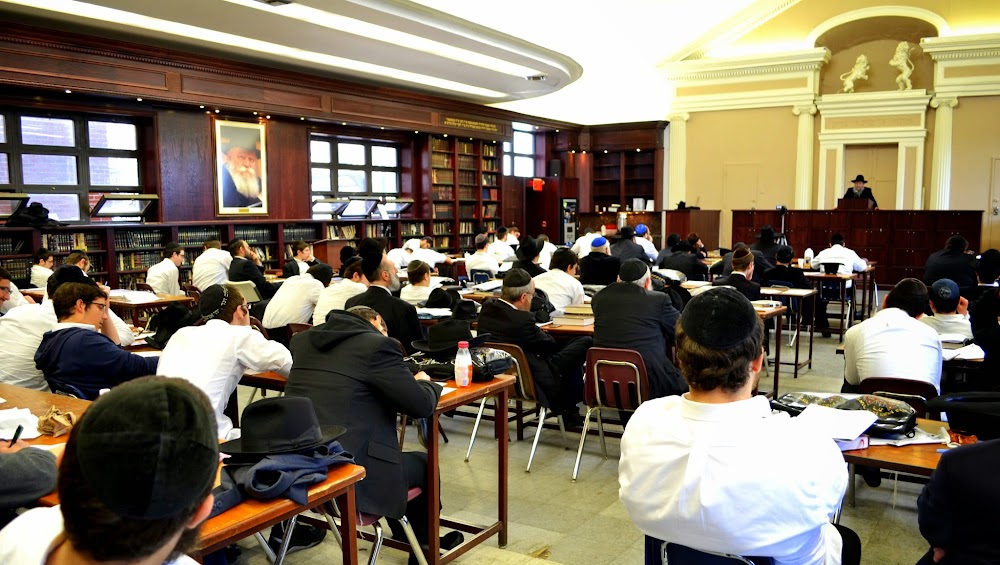
“Sharing the Burden”
Through Torah Study
Rabbi Yehoishophot Oliver
Complementary RolesThe Gemara states:[1]
Rabbi Abba bar Kahana said: Were it not for David, Yoav would not have done battle, and were it not for Yoav, David would not have engaged in Torah. As it is written, “David performed justice and righteousness for all his people, and Yoav ben Tzeruya was in charge of the army.” What does it meant that “David performed justice and righteousness for all his people?” [He was able to,] because Yoav was taking care of the army. And what is the meaning of “Yoav was in charge of the army?” So that David could perform justice and righteousness for all his people.Yoav and David HaMelech were partners who each valued the other’s contribution. David HaMelech knew that since the Jewish people had enemies, and since Torah instructs us “We do not rely on a miracle,”[2] he needed an army of soldiers led by a mighty general to lead the battles against the enemies of the Jewish people. This general was Yoav.
But David HaMelech himself did not go to war, although he was fully capable of doing so. He chose, instead, to remain behind in order to study Torah and teach it to the people.
Yet Yoav had no complaints. He knew that David HaMelech’s contribution was indispensable. “Were it not for David, Yoav would not have done battle.” He did not view David HaMelech’s choice as shirking responsibility, never mind as cowardice, G–d forbid. He knew that most fundamental principle of the Jewish faith: Success at any endeavor comes not from one’s efforts, intelligence, and strength, but from divine blessings—“it is the blessing of Hashem that gives us wealth.”[3]
Yes, accomplishment require a human investment, for Hashem created the natural order and desires that we follow its laws. But one who relies on his own power and does not combine reasonable efforts with prayers for divine assistance denies the existence of Hashem as “the One Who sustains the entire world with His goodness, grace, kindness, and compassion”[4]—as the Provider of all our needs. The Torah warns us against this: “And you may come to say in your heart that your strength and the might of your hand made you this wealth, but remember that it is Hashem, your G–d Who endows you with strength to perform deeds of valor.”[5] In particular, “war does not belong to the mighty.”[6]
So Yoav knew that in order to triumph over his foes, he needed divine blessings, and that this depends upon Torah study. But not the Torah study of the soldiers, for a soldier must focus his attention on the technicalities of warfare and cannot simultaneously analyze intricate Talmudic debates. Rather, the material efforts of the soldiers must be complemented by the spiritual efforts of the full-time Torah scholars, for “Torah protects and saves”[7]—Torah study brings protection and safety not only to those who study it, but to the Jewish people as a whole, and therefore to its protectors in particular.
Foolish Bravery
An analogy for this division of roles can be drawn from the army itself. Consider the chief general who sits calmly in his protected headquarters, poring over one classified intelligence report after another, calculating how the war ought to be fought—with what tactics, with which weapons, when to attack, how many soldiers to deploy, and countless other complex considerations. In the course of his duties, he instructs that others be dispatched to the battlefront, while he remains hard at work.
One day, his son and best friend approach him in outrage and accuse him of hypocrisy and cowardice: “How can you do this?! You send us and many others to face mortal danger, while you remain far from harm’s way in your cushy office chair, reading all day? Shame on you! As the verse puts it, ‘Will your brothers go to war while you sit here?’”[8]
Filled with guilt, the general concedes to the pressure, considering himself guilty of reprehensible double standards. He bows his head, clears away all the classified documents, closes down the headquarters, dons army fatigues and a gun, goes to the front, and fights.
Not only would no one benefit from this “sacrifice,” but it would lead to certain defeat and horrendous loss of life, may G–d save us, for both the soldiers and the civilians whom they are protecting.
So, too, on the broader, national level, in order for the army, the general, and everyone else involved in the material war effort to succeed, spiritual war efforts are necessary—devoted, full-time, G–d-fearing Torah scholars.
Spiritual Desertion
But when the Torah scholar lacks fear of Hashem and forgets what his Torah study accomplishes, he can become so captivated with awe for the heroic soldier that he desires to quit learning. He wants to let everyone know that he, too, can wield a gun, earn a medal, and perform daring feats of military prowess.
Just as one who is assigned to the front and abandons it is termed a deserter, so are Torah scholars assigned with the mission of studying Torah day and night who abandon their post, don army fatigues and a gun, and go to fight, also deserters. Since Jewish military victory depends upon the merit of Torah study, instead of benefiting the war effort, these young men jeopardize it and bring disaster upon the Jewish people, may G–d save us.
Unsung Heroism
In a sense, the Torah scholar is faced with a more difficult challenge than the soldier. Soldiers are lionized. They are given honorable mentions in the newspaper, awarded with marks of distinction, and their exploits and victories are publicly recounted and rhapsodized. They are national heroes.
But far away from the action of the battlefield, the Torah scholar sits and learns without fanfare. His efforts to protect the Jewish people (studying Torah all day is very difficult, as anyone who has done so, or attempted to do so, can testify) confer upon him no elevated status and glory; he goes unknown.
If anything, he is punished for his choice, subjected to constant insults and condemnation by his less religious brethren, who scream at him in self-righteous indignation: “Will your brothers go to war while you sit here?” And not only doesn’t his vital contribution earn him an honorable mention in the media, but the media regularly spews vitriol against the full-time Torah scholar and incites the populace to despise him, branding him a leech and a drain upon society, one who selfishly refuses to “share the burden.”
An Invisible Lifeline
There is a response to their complaint, albeit one that some don’t appreciate because they don’t want to.
The Torah is a “Torah of light”[9] in which Hashem reveals sublime, perfect teachings that illuminate our daily lives with moral clarity and direction. The Torah tells us: Look beneath the material reality.
Even the soldier himself depends upon others whose involvement is not visible. For the soldier to stand and shoot, many other army personnel and others are required to assist the war effort from the sidelines by providing food, technical know how, logistical direction, discipline, funding, and so on.
Likewise, the soldier needs spiritual help from behind the scenes in order to be alive. After all, all his training and weaponry will be of no avail if he is not alive. And the true source of life and safety is Hashem, Who grants us life through His holy Torah, which is “our life and the length of our days.”[10] So for the soldier to be alive, he must be infused with life through the life-giving studies of the Torah scholar.
______________________________
[1] Sanhedrin 49a.
[2] Toras Kohanim on Vayikra 22:32.
[3] Mishlei 10: 22.
[4] Grace After Meals liturgy.
[5] Devarim 8:17,18.
[6] Koheles 9:11.
[7] Sotah 21a.
[8] Bamidbar 32:6.
[9] Mishlei 6:23.
[10] Evening prayer liturgy.
Addendum:
See also this letter of the Rebbe posted here, which touches on the topic:
You ask why Lubavitch Chassidim do not serve in Tzahal. Obviously you are misinformed, for many do and many have attained high rank in the defense forces on active duty; and not only in the Chaplaincy, as you thought. As for those who serve in the Chaplaincy, clearly that is where they contribute most to Tzahal and the security of the country, since keeping the morale of the defense forces on the highest level is of primary importance. It would be a poor judgment on the part of Tzahal to press one who is qualified to be a Chaplain into service as a private, as it would be to force one who is qualified to be a colonel to serve as private instead.
While on this subject, let me mention a further point, though you do not refer to it explicitly, namely, the exemption of yeshivah students from military service. As you may know, this exemption was recognized and agreed to by the founder of Tzahal, the late D. Ben Gurion. It is based on the fact that a yeshivah student can accomplish more to the security of the country by continuing his Torah learning than by military duty. Anyone who is familiar with the Sedra Bechukosai and is not prejudiced can see this clearly.
~~~~~~~
Like what you read? The articles I write take a lot of time and effort. Please contact me to sponsor an article for (at least) $36 in honor of the birthday, wedding anniversary, or yarhtzeit of a loved one, or for a refuah shleimah or the like. Also, see here concerning the tremendous merit of supporting the dissemination of Chassidus, and the blessings that one receives for doing so.


