"Moshiach is ready to come now-our part is to increase in acts of goodness and kindness" -The Rebbe

Showing posts with label Divine Soul. Show all posts

Monday, March 31, 2025

Amalek: The Source of the Seven Nations

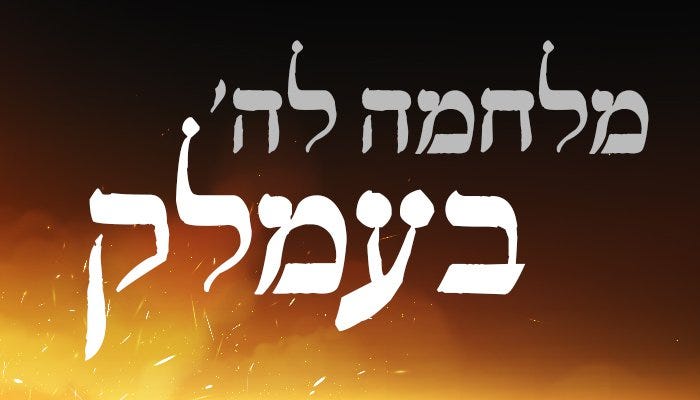
 ישיבת המקובלים נהר שלום | הרב בניהו שמואלי שליט"א - מלחמת עמלק

(Continued from here.)

Amalek’s goal in preventing Daas of holiness from influencing the emotions is for the person to then succumb to his desire to sin.

This is the meaning of the verse: “Amalek is the first of the nations.”[1]

Rashi there explains that Amalek was first in the sense that it was the first nation to attack the Jewish people after the Exodus, despite knowing about the tremendous miracles that Hashem had performed for the Jewish people.

But the deeper explanation is that the Amalek within is “the first,” the source, “of the nations,” of the Seven Nations within, of the seven negative character traits.

For, as explained, the inner Amalek blocks the Daas of the Divine Soul from arousing emotions of love and fear of Hashem.

This vacuum in the emotions automatically enables the seven negative character traits to seize control and tempt one to sin.

This is also the deeper meaning of the verse, “One who is separated seeks pleasure.”[2] By separating the emotions from the intellect, so that the person lacks fear of Hashem, he comes to “seek pleasure,” to indulge in all the forbidden pleasures.

This is the reason that the inner Amalek’s “end is to be destroyed,” for the drive to provoke the desire to sin is evil and irredeemable.

Earlier, we said that we accomplish the mitzvah to banish the Seven Nations by uprooting the desire for sin, through Teshuvah.

This obligation is directly tied to the mitzvah to eradicate Amalek, for Amalek’s objective in his chutzpah is for the person to succumb to his negative desires and fall into sin. Thus, we also eradicate the Amalek within through Teshuvah.

Erasing Amalek by Remembering Him

Another way in which we overcome the Amalek within is by fulfilling the mitzvah to remember the nation of Amalek, as it is written, “Remember what Amalek did to you.” [3]

Based on the above explanation, this remembrance entails a command to reflect upon the distinguishing trait of the nation of Amalek: An all-consuming desire to incite arrogant, insolent rebellion against the truth of Hashem. One should feel pained at the very existence of such obscene evil in the world, and in so doing, one also subdues the Amalek within.

This strengthens the person so that his meditation upon Hashem’s greatness will indeed result in love and fear of Hashem, which will in turn inspire him to observe the Mitzvos with passion and an inner sensitivity to G-dliness.

Based on the Rebbe Rashab’s Sefer Hamaamarim 5643, 5644, 5645, p. 305 ff.; Sefer Hamaamarim 5654, p. 196 ff., p. 337 ff.


[1] Bamidbar ibid.

[2] Mishlei 18:1.

[3] Devarim 25:17.

Wednesday, February 13, 2013

The Fundamental Components of Existence

The Fundamental Components of Existence:
Kedushah and Kelipah

Rabbi Yehoishophot Oliver

All physical beings draw their vitality from one of two fundamental spiritual energies: Kedushah, holiness, or Kelipah, unholiness.

Kedushah is a spiritual energy that is in a state of bittul, submission to Hashem,[1] while Kelipah is a spiritual energy in a state of yeshus, a sense of ego that arrogantly declares “I exist” and denies the absolute reality of Hashem.

Although the Kelipah typically admits that Hashem exists, and even obeys His will in practice,[2] it feels itself independent from Hashem, and so it denies that He is the only true reality.[3]

Thus, the word Kelipah literally means “shell,” for the essence of this force is that it conceals the reality of Hashem just as a peel hides the fruit within it.[4]

Within the Kelipah itself, there are two general categories:
  • The higher level of Kelipah, known as Kelipas Nogah, which constitutes a mixture of good and evil.[6] This is the source of the spiritual sustenance of all objects in the world that the Halacha (Jewish law) permits one to use.
  • The lower level of Kelipah, known by the collective title of Shalosh Kelipos HaTemei’os, literally, “The Three Impure Kelipos.” Aside from a minute spark of holiness hidden very deep down, this level constitutes total evil and selfishness, without any positive aspect. This is the source of the spiritual sustenance of all forbidden objects.
The Nefesh HoElokis, the Divine Soul, stems from Kedushah, while the Nefesh HaSichlis, the Intellectual Soul, and the Nefesh HaBehamis, the Bestial Soul, stem from Kelipas Nogah.[5]

More particularly, the Nefesh HaSichlis stems from a higher level of Kelipas Nogah, while the Nefesh HaBehamis stems from a lower level of Kelipas Nogah.[6]

Kelipas Nogah also acts as the intermediary between Sholosh Kelipos HaTemei’os and Kedushah.[7]

(For an earlier article on this topic, see here.)

____________________________________________
[1] Tanya ch. 6: “The side of holiness is nothing but the indwelling and extension of the holiness of the Holy One, blessed be He, and He dwells only upon a thing that nullifies itself to Him.”
[2] Ibid. ch. 24: “[The forces of Kelipah] are completely unable to contravene Hashem’s will, for they know and apprehend that He is their life and sustenance, since they nurture from the ‘hinder-most part’ of the blessed Supreme Will that encompasses them.”
[3] Ibid. ch. 22.
[4] Torah Ohr 61d. Sefer HaMa’amarim 5648, p. 220.
[5] Etz Chaim, Sha’ar Kelipas Nogah ch. 3. Tanya ch. 1, end; ch. 7. In some sources it is explained that the Nefesh HaSichlis and Nefesh HaBehamis are in fact one soul consisting of two components, the former being the higher component, and the latter, the lower component (Sefer Kitzurim, p. 81, cited in Tanya Betziruf Marei Mekomos, Likkutei Pirushim, Shinuyei Nuscha’os, chs. 1-28, p. 37). See also Likkutei Torah, Tetzei 37d, which states that “human intellect” comes from the Nefesh HaBehamis.
[6] Sefer HaMa’amarim 5700, p. 93.
[7] Tanya ch. 37.


This post was dedicated by ovi mori, Reb Kasriel Oliver and family in honor of the yohrtzeit of Yehudis bas Dov Ber on 3 Adar.

Like what you read? The articles I write take a lot of time and effort. Please contact me to sponsor an article for (at least) $36 in honor of the birthday, wedding anniversary, or yarhtzeit of a loved one, or for a refuah shleimah or the like. Also, see here concerning the tremendous merit of supporting the dissemination of Chassidus, and the blessings that one receives for doing so.
Thursday, February 7, 2013

Two Kinds of Intellect

Two Kinds of Intellect

Rabbi Yehoishophot Oliver

One can understand a concept in two ways:

Lowering the concept to the student: The teacher lowers the concept into terms to which the student can relate by using analogies, concrete examples, and elaborate explanations that convey the concept on the level of the recipient. This simplifies and coarsens the concept, robbing it of the abstract purity of its original state. The recipient remains unchanged in his intellectual domain; all that is expected of him is to pay attention to the lesson. When he listens, he learns new information.

Elevating the student to the concept: The student invests tremendous effort to develop, refine, and purify his faculties until he is able to grasp the concept as is, in its unadulterated state. He may also make some use of analogies and the like during the learning process, but these methods are more “transparent,” and his primary focus is on bonding with the concept itself.

This is the difference between human intellect, the intellect of the Intellectual Soul, and divine intellect, the intellect of the Divine Soul:

Human intellect seeks to bring the concept it strives to understand down into its own frame of reference, and only then is it able to accept and assimilate it. This selfish focus dilutes and coarsens the concept, leaving the mind in its original lowly state. The mind has merely learned some new information on its own terms, but it has not fundamentally changed at all. On the contrary, the more one understands, the more powerful and self-confident the mind becomes.

In contrast, divine intellect seeks to rise out of its parameters, to use intellect itself to transcend the limitations of ego, lose itself, and become subsumed within G–dliness itself.

This explains the difference between the approaches of human intellect and divine intellect to faith in Hashem:

Understanding leading to faith: Human intellect starts without faith, with its own existence as its first premise. Then, through intensive study and comprehension, it comes to accept the existence of Hashem and appreciate His greatness and unity. However, no matter how much it learns, it views Hashem and G–dliness as external subjects of study, not as all-pervasive realities to which it ought to surrender and abnegate itself.

Faith followed by understanding: Divine intellect starts with faith, a faith that stems from its fundamental G–dly makeup, which endows it with an innate sensitivity to the transcendent, absolute reality of Hashem. Then the intellect strives to not only sense this reality, but to understand it intellectually by toiling in study of Hashem’s greatness and unity as explained in Kabbalah and Chassidus. However, the goal of this cognitive process is to bond with the G–dliness whose existence this intellect naturally senses.

This also reflects itself in the emotions that emerge from these two types of intellect:

Selfish, uncooperative emotions: Since human intellect relates to everything through a selfish focus, its intellect need not be translated into commensurate emotions. For instance, one can appreciate the virtue of humility well, but be conceited and obnoxious.

Humble, pliant emotions: In contrast, since divine intellect seeks to humble itself before the Truth of Hashem, it also has a humbling effect on the emotions, making them susceptible and open to becoming aroused with the emotions that divine intellect calls for—love and fear of Hashem, love of Torah, love of one’s fellow Jew, fine character traits as taught in Torah, and so on.

Adapted from the Frierdikeh Rebbe’s Sefer HaMa’amarim 5691, p. 186.


Dedicated by avi mori Reb Kasriel Oliver (Kasriel ben Shmuel) and family in honor of the birthday of my dear sister, Bracha Tsap (Hinda Zelda Bracha bas Kasriel), on 2 Adar. May she be blessed with a sh'nas hatzlachah begashmiyus uveruchniyus!

Dedicated in the merit of a speedy release for the captives Yonasan ben Malka (Jonathan Pollard), Alan Gross (Aba Chonah ben Chava Chana), Sholom Mordechai Halevi ben Rivka (Sholom Rubashkin), and Zeva Rochel bas Chaya (Wendy Weiner Runge).


~~~~~~~~~~~~~~~~~~~~

Like what you read? The articles I write take a lot of time and effort. Please contact me to sponsor an article for (at least) $36 in honor of the birthday, wedding anniversary, or yarhtzeit of a loved one, or for a refuah shleimah or the like. Also, see here concerning the tremendous merit of supporting the dissemination of Chassidus, and the blessings that one receives for doing so.

Wednesday, December 26, 2012

Yechidah: Suprarational stubbornness

Yechidah: Suprarational stubbornness

Rabbi Y. Oliver

The Jew’s bond with Hashem at the soul-level of Yechidah transcends intellect completely, even the intellect of the Divine Soul.

The Yechidah is also known as the “eisan of the soul.”[1] The word eisan means firm, for this level is firm and unyielding to any force that might separate the Jew from Hashem, G–d forbid. Of this stubbornness to obey Hashem the Jewish people are called “a stiff-necked nation”[2] in the positive sense.[3]

In the Hoshanos liturgy,[4] it is written: “It embraces and is attached to You, it carries Your yoke, the Yechidah to unite You.” This alludes to the qualities of the soul-level of Yechidah:

  • “It embraces and is attached to You”: The core of every Jew, no matter who he may be, is connected to Hashem’s very Essence. This expresses itself in the Jewish custom to constantly thank and otherwise refer to Hashem, such as by saying “boruch Hashem.”[5]
  • “It carries Your yoke”: Regardless of his external behavior, the Jew’s Yechidah naturally submits to and “carries” the yoke of observance of Torah and Mitzvos.
  • “The Yechidah to unite with You”: On this level, the bond with Hashem is so deep that the Jew is even willing to give up his life rather than sin.[6] Of this the Alter Rebbe taught: “A Jew neither desires, nor is able, to sever himself from G–dliness.”[7] 
(For one way to reveal the Yechidah, see here.)

Based on the Previous Rebbe’s Ma’amar Hachodesh hazeh lachem 5685, pp. 16-17.

________________________________
[1] Sefer HaMa’amarim 5703, p. 73 ff. Igros Kodesh Admur HaRayatz, Vol. 3, p. 335.
[2] Shemos 34:9.
[3] Shemos Rabbah 42:9, cited in Torah Ohr, Megillas Esther 123b.
[4] As recited on the third day of Sukkos.
[5] “Shem Shomayim shagur befi kol.” Cf. Ma’amarei Admur HaZaken 5565, Vol. 1, p. 12. Sha’arei Teshuvah, Vol. 1 8b.
[6] Tanya chs. 18, 19, 24.
[7] Hayom Yom p. 73.


Dedicated by Reb Shmuel Leib and Sara Rochel Markel in honor of the birth of their daughter, Yehudis bas Shmuel Leib. Yegadluha leTorah, lechuppah, ulemaasim tovim mitoch harchavah!


Dedicated in the merit of a speedy release for the captives Yonasan ben Malka (Jonathan Pollard), Jacob Ostreicher (Yaakov Yehuda ben Shaindel), Alan Gross (Aba Chonah ben Hava Chana), Sholom Mordechai Halevi ben Rivka (Sholom Rubashkin), and Zeva Rochel bas Chaya (Wendy Weiner Runge).

~~~~~~~~~~~~~~~~~~~~
Like what you read? The articles I write take a lot of time and effort. Please contact me to sponsor an article for (at least) $36 in honor of the birthday, wedding anniversary, or yarhtzeit of a loved one, or for a refuah shleimah or the like. Also, see here concerning the tremendous merit of supporting the dissemination of Chassidus, and the blessings that one receives for doing so.

Saturday, December 22, 2012

The Intellectual Soul (pt. 3): The Boost from the Divine Soul

The Intellectual Soul (pt. 3)
The Boost from the Divine Soul

Rabbi Yehoishophot Oliver

(Continued from The Intellectual Soul, pt. 1 and The Intellectual Soul, pt. 2.)

But if so, how is the Intellectual Soul of a Jew any better? It too consists of worldly, human intellect; by what virtue does it also “sense spiritual refinement”?

Rather, the Jew’s Intellectual Soul itself is not inherently different from the non-Jew’s. However, since the Jew possesses the Divine Soul (a.k.a., Nefesh HoElokis) that transcends the world completely, and the Nefesh HoElokis becomes vested within the Nefesh HoElokis, this proximity subdues the Nefesh HoElokis’ natural sense of ego and enables it to “sense spiritual refinement” in a way that makes it possible for the Jew to attain true objectivity in intellectual judgments, and thus fully fulfill the potential of the Intellectual Soul. It emerges that the verse, “The spirit ... of man rises upwards” refers primarily to the Jew’s Intellectual Soul.

Perhaps this is comparable to the difference between two people of equal intelligence. One constantly keeps the company of a very spiritual, inspired, and sagely rabbi, while the other keeps no such company, and so he is left to live a life focused on materialism. All things being equal, the former will be much more spiritually inclined than the other.

This explains the double expression in the Mishnah cited above: “Beloved is man ... it is by special divine love ... ”

The first phrase refers to the Intellectual Soul within all mankind, while the second phrase refers to the Intellectual Soul within the Jewish people. “Beloved is man ... ” tells us that the non-Jew is beloved to Hashem because of his Intellectual Soul. In contrast, “it is by special divine love that he is informed that he was created in the image of G–d” tells us that a Jew is beloved to Hashem because of his Divine Soul. Because of this belovedness, Hashem also gives the Jew an Intellectual Soul.

The Jew’s responsibility to elevate the nations

This is also the reason that Torah instructs, and even obligates the Jew to influence non-Jews positively by teaching them the Noahide laws, as the Rambam rules explicitly: “Moshe was commanded via a direct divine revelation [to tell the Jewish people] to compel all the world’s inhabitants to undertake the laws commanded to Noah’s descendants.”[1] The Tosafos Yom Tov explains[2] that the expression “compel” also includes the imperative to use verbal persuasion, to explain to someone resistant the necessity to adhere to the Noahide laws. Of course, [3] at the same time one should be careful to influence non-Jews in a pleasant, peaceful manner, for it is written of the Torah, “Its ways are ways of pleasantness, and all its paths are peace.”[4]

Why was the Jew in particular assigned with this mission? Because provided that the Jew is refined and G–d-fearing, his more sensitive Intellectual Soul enables him to serve as a true guide for the non-Jew, elevating him above the limitation of his Intellectual Soul, and bringing him to relate to the world, and to the moral choices he is constantly called upon to render, in a manner that is truly objective, and therefore truly correct and truly ethical.


Based on the Rebbe's Likkutei Sichos, Vol. 15, pp. 58 ff.

________________________________
[1] Mishneh Torah, Laws of Kings, 8:10.
[2] Tosafos Yom Tov, Avos 3:14.
[3] Hisva’aduyos 5747, Vol. 1, p. 82.
[4] Mishlei 3:17.


This article was dedicated by Moshe Maaravi and family as a merit for the refuah sheleimah of Yehoshua ben Sheva.


Dedicated in the merit of a speedy release for the captives Yonasan ben Malka (Jonathan Pollard), Jacob Ostreicher (Yaakov Yehuda ben Shaindel), Alan Gross (Aba Chonah ben Hava Chana), Sholom Mordechai Halevi ben Rivka (Sholom Rubashkin), and Zeva Rochel bas Chaya (Wendy Weiner Runge).

Like what you read? The articles I write take a lot of time and effort. Please contact me to sponsor an article for (at least) $36 in honor of the birthday, wedding anniversary, or yarhtzeit of a loved one, or for a refuah shleimah or the like. Also, see here concerning the tremendous merit of supporting the dissemination of Chassidus, and the blessings that one receives for doing so.

Wednesday, July 18, 2012

Emotional transformation: The main goal of inner change

Emotional transformation:
The main goal of inner change

Rabbi Yehoishophot Oliver

Hashem exhorted the Jewish people, “Make for Me a Mishkan, and I will dwell in their midst.”[1] Chassidus quotes earlier sources[2] that explain that the reason that it doesn’t say “I will dwell in its midst” is to allude to Hashem’s desire to dwell “in their midst”—that every Jew make a Mishkan for the Shechinah, the divine presence, within his or her inner self. Thus, all the details of the Mishkan provide a lesson for us in our divine service, alluding to the correct approach to revealing the Shechinah within.

The Torah relates[3] that Betzalel decided to make the Mishkan first, and then the keilim, the vessels to be used there. This represents the two stages of within: The external structure of the Mishkan—intellect and the keilim—emotions.

To digress, as is known, the Nefesh HoElokis, also known as the Neshamah—the extra Divine Soul unique to the Jewish people—is called adam, man.[4] Sometimes Chassidus explains that this alludes to the relationship between the intellect and the emotions in this soul. Just as in a human, the brain is above the heart because the intellect is (or ought to be) controlling the emotions, so, too, in the Neshamah, the intellect dominates over and dictates the emotions of this soul. This is in contradistinction to the Bestial Soul, where the emotions dominate over and dictate the intellect.

At first glance, one might deduce from this that in the Nefesh HoElokis, the emotions are somehow of secondary importance. However, this is incorrect. The above merely describes how the emotions of the Nefesh HoElokis are to be evoked—via intellect. But in terms of their relative value, especially when considering how we should approach our service of Hashem, to the contrary—inspiring the emotions of the Nefesh HoElokis is the main thing, and the intellect is merely the means to that end, albeit a stage that is an essential prerequisite to emotions.

This is another interpretation of the fact that the Nefesh HoElokis is called adam, “man.” Adam has the numerical value of 45, which corresponds to the divine name of Mah, which refers to the emotions of the heart.[5] This means that the Nefesh HoElokis is called adam primarily because of its emotions. It follows that only when the emotions of the Nefesh HoElokis are manifest is the Nefesh HoElokis truly revealed within the Jew, and he is truly called adam.

Back to the lesson from Betzalel’s preferred order in constructing the Mishkan.

The Mishkan was, of course, a kind of edifice. Now, an edifice benefits the person by providing shelter and the like, but encompasses the person and does not relate to those within it on an individual level. This represents the concept of an ohr makif—a kind of influence that affects the person to a certain degree, but remains superficial, and does not permeate that person’s inner self.

In contrast, the keilim, each of which is designed to hold certain contents in a measured fashion, represent the concept of an ohr pnimi—a kind of influence that is measured to fit the level of the recipient, and therefore permeates and transforms that person’s inner self.

This may seem odd to some. Chassidus typically describes intellect as an ohr pnimi, for a teacher must deliver his or her teaching to the student in a way that the student can comprehend. Yet in the context of changing one’s inner self, intellect is described as an ohr makif, while emotions are called an ohr pnimi.

The reason is that although one typically identifies both by one’s intellect and emotions, of the two, emotions cut to the core of identity. We are defined by what we feel far more than by what we understand.

For instance, when a person understands intellectually that a certain course of action is wrong, but his emotions are excited by it and attracted to it nonetheless, we would correctly define this person by his desires and not by his abstract understanding. Moreover, emotions are the key to thought, speech, and action, so only through reaching suitable emotions can one come to proper behavior.

This is the deeper meaning of the verse, “Know today, and take to heart, that Havayeh is Elokim.”[6] First and foremost, “know today”—study about Hashem’s greatness until you reach hispa’alus sichlis—intellectual excitement. This reveals the Neshamah’s intellect.

But don’t suffice with “know today.” Go further: “Take to heart”—take the excitement at what you studied from the realm of abstract theory down into the emotions, to hispa’alus shebelev—excitement of the heart. Bring the heart to become passionate with whatever emotion ought to emerge from the concept that you learnt, whether love of Hashem, fear of Hashem, or the like.

So Betzalel made the Mishkan first, to represent the first stage (in this context)—“know today,” and then he fashioned the keilim, to represent the next stage, the goal of divine service—“take to heart.”

Then one may merit a personal fulfillment of the next phrase: “Havayeh is Elokim.” This means that then the most sublime aspect of the Shechinah becomes revealed in one’s innermost self, and this constitutes the ultimate fulfillment of “I will dwell in their midst.”

To be continued. Next, G–d willing, I need to explain the meaning of the inner revelation of “Havayeh is Elokim in the heart.

Adapted from Ma’amarei Admur HaEmtza’i, Shemos, Vol. 3, p. 671 ff.


______________________________________
[1] Shemos 25:8.
[2] Shelah, Terumah 325b.
[3] Vayikra 35:30.
[4] Cf. Bava Metzia 114b. See Ma’amarei Admur HaZaken 5466, Vol. 2, p. 460.
[5] Etz Chaim, Sha’ar HaTikkun, ch. 3. Ma’amarei Admur HaZaken, Parshiyos HaTorah, Vol. 2, p. 567.
[6] Devarim 4:39.

Dedicated by Rabbi Levi Kurinski (
Levi Yitzchok Halevi ben Chana Brocha) and family in honor of his birthday on Rosh Chodesh Menachem Av.


~~~~~~~~~~~~~~~~
Like what you read? The articles I write take a lot of time and effort. Please contact me to sponsor an article for (at least) $36 in honor of the birthday, wedding anniversary, or yarhtzeit of a loved one, or for a refuah shleimah or the like. Also, see here concerning the tremendous merit of supporting the dissemination of Chassidus, and the blessings that one receives for doing so.

Sunday, February 12, 2012

Conversion and Birth

Conversion and Birth

Rabbi Yehoishophot Oliver

Our Sages say: “A convert is like a newborn child.”[1] At first glance, this analogy comes to describe the utter transformation that the convert undergoes upon conversion. He becomes a new being, like a newly born child.

However, if this is the purpose of the comparison, it seems lacking. After all, even a newborn child exists before its birth—and fully formed, with all its organs in place. All that occurs at birth is that the child’s hidden existence becomes manifest, and it functions (albeit only on the basic level) independently in the outside world. Why isn’t conversion described with another analogy, one that truly implies a complete metamorphosis?

The answer: Indeed, the process of conversion is directly comparable to physical birth, for the convert’s special Jewish Neshamah existed even before conversion, just as a baby exists before birth. 

In fact, just as the Neshamos of all unborn Jews were present when the Torah was given, so were the Neshamos of converts.[2] This is comparable to the way that an unborn child is taught the entire Torah,[3] just as the entire Torah was given to every single Jew at Sinai.

However, although the convert’s Neshamah exists, it is hidden, like an embryo in the womb, and it has no impact on “the outside world”—our physical world. But when the conversion occurs, the convert’s Neshamah is “born”—it emerges and begins to exert its impact upon the outside world.

Thus, we find that our Sages refer to a convert using the apparently odd phrase, “ger shenisgayeir—a convert who converts.” Shouldn’t it refer to “goy shenisgayeir—a non-Jew who converts,” along the lines of the standard Talmudic expression, “katan shehigdil—a minor who becomes an adult”?

Rather, ger shenisgayeir alludes to the spark of a holy Jewish soul that lay hidden within the convert even before conversion.[4] 

Moreover, this Jewish soul existed in the non-Jew from his physical birth.

To explain, the Talmud says, “The son of David [Moshiach] will not come until all the souls in a body have been exhausted.”[5] This means that Moshiach’s coming depends upon a certain number of Jewish people being born. But if it is talking about the souls descending into bodies, why is the singular word “guf/body” used?

Rashi there explains that every Neshamah that will ever be placed in a Jew awaits in a heavenly storehouse called “Guf.” 

It is quoted in the name of Rabbi Yehuda HaChassid[6] that the angel appointed over birth takes the Neshamah from that storehouse and implants it inside the embryo in the mother’s womb.

However, sometimes the angel puts a Jewish Neshamah in the embryo of the womb of a non-Jewish mother, and that child ends up becoming a convert.

In conclusion, conversion doesn’t create something new; it reveals what was always meant to be.

Based on the RebbeHisva’aduyos 5743, vol. 2, p. 925. Likutei Sichos, vol. 38, pp. 44-45, fn. 41*.

__________________________
[1] Yevamos 62b.
[2] Pirkei DeRebbi Elazar ch. 41.
[3] Niddah 30b.
[4] Chida, Midbar Kedeimos, Maareches Gimmel, Ois Gimmel.
[5] Yevamos 62a.
[6] Teshuvos Baalei HaTosafos, p. 286, sec. 19, quoting Rabbi Meir of Rotenburg, in the name of Rabbi Yehuda HaChassid.


This post is dedicated to all the righteous converts; may they be blessed begashmiyus and beruchniyus!


~~~~~~~~~~

Like what you read? The articles I write take a lot of time and effort. Please contact me to sponsor an article for (at least) $36 in honor of the birthday, wedding anniversary, or yarhtzeit of a loved one, or for a refuah sheleimah or the like. Also, see here concerning the tremendous merit of supporting the dissemination of Chassidus, and the blessings that one receives for doing so.

Thursday, December 29, 2011

On the Greeks' demand that the Jews write heresy


(See my article concerning Hei Teves here.)

(This post comes in continuation to the posts here and here.)

This also sheds light on the Greeks’ demand of the Jewish people: “Write for yourselves on the horn of an ox that you have no portion in the G–d of Israel.”[1] Here, too, in the case of the Greeks’ agenda to force the Jewish people to write words of heresy, we see how their oppression of the Jewish people was primarily spiritual.

But what is the significance of “the horn of an ox,” and what led the Greeks, who were highly intelligent, to think that this act of coercion would somehow influence the Jews to give up their connection with the holiness of Torah and Mitzvos, G–d forbid?

The answer is related to the different supernal origins of the Jewish people and the nations.[2] There are four “faces” in the supernal divine chariot,[3] and the souls of the gentile nations stem from the level known as “the face of an ox.” More precisely, their souls are derived from the “horn” of this supernal ox. Just as a horn is considered secondary to the animal itself,[4] so does the horn represent the lower, external level of G–dliness from which the souls of the gentile nations (and the entire natural order, for that matter) are derived, which is related to the divine name of Elokim, which represents nature.[5]

In contrast, the souls of the Jewish people are derived from a transcendent or “internal” level of G–dliness, the name of Havayeh, as it is written, “For his nation remained the portion of Havayeh.”[6] This is alluded to in the verse, “And He [Hashem] blew into his [Adam’s] nose a soul of life.”[7] Vigorous blowing represents expending one’s inner strength.[8]

This is why the Greeks specifically wanted the Jewish people to write this statement on the horn of an ox. They wanted the Jews to degrade themselves to receive their sustenance from the same external[9] level of G–dliness from which the gentile nations derive their sustenance, the Name of Elokim, and in so doing they would forfeit their special bond with Hashem and his Torah and Mitzvos, which would lead them to assimilate with the non-Jews, G–d forbid.

Based on Sefer HaMa’amarim 5729, p. 86 ff. To be continued...

_______________________________________________________
[1] Bereshis Rabba 2:9.
[2] Torah Ohr, Vayeshev 30a. Ohr HaTorah, Chanukah 300a ff.
[3] Discussed in Yechezkel 1:1-3:27. Obviously, there is no physical chariot or ox in the higher spiritual realms, and these are anthropomorphisms, as is common in the Kabbalistic teachings.
[4] Chullin 117b.
[5] Cf. Tanya, Igeres HaTeshuvah ch. 4.
[6] Devarim 32:9.
[7] Bereshis 2:7. Since, as Kabbalah teaches, Adam possessed a Jewish soul, this verse sheds light on the nature of the Jew’s special soul.
[8] Tanya, beg. ch. 2.
[9] Likewise, the Greeks sought to influence the Jews to engage in secular studies, known as “chochmos chitzoniyus,” lit., “external wisdoms.”


This post was dedicated by Yerachmiel “Mitch” Belzer and family, as a merit for Malkah bas Neyereh. Also dedicated by Rabbi Shmuli Markel and family (Shmuel Leib ben Esther and Sara Rochel bas Chayah Nechomoh).

________________________
Like what you read? The articles I write take a lot of time and effort. Please contact me to sponsor an article for (at least) $36 in honor of the birthday, wedding anniversary, or yarhtzeitof a loved one, or for a refuah shleimah or the like. Also, see here concerning the tremendous merit of supporting the dissemination of Chassidus, and the blessings that one receives for doing so.

Thursday, November 17, 2011

The Neshamah: The Jew’s True Inner Self

The Neshamah: The Jew’s True Inner Self

Rabbi Yehoishophot Oliver


The Rambam discusses[1] a case of a husband who refuses to grant his wife a get when the beis din (Jewish court) requires it. Although our sages do not usually follow such an approach, in this extreme case, for the wife’s sake, they require that the husband be forced—even, if necessary, by the use of physical force—to release his wife from marriage by issuing her a get.

But, the Rambam asks, how can such a get be valid? Isn’t this a get me’useh, a get given under duress, which is invalid? The Rambam explains that Torah only recognizes an act as coercion when one was coerced into doing an act that Torah doesn’t require. However, if one was coerced to fulfill a Torah requirement, he is considered to have done so of his own volition. For since he is a Jew, his true desire is to perform the Mitzvos. In the Rambam’s words:
... He wants to be a Jew; he wants to perform all the mitzvos and distance himself from transgressions, and [the] only [reason that he acts to the contrary is that] his evil inclination has overpowered him. So once he is beaten to the extent that his evil inclination has become weakened, and he says I want [to divorce], he has surely divorced of his own volition.
In the language of Chassidus, when the husband refuses to obey the beis din, he is being consumed by his Bestial Soul (the term more commonly used in this literature to refer to the Evil Inclination). But his true inner self is his Neshamah, his Divine Soul. When pressure is applied upon the Bestial Soul, it stops obstructing the will of the Neshamah, and the divorce is considered to have been issued voluntarily, for the Neshamah wants to obey the beis din.

In other words, although the Bestial Soul is very much a part of the person—in fact, for most of us, it is our conscious self[2]—Torah views it as external and additional; it is not the Jew’s true, inner self. His true self is his Neshamah

The Neshamah possesses a natural love for Hashem that spurs an intense desire to connect with Him, and a natural awe of Hashem that makes him recoil from sin and want to keep a distance from it,[3] even to the point of being willing to give up his life rather than sin.[4] Concerning this, the Alter Rebbe declared: “A Jew neither desires, nor is able, to sever himself from G–dliness.”[5] 

This awareness can also encourage the Jew in his performing the Mitzvah of Teshuvah, of repenting for sin.[6] Since the Jew’s true, inner desire is to serve Hashem, as soon as he sins, he regrets, feels pained, and worries over it. I.e., deep down, he does Teshuvah immediately. I.e., the Jew’s connection with his true, inner self is even more emphasized with regard to Teshuvah than other Mitzvos, for the Jew’s Neshamah not only desires to keep all the Mitzvos, but it actually does Teshuvah as soon as he sins, and so in order to do Teshuvah all the Jew need do is reveal his inner Teshuvah to his external, conscious self.

(For an earlier post on this topic, see here.)
____________________________________

[1] Mishneh Torah, Laws of Divorceend ch. 2.
[2] Cf. Tanya ch. 29: “היא היא האדם עצמו.”
[3] Ibid. chs. 141925.
[4] Ibid. chs. 181924.
[5] Hayom Yom p. 73.
[6] Sefer HaMa’amarim Melukat, Vol. 5, p. 56


This post has been dedicated by Rabbi Dov and Shevi Oliver of Monsey in honor of the yahrtzeit of Rephoel Dovid ben Kasriel, ע"ה, on 13 Tishrei.

Like what you read? The articles I write take a lot of time and effort. Please contact me to sponsor an article for $36 in honor of the birthday, wedding anniversary, or yarhtzeit of a loved one, or for a refuah shleimah or the like. Also, see here concerning the tremendous merit of supporting the dissemination of Chassidus, and the blessings that one receives for doing so.

Sunday, July 10, 2011

A Jew? Sin?! Unthinkable!

A Jew? Sin?! Unthinkable!

Rabbi Y. Oliver


The Zohar[1] says that the verse, “Nefesh ki secheta”—“When a Jew sins,”[2] should be read as an expression of incredulity: “How could a Jew sin?!”

Just a second. What does this mean? Unfortunately, the reality is that almost everyone—even those who sincerely strive to do the right thing both in their relationship with Hashem and with other people, do slip here and there and sin, and in both of these relationships. And then there are “sins that a person tramples with his feet”[3]—behaviors commonly regarded as “not so terrible,” which are prevalent even among those who are otherwise observant. These include bittul Torah (neglect of Torah study), lashon hora (gossip), indulgence in permitted pleasures, and so on.[4] So how do we understand the Zohar’s shock?

The Hebrew word for world, olam, is etymologically related to the word he’elem, concealment, for the world conceals the true reality of Hashem. In our world, where Hashem’s presence is the most hidden, the world also conceals the spiritual processes that underlie the physical world around us. Thus, when we only consider things from a coarse, physical perspective, we are bound to reach incorrect interpretations and conclusions.

However, Hashem reveals His all-perfect, all-knowing wisdom to us in the Torah, and so gives us the inside scoop on deeper spiritual realities. Through Torah, the Jew is privy to the true perspective on everything in the world around us, while everyone else is confused, or interpreting worldly phenomena in a way exactly contrary to their true nature.

Similarly, when we approach a Jew, we should look to the Torah, and especially its inner dimension, to reveal to us a Jew’s true nature. By nature, not only does a Jew not sin, but the very thought of sin comes as a total shock. What? A Jew? Sin?? It makes no sense!

Rather, the sin is something superimposed, that comes due to the influences of the Jew’s non-Jewish environment; it is not his or her true inner core and identity. Thus, “Even while [the Jew] sins, his soul is still faithful to Hashem.”[5]

This is also the deeper meaning of the Previous Rebbe’s teaching: “Just as a Jew should know the shortcomings, so should he know his own strengths.”[6] One should know the shortcomings in order to correct them, and the strengths in order to be able to utilize them to perform to the utmost in one’s service of Hashem.

The Rebbe[7] points out the apparent inconsistency of the Previous Rebbe’s choice of words. When speaking of shortcomings, the Previous Rebbe said “the shortcomings,” without identifying the possessor of those shortcomings, while in reference to the strengths, he explains, “one’s own strengths.” The Rebbe interprets that the Previous Rebbe meant to make a statement about the fundamental identity of a Jew. Since a Jew’s virtues are true to the wishes of his Neshamah, they can be truly attributed to him; in contrast, when he sins and falls short, these are not his sins; rather, they are sins that attached themselves to him from without.

So when a Jew sins, he goes totally against his nature.

Let’s explain this more deeply. The Neshamah of a Jew consists of five levels (see here). The lowest is the level of Nefesh, which becomes vested in his body and sustains the Jew’s thought, speech, and action in Torah and Mitzvos.

Now, the Hebrew for “when a Jew sins” is “nefesh ki secheta”—literally, “when a Nefesh sins.” So Chassidus interprets the Zohar’s shock to mean that for a Jew, sin is totally unthinkable not only for the essence of the soul, but also for the four higher levels of the external manifestations of the soul—Ruach, Neshamah, Chayah, and Yechidah. Even for the lowest level, Nefesh—which is technically able to take part in a sin through the influence of the Bestial Soul—although sin is not unthinkable, it comes as a total shock![8]

When a Jew realizes that his sins do not define his true self; rather, they are an external force that somehow became stuck to him, this knowledge helps him keep his spirits up despite his low state. At the same time, it empowers him with the confidence that no matter what he did wrong, he can fix it. He is then motivated to do everything in his power to rectify his sins through sincere Teshuvah, and then Hashem will forgive and favor him as if he had never sinned.[9]

________________________________________
[1] Zohar 3:13b, beg.
[2] Vayikra 4:1.
[3] Avoda Zara 18a.
[4] Tanya ch. 30.
[5] ibid. ch. 24, end.
[6] Likkutei Dibburim, Vol. 4, p. 581.
[7] Hisva’aduyos 5742, Vol. 1, pp. 53-54.
[8] Sefer HaMaamarim, Basi Legani, Vol. 1, p. 46.
[9] Mishneh Torah, Laws of Teshuvah, 7:4.


This post has been dedicated by Rabbi Shimon Cowen and family lizchus Zalman HaKohen ben Sarah, in the zchus of R' Dovid Fishel ben Rochel for a refuah shleima u'krova, and by Menachem Kovacs in honor of the Yahrzeit of his father, Eliezer ben Shalom ע"ה, on 17 Sivan.


Like what you read? The articles I write take a lot of time and effort. Please contact me to sponsor an article for $36 in honor of the birthday, wedding anniversary, or yarhtzeit of a loved one, or for a refuah shleimah or the like. Also, see here concerning the tremendous merit of supporting the dissemination of Chassidus, and the blessings that one receives for doing so.

Thursday, October 21, 2010

Levels of the Neshamah

Every morning, Hashem wants us to remind ourselves about the special Neshamah that we have—about its origin, composite levels, and current state.

In the beginning of the Morning Liturgy we recite: “My G–d, the soul that You implanted within me—it is pure. You created it, You formed it, You blew it into me.” Chassidus explains that this prayer alludes to the various levels of the Neshamah.


The Neshamah may be divided into two general parts (for a somewhat more detailed explanation of these levels of the soul, see here).


The lower part of the soul descends into the body and becomes vested in it; this comprises the levels of Nefesh, Ruach, and Neshamah (referred to henceforth by the acronym naran). This level is alluded to in the above phrase, “You created it”—referring to Neshamah; “You formed it”—referring to Ruach; “You blew it into me”—referring to Nefesh.


Then there is the higher part of the soul that does not enter the body, but remains in the sublime spiritual realms. This comprises the levels of Chayah and Yechidah (referred to henceforth by the acronym chai). This level is alluded to in the phrase, “My G–d, the soul that You implanted within me—it is pure.”


This is related the distinction between the spiritual world of Atzilus and the three spiritual worlds below it—Beriah, Yetzirah, and Asiyah (referred to henceforth as B’ya).


Atzilus is a world of pure and untainted G–dliness, of which it is written, “Evil does not reside with You” (Tehillim 5:5). This is a world that submits totally to Hashem’s infinite light. This complete nullification of self is referred to as bittul bimetzius, “[total] nullification of selfhood.”


In contrast, the worlds of B’ya contain a spiritual energy that is fundamentally different from that found in the world of Atzilus, for these worlds have an independent sense of self, called yesh. Although they submit to Hashem, their submission is partial. Even as they submit, they maintain their sense of selfhood. This type of self-nullification is referred to as bittul ha’yesh, “nullification of ego [that maintains its ego nonetheless].”


As mentioned, “It is pure” refers to the level of chai. The reason for this is that the levels of chai remain in the world of Atzilus, and, as mentioned, Atzilus is a world of pure G–dliness.


Naran, however, descends into the lower worlds of B’ya, and ultimately into the physical world and the body, and thereby undergoes a tremendous spiritual descent. Thus, Chassidus explains that “You created it” refers to the soul’s descent into the world of Beriah; “You formed it” refers to the soul’s descent into the world of Yetzirah; and “You blew it into me” refers to the soul’s descent into the world of Asiyah.


There are two stages to this descent.


1. Naran’s very descent into the body changes its perspective radically.


When naran resided in Heaven, it basked in an intense divine light, and thus sensed G–dliness as an immediate, tangible reality, while it regarded the physical world as an abstract, novel concept.


However, once naran descended and became vested in a physical body, its attitude was reversed: Once in a body, naran naturally regards the world around it as the obvious and undeniable reality, and G–dliness as a distant, abstract concept. This also means that there is a certain sensitivity to and awareness of G–dliness that no matter how hard one tries, as long as naran remains in a body, it can never attain.


2. Then naran undergoes an even further descent through becoming vested in the Bestial Soul, which creates obstacles to the expression of naran, seeking to prevent it from grasping even the limited level of G–dliness that it can grasp in a physical world.

Thursday, July 22, 2010

An essential yearning


The levels of the Divine Soul

By way of preface, there are five levels of the Divine Soul. Below they are listed in ascending order of magnitude:
·       Nefesh: the part of the soul vested within the soul’s expression to the outside world through thought, speech, and action
·       Ruach: emotions of love and awe of Hashem, and so on
·       Neshamah: intellectual appreciation of Hashem
·       Chayah: faith
·       Yechidah: the soul’s very essence

Yechidah: An essential, suprarational bond

Chassidus refers to the Jewish soul, the Neshamah, as the Nefesh Ha’Elokis, the Divine Soul. Although this term encompasses all the above levels of this soul, since Hashem is beyond intellect, when the expression “divine” is used in reference to the soul, this denotes the level within the soul that is truly beyond intellect—the level of Yechidah.
Although we may not sense it, the Nefesh Elokis, or Divine Soul, of every Jew possesses an intense yearning to transcend its existence within the body and become subsumed within the Essence of Hashem. This desire is not precipitated by any external stimulus; rather, it is an innate urge that stems from the soul-level of Yechidah, which yearns to become subsumed in its source. (This is in contrast to the soul-level of Chayah, whose desire to surrender to Hashem does stem from an external stimulus.)
In the Jew’s normal day-to-day functioning, the Yechidah (along with the level of Chayah) is usually not manifest; rather, it is primarily the lower three faculties of NefeshRuach, and Neshamah that are externally dominant. Nevertheless, in reality the Yechidah is the most important level of the soul. Thus, the soul’s other, lower faculties are secondary and subordinate to the level of Yechidah.

A natural yearning of all the soul-levels

In fact, the natural yearning for G–d characteristic of the soul-level of Yechidah is present in all the levels of the Jewish soul. Now on a conscious level, when we employ the soul’s faculties, we are surely not in a state of yearning and self-transcendence; on the contrary, using the faculties involves a certain sense of self (albeit a very refined one, as is characteristic of the Divine Soul). 
Yet this is only at the external level of each of the soul’s faculties. However, at the core of each soul-level, it yearns to become subsumed in G–d’s very Essence. Concerning this the Alter Rebbe writes in Tanya 24b: “... the [level of] Neshamah of man, as do the levels of Ruach and Nefesh, naturally desires and craves to become detached and to depart from the body and connect with its root and source in Hashem, the Source of all Life, blessed be He.”) This is the reason that Chassidus refers to the entire soul, on all its levels, as the Divine Soul.

Superior sensitivity

This is also the reason that when a Jew learns explanations of G–d’s unity and greatness—especially as explained according to Torah, in the teachings of Kabbalah and Chassidus—he is able to grasp them well and enjoy them thoroughly, and then, when he meditates upon them, he can arouse deeply-felt emotions of love and awe of Hashem.
Hence, for a Jew, the process of learning about G–d’s unity and greatness is different from the way in which he assimilates a secular concept, lehavdil. It is not merely a technical matter of learning, understanding, and arousing emotions. Rather, since the mind and heart of the Jew’s Divine Soul naturally yearn for G–dliness, they are inbuilt with a heightened receptiveness to G–dliness that is not possible to attain through natural, human intellect and emotions alone. This enables the Jew to reach lofty heights of intellectual comprehension and emotional inspiration inaccessible to non-Jews.

Based on Sefer HaMa’amarim 5670, p. 149.

Thursday, July 15, 2010

Understanding the conflicting sides within

The Torah says that our lives are a constant inner struggle, and Chassidus teaches that in order to succeed, we need to thoroughly understand the parties to that struggle. 


In pre-Chassidic terminology, these parties are traditionally known as the Evil Inclination and the Good Inclination. However, Chassidus often also refers to these respective forces as the Nefesh Ha’Behamis, the Animal Soul, and the Nefesh Ha’Elokis, the Divine Soul. If in fact these terms are synonymous, why are additional terms needed?


The answer is that Chassidus, devoted as it is to explaining the inner workings of the soul, seeks to be more precise by adding additional terms in order to refer to different subparts of the same general soul entity. These subparts are the complementary intellectual and emotional elements of the respective souls:


Divine Soul: This refers specifically to the aspect of intellect that has a natural affinity for grasping G–dliness.


Good Inclination: This refers to this soul’s emotions, which consist primarily of love and awe of Hashem.


Animal Soul: This refers to the intellect of the Evil Inclination, which naturally grasps the pleasure of selfish instincts and lusts, and provides the person with the knowhow to satisfy these instincts. In this respect its intellect is animal-like, for an animal too uses its intellect to secure its survival, as it is written, “The ox knows its master, and the mule, its feeding trough” [Yeshaya 1:3]. Similarly, the animalistic intellect grasps the pleasure of selfish instincts and lusts, and provides the person with clever schemes in his quest to indulge in his lusts and commit sins and crime. Concerning this it is said, “They are shrewd to do evil” [Yirmiyahu 4:22].


Evil Inclination: This refers to this soul’s emotions, such as the desire for the physical, the fear of bodily harm, and the like. In the animal soul, the emotions are primary.


Although both souls contain intellect and emotions, they differ in terms of which of the two soul-powers is primary:


The Divine Soul is compared to a human, in which the intellect dominates (or at least ought to dominate) over the emotions. Thus, in the Divine Soul, the intellect is dominant and primary, while the emotions are subordinate to the intellect, and thus secondary.


In contrast, the Animal Soul is likened to an animal (hence the name), whose intellect is entirely subordinate to its instincts and emotions. Thus, just as an animal may be very intelligent, such as a fox, the most clever of the animals, its intellect can only be used to satiate its desires and instincts. Likewise, no matter how highly the intellect of the Animal Soul may be developed, it will use that force as a tool to pursue self-interest, and it will never be able to attain true impartiality and objectivity.


Torah Ohr, 38b.

Monday, May 4, 2009

Birthday: Cause for Celebration


The Rebbe initiated a campaign that a birthday be celebrated with a joyous farbrengen [chassidic gathering], to which one should invite one’s friends.

Some may ask: Why set up a farbrengen to celebrate a birthday? What’s so special about a birthday of any individual, and an individual such as myself in particular? What are my great accomplishments? If anything, what I have left to accomplish is much greater than what I’ve accomplished.

One answer is that if this is what the Rebbe says, as
chassidim, we should obey out of Kabbolas Ol(May I add that the Rebbe directed this campaign to all Jews. However, a chossid must obey the Rebbe’s words, while a non-chossid is not bound by the Rebbe’s words in the same way; it would be more accurate to say that the Rebbes directives are something he is encouraged to do.)

We may be uncomfortable doing this, and on the contrary, we
should feel that way; if it’s uncomfortable, that’s a good sign. For after all, who are we, that we should make a big fuss over ourselves, especially considering all our faults, which each of us knows better than anyone else?


Yet from another perspective, we should not feel uncomfortable at all.

What are we celebrating on a birthday—the body? The Bestial Soul? No, we’re celebrating the
Neshamah (the Divine Soul), and the very fact that we have a Neshamah. And that the Neshamah is “a part of Hashem above” (Tanya ch. 2). The meaning of a birthday is that we do have a better self, and it’s time to get in touch with it. And it’s a time to think about the potential of this better self, and how much of this potential has been actualized thus far, and how to bring out more of this potential. This is the purpose of a birthday farbrengen.

To understand further why the
Neshamah is so crucial, let us quote from the Rebbe’s explanation here in Kuntres Inyanah Shel Toras HaChassidus:

Physical life is also very important, and especially that of a human being. Nevertheless, all Jews are princes, and the life of a prince is intrinsically dependent upon his bond with his father, the king. Thus, if he is given life but severed from his father, the king, and cast into a dung heap to live the life of an animal, not only will he not enjoy this life, but he will despise it.

[Along these lines,] there is the known story of the
chossid, Reb Yekusiel Liepler (see HaYom Yom of 6 Cheshvan). When the Alter Rebbe wanted to bless him with long life, he responded: “But not with peasant years, who have eyes, but don’t see, and ears, but don’t hear; they don’t see G–dliness, and they don’t hear G–dliness.”

This appears surprising. When one is given a gift, and all the more so when one is given a great gift, how can he refuse to accept it unless the gift is even greater? A long life has great intrinsic value (and especially since the pleasure of living includes all the pleasures of the world), how could Reb Yekusiel have made conditions in the blessing?

The explanation is that Reb Yekusiel’s condition was not that the blessing be increased, but that the long life be true life. He felt with certainty that the entire existence of life was to see and hear G–dliness. Thus, he stipulated, “but not with peasant years,” for he considered days and years in which one does not see and hear G–dliness completely worthless; on the contrary, he despised such days and years.
Thus, the Rebbe explains that when a Jew recites Modeh ani, he is not thanking Hashem that he is alive, as one might think. Rather, he declares “I thank you ... for returning my soul to me”—i.e., the special Neshamah of a Jew. For without the Neshamah, life is not worth living.

The same applies to a birthday. The true significance of a birthday is not that on this day the person was born, but that on this day he became a Jew—one who possesses a
Neshamah. (Moreover, the Rebbe says that since the Neshamah does not fully enter the person until the Bar/Bas Mitzvah, the birthday is also the anniversary of the person’s Bar/Bas Mitzvah.)


Since from the perspective of the
Neshamah every Jew is a prince, and this fact infuses the Jew’s life with invaluable inherent significance, the anniversary of the day on which one was endowed with the Neshamah is definitely cause for joyous celebration.


Adapted from a farbrengen heard from
Rabbi Yaakov Winner, shlita, of Melbourne, Australia.