"Moshiach is ready to come now-our part is to increase in acts of goodness and kindness" -The Rebbe

Monday, October 31, 2011

Modeh Ani: Essence facing Essence

Modeh Ani: Essence facing Essence

Rabbi Y. Oliver

The very first thing that a Jew does in the day is to recite Modeh ani: “I gratefully thank You, living and eternal King, for You have returned my soul within me with compassion—abundant is Your faithfulness!”

Although the word modeh can mean to thank, it can also mean to acknowledge. When a Jew declares Modeh ani, he says: “Hashem, I acknowledge You!”

At first glance, this acknowledgment lacks any depth. After all, the Jew has only just woken up; he’s still shaking the sleep out of his eyes and coming to his wits; he has not yet had the chance to reflect, understand, feel, and internalize anything at all. When a Jew recites Modeh ani, his lack of development and comprehension is akin to that of a newborn child.

This begs the question: Of what value is an acknowledgment when submitted in such a lowly state?

However, Chassidus explains that the opposite is the case: Because it does not involve intellectual comprehension, in a sense, Modeh ani is the highest prayer of all.

There are two levels to the Jew’s soul: its essence, and its manifestations. Corresponding to this, there are two levels of acknowledgment of Hashem: One that stems from the soul’s very essence, and another that stems from its manifestations.

There is a principle in Chassidus that “the manifestations hide the essence.” When you see the superficial aspect of a thing, you lose sight of its very core. For example, when reading words on a page—the “manifestations”—one can come to forget that one is actually staring at ink—the “essence.”

Likewise, as soon as the Jew has reached a certain level of understanding, he can no longer submit to Hashem (at least, not on a conscious level) from the very essence of his soul; his submission must stem from his understanding. He does not submit naturally, because of the essential bond between a Jew and Hashem’s very Essence. Rather, he submits because he understands that he should. He understands Hashem to a certain degree, and yet he also understands that certain things are beyond his comprehension, and so he acknowledges them.

This is the difference between the acknowledgement of Modeh ani and of Hodu laHavayeh, which is the start of Shacharis, the morning prayer.

In Modeh ani, the essence of the soul, “ani,” submits “lefonecho,” “before You”—before Hashem’s very Essence. Because the Jew doesn’t understand anything, his mind and heart do not “get in the way” of the revelation of the soul’s essence. And since the soul’s very essence is manifest, as it were, it connects the Jew with Hashem’s very essence.

In contrast, at the beginning of Shacharis, we recite, “Acknowledge Havayeh, and call out in His name.” “His name” refers to the level of G–dliness that enters nature (which stems from the divine names of Ad-nai and Elokim). So we need to “call,” i.e. summon down into our world this level of G–dliness, so that it can constantly create the world. In contrast, with respect to Havayeh, a level that transcends time and space and is therefore completely beyond us, we must simply acknowledge and accept without understanding.

Yet although one acknowledges, since his acknowledgement actually stems from his understanding—his understanding of the limits of his intellect—it does not permeate his entire being, and thus it only connects him with levels that transcend intellect, but not with Hashem’s very Essence, as when one recites Modeh ani.

Based on the Rebbe's Sefer HaMa’amarim 5714-5716, pp. 337-338. 


This post was dedicated by Reb Yisroel Meir Rafael and family.


~~~~~~~~~~~~~~~
Like what you read? The articles I write take a lot of time and effort. Please contact me to sponsor an article for $36 in honor of the birthday, wedding anniversary, or yarhtzeit of a loved one, or for a refuah shleimah or the like. Also, see here concerning the tremendous merit of supporting the dissemination of Chassidus, and the blessings that one receives for doing so.

Thursday, October 27, 2011

Wednesday, October 26, 2011

Music: The Greatest Heights or the Lowest Depths

Music: The Greatest Heights
or the Lowest Depths

Rabbi Yehoishophot Oliver


The Alter Rebbe explains[1] the Talmudic phrase, “All those who sing go out in song”[2] as referring to the song of the angels. Likewise, the Jewish souls in Gan Eden also sing to Hashem.

From what do the angels and souls “go out” through song? The Alter Rebbe quotes the Maggid,[3] who explains that through song the angels and souls transcend their limitations (albeit exceedingly refined limitations, for they are altogether spiritual entities).

Likewise, although Hashem set up a world of limitation, song has a tremendous power in the service of Hashem; it can elevate the person with such an intense love of Hashem that he rises completely above the limitations of the Bestial Soul and the world in general. This was the reason that the Levites sang melodies in the Beis HaMikdash while the Kohanim were offering the sacrifices.

And since “The prayers come in place of the sacrifices,”[4] in prayer one should also strive to rise above all limitations, until one transcends the limitations of the body entirely, with the soul almost expiring in an overwhelming love for Hashem. (This also explains why it is praiseworthy, when practical, to incorporate song into one’s prayers.)

This expresses the awesome power of music when used as Hashem intended—to bring one to the most sublime levels of divine service.

Unfortunately, in order to enable us to have free choice, until Moshiach redeems us (may it happen today!), “Hashem created this one opposite this one”[5]—every force that exists in holiness must have a parallel force in unholiness.

So just as holy Jewish music has the power to raise one to the greatest heights of love of Hashem, so can unholy, non-Jewish music, degrade the Jew to the depths of evil, may G–d save us. It too casts away limitations, but in the opposite way.

The verse states, “Man is born a wild donkey.”[6] Chassidus explains this to mean that we are born with a Bestial Soul that possesses intense, untamed, and self-destructive character traits. By serving Hashem through prayer, Torah study, and observance of the Mitzvos, one weeds out the negative character traits and harnesses the raw energy of the Bestial Soul to the service of the Divine Soul, as it is written, “With the strength of an ox,” the Bestial Soul, “there is much grain,”[7] constructive benefit for the Divine Soul.

However, listening to goyisheh (non-Jewish) music elicits a desire for perikas ol, a desire to cast off all these constructive “limitations.” This music excites and strengthens the Bestial Soul in a very unhealthy way, causing the Divine Soul to become hidden. All the hard work that one did to live with self-control and establish boundaries is thereby undone. One’s negative character traits resurface with even more intensity, and the raw energy of the Bestial Soul is directed to behaviors that are both spiritually and physically harmful, may G–d save us.

All this would be true of goyisheh music even if it had no words; all the more so, considering that in modern times, the lyrics of this music often communicate immodest and heretical messages.

Based on Sefer HaMa’amarim Basi LeGani, Vol. 2, p. 54 ff.

____________________
[1] Likkutei Torah, Pinchas 77c.
[2] Shabbos 51b.
[3] Likkutei Torah, Berachah 98a. Cf. Sefer HaSichos 5703 p. 111 ff.
[4] Berachos 26a-b.
[5] Koheles 7:14; Zohar 1:27b.
[6] Iyov 11:12.
[7] Mishlei 14:4.

This post was dedicated by Reb Kasriel ben Yehudis and Chana Feigeh bas Reizl (my parents, tzu langeh, gezunteh, ziseh yoren).


Like what you read? The articles I write take a lot of time and effort. Please contact me to sponsor an article for (at least) $36 in honor of the birthday, wedding anniversary, or yarhtzeit of a loved one, or for a refuah shleimah or the like. Also, see here concerning the tremendous merit of supporting the dissemination of Chassidus, and the blessings that one receives for doing so.

Saturday, October 15, 2011

The Shalit Deal--Disgraceful and Deadly


The Shalit Deal—Disgraceful and Deadly

Rabbi Yehoishophot Oliver

This is not the normal kind of topic that I write about on my blog, but this time I’m making an exception.

The Israeli government has declared that in a short while it will exchange Gilad Shalit for over a thousand convicted terrorists serving life sentences. Now, saving a captive is one of the greatest Mitzvos in the Torah, but not when done in this way. With all due respect to Gilad’s family and various other well-meaning supporters, this “deal” is evil and obscene:

1. High risk of re-offense, G–d forbid: Letting loose terrorists with blood on their hands endangers Jews who would, G–d forbid, be their next target. This has happened before countless times, and not even the most ardent advocate of this deal doubts will happen again this time. In fact, according to this article, sixty percent of freed terrorists re-offend. Now, this objection would stand even if only one terrorist were to be released; all the more so in this case, when over a thousand are to be released. These excuses for human beings running amok in society is tantamount to hundreds of stabbings, sniping attacks, or suicide bombings waiting to happen, G–d forbid. Once these attacks begin, G–d forbid, I wonder what the pro-deal camp will say, or how Gilad and his family will manage to live with themselves.

2. Rewarding terror emboldens the enemy: When you surrender to terrorists in any way, you show them through your actions that their acts of cold-blooded mass murder pay off. In this case, the Israeli government should have treated this capture as an open act of war and gone on the offensive by occupying the entire Gaza, executing terrorist prisoners, cutting off Gaza’s electricity, taking prominent Arab leaders captive, and so on, until Gilad was released. Instead, the Jews have shown the terrorists that Jews are weak and cowardly, and that abduction is a highly effective method for the enemy to achieve its goals. So now that the the enemy sees that the Jews have capitulated, they know to continue such acts again, and again, and again, G–d forbid, thereby manipulating the Jews in power to cede to their every demand. So this tremendous emboldening of the enemy makes the Jews in the Holy Land in general much more at risk of being captured, G–d forbid.

3. Strikes fear into Jews: Terror means more than cowardly killing people in cold blood. Terror is a strategy and philosophy that advocates using violence to drive terror, i.e., fear, into the hearts of the target population, in order to bring them to capitulate to the terrorists’ demands. So when those in leadership play right into the terrorists’ hands by acting out of fear and a sense of powerlessness, these leaders in effect promote fear among the Jews they were charged with bravely leading and protecting. In the case of this deal, these released murderers will go on to become community icons, bragging to their Arab brethren about their “courageous feats,” inciting others to do likewise, and continuing such activities with even greater zeal, may G–d save us. This increased danger and sense of vulnerability creates an atmosphere of low morale and fear among the general Jewish populace, military and civilian.

3. Destruction of deterrent power: Even once terrorists are in prison, they will know (as they have after past deals, and all the more so now) that it’s only a matter of time until their cohorts capture someone else and use that captive as a bargaining chip; this knowledge encourages them to commit terror, secure that not only will they not be put to death when caught (which is what we should do—see point #9 below), but they may only have to sit a few years (indeed, many of them boasted just that when they were first imprisoned, and to our disgrace, their arrogant words proved correct).

4. Affront to families of victims: What about the many hundreds of grieving families of the victims of these prisoners? They were assured that their slain relatives’ murderers would never see the light of day. How will they feel now, knowing that not only were their loved ones not brought to true justice by being executed, but they are being set free? Why don’t these families at least have a say in these deals? And why were most of them not even politely informed of the court’s decision?

5. Violation of Jewish law: Jewish law unequivocally forbids any deal of this kind, according to the principle of the Gemara[1] that Pikuach Nefesh, saving a life, does not override the prohibition against killing another Jew. Here is not the context to discuss this topic on a more technical level, but Jewish law explicitly prohibits a ransom of this kind.[2]

6. Warped morality: The Midrash warns: “Whoever is kind to the cruel will end up being cruel to the kind.”[3] True, every Jew is priceless: “Whoever saves a Jewish life, it is considered as if he saved an entire world.”[4] And yet the thought to release hundreds of vicious murderers for the sake of saving one Jew is warped morality; it is misplaced kindness and compassion that stems from Kelipah, the forces of impurity (see here and here). This is why Hashem gave us the Torah, which is called “a Torah of light,”[5] for it illuminates our way in this dark world, “a world of falsehood.”[6] In this context, Torah would have been vital for the Jews striving to free Gilad to approach the matter with moral clarity. Yes, they may have meant well, but without Torah as their anchor, they were bound to sink into a bottomless pit of moral confusion, doing harm when they sought so sincerely to do good. May they come to realize the foolishness of abandoning timeless divine morality in favor of their own highly limited intellects.

7. Farce of the justice system: How is it that unrepentant mass murderers are let loose en masse, but criminals convicted of crimes incomparably less severe must do their time? And this complaint applies all the more with regard to Jews in prison for actions that were perhaps misguided, but were reactions to attacks, motivated out of a worthy desire to protect Jews, such as those imprisoned for throwing rocks back at Arab youth who were throwing rocks at them, and the like.

8. Disgrace before the world community: Jews should be setting an example of proper behavior for all mankind—being a “light unto the nations.”[7] In the case of this deal, they have failed miserably. I cannot imagine any other country negotiating such a disgraceful deal. Look at how America went and occupied Afghanistan as soon as it viewed it as a terrorist threat, and later on, Iraq. The world respects those who respect themselves. Such craven concessions as these lead the nations to look down on Jews in general, and greatly weakens the case of the Jewish people to live in their G–d-given Land.

9. No mercy on mass murderers! Lastly, I can only reiterate the Rebbe’s words[8] warning the Israeli government to execute terrorists. a. This is this the punishment that these scum more than deserve; b. it deters further acts of terror; c. most importantly, it protects, or at least significantly decreases, the likelihood of Jews being abducted, because if there are no convicted murderers being held, there is no one to exchange (not that there will not be Arab criminals in prisons in the Holy Land, but their crimes will not be related to terror, and so there will be less of a desire on the part of the terror groups to free their comrades).[9]

Based in part on the Rebbe’s public talk of Motzoei Shabbos Parshas Bamidbar, 5739.


_______________________________
[1] Sanhedrin 37a.
[2] See Shulchan Aruch, Yoreh Deah 252:4.
[3] Yalkut Shimoni, Shmuel I, 221.
[4] Sanhedrin 37a.
[5] Mishlei 6:23.
[6] Zohar 1:192b.
[7] Yeshayah 42:6.
[9] Here is an article about a rabbi who has spoken out in favor of this approach.

ETA: Thank G–d, Gilad Shalit has returned to the Holy Land! We are overjoyed for him and his family, and we wish them all the best; however, we continue to object to the means by which this was done, and express our concern for the long-term repercussions of this release.

See a similar article here.

This post was dedicated by Reb Yisroel Meir Rafael and family.

Like what you read? The articles I write take a lot of time and effort. Please contact me to sponsor an article for $36 in honor of the birthday, wedding anniversary, or yarhtzeit of a loved one, or for a refuah shleimah or the like. Also, see here concerning the tremendous merit of supporting the dissemination of Chassidus, and the blessings that one receives for doing so.

Wednesday, October 12, 2011

Sukkah: Unity through transcending all divisions

Unlike the Mitzvah of the Four Kinds, which creates a complementary unity from individuality and multiplicity (as discussed here), the Mitzvah of Sukkah fosters an almost opposite type of unity. This unity involves reaching to a level of G–dliness so sublime that it utterly transcends all distinctions between one Jew and another.

In Chassidic parlance such a level is known as an
Ohr Makif, an “encompassing light,” one that impacts upon the recipients and yet does not differentiate between the various levels they are on. This is comparable to a king’s edict, which is just as binding upon the greatest minister and the simplest subject.

This level shines in the
Sukkah, and Jews unite at this level through the simple act of sitting in the Sukkah with one another.

This quality is reflected in the very dimensions of the
Sukkah, which does not touch the person sitting in it, but surrounds his head, body, and feet equally. This is indicative of the nature of the divine revelation in the Sukkah, which does not relate to the unique individuality of each Jew at all. Instead, it transcends these (important but ultimately) external qualities. Likewise, all Jews who sit in the Sukkah, both the great scholar and the small child, are physically surrounded in the same manner; this symbolizes the nature of the spiritual unity that they accomplish with one another by sitting in the Sukkah.

This fits nicely with one of the opinions recorded in the Talmud (ibid. 11b)—which is also the way Rashi explains it in his commentary on
Chumash (Vayikra 23:43)—which maintains that the Sukkah is symbolic of the Clouds of Glory (which accompanied the Jewish people on their journey through the desert), which encompassed the entire Jewish people equally. This is also the deeper meaning of the Talmudic dictum: “All Jews are fit to sit in one Sukkah” (Sukkah 27b)—alluding to the fact that in the Sukkah we connect with a level at which all Jews are literally equal.

Based on Sefer HaMa’amarim Melukat, Vol. 4, p. 23, and ibid, Vol. 1, p. 166.

Dedicated by Menachem Shakulov in the merit of Menachem Mendel ben Sarah, and by Guillermo Eduardo Chinchilla Zúñiga as a merit for Kevin Esteban Chinchilla Montero.

Like what you read? The articles I write take a lot of time and effort. Please contact me to sponsor an article for $36 in honor of the birthday, wedding anniversary, or yarhtzeit of a loved one, or for a refuah shleimah or the like. Also, see here concerning the tremendous merit of supporting the dissemination of Chassidus, and the blessings that one receives for doing so.

Sunday, October 9, 2011

The four kinds: Individuality, complementarity, and unity

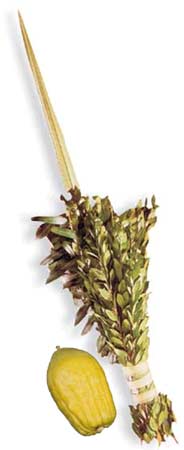
The Midrash (Vayikra Rabbah 30:12) teaches that the four kinds that we “shake” on Sukkos are symbolic of the four different types of Jews, taste representing Torah knowledge and a pleasant aroma representing good deeds:
  • Esrog (unusual citrus fruit): has taste and a pleasant aroma, and thus represents those who are both accomplished Torah scholars and doers of good deeds;
  • Lulav (a frond from a palm tree): has tasty dates, but no aroma, representing dedicated Torah scholars;
  • Haddasim (myrtle branches): only has a pleasant aroma, representing those who excel in good deeds but not in Torah study;
  • Arovos (willow branches): have neither taste nor fragrance, which represents the simple Jews who, though lacking distinction through Torah scholarship or good deeds, serve Hashem with simple faith.
(It should be noted that everyone should (and is obligated to!) study Torah, but only some can be said to excel in Torah study. Similarly, everyone should engage in good deeds, but only some are meant to do so in an exceptional manner.)

After explaining this teaching to a beginner, he commented: “So we should all become
Esrogim!”

I responded that according to my understanding, this is incorrect. Although the combination of Torah study and good deeds is clearly a special quality, it may also have a drawback. Those Jews who lack excellence in Torah knowledge but are dedicated to helping others typically (but not always) excel in their good deeds more than those who engage in both Torah study and good deeds. The same goes for dedicated Torah scholars who do not engage in good deeds vis-a-vis those who do not. Likewise, as mentioned, those who lack other qualities but serve
Hashem with simple faith excel in the purity of their faith. Thus, each Jew should excel in the area/s in which s/he is gifted.

The Midrash says that the act of bringing together the four kinds represents creating unity between the four different types of Jews.

Most of the time we have little difficulty realizing our own talents and skills. However, recognizing and appreciating the good qualities of others, especially when their areas of excellence differ radically from one’s own, is not so easy. It requires the humility to understand that as great as one may (or may not!) be, one is only a part of the whole, a whole that is fundamentally lacking without the vital contributions of everyone. Even the
Esrog Jew needs to unite with the other kinds through recognizing their respective virtues, which in a sense he lacks (as explained).

When each person both maximizes his own individual potential, and recognizes that he is an integral part of a whole, then he can truly complement others, and together they can attain the special common goal that can only be reached through this process of uniting through complementing.

This post was dedicated by Dan Schechter and family as a merit for Moshe ben Yehuda.

Like what you read? The articles I write take a lot of time and effort. Please contact me to sponsor an article for $36 in honor of the birthday, wedding anniversary, or yarhtzeit of a loved one, or for a refuah shleimah or the like. Also, see here concerning the tremendous merit of supporting the dissemination of Chassidus, and the blessings that one receives for doing so.

Wednesday, October 5, 2011

High Holiday fundraising drive


Dear Friend,

For the last three years I have maintained a website, www.a-farbrengen.blogspot.com. On it I have produced a consistent output of high-quality articles and essays on various topics related to the teachings and the lifestyle of Chassidus. I have also distributed these postings via a growing e-mail list to subscribers worldwide, and you have been one of my loyal readers.

Do you like what you read? The articles I write require a lot of time and effort—for research, writing, and reviewing.

A recent topic of interest on which I have focused my articles in recent months is the purpose of our lives in exile, the task of refining the sparks of holiness. With Hashem’s help, I hope to greatly develop this material, and compile it into a full-length book.

Some other recent articles of interest include:Other topics I hope to write about, with Hashem’s help, include: the nature of the different souls, the different levels of angels, the interaction between intellect and emotion and intellect and faith, the absolute unity of Hashem, the relevance of the higher spiritual worlds in our lives, the Chassidic perspective on music, the difference between love and fear of Hashem, and so on.

However, in order to continue this noble and holy work, I require significant financial assistance. Even once, with Hashem’s help, these writings are published in book form, the income from these books will be negligible when compared with the amount of money that I need to provide for my family.

Please make a donation in order to help support these efforts to publicize the teachings of Chassidus, which the Rebbe, quoting the famous words of Moshiach to the Baal Shem Tov, identified countless times as the main purpose of our generation, and the key to bringing Moshiach.

Assisting this endeavor also brings one tremendous personal blessings, as the Rebbe writes (in Letters of the Rebbe):
By helping publish a Torah text and disseminating it … motivating change, helping people find the proper path and resolve their problems ... the reward for this manifests in this world—with abundant material and spiritual good.

For just $36, please sponsor an article in honor of your loved one/s. I would suggest that you sponsor an article regularly in honor of your anniversary, in honor of the birthdays of your various family members, and in honor of the yohrtzeits of your departed loved ones. This donation can also be made lirefuah sheleimah, or in honor of a bris, wedding, or the like.

If you are able, please consider making a more substantial donation, to sponsor a series of articles, a full-length booklet, or even an entire book.

I will also add that if there is a specific subject in Chassidus that is close to your heart, and you would like to sponsor an article discussing that particular topic, I would be eager to do so.

Please click on the Donate image on the right-hand-side of my site in order to make a secure donation via PayPal. Or, to send me a check, please get in touch with me via email for my mailing information.

Thank you, and best wishes to be sealed for a good and sweet new year.
Moshiach now!

Yours sincerely,

Rabbi Yehoishophot Oliver

Sunday, October 2, 2011

Ridicule: The Ultimate Test


Ridicule: The Ultimate Test

Rabbi Yehoishophot Oliver


Earlier, we explained that the Jewish people refine the sparks of holiness in their host countries through their tenacity in observing Torah and Mitzvos despite the physical suffering that they endure there. In most times and places of our exile, this was our main test—the test of physical suffering. 


However, there is another test of exile through which we refine the sparks of holiness, one that relates more to the divine service of recent generations, and especially for Jews living in the western world, which comprise the majority of the Jewish people. This is the test of the age known as ikvesa diMeshicha, the generations directly preceding the arrival of Moshiach.

During this period, belief in Hashem and adherence to the strict standards of Torah are widely regarded with disdain and dismissed with ridicule. In fact, our sages predicted this state of the world:[1]
The government will turn to heresy. ... The wisdom of scribes [Torah scholars] will decay, and those who dread sin will be despised.
Indeed, modern secular thought is permeated with an attitude of cynicism and apathy toward belief in Hashem and careful religious adherence, and one encounters this especially when one goes out into the workplace and comes into direct contact with the secular world. Unless one is careful, it is human nature for this ridicule, whether overt or hidden, to wear a person down and weaken his observance, until over time, he could come to abandon observance of Torah and Mitzvos altogether, G–d forbid.

The only way to overcome this pressure is by standing upright and proud and maintaining one’s observance of Torah and Mitzvos without compromise. This is the test of “Do not be embarrassed before the scoffers.”[2] 

If anything, the opposition should make one stronger, along the lines of the verse concerning the suffering of the Jewish people in Egypt: “And as they afflicted them, so did they increase, and so did they grow strong.”[3]

This fearlessness in the face of ridicule of one’s Torah observance is in fact required by Jewish law,[4] and considered so important that it is placed at the very beginning of the entire Code of Jewish Law—in the first volume (Orach Chaim), in the first section (siman), and in the very first subsection (se’if). Why is it is placed at the very beginning? For without this precondition, the Jew cannot consistently abide by Hashem’s law. For as soon as anyone says a derogatory word, e.g., by branding him as an “extremist” or a “fanatic,” he will become intimidated, and his observance will decline.

Although this character trait was always necessary (which is why it is included in Shulchan Aruch), in our times it is so crucial that it is the main test of our generation. Now that we face it, we should know that comparatively speaking, if anything this test is the most difficult of all, requiring mesiras nefesh, self-sacrifice, in a sense more than that required of those who suffered physical afflictions for the sake of their Torah observance.[5]

The intense difficulty of this challenge is evident from the Alter Rebbe’s interpretation of the verse (and I have translated it literally, to show how he interprets it): “The man Moshe was exceedingly humble from every man on the face of the earth.”[6] Moshe Rabeinu was shown a prophetic vision[7] of “every man on the face of the earth”—the generation of Ikvesa DiMeshicha. He foresaw how the Jewish people would be tested in general, and with ridicule of their observance in particular, and yet would cling to observance of Torah and Mitzvos regardless. When he saw this, he became “exceedingly humble” from them, i.e., from his high esteem for their fortitude. Despite Moshe Rabeinu’s awesome greatness, he felt genuinely humble and what’s more, exceedingly humble, when he witnessed the trials that we face in our generation.

Based on Sefer HaMa’amarim Melukat, Vol. 2, p. 187.

___________________________________________________________
[1] Sotah 49b.
[2] Shulchan Aruch Orach Chaim, 1:1, Tur, Ramo. Shulchan Aruch Admur HaZakein, mahadura basra, 1:3.
[3] Shemos 1:12.
[4] One of the many “duties of the heart” that Torah requires.
[5] Or, as the Previous Rebbe puts it, self sacrifice is the primary area in which our generation excels (Sefer HaMa’amarim 5709, p. 104).
[6] Bamidbar 12:3.
[7] Cf. Devarim 34:2, where Rashi states that Moshe Rabeinu was shown a vision of all the events that would occur to the Jewish people until the Resurrection of the Dead.


This post was dedicated by Avi Turner and family as a merit for Nechama Bas Luba to have a complete recovery.

Like what you read? The articles I write take a lot of time and effort. Please contact me to sponsor an article for $36 in honor of the birthday, wedding anniversary, or yarhtzeit of a loved one, or for a refuah shleimah or the like. Also, see here concerning the tremendous merit of supporting the dissemination of Chassidus, and the blessings that one receives for doing so.

Tuesday, September 27, 2011

Rosh Hashanah: Also about spiritual blessings

It is written: “For it [Rosh Hashanah] is a decree for Israel, a [day of] judgment for the G-d of Yaakov” (Tehillim 81:5).

“Decree” refers to Hashem’s judgment concerning material blessings, while “judgment for the G–d of Yaakov” refers to the judgment concerning the amount of G–dliness and spiritual blessings the person will receive in the coming year (Likkutei Torah, Rosh Hashanah 55d ff.; Sefer HaMa’amarim 5710, p. 15).

So on Rosh Hashanah not only are we judged for material blessings, but also spiritual ones. Now, at first glance, this seems difficult to comprehend. Isn’t every person granted free choice in spiritual matters?

The answer: In any given situation, one can choose whether to follow the path of Hashem, or otherwise. But which situation the person will find himself in is beyond his control:

-He may be trapped in a place where he can’t wear Tefillin for many months. He may even be a Jew who unfortunately was never taught that he is obligated to lay the Tefillin. Or he may be free to not only lay Tefillin himself, and with full awareness of its deeper meaning, but he may also have the opportunity to encourage other Jews to lay Tefillin.

-He could be so harried that he barely ever has a moment to study Torah. Or he could have the privilege of being in a Yeshivah environment, in which he is free to study Torah all day.

-He may never have the opportunity to davven with a minyan. He may be able to davven with a minyan, but never have mental clarity and the ability to focus on the meaning of the words of prayer. Or he may have a clear head, and the opportunity and ability to davven at length for hours on end.

-He might be forced to work together with crooks or criminals, and have to fight valiantly to maintain his integrity. Or he may be earning a great deal of money without confronting any temptation to dishonesty.

On Rosh Hashanah we beseech Hashem: Please, don’t test us; on the contrary, make it easier for us to learn, to davven, to perform Mitzvos. Bring people into our lives—friends and acquaintances, mentors and leaders—who will act a positive influences on us. Bring people into our lives whom we can guide on the right path. Bring us many opportunities—pleasant ones—to come closer to you. Bring us close to You so that our sins are behind us, and so that if we must be tested, we no longer be tested with sin, but with the opportunity to push ourselves further to do still more good deeds.

And most of all, send us Moshiach NOW!

Monday, September 26, 2011

On the Human Subhuman and the Spiritual Living Dead


On the Human Subhuman and
the Spiritual Living Dead

Rabbi Yehoishophot Oliver

Hashem urges us: “See, I have set before you today life and goodness, death and evil” (Devarim 30:15).

When the Torah urges us to choose “life and goodness” and not “death and evil,” it is not coming to dismiss a materialistic lifestyle—never mind a sinful lifestyle. What rational person would think that we exist in this world in order to pursue wealth and honor, and indulge our animalistic urges? We are not animals—the wondrous intellect that Hashem implanted in us makes it patently obvious how superior we are to animals. Did He then give us intellect so that we could indulge in even more pleasures than the animals, outdoing the animals in our depraved lusts?!

One who lives such a life, one in which his mind is enslaved to his animalistic desires, degrades himself to the level of an animal, and is essentially subhuman. He fails to consider that if he was supposed to devote his life to pursuing animalistic pleasures, Hashem would not have given him an intellect that enables him to transcend his Bestial Soul and submit to the will of Hashem.

Rather, when we use the intellect with which we have been blessed, we will naturally come to realize that the world and everything in it does not exist for our self-gratification, but for a higher purpose—to serve Hashem. Thus, true life is only life that revolves around the spiritual.

If so, what is Hashem coming to tell us by urging us to choose life and goodness and avoid death and evil?

We are talking about a more insidious evil here, one that plagues someone who is fully frum. A Jew could live a life of Torah and Mitzvos, but lack interest and enthusiasm, to the point that what is in fact an awesome privilege seems like an onerous burden. Concerning this the Torah tells him: Although you are fulfilling the letter of the law—and so in a certain sense, you are living a spiritual life—with all due respect, this is a spiritual life that is dead. Choose “life and goodness”—choose to live in a way that Torah and Mitzvos excite and inspire you. And then you will be truly alive.

Based on the Previous Rebbe’s Sefer HaMa’amarim 5700, p. 90.
Also, see this article.


Dedicated by Yissachar Naftali Schneiderman as a merit for a refuah shelaimah for Aidel Rivka Bas Chaya Sara and Esther bas Aidel Rivka.

Like what you read? The articles I write take a lot of time and effort. Please contact me to sponsor an article for $36 in honor of the birthday, wedding anniversary, or yarhtzeit of a loved one, or for a refuah shleimah or the like. Also, see here concerning the tremendous merit of supporting the dissemination of Chassidus, and the blessings that one receives for doing so.

Sunday, September 25, 2011

Monarchy, Democracy, and Rosh Hashanah


Monarchy, Democracy,
and Rosh Hashanah

Rabbi Yehoishophot Oliver


Monarchy—a difficult concept

The awesome day of Rosh Hashanah is almost upon us. The central focus of this day is accepting Hashem upon us as king (“kabbolas ol malchus Shomayim”).

Unfortunately, in our times this concept is foreign to us, for monarchy (in Hebrew, “malchus”) as it was practiced in bygone days is almost completely obsolete. But let us try our best to cast our minds back into the past—the vast majority of human history, in fact—and try to imagine what it must have been like.

Well, these are the basics: A king was an absolute authority, with power over life and death. His subjects typically were very afraid of him and very loyal to him. Why was it beneficial for the king to wield such great power? On the basic level, it was needed to keep the people in line—to maintain law and order.

Appointment of the king by grand coronation

Now, at first glance, monarchy sounds very different from modern-day democracy. But in a very important sense, it was not so different. Monarchy is similar to democracy insofar as it is a consensual relationship. The only way that a person could come to have the absolute power of monarchy is for the people to willingly grant him that power.

But how do the people do this—how do they willingly appoint their chosen candidate as king? It is not enough for them to feel that way in their hearts; rather, they must make an external show of their devotion and allegiance.

For this purpose, the people organize a grand coronation event. All the people rally there, declare that they want this man to accept the mantle of kingship, and affirm their unwavering loyalty to him.

Despite the vast differences between people—“their ways of thinking are different”[1]—all the citizens of the country—men, women, and children—join in this ceremony just the same—the simple subjects, the wealthy landowners, the low-level ministers, until the high-level ministers, who are especially dear to the king. They all prostrate before the king and fully commit to obey him. “Long live the king!”[2] they declare.

If, however, one becomes an absolute ruler without the people’s consent; instead, one seizes power by force, then Torah does not define that as malchus, monarchy, but as memshalah, dictatorship. The king assumes his role only by virtue of the people’s demand.

Monarchy vs. Democracy

Moreover, a true candidate for kingship does not aspire to become king. On the contrary, that is the last thing on his mind—he consistently shuns the limelight, and all he wants is to be left alone. But despite his reclusiveness, the people somehow find out about him, learn of his unparalleled greatness, and realize that he is truly worthy of the position. So they approach him and nudge him incessantly to become their king, with this nudging culminating in a grand coronation ceremony.

When the would-be king sees just how much the people want him to rule over them, this evokes within his heart a desire to do so. This feeling is not tainted by any arrogance or bossiness; rather, it is a feeling of humbly and apprehensively stepping up to a role of tremendous responsibility for the sake of serving the community. This is the hallmark of true leadership.

Here the comparison to democracy ends, for according to the democratic system, the candidate can only become elected if he is filled with ambition and aspires to be the leader so much that he “runs” for elections. Instead of the people convincing him to want to rule, he convinces the people to want him to rule.

Although the aspirant to democratic elections may also have some genuine desire to serve the community, it cannot be claimed that his intentions are pure and not tainted by an element of lust for prestige and power. After all, he doesn’t just want any worthy person to rule—he campaigns for the people to decide that he is more worthy than anyone else for the job.

So clearly, no matter what his rhetoric, the best interests of the people are not the only thing on his mind; rather, there is also a strong element of self-interest in his bid for power and his efforts to remain in his position. This self-interest inevitably taints his leadership, for if the interests of the people conflict with his own, he may succumb to temptation and allow his own interests to trump those of the people. For example, upon seeing that another person is much more fit to rule than he, his selfish craving for power may induce him to deny this and even seek ways to viciously condemn and discredit the one whom he views as a threat to his power.

Of course, monarchy also has its pitfalls, for if the king is unworthy, he can abuse his power far more than an elected president can. Much more could be said on this topic, but here is not the place. In any case, a true king only becomes king because the people convinced him so.

Renewing Hashem’s rule and creation

Likewise, Hashem, the King of all Kings, becomes King when we declare our devotion to Him, thereby inaugurating Him as our King.

The difference, though—of course, one of many—between a human king and Hashem, is that a human king does not create the people; he merely enforces law and order, enabling society to function productively. In contrast, when we speak of Hashem as our King, we mean that He creates the world and rules over every single aspect of it.

This is the theme of Rosh Hashanah. The prayers and customs of this day are entirely devoted to repeatedly pleading of Hashem to rule over us as King, especially when we blow the Shofar. This evokes within Hashem the desire to rule over us, such that he commits to continue creating the world.

But why is it necessary to accept Hashem as King every year all over again?[3]

It is written, “The eyes of Hashem, your G–d, are constantly on it [the Holy Land] from the beginning until the end of the year.”[4] What is the meaning of this apparently unnecessary phrase, “from the beginning until the end of the year”—isn’t that already clear from the word “constantly”?

Rather, this verse alludes to the fact that Hashem annually renews the life-force with which he creates the world (and the Holy Land is the subject of the verse, for the entire world receives its life-force through that given to the Holy Land). Each year at “the end of the year”—as the twenty-ninth day of Elul passes, and we enter the night of Rosh Hashanah—Hashem’s desire to create the world recedes, as it were, until it vanishes completely, and although we cannot see it, the world’s very existence is hanging by a thread.

Then, for the next two nights and days, we must devote ourselves to showing Hashem our total commitment to serve Him. We declare, “Our Father, our King!” ... “Be King over us in Your glory,” and so on. And in this way we renew His desire to create the world for the entire coming year, and then this cycle is repeated the following year, and so on.

“Judgment day”

This is how the concept of accepting upon ourselves the yoke of the Kingdom of Heaven ties in with the other, perhaps more well-known, theme of Rosh Hashanah—that it is the “Judgment day” when Hashem judges every creature in existence.

As mentioned, Hashem’s decision to rule means that He commits to continue to create the world, and He does so because we submit to Him as King through our divine service on Rosh Hashanah. Now, this decision doesn’t only mean that Hashem decides to continue to create the world and not destroy it, G–d forbid. Rather, He decides the exact nature and amount of blessings that every single person is destined to receive in the coming year, in all areas.

And on what is His decision based? “Hashem sees the heart,”[5] and judges every individual according to their worthiness at the time of judgment.[6] So the sincerity of the individual’s acceptance of the yoke of Hashem’s sovereignty will determine whether Hashem’s ruling will be favorable, and exactly to what degree, and in which areas.

And this is the connection between Rosh Hashanah and Teshuvah. It is absurd to sin and simultaneously commit to serve Hashem. Until the person repents sincerely of his or her sins, they sully his heart and disqualify his profession of total devotion to Hashem on Rosh Hashanah. So on Rosh Hashanah we do Teshuvah, because Teshuvah is vital to accepting Hashem’s sovereignty.

This is also the reason that we are given the entire month of Elul to prepare for Rosh Hashanah. We don’t want to wait until Rosh Hashanah, when we are already being strictly judged, to start thinking about Teshuvah. Rather, we spend the month of Elul doing everything we can to rectify ourselves so that when Rosh Hashanah comes around, we will already be cleansed of sin and fit to commit to serve Hashem with all our heart. 

This is the reason that the atmosphere on Rosh Hashanah, especially according to the school of Chassidus Chabad, is very serious. For on Rosh Hashanah we are standing before Hashem, and He is scrutinizing our hearts carefully. Thus, it is the Chabad custom to spend as much time as possible between the prayers reciting the words of Tehillim with a broken heart, and if one can, avoiding all idle chatter.

May Hashem bless us and write and seal us all for a good and sweet new year in both the material and the spiritual, and may we witness the coming of Moshiach to usher in the true and complete redemption this year, and at its very beginning, NOW!

____________________________
[1] Berachos 58a.
[2] This declaration was used to appoint Jewish kings; cf. I Melachim 1:31.
[3] The explanation below is taken from Tanya, Iggeres HaKodesh, ch. 14.
[4] Devarim 11:12.
[5] I Shmuel 16:7.
[6] Rosh Hashanah 16b.

Dedicated by Avi Turner and family in honor of the Yahrtzeit of Mordechai Ben Yosef on 15 Av.

Like what you read? The articles I write take a lot of time and effort. Please contact me to sponsor an article for $36 in honor of the birthday, wedding anniversary, or yarhtzeit of a loved one, or for a refuah shleimah or the like. Also, see here concerning the tremendous merit of supporting the dissemination of Chassidus, and the blessings that one receives for doing so.

Thursday, September 22, 2011

Refining the Sparks Through the Suffering of Exile


Refining the Sparks Through
the Suffering of Exile

Rabbi Y. Oliver

We have spoken about how when the Jewish people use objects in the world to serve Hashem, they refine the sparks of holiness in those objects.

Another significant way in which the Jewish people refine the sparks of holiness in exile relates to their suffering in their alien environment. Over the course of Jewish history, the Jewish people have been “hosted” by various nations because those nations held sparks of holiness that the Jewish people were expected to refine. When the Jewish people are oppressed by their host nations in various ways, and yet remain firm in their observance of Torah and Mitzvos, they pull out the sparks of holiness in the nations and in their countries.

When the Jewish people have completed their task of refining the sparks within a specific nation, they are released from it, and that nation is left lowly and disgraced, for it has been deprived of its extra life-force—the sparks of holiness that lay within it.[1]

When Adam HaRishon sinned, he caused the sparks of holiness to fall into the forces of Kelipah (see here),[2] and the Jewish people refine these sparks through their suffering in exile. This is the meaning of “All who cause the Jewish people to suffer become the ‘head’ [i.e., the leading nation].”[3] When the gentile nations oppress the Jewish people, we take their “head.” The head, which is above the rest of the body, represents a high level—the lofty sparks of holiness that lie within the nations, that are the true source of their prosperity.

This is the deeper meaning of the verse, “One man dominates over another man, to his detriment,”[4] for the detriment of “the evil man,” i.e., the spiritual forces of Kelipah, which give sustenance to the nations who oppress us. When they dominate over us and oppress us, it is in fact to their detriment, for in this way the sparks of holiness are refined from their midst, and then they lose the blessings that those sparks brought them.

To explain further, each nation draws its sustenance from a particular force of Kelipah. Thus, there are seventy nations, corresponding to the “seventy ministers of Nogah”—the seventy spiritual forces of Kelipas Nogah (the level of Kelipah that sustains the physical world in general, but not things that are forbidden for a Jew),[5] from which each of the seventy gentile nations draws its sustenance, respectively.[6]

As long as the Jewish people are being hosted by a particular country in order to refine the sparks of holiness trapped there, the “minister,” the angel from which that country derives its sustenance, benefits greatly, causing that angel’s nation to be blessed with material prosperity.

However, once the Jewish people have finished refining all the sparks there, then, of course, no sparks are left, and so the individual Kelipah from which that nation had drawn its sustenance becomes greatly weakened, causing the nation to which it gives sustenance to lose, or at least experience a significant decline, in its prosperity and prominent position on the world stage.

The Jewish people are then relocated to another country, in order to refine the sparks of holiness that await them there. Once they have refined all the sparks of holiness in all the lands of exile, Moshiach will come and redeem them, bringing them to Eretz Yisrael forever.
___________________________
[1] Igra DeKallah, Bereshis, p. 496.
[2] Likkutei Torah lehoArizal, Tetzei.
[3] Gittin 56b.
[4] Koheles 8:9.
[5] Cf. Tanya, Iggeres HaKodesh ch. 25.
[6] Cf. Toras Sholom p. 204.


This post was dedicated by Reb Kasriel ben Yehudis and Chana Feige bas Reizl (my parents, tzu langeh, gezunteh, zisseh yoren) in honor of their 36th wedding anniversary. This post was also dedicated by Reb Menachem Kovacs, who requested that this message be attached:
"Zachor: to mark the 6th anniversary of the expulsion of the Jews from Gush Katif and the Northern Shomron; we continue to pray and work for their restoration and for the Ge'ula Shlayma. Thank you."
Like what you read? The articles I write take a lot of time and effort. Please contact me to sponsor an article for $36 in honor of the birthday, wedding anniversary, or yarhtzeit of a loved one, or for a refuah shleimah or the like. Also, see here concerning the tremendous merit of supporting the dissemination of Chassidus, and the blessings that one receives for doing so.
Tuesday, September 6, 2011

Refining the sparks within the nations

The Rebbe Maharash teaches:

“Hashem did a charity for us by scattering us among the nations.”[1] Why was this a charity? For by scattering us among the nations, He enabled us to fulfill a special mission: To refine the sparks of holiness hidden within them.

This is the deeper meaning of Hashem’s blessing to the Jewish people, “You will eat all the nations.”[2] Eating represents birur, refinement, and G–d then declared that the Jewish people would ultimately “eat up” and refine the sparks of holiness that lie hidden within the nations and their countries.

This is also the deeper meaning of Hashem’s statement to the Jewish people: “You shall be for me a segulah from all the nations”[3]—from all the gentile nations. I.e., when we refine them, we, the Jewish people, become a segulah, a beloved treasure, for Hashem.

Based on Sefer HaMa’amarim Toras Shmuel 5729, p. 65.

Jews refine non-Jews in several ways. When Jews interact with non-Jews in an upstanding, righteous manner, and make a kiddush Hashem (“sanctification of Hashem’s Name”):

– they[4] act as a “Light unto the nations,”[5] inspiring certain non-Jews to adopt a more refined, wholesome, G–d-centered lifestyle, seeing the shining example set by the Jewish people;

– they inspire certain non-Jews to come and learn from Jews how to serve Hashem as is required for them, by keeping the Noahide laws; moreover, Jews who have the opportunity (especially when they already have connections with non-Jews for business purposes, or the like) even approach non-Jews and convince them to undertake to follow the Noahide laws, and in this way they fulfill Rambam’s ruling[6] that Jews must encourage non-Jews to fulfill their laws;

– they inspire certain non-Jews to convert, for “Hashem only exiled the Jewish people among the nations in order to increase converts.”[7]

_______________
[1] Pesachim 87b.
[2] Devarim 7:16.
[3] Ibid. 7:6
[4] In connection with this point and the following one, see Hisva’aduyos 5744, Vol. 3, p. 1813.
[5] Yeshayah 49:6, 42:6.
[6] Mishneh Torah, Laws of Kings, 8:10.
[7] Pesachim 87b. See Orchos Tzaddikim, Gate of Truth: “One should not lie to a Jew or a non-Jew, or deceive them in any matter. ... Hashem only exiled the Jewish people in order to increase converts, and as long as they [Jews] behave with them [non-Jews] without deception, [non-Jews] will attach themselves to them [Jews].”

This post was dedicated by Reb Yeshayahu Don ben Chayah Tsipah and Sheila Shulamit bas Sarah Beila in honor of their wedding anniversary, and in honor of the yohrtzeit of Tsvi Horst Lubinizki.

Like what you read? The articles I write take a lot of time and effort. Please contact me to sponsor an article for $36 in honor of the birthday, wedding anniversary, or yarhtzeit of a loved one, or for a refuah shleimah or the like. Also, see here concerning the tremendous merit of supporting the dissemination of Chassidus, and the blessings that one receives for doing so.

Wednesday, August 24, 2011

Food: The fusion of body and soul

Since[1] the body is physical and the soul is spiritual, there is a vast gap between them. Even the most refined limb in the body, the physical brain, which is a vessel for the most refined soul-faculty, the mind, is still physical, and so it cannot be compared to even the lowest level of the soul.

Since the body and the soul are so vastly different from each other, they need a force to combine them. This is the purpose of food—to bring the vitality of the soul to infuse the body with life, making one healthy. Thus, lack of food weakens a person’s vitality to the point that if he is deprived of food for a long time, he will die.

What gives food this power? It is written, “A man does not live on bread alone; rather, a man lives on that which comes out of the mouth of Havayeh.”[2] “Mouth of Havayeh” refers to the divine vitality, the spark of G–dliness within the food, and the verse is telling us that it is this G–dly energy that truly sustains the person. We will discuss this process further in future posts, G–d-willing.

This is not to say that the body is not sustained by the nutrients and vitamins in the physical food, which it absorbs through the physical, chemical process of digestion. Rather, this is an external process that is merely a vessel for the deeper reality of the deeper, spiritual process by which the food is refined, which is primary.

_________________________________________
[1] Sefer HaMa’amarim 5670, p. 335-336.
[2] Devarim 8:3.

Thursday, August 18, 2011

Tohu vs. Tikkun


Tohus Vs. Tikkun

Rabbi Y. Oliver

There are four spiritual worlds above our physical world, in descending order—Atzilus, Beriyah, Yetzirah, and Asiyah. This system is called “Seder Hishtalshelus,” “the chain of worlds.” Kabbalah refers to this multiverse, and especially the world of Atzilus, as “the world of Tikkun.” Tikkun, lit. “rectification,” implies orderliness, for these worlds descend from higher to lower in an orderly, systematic manner.

Above these worlds lies the world of Tohu, lit. “chaos,” which is alluded to in the verse, “And the earth was chaos.”[1] This realm lies in a state of destruction and devastation. The Arizal teaches that when the Medrash says that Hashem “built worlds and destroyed them,”[2] this refers not to physical worlds, but to exceedingly lofty spiritual realms that lie in a state of destruction—the worlds of Tohu.

This is the deeper meaning of our Sages’ interpretation of the verse, “Back and front you have formed me”[3] to mean that mankind is “back,” i.e., last of all of Hashem’s creations, for Adam, who represents medaber, mankind, was the last being to be created on the sixth and last day of creation.[4] Kabbalah interprets this to mean that the source of all the other creations is “front,” i.e., higher—the level of Tohu, while the source of medaber is “back,” i.e., lower—the level of Tikkun.

__________________________________
[1] Bereshis 1:2.
[2] Bereshis Rabbah 3:7; Koheles Rabbah 13:11.
[3] Tehillim 139:5.
[4] Berachos 61a.


Sunday, August 14, 2011

The interdependence in the echelons of creation

There are four levels of creation, in ascending order: domem—inorganic objects; tzomei’ach—plant life; chai—animal life; medaber—mankind (for more elaboration, see here).

Why did Hashem create mankind in a way that he must eat in order to survive? Moreover, food comes from domem, tzomei’ach, and chai. Why should mankind be dependent upon the creatures at lower echelons than his own?

The answer to this will become clear when we understand the true purpose of eating. The food that we eat becomes transformed into blood, and blood is the key to life, as it is written: “The soul is blood,”[1] for life is maintained through the continuous circulation of blood through the body. Thus, our physical life comes from the food that we eat.

Once the food is converted into blood, the blood gathers in the liver. From there it is distributed throughout the body, giving energy to the mind and the heart and so enabling the person to function as a human being. Since it is the human being’s intellectual and emotional abilities that differentiate him from the lower echelons of creation, when products of the three lower echelons are eaten and absorbed into the body, which gives sustenance (not only to the lower human faculties, but also) to the mind and the heart, the three lower echelons are elevated to the highest level of medaber.

In this way, domem, tzomei’ach, and chai realize their purpose, for the purpose of everything is to become subsumed into the level above it. Thus, the purpose of domem is to become subsumed within tzomei’ach; the purpose of tzomei’ach is to become subsumed within chai; and the purpose of chai is to become subsumed—along with the elements of domem and tzomei’ach which now constitute it—into medaber.[2]

Moreover, since the soul needs the body to express itself in the world,[3] and the body can only serve this purpose when it is healthy, and food makes the body healthy, the food is not only elevated to the level of medaber, but when the Jew uses that energy to serve Hashem, the food becomes infused with the holiness of the Torah and Mitzvos that the Jew is using the food to perform.

To be specific, food enables one to serve Hashem with the heart, by becoming inspired with passionate love to Hashem in prayer. It also enables one to use one’s mind, including the intellect of the Divine Soul, to understand Hashem’s greatness.[4]

This is the meaning of the concept of birur, “refinement” discussed in the writings of the Arizal—that the food is transformed into the person.

This is one reason that Hashem made medaber dependent upon the creations of the three lower echelons—so that he will do his job of refining them.

Based on Torah Ohr, s.v. Yegalei lan taamei.
__________________________
[1] Devarim 12:23.
[2] Sefer HaIkkarim 3:1.
[3] Tanya ch. 37.
[4] Siddur Im Dach.


This post was dedicated by:
~Reb Kasriel ben Yehudis and Chana Feige bas Reizl (my parents, tzu langeh, gezunteh, zisseh yoren) in honor of their 36th wedding anniversary.
~Reb Menachem Kovacs, who requested that this message be attached:
"Zachor: to mark the 6th anniversary of the expulsion of the Jews from Gush Katif and the Northern Shomron; we continue to pray and work for their restoration and for the Ge'ula Shlayma. Thank you."
Like what you read? The articles I write take a lot of time and effort. Please contact me to sponsor an article for $36 in honor of the birthday, wedding anniversary, or yarhtzeit of a loved one, or for a refuah shleimah or the like. Also, see here concerning the tremendous merit of supporting the dissemination of Chassidus, and the blessings that one receives for doing so.