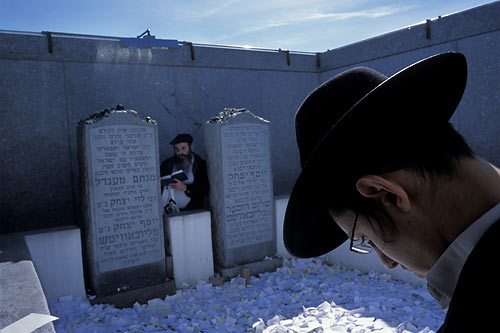
"Moshiach is ready to come now-our part is to increase in acts of goodness and kindness" -The Rebbe

Showing posts with label preparation. Show all posts

Monday, August 26, 2013

Light Prepares for Darkness


Light Prepares for Darkness

Rabbi Yehoishophot Oliver

I recently spent a few days in the country, where at night even the streets are much more poorly lit than in the city, and in the fields there is almost no light. Yet during my time here, I have not needed to walk around at night, only during the day.

Last night, for the first time, I had to make my way across several large fields in order to reach my destination, with only some faint streetlights in the distance and a glimmer of moonlight and starlight to help me find my way.

Although I did trip a few times and veered onto a minor detour, I managed. Why? I had gone down that path often enough during the daylight hours that the little light that shone was sufficient to direct me.

Perhaps the lesson is as follows. When one is in an environment of spiritual light, of holiness and purity, such as a beis ha'knesses (synagogue) or a beis ha'medrash (Torah study hall), the way is clear. In contrast, the outside world is a place of intense spiritual darkness (see here), rife with fraud and deception, ignorance of Hashem's Word, materialism, hedonism, and apathy to faith and even ridicule of it (see here). In this "doubled and redoubled darkness" the Jew is prone to lose his or her way, G-d forbid.

But when we are accustomed to devoting time daily to davven and learn in the beis ha'knesses and beis ha'medrash (and their equivalent as appropriate for women and girls), we keep ourselves spiritually attuned and fortify ourselves (see here). Then even when we descend into the hostile environment of the outside world, we will not lose our way, for we remember the experience of being in an environment of G-dliness and purity.

This also explains why it is so important for bochrim to attend Yeshivah, for girls to attend seminary, and for chassidim to go to the Rebbe (or, until Moshiach comes, the places where the holiness of the Rebbe resides--770 and the Ohel) at least once a year.


~~~~~~~
Like what you read? The articles I write take a lot of time and effort. Please contact me to sponsor an article for (at least) $36 in honor of the birthday, wedding anniversary, or yarhtzeit of a loved one, or for a refuah shleimah or the like. Also, see here concerning the tremendous merit of supporting the dissemination of Chassidus, and the blessings that one receives for doing so.

Tuesday, July 24, 2012

Iskafya: Ploughing the inner soil


Iskafya: Ploughing the inner soil
Rabbi Yehoishophot Oliver


(For earlier articles on this topic, see here,  here, here, and here.)


(In this recent article, we discussed how tremendous effort is required to go from love for the physical to love for Hashem. This article develops that theme.)


What is Iskafya? Iskafya means that when your heart craves a material pleasure, you tell yourself “no.” You restrain yourself, and you don’t do it.


G–d forbid, there is no emotionally unhealthy, masochistic desire here to bring oneself to suffer for the sake of suffering. (If there is, such a person shouldn’t be engaging in Iskafya.) On the contrary, a Jew should serve Hashem with joy, and Chassidus rejects the approach of bringing afflictions (“siggufim”) upon oneself as an atonement for one’s sins.[1]


Rather, true Iskafya stems from a profound desire to bond with G–dliness, and the knowledge that in order to reach this goal, one must give up worldly pleasures to a significant degree.


The Torah instructs us, “All your actions should be for the sake of Heaven.”[2] This means that when a Jew engages in the material world, he shouldn’t do so in order to satisfy his physical desires, or even to provide for his basic needs and survive (although it is indeed necessary). Rather, he should do so for the sake of serving Hashem—e.g., he eats and drinks in order to have strength to study Torah and davven; he pursues a livelihood in order to provide his children with a pure Torah education, give charity to the poor, support Torah study, and so on.


Now, when one craves something physical, that means that he wants it for himself, for his own egotistical enjoyment and pleasure, and not for the sake of Hashem. And so giving into this desire will strengthen his ego, and make him that much less receptive to G–dliness. Conversely, by engaging in Iskafya and restraining oneself from indulgence, the Jew makes himself that much more receptive to G–dliness.


We can understand this from an analogy. In order for plants to grow, a farmer must plough the soil. This softens it so that the seeds deposited on the soil can germinate and grow into a plant. In contrast, a seed sown on hard soil cannot grow. The more the soil is ploughed, the softer it becomes, and the more easily the seed can take root, thrive, and produce fruit.


So, too, hidden in the heart of every Jew lies a priceless treasure: The ahavah mesuteres, a natural love for Hashem that stems from the Neshamah, which is “literally a part of Hashem above.”[3] But in most of us, it is deeply hidden by the negative spiritual forces of Kelipah, of concealment of the divine, and to be more specific, by the coarseness of the Bestial Soul within the person, which stems from Kelipah.


How do we break through this coarseness, this spiritual blockage, and enable the Neshamah to emerge? By working on the avodah of Iskafya. Each time we practice Iskafya, we weaken the Bestial Soul. Just as ploughing loosens the soil and enables the seeds to grow, so does Iskafya weaken the Bestial Soul so that the ahavah mesuteres can come to the fore. (On the topic of eliminating coarseness and removing spiritual blockages, see here. As for the way to approach Iskafya in practice, and which areas it is preferable to focus on, see here.)


However, Iskafya itself does not reveal the ahavah mesuteres. Rather, it humbles the person and prepares one’s heart so that during Tefillah, the heart will be truly receptive to the various steps in the process of Tefillah (see here), until one reaches love of Hashem.


To be sure, the Jew who engages in Iskafya probably already feels love for Hashem to a significant extent, for it was this desire to connect to G–dliness that motivated him to engage in Iskafya in the first place. However, by engaging in Iskafya and actually davvening with that extra sensitivity, with Hashem’s help, he will reach a far more sublime level of love for Hashem.


Adapted from Likkutei Torah, Masei 96d. 


_____________________________________
[1] Tanya, Igeres HaTeshuvah ch. 1. Cf. Hayom Yom 28 Shevat.
[2] Avos 2:12.
[3] Tanya ch. 2, beg.


Dedicated in the merit of a speedy release for the captives 
Yonasan ben Malka (Jonathan Pollard), Sholom Mordechai Halevi ben Rivka (Sholom Rubashkin), and Zeva Rochel bas Chaya (Wendy Weiner Runge).


Dedicated by avi mori, Reb Kasriel Oliver and family, as a merit for imi morosi, Chana Feigeh bas Reizel (aka "Zippi"), on the occasion of her 60th birthday, tzu langeh, gezunteh, zisseh yorn, filled with material and spiritual success and prosperity.


Like what you read? The articles I write take a lot of time and effort. Please contact me to sponsor an article for (at least) $36 in honor of the birthday, wedding anniversary, or yarhtzeit of a loved one, or for a refuah shleimah or the like. Also, see here concerning the tremendous merit of supporting the dissemination of Chassidus, and the blessings that one receives for doing so.

Thursday, May 10, 2012

Shabbos: Utterly transcending the world

Shabbos: Transcending the world
Rabbi Yehoishophot Oliver


Our sages say, “He who toils before Shabbos, will eat on Shabbos.”[1] On the simple level, this means that in order to eat a ready meal on Shabbos, one should toil to prepare the food before Shabbos. But on the deeper level, this alludes to the relationship between the divine service of the weekdays and of Shabbos. During the week we prepare ourselves spiritually for Shabbos, and so the more one toils to accomplish the divine service required during the week, the higher the level of the Shabbos experience that follows it.


The main theme of Shabbos is menuchah, rest, as our sages say, “What was the world lacking [after the completion of the six days of creation]? Menuchah. When Shabbos came, menuchah came.”[2] Thus, the verse tells us, “And Hashem completed [His work of creating the world] on the seventh day.”[3] But didn’t He complete the creation on the sixth day, as it states concerning the sixth day in the previous verse, “And He completed the heavens, the earth, and all their hosts”? No, for in a sense, Hashem did create something on Shabbos—menuchah.


This is related to the intense divine revelation on Shabbos, for Hashem is called menuchah.[4]


To explain, everything in the world is in a state of constant movement, for it is fundamentally bound by the limitations of time and space. Time is constantly changing—the future is becoming the present, and the present is becoming the past.[5] And space too, which is fundamentally intertwined with time, also involves movement.[6]


Hashem, however, is infinite, and so He completely transcends space—He does not move from one place to another—and He transcends time, a construct that He created. Thus, Hashem is called menuchah, for in His Essence, He is utterly unchanging—the epitome of true menuchah.


We mentioned the verse, “And He completed [“vayechulu”] the heavens, the earth, and all their hosts.” Vayechulu can also imply kilayon, yearning,[7] for after He finished creating the world, on the first Shabbos, Hashem revealed the level of menuchah associated with His Essence, and this inspired all His creations with a yearning to rise up and reach this level of menuchah.


This also explains the deeper meaning of the weekly cycle.[8] In the daily Shacharis liturgy, we speak of Sunday as being the “first day.”[9] Since everything in Torah is precise, if so much time has passed since the first day of Creation, why don’t we count by the number of days since creation, or use some other more precise phrase when counting?


The answer is that since on Shabbos the level of Hashem’s very Essence shines, this elevates the world completely beyond its mundane state. Thus, on the following Sunday, the mundane world is indeed new, both in space and time, and so we start the count anew.


Likewise, on every Shabbos, the Jew who keeps Shabbos as is required is given the privilege to “eat on Shabbos”—to personally experience a special revelation from Atzmus, Hashem’s very Essence. This comes as a reward for his or her divine service during the week—“He who toils before Shabbos,” and renews and invigorates him physically and spiritually in preparation for the coming week.


Based on Sefer HaMa’amarim 5722, s.v. Basi LeGani, pp. 132-133. 


______________________________________________________________________
[1] Avoda Zara 3a.
[2] Bereshis 2:2, Rashi.
[3] Bereshis ibid.
[4] Kesser Shem Tov §400-401. Likewise, Hashem is called Shabbos (Zohar 2:88b).
[5] Sha’ar HaYichud VehaEmunah ch. 7. Likkutei Torah, Berachah 98a.
[6] This is all the more so according to modern science, which teaches that nothing is truly stationary; everything in the universe is moving. Likewise, all matter consists of atoms and molecules that are in constant motion.
[7] Ohr HaTorah Bereshis 42b ff.
[8] Likkutei Torah, Shir HaShirim 25a. Ohr HaTorah, Berachah, p. 1891. ibid., p. 1897 ff.
[9] “Hayom yom rishon laShabbos.”


Like what you read? The articles I write take a lot of time and effort. Please contact me to sponsor an article for (at least) $36 in honor of the birthday, wedding anniversary, or yarhtzeit of a loved one, or for a refuah shleimah or the like. Also, see here concerning the tremendous merit of supporting the dissemination of Chassidus, and the blessings that one receives for doing so.

Tuesday, October 19, 2010

Cultivating a Tefillah state of mind

It happens regularly that we walk into Shul, begin reciting the words of Tefillah, and suddenly find our minds bombarded with all kinds of extraneous thoughts, from the mundane, to the banal, to the unworthy, to the outright forbidden. Even when we genuinely try to focus our attention, much of the time our thoughts still wander, and for most of us, we succeed at best partially.


Indeed, the struggle to remove extraneous thoughts from one’s mind and focus on the words of the prayers is immense.


And this stems from the fact that the goal is uncompromising: all thoughts other than meditating on Hashem’s greatness and the meaning of the words one is reading must be rejected. This even means that one should not read the words of Tefillah with one’s lips while reflecting in the back of one’s mind on topics in Torah. This is the reason that before Tefillah one should not study pilpul, intensive Talmudic analysis, but only practical halachic rulings. After studying pilpul, the mind is still excitedly grappling with complex ideas, and so even without consciously intent, one’s thoughts are prone to drift off from Tefillah to one’s studies. In contrast, practical halachic rulings do not engross the person, and so we are not concerned that such study will bring on stray thoughts during Tefillah.


If even thoughts of Torah should be rejected during Tefillah, one should surely reject thoughts of the mundane. This includes dispelling otherwise permitted and constructive thoughts, such as thoughts of one’s livelihood. It is especially difficult to clear one’s mind if one is emotionally distraught from hardship in some area of one’s personal life (may Hashem spare us).


This is also the reason that during Tefillah one should keep looking inside the Siddur at all times, for allowing one’s gaze to wander around Shul can trigger distracting thoughts. Moreover, since “letters illuminate,” gazing at the printed words helps focus one’s concentration.


In the case of Shacharis, we know that various specific preparations are prescribed with the goal of fostering the appropriate mental state (see here). So instead let us discuss Minchah and Maariv, for it is not written (as far as I am aware) that one ought to make a point of preparing for these Tefillos through a session of Torah study and hisbonenus (contemplation of Hashem’s greatness). (The reason for this is that the preparations for Shacharis are said to extend throughout the day, to Minchah and Maariv.) Nevertheless, this does not mean that it is acceptable to rush in from one’s car such that one enters the Shul at the exact moment that the Minyan begins (and that’s in a good scenario).


This is reflected in the Talmudic ruling: “Rav Chisda said: [When entering Shul] one should always enter a measure of two doors-worth and then pray” (Berachos 8a). One explanation of this is that one should wait briefly before starting to read the words of Tefillah.


During this time one should make a conscious effort to mentally cast aside all the aspects of day-to-day life that were preoccupying one until then, in order to enter the calm, lucid state of mind conducive to proper concentration. In Yiddish this process of transition is known as “shtelen zich davvenen.”


So instead of arriving at the 2 pm Minyan for Minchah at 2:00:39 short of breath and zipping through Ashrei in order to make it in time to answer Kaddish, do yourself a favor and come just five minutes earlier. Relax a bit, say Korbanos slowly, glance in a sefer, put a coin in the pushkeh, and remind yourself simply about what you are about to do—the purpose of all the words you are about to read: You are about to be granted the opportunity to stand directly before Hashem and praise Him, plead that He grant your requests for sustenance, and then thank Him for His kindness.


It will make all the difference.


Adapted from Kuntres HaTefillah, p. 23.

Wednesday, September 15, 2010

The Moshiach paradox: Preparing and praying

The Moshiach Paradox:
Preparing and Praying

Rabbi Y. Oliver

When Reb Itche Der Masmid would speak of the imminent arrival of Moshiach, he would say, “If only I had another fifteen years to prepare!” In other words, although he was confident that Moshiach would come immediately, since he felt that he wasn’t truly ready, he wished that he could have more time to prepare.


Yiras Hashem Otzaro, p. 144.
Chassidus Chabad teaches that everything a Jew does should be done in a way of pnimiyus, through full preparation, and so every chossid yearns that everything he does be done in a way of pnimiyus, and if it is not, he feels pained. So when he thinks of the coming of Moshiach, a part of him may thus legitimately desire that Moshiach’s coming be delayed so that he can prepare himself further.


However, at the same time, the one’s faculty of emunah will bring him to feel that Moshiach’s arrival is imminent. One feels this all the more now that the Rebbe has declared that “The time of your redemption has arrived!” and that “Ot, ot, kumt Moshiach! (Moshiach is coming very soon)!” Moreover, one davvens sincerely for Moshiach to come immediately because he senses the pain of the Shechinah and the Jewish people in exile. He yearns for the end of the concealment of G–dliness that exile brings, and for Hashem to be revealed in all His glory. He also yearns to be able to serve Hashem in the fullest manner possible—“According to the Mitzvah of Your will” (Mussaf liturgy)—for only when Moshiach comes will we be able to perform all the Mitzvos in the proper manner, and he yearns for the Jewish people as a whole to be able to serve Hashem in this way. 


These considerations override the personal wish that the exile be lengthened so that one can prepare more fully for Moshiach’s arrival. One willingly forgoes personal perfection for the sake of these infinitely greater concerns, and cries out “ad mosai?!”—how long?! Enough of this exile; Hashem, have mercy on us, and send Moshiach now!


When these two conflicting feelings are combined, one feels the intense desire to utilize every single remaining moment of the exile to prepare as much as possible for the coming of Moshiach, while simultaneously pleading that Moshiach come immediately, even if that means that Moshiach will arrive long before one has finished his personal preparation.

Tuesday, July 27, 2010

Sensitizing Ourselves to Hashem

Sensitizing Ourselves to Hashem

Rabbi Y. Oliver

We come to shul in the morning, and we want to leave somewhat different from the way we came—more refined, inspired, and spiritually attuned. And yet sometimes, although we concentrate on the meaning of the words, and even study Chassidus (see here) and reflecting on concepts in Chassidus beforehand (a.k.a. hisbonenus), we feel as if nothing has changed.

There are a number of responses to this complaint. One is that hisbonenus and davvenen with kavvanah (concentration) have a cumulative effect that is not necessarily immediately discernible. Just as one does not become full from eating one mouthful of food, so can true inner change come only after sustained effort.

However, if one has engaged in hisbonenus consistently for an extended period, say many months, and he still senses no change whatsoever, then that answer is no longer tenable. Rather, one must conclude that the hisbonenus was indeed ineffective, and the reason for this is that the person failed to prepare for it appropriately.

True inner change requires preparation.

Why is preparation so necessary? Because one may be in an intellectually lucid state, and fully capable of concentrating on a secular subject. However, if he is honest with himself, he may recognize that when he tries to davven or study Torah in general, and when he tries to study Chassidus and reflect upon ideas in Chassidus in particular, he feels a certain inner resistance, and even apathy. If one is constantly in this state, then when one looks back at his attempts to meditate upon Hashem’s greatness, he may well feel like all his efforts were in vain, “like water off a duck’s back.”

The reason for this may be that he is in a state of yeshus, of heightened self-consciousness and even arrogance. Preoccupied as he is with himself, he is not receptive to Hashem and to the revelation of G–dliness with which one connects through Torah study and prayer. The reason that he is not receptive is that Hashem reveals Himself only in a place of humility and self-nullification (Tanya ch. 6). Thus, although the person recognizes intellectually the need to engage in spiritual pursuits, as long as he remains in this state, he will emotionally regard any effort at deep spiritual growth as an odious chore to be cast off at the first opportunity. It is no wonder that these efforts do not bear fruit—it is akin to trying to plant a seed in unploughed earth.

So how indeed do we release ourselves from this coarse, egotistical state, and in so doing prepare ourselves for Tefillah and hisbonenus?

The answer is that before one can relate to Hashem through intellectual study, one must arouse within oneself a basic ratzon (desire) to submit and devote oneself to Hashem. This is accomplished through the practice of hoda’ah, acknowledging and accepting Hashem.

In a sense, hoda
’ah affects one emotionally in a much more compelling way than intellectual study of Hashem’s greatness and contemplation of it.


To explain, there are two ways of accepting something—accepting something that one doesn’t understand, and accepting something that one does understand. When one doesn’t understand, and yet accepts, he is much more humbled and awed by the concept. For instance, consider that someone explains that a certain complex mathematical equation enables scientists to calculate the number of grains of sand in the entire world, or the amount of water in all the seas. Now, when one believes and accepts this fact without understanding the equation, he feels awed and humbled. However, if the equation is explained and the listener grasps it fully, although he may be somewhat impressed at its cleverness, since he has mastered it himself, he will not feel humbled by it.

Likewise, when one starts one’s divine service by submitting to Hashem without understanding Him, he feels awed and humbled before Hashem, and this moves him with the desire to devote himself to Hashem.

This is the reason that Torah requires that a Jew start out his day with the declaration of Modeh Ani, “I offer thanks to You, ever-living and enduring King ... ” If recited with the proper intention, this declaration arouses the person’s basic desire to submit to Hashem, and so afterward, his efforts to unite with Hashem intellectually and emotionally are far more likely to succeed—of course, with Hashem’s help.

Adapted from Sefer HaMa’amarim Admur HaRashab 5670, pp. 145.

Tuesday, June 1, 2010

Doing Our Part to Change the World

Doing Our Part to Change the World

Rabbi Y. Oliver

There are so many problems in the world, this mind-boggling world of over six billion people.


There are global problems.


Then each country has its own problems.


Jews have their own problems.


Religious Jews have their own problems.


Our own community has its own problems.


And then there are the problems of those in my immediate circle of friends, and then within my family, and finally my own personal problems.


And no matter how much bad news one knows (and by the way, perhaps there are more constructive ways of spending one’s time), it is surely infinitesimal when compared with the problems that one doesn’t know about for whatever reason.


It would seem self-evident that Hashem gives us these problems on all these strata in order that we overcome them.


But overcoming them often seems so hopeless and foolish, so childish and naïve.


When I reflect upon the sheer enormity and seeming impossibility of truly rectifying even one of my own personal problems, attempting to tackle large-scale problems, never mind global ones, seems laughable and preposterous. Come now, what species of deranged megalomaniac would have such pretensions?


There is good news.


I don’t have to totally change the world, the country, frum society, my own community, my friends, or family. I need not even change myself.


Because I can’t.


But there is one little thing I need to do.


I need to dream.


To dream for a time in which everything will change. Everything from the globe to ‘lil ‘ol me.


But how can we reach perfection? Aren’t we stuck in a mire of inherent imperfection?


The answer is that although it seems this way now, this imperfect state of existence is merely a temporary phase. It is setting the stage for something far greater and more amazing and wondrous than anything we can imagine. The world will be soon healed, purified, and elevated to an incomparably higher state of existence. And this will happen because Hashem has promised that He will usher in this era from above, through His redeemer, our righteous Moshiach. 


So I need to dream about this time, learn about it, and try my best to visualize it. Once I realize how much suffering and hardship reaching this time would alleviate, I will surely pray for it as well.


And then I need to remind myself: “This time is coming, very soon, sooner than I realize. I need to be as ready as I can be. What can I do practically to improve myself, step by step? And what can I do practically to encourage others in the same direction?”


And every day I need to ask myself this question again.


And when the day is finished, I need to look back and ask myself whether I fulfilled the opportunities given me on that day to fulfill this goal.


And each individual who takes upon himself this mission shows Hashem in the most tangible way possible that he truly believes in the coming of Moshiach, and is awaiting his coming so sincerely and passionately that he is doing his utmost to prepare himself and others for this new age.


And when Hashem sees that we truly want Moshiach now, and he sees the tangible preparations that we have made, He will send Moshiach to finish off the job in a way that we could never accomplish.


May it happen today!

Wednesday, May 26, 2010

Going to the Rebbe: Embarrassment and preparation


Going to the Rebbe: 
Embarrassment and Preparation


Rabbi Y. Oliver


Reb Chanoch Hendel Kugel was one of the great chassidim of the Rebbe, the Tzemach Tzedek, the Rebbe Maharash, and the Rebbe Rashab. He was one of the first mashpi’im in the Yeshivah of Tomchei Temimim. The Previous Rebbe relates:
Reb Chanoch Hendel once said during one of his farbrengens: “One who suffers from tzora’as (spiritual leprosy) may not enter the Beis HaMikdash until he is healed. Likewise, until a young man is healed of his repulsive character traits, he may not go to Lubavitch. It is forbidden to defile the chamber of Hashem found in the Rebbe’s surroundings.
“For ten years I studied Rabenu Yonah’s Shaarei Teshuvah, Sefer Charedim, Reishis Chochmah, and Pokeach Ivrim. I also studied [the Alter Rebbe’s] Iggeres HaTeshuvah tens of times and certain chapters of [the Mitteler Rebbe’s] Derech Chaim. [My goal was] to scrape away the evil character traits and rid myself of the body’s habits. Only then [once I had accomplished this goal], and with the consent of elderly chassidim, did I travel for the first time to the Rebbe [the Tzemach Tzedek] in Lubavitch.”
Listen, young men, to what an old chossid told concerning how he became a chossid.
This young man toiled for ten years [to refine] his character traits, and during these ten years he did not travel to Lubavitch to my great-grandfather, for he was ashamed to appear before the Rebbe while on his spiritual level.
This is a good preparation for becoming a chossid.
Sefer HaSichos 5697, p. 184.
In this sicha the Previous Rebbe encourages “young men” to listen to the story of a chossid who prepared for ten years before travelling to his Rebbe, and the Previous Rebbe impressed upon them that “This is a good preparation for becoming a chossid.”


Without this preparation, the chossid deserves to feel embarrassed to appear in the Rebbe’s presence. The chossid knows with certainty that his spiritual level is immediately felt by the Rebbe, and if foul character traits remain and sincere Teshuvah is lacking, entering the Rebbe’s holy presence is a kind of desecration, akin to “defiling the chamber of Hashem” (in the words of Reb Chanoch Hendel).


On a similar note, at a farbrengen the Previous Rebbe once turned to the famous chossid, Reb Zalman Moishe HaYitzchaki, and said something to him. Afterwards, the other chassidim asked him what the Rebbe had said. “I didn't hear one word,” he responded. “Only one thought bothered me at that moment: When will the Rebbe already remove his holy eyes from my piggy face?” (Anoshim Chassidim Hoyu, Yosef Yitzchak Kaminetzki, Israel, 2003, p. 24)


My understanding of this story is that Reb Zalman Moishe knew that when the Previous Rebbe looked at him physically, he also looked right through him, into the depths of his soul. Reb Zalman Moishe was a chossid who strove with tremendous effort at avodah, the chassidic discipline of self-refinement, and so he was acutely aware of his spiritual shortcomings. He felt that compared to the Previous Rebbe’s eyes, his own face was “piggy.” So when the Previous Rebbe looked at him, his deep embarrassment so discombobulated him that he couldn’t focus on what the Previous Rebbe had said to him.


Over time, and especially with the relocation of the Chabad movement from Europe to America, this sensitivity has been largely lost, or at least greatly diminished. I once heard it said that the famous mashpia Reb Nissan Neminov once complained: “In our times, when the Rebbe [i.e., the Rebbe Rashab or the Previous Rebbe] would come, we would run away, not wanting to be seen. Nowadays, when the Rebbe comes, everyone runs to be seen!”


This phenomenon also reveals a significant lack in the traditional Chabad emphasis on pnimiyus—the feeling that personal change ought to come through one’s own effort and not through “makifim”—unearned divine revelation from above that pulls one out of one’s problems. The idea that one will go to one’s Rebbe and be lifted out of one’s internal mud with minimal effort was always shunned by Chabad and embraced by other Chassidic approaches.


In light of the above, it would seem that a desire to be seen by the Rebbe without any accompanying sense of embarrassment and reluctance out of an awareness of one’s unworthiness, or any desire for some form of preparation in order to become at least somewhat more worthy of standing in the Rebbe’s presence (even if not fully worthy) indicates that this person is probably suffering from some or all of the following basic problems. First, he lacks firm emunas Tzaddikim—belief that the Rebbe sees unerringly into his heart (see here). Second, he lacks a strong awareness of his character flaws, and the need for avodah in order to rectify them. Finally, he lacks a recognition of the importance of pnimiyus.


It is easy to go the Rebbe and say “hineni”—“here I am!” But without some substantial preparation, it is unlikely that such a visit will make a lasting impact on one’s life. And one will certainly not accomplish an inner change remotely close to that which one can accomplish through preparation.

The sensitivity (albeit not to the extreme described in the Previous Rebbe's talk) should energize one to prepare before going to the Ohel, and in general, to intensify one's preparation for the long-awaited day when we will see the Rebbe again, with the coming of Moshiach.

Wednesday, March 10, 2010

Studying Chassidus before Tefillah

It is the Chabad practice to study Chassidus Chabad, the intricate Chassidic discourses of the Rebbeim of Chabad, before Tefillah (prayer) daily. In this essay I will explain the sources, reasons, and goals of this practice, and I will conclude with an explanation of the connection between this study and hisbonenus (Chassidic meditation).

The earliest explicit source that I have found for this is in
Kuntres Etz Chaim (pp. 52-53), where the Rebbe Rashab writes: “In general, before Tefillah, there need not be any study other than study of Chassidus” (and therefore “those who rise early should learn Chassidus for the entire time before Tefillah”). Obviously, this study serves as a preparation for Tefillah. The reason for this is not discussed there.

The footnote to these words of the Rebbe Rashab (ibid., p. 52), which was written by the Rebbe (who wrote references and glosses to many works of the Chabad Rebbeim before his succession to the position of Rebbe), references Likkutei Torah, Savo, 53c. There the Alter Rebbe writes:
... The third [preparation for Tefillah (the first two being to donate Tzedakah and immerse in the Mikveh)] is to engage in and study words of mussar [ethical rebuke], and those words of mussar found in the Zohar in particular. For the word Zohar is etymologically related to the word for illumination, for [the Zohar] illuminates the place of darkness; this is the “wisdom of truth” [a term used to refer to kabbalistic teachings]. ... [The Alter Rebbe goes on to speak about the power of this study to arouse simple faith.]
Thus, the Rebbe cites Likkutei Torah as proving the concept of learning Chassidus before Tefillah. The obvious question is: where is Chassidus mentioned there? At first glance, Chassidus is significantly different both from Mussar and from Zohar and “The Wisdom of Truth”—Kabbalah.

In later years the Rebbe explained the connection (Toras Menachem 5713, Vol. 3, p. 17; see also Toras Menachem 5720, pp. 92):
... It is written in Likkutei Torah that one should “engage in and study words of mussar [ethical rebuke], and those words of mussar found in Zohar in particular.”

However, our Rebbeim, our Nesi’im, and elderly chassidim have already said that all the concepts in works of Mussar (such as Reishis Chochmah) and in the Zohar that are needed for one’s divine service were imbued by the Rebbeim into the teachings of Chassidus. Thus, the study of Chassidus contains all these qualities, along the lines of “two hundred includes one hundred” [Bava Kama 74a].
The Rebbe explains that since Chassidus contains teachings of Mussar and Zohar (and much more), it also counts as Mussar and Zohar.

I wish to suggest another, additional and closely related connection between Chassidus and the Zohar. The study of Chassidus, in addition to including numerous actual teachings from the Zohar, accomplishes the same thing as the Zohar. For the Alter Rebbe emphasizes that the greatness of the study of the Zohar is that it illuminates with an intense divine light. Similarly, it is known that the inner dimension of the Torah, which includes both Kabbalah and Chassidus, is known as the “luminary of Torah” on account of the intense divine light that shines through such Torah study. Thus, since Chassidus shares with Kabbalah this quality of providing divine illumination, it also qualifies for the Alter Rebbe’s words in Likkutei Torah.

What indeed is the purpose of this extra divine light that shines through the study of Zohar or Chassidus before Tefillah, by virtue of which it prepares one for Tefillah? This can apparently be explained in light of on an almost identical teaching of the Alter Rebbe (Migdal Oz, p. 426):
I heard from Maharam Halevi Yaffeh, who said in the Alter Rebbe’s name, that there are three methods for warding off foreign thoughts during Tefillah: ... [Tzedakah and Mikveh] Likewise, the language in the book of Zohar has a favorable effect on the soul, even if one does not know what one is saying. Since these three things do not require conscious intent, they are effective in cleansing one of foreign thoughts.
The similarity between this quote and the Alter Rebbe’s words in Likkutei Torah makes it reasonable to assume that it is quoting the same teaching. If so, it emerges that part of the reason for the Alter Rebbe’s recommendation in Likkutei Torah to observe these three practices is in order to ward off foreign thoughts during Tefillah. And since the Rebbe refers to Likkutei Torah as the basis for the custom of chassidim to study Chassidus before Tefillah, it follows that warding off foreign thoughts is also part of the reason for this custom.

Likewise, Reb Aizik of Homil writes (Choneh Ariel, Shemos, p. 64):
... As we heard explicitly from the Alter Rebbe in Liozhna, when there is a blockage of the brain [“timtum ha’moach”—i.e., the mind is spiritual dulled and not receptive reflection on holy concepts], [in order to counteract this] it is effective to read the words of the holy Zohar, even if one does not know what one is saying.
Here it refers to timtum ha’moach and not foreign thoughts, but the two are clearly related, for one whose mind is blocked up is also more likely to be beset by foreign thoughts. Learning Zohar and the like elicits a powerful light that significantly cleanses one’s mind of negative forces (known as “kelipos”) and thereby also repels foreign thoughts.

(Similar teachings can be found in non-Chabad Chassidic traditions. For example, Rabbi Shlomo HaCohen Rabinowitz of Radomsk interprets (Tiferes Shlomo, Rimzei Purim) the following verse concerning Esther and Achashverosh in a similar manner “ובבואה לפני המלך אמר עם הספר ישוב מחשבתו הרעה”—“But when she came before the king, he commanded via letters [lit., “he said with a book”] that his wicked device [lit., “wicked thought”] should be rescinded.” When one “comes before the king,” the King of all kings, in prayer, one should employ “the book,” i.e., Torah study, in order that “the wicked thought will be rescinded,” i.e., to dispel all foreign thoughts, enabling one to pray with clarity and purity.)

Thus, it emerges that the study of Kabbalah or Chassidus illuminates a Jew with a G–dly light, which cleanses him significantly of negative forces in preparation for Tefillah. This is what is typically known as an “Ohr Makif,” an “encompassing light,” a divine revelation that has a general positive effect but does not change the person on an individual, personal level, which is called an “Ohr Pnimi,” an “internal light.” This explanation is also consistent with the Alter Rebbe’s words further in the above quote from Likkutei Torah that the study of Zohar arouses the Jew’s simple faith, for faith is an Ohr Makif quality.

However, it should be pointed out that study alone is not sufficient to bring one to love and fear of Hashem during Tefillah. Indeed, learning Chassidus before Tefillah exerts a positive effect, both in terms of illuminating the person with an Ohr Makif and developing the soul’s faculty of Binah, abstract intellectual knowledge. However, this does not change one’s emotions, for (as explained at the end of Tanya ch. 3) the only way to arouse true feelings of love and fear of Hashem is through the soul’s faculty of Da’as. One can only tap into this faculty through hisbonenus—lengthy meditation upon Hashem’s greatness before and during Tefillah.

Accordingly, the study of Chassidus before Tefillah may also accomplish the goal of providing the person with material for reflection during his hisbonenus. Thus, the Rebbe writes (Igros Kodesh, Vol. 12, p. 241) that since there is an obligation to reflect upon “the greatness of Hashem and the lowliness of man” before Tefillah (Shulchan Aruch, Orach Chaim 98:1), one should learn Chassidus before Tefillah in order to enable one to engage in such reflection. 

However, what I understand this to mean is that one who has for whatever reason not studied sufficient material in order to engage in
hisbonenus at the time of Tefillah must learn Chassidus beforehand in order to attain this knowledge. However, this is not to say that one must engage in hisbonenus on the same subject matter that one studied before Tefillah; one may reflect upon other topics as well, as long as the concepts that one wishes to reflect upon are clear in one’s mind. Conversely, learning Chassidus before Tefillah still has value regardless of whether one goes on to use the knowledge then gained for hisbonenus, on account of the Ohr Makif that it elicits, as explained above.

It should be noted that it is in fact not desirable to make a habit of engaging in
hisbonenus on the same topic one studied that morning, for the goals of learning and hisbonenus may not coincide: When learning, one learns in order to cover ground, and the maamar (Chassidic discourse) that one learnt that morning one may have learnt for the first time. It is not appropriate to select such a maamar for hisbonenus, for one cannot truly grasp a concept without having studied it thoroughly and reviewed it several times (see Kuntres Etz Chaim, p. 52), and until the concept is fully grasped, one cannot truly use it for 
hisbonenus (see Igros Kodesh, Vol. 20, p. 52; cf. Kuntres HaTefillah, p. 12, line starting ve’af).

In summary, learning
Chassidus before Tefillah, along with immersing in the Mikveh and giving Tzedakah, illuminate the Jew’s soul with a divine light that prepares him for Tefillah. However, in order for one to arouse true love and fear of Hashem during Tefillah, these preparations need to be followed by hisbonenus.


_________________________
Note: See also Likkutei Sichos, Vol. 35, p. 296. Kesser Shem Tov #120. Sefer HaMa’amarim 5700, p. 140.