"Moshiach is ready to come now-our part is to increase in acts of goodness and kindness" -The Rebbe

Showing posts with label the Rebbe Rashab's teachings. Show all posts

Monday, April 7, 2025

Smashing Holes in the Inner Iron Wall

Smashing Holes in the
Inner Iron Wall

Rabbi Yehoishophot Oliver

Continued from here.

It is written, “Behold, he is standing behind our wall, gazing through the windows, peering through the slits.”[1]

What is this wall, who is peering through it, and what are the windows and the slits in it?

One explanation of this is based on the words of the Talmud:[2]

Rabbi Elazar said: Since the day the Temple was destroyed, an iron wall separates Israel from their Father in heaven, as it is stated [to the prophet Yechezkel, instructing him to symbolize that separation]: “And take for yourself an iron griddle, and set it as an iron wall between yourself and the city … it will be a sign for the house of Israel.[3]

Hashem told Yechezkel to place a piece of iron in order to physically symbolize to the Jewish people how during exile, a metaphorical wall of iron separates between Hashem and the Jewish people. What is this wall and why is it made of iron?

Amalek has the same numerical value as the Hebrew word for iron, barzel.[4]

This explains why the Beis Hamikdash contained various metals: gold, silver, and copper—but not iron. Also, Moshe instructs the Jewish people to build an altar of unhewn stones for the Mishkan upon which no iron tool has been used.[5] Likewise, during the building of the first Beis Hamikdash, no iron implements were used.[6]

The reason is that iron represents the spiritual energy of Amalek which cannot be elevated and only “Its destruction is its rectification.”

Yechezkel's iron wall symbolizes the inner Amalek, a spiritual barrier separating one's understanding of G-dliness from one's emotions. This is what it means that “Behold, he”—Hashem—"is standing behind our wall”—our inner Amalek.

Our mission during the exile is to destroy this wall. One does so through Teshuvah from the depths of one’s heart, and “Nothing stands before Teshuvah.”[7]

And if the person doesn’t engage in Teshuvah of his own accord, Hashem may impose suffering[8] upon him from above, G-d forbid, in order to encourage him to do Teshuvah.

Teshuvah inflicts “holes” and “slits” in this inner wall, allowing the light of G-dliness that is “standing behind” to enter. Just as a window in a wall allows the sunlight, which is associated with the divine revelation of Havayeh[9] to enter, so does Teshuvah allow one’s intellectual understanding of Havayeh to come down into one’s emotions.

The Power of Torah Study to Erase the Inner Amalek

The Torah relates that “whenever Moshe held up his hand, Israel prevailed; but whenever he let down his hand, Amalek prevailed.”[10] This indicates that the ability to defeat Amalek comes from Moshe.

One way of explaining this is in light of the fact that the Torah is named after Moshe, as it is written, “Remember the Torah of Moshe, My servant.”[11] Thus, another, complementary way to defeat the inner Amalek is through Torah study.

As the Talmud says of the Evil Inclination, “If you meet that despicable one, drag him to the house of Torah study. If he is a stone, he will melt; if he is iron, he will explode.” [12]

The Alter Rebbe explains[13] the Talmud’s statement that “If he is a stone, he will melt” as discussing one whose heart is like stone, for he suffers from timtum ha’lev, a “blockage of the heart,” [14] where his heart is as hard and unreceptive as a stone to understanding Hashem’s greatness.

Nevertheless, Torah study will melt it, for Torah is compared to water, as the prophet exhorts, “Ho, every thirsty person, go to the water.” Even though water droplets are soft and insubstantial, while stone is hard, repeated drops of water can eventually create a hole in the stone where they land. [15]

Thus, through a great amount of assiduous Torah study with at least a small amount of submission to Hashem,[16] Torah has the power to break through the wall of Amalek and to smash “windows” and “slits” in it so that the divine light of Havayeh revealed in the intellect will shine in the heart, leading one to fulfill the negative and positive Mitzvos properly and bring the Neshamah to attain full control over one’s thought, speech, and action.[17]


Based on the Rebbe Rashab’s Sefer Hamaamarim 5643, 5644, 5645, p. 305 ff.; Sefer Hamaamarim 5654, p. 196 ff., p. 337 ff.


[1] Shir Hashirim 2:9.

[2] Berachos 32b.

[3] Yechezkel 4:3.

[4] Amalek/עמלק is gematria 240 and ברזל/iron is gematria 239; along with the kollel, i.e., plus one, it also adds up to 240.

[5] Devarim 27:5-6,

[6] I Melachim 6:7.

[7] Yerushalmi Pe’ah, Chapter 1. Mishneh Torah, Hilchos Teshuvah, 3:14.

[8] In the Hebrew, “ביטושים.”

[9] The name of Hashem associated with divine revelation. Chassidus interprets Psalms 84:12 as saying that this name is associated with the sun, which represents revelation.

[10] Shemos 17:11.

[11] Malachi 3:22.

[12] Sukkah 52b, with Rashi.

[13] Likutei Torah Haazinu 75d.

[14] See Tanya, ch. 29.

[15] See Avos DeRabi Nasan 6:2.

[16] In the Hebrew, “בביטול קצת.”

[17] Cf. Tanya, ch. 9.

Monday, March 31, 2025

Amalek: The Source of the Seven Nations

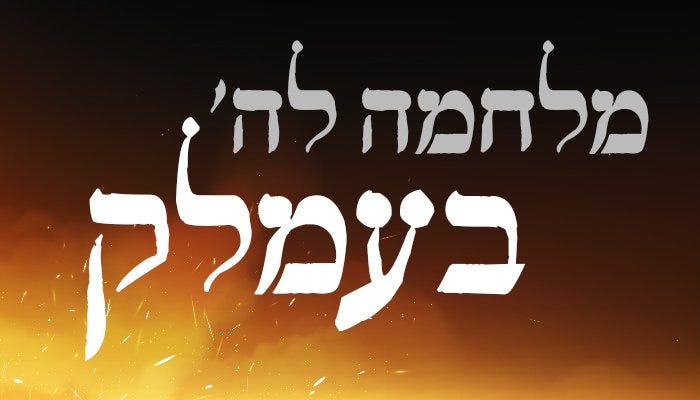
 ישיבת המקובלים נהר שלום | הרב בניהו שמואלי שליט"א - מלחמת עמלק

(Continued from here.)

Amalek’s goal in preventing Daas of holiness from influencing the emotions is for the person to then succumb to his desire to sin.

This is the meaning of the verse: “Amalek is the first of the nations.”[1]

Rashi there explains that Amalek was first in the sense that it was the first nation to attack the Jewish people after the Exodus, despite knowing about the tremendous miracles that Hashem had performed for the Jewish people.

But the deeper explanation is that the Amalek within is “the first,” the source, “of the nations,” of the Seven Nations within, of the seven negative character traits.

For, as explained, the inner Amalek blocks the Daas of the Divine Soul from arousing emotions of love and fear of Hashem.

This vacuum in the emotions automatically enables the seven negative character traits to seize control and tempt one to sin.

This is also the deeper meaning of the verse, “One who is separated seeks pleasure.”[2] By separating the emotions from the intellect, so that the person lacks fear of Hashem, he comes to “seek pleasure,” to indulge in all the forbidden pleasures.

This is the reason that the inner Amalek’s “end is to be destroyed,” for the drive to provoke the desire to sin is evil and irredeemable.

Earlier, we said that we accomplish the mitzvah to banish the Seven Nations by uprooting the desire for sin, through Teshuvah.

This obligation is directly tied to the mitzvah to eradicate Amalek, for Amalek’s objective in his chutzpah is for the person to succumb to his negative desires and fall into sin. Thus, we also eradicate the Amalek within through Teshuvah.

Erasing Amalek by Remembering Him

Another way in which we overcome the Amalek within is by fulfilling the mitzvah to remember the nation of Amalek, as it is written, “Remember what Amalek did to you.” [3]

Based on the above explanation, this remembrance entails a command to reflect upon the distinguishing trait of the nation of Amalek: An all-consuming desire to incite arrogant, insolent rebellion against the truth of Hashem. One should feel pained at the very existence of such obscene evil in the world, and in so doing, one also subdues the Amalek within.

This strengthens the person so that his meditation upon Hashem’s greatness will indeed result in love and fear of Hashem, which will in turn inspire him to observe the Mitzvos with passion and an inner sensitivity to G-dliness.

Based on the Rebbe Rashab’s Sefer Hamaamarim 5643, 5644, 5645, p. 305 ff.; Sefer Hamaamarim 5654, p. 196 ff., p. 337 ff.


[1] Bamidbar ibid.

[2] Mishlei 18:1.

[3] Devarim 25:17.

Wednesday, March 26, 2025

Amalek: Sacrifice for Evil


Amalek: Sacrifice for Evil

Rabbi Yehoishophot Oliver

(Continued from here.)

The trait of Amalek is different and far worse than the seven negative traits, for although those traits entice one to selfishly indulge in forbidden pleasures, they don’t intend to oppose Hashem, but merely to satisfy their desires.

As explained, someone who indulges his negative emotions in sin is being seized with a “spirit of foolishness.” He is not consciously denying the importance of obeying Hashem. Rather, he has temporarily lost his mind, making him do various idiotic things and even act like a degenerate. However, when his intellect regains control and he realizes his foolishness, he will overcome his desires and refrain from such behavior.

In contrast, the trait of Amalek doesn’t seek pleasure and indulgence.

On the contrary, the Midrash states:[1]

To what is the incident [of Amalek] comparable? To a boiling tub of water which no being was able to enter. Along came one ruffian and jumped into it. Although he was burned, he cooled it down for the others. So, too, when Israel came out of Egypt, and Hashem split the sea before them and drowned the Egyptians within it, the fear of them fell upon all the nations. But when Amalek came and challenged them, although he received his due from them, he cooled the awe of the nations of the world for them.

Thus, just as one who jumps into boiling water gets burnt but does so in order to cool it off for others, so was Amalek willing to suffer and sacrifice in order to accomplish their evil agenda of opposing Hashem.

And so is it with the Amalek within: It doesn’t seek pleasure but the opposite, it is even willing to bring suffering and misery upon the person in pursuit of its goal.

Amalek and Chutzpah

This inner ability to irrationally oppose Hashem despite full knowledge of His greatness stems from an intense egotism and arrogance, which manifests itself in chutzpah, audacity.

This can be compared to a lowly person who challenges a man of very great stature. Although he is fully aware of his own lowliness and the man’s greatness, and even of his own dependence on the great man, and that the great man is in the right, not only does he not humble himself before him, but he opposes him brazenly. Such is the chutzpah of the nation of Amalek and of the inner Amalek.

There is a mitzvah to wipe out members of the ancient nation of Amalek, as it is written of Amalek, “erase the memory of Amalek”[2] and “his end is to be destroyed.”[3]

Likewise, the character trait of brazen opposition to the truth of Hashem is evil and irredeemable and must therefore be eradicated completely.

There is a Talmudic discussion about how to render vessels made of various substances fit for use if they have come in contact with forbidden food. This can be done in various ways, such as by being immersed in boiling water (hagalah), or being placed in fire (libun). However, “an earthenware vessel—its destruction is its rectification.”[4] This expression is borrowed and applied with regard to the nation of Amalek and the inner Amalek—it cannot be elevated, it must be destroyed.

Based on the Rebbe Rashab’s Sefer Hamaamarim 5643, 5644, 5645, p. 305 ff.; Sefer Hamaamarim 5654, p. 196 ff., p. 337 ff.


[1] Tanchuma, Ki Teitzei 9.

[2] Devarim 25:19.

[3] Bamidbar 24:20.

[4] Keilim 2:1.


Thursday, March 20, 2025

The Inner Amalek


The Inner Amalek

Rabbi Yehoishophot Oliver

The nation of Amalek embodied a uniquely evil spiritual energy.

After the miracles of the plagues and the splitting of the Red Sea, all the nations feared the Jewish people and certainly wouldn’t dare attack them, as it is written, “The nations heard, they trembled; a shudder seized the inhabitants of Philistia.”[1]

Yet despite being fully aware of all the great miracles that Hashem had performed for the Jewish people, the nation of Amalek attacked them anyway.

Thus, within our divine service, Amalek represents the negative spiritual character trait that knowingly rebels against G-dliness.

Daas: Bringing Intellect Into Emotions

Thus, of Amalek it is said: “He knows (yodei’a) his Master and intentionally rebels against Him.” The word yodei’a denotes the attribute of Daas (literally, “knowledge”).

What is Daas?

Intellect and emotions are two separate and even opposite realms.[2] Intellect on its own is associated with the cognitive traits of Chochmah, the initial flash of understanding, and Binah, in-depth understanding. Intellect stands at a distance from emotions and will not lead to them.

Daas is the trait that draws the abstract knowledge of the intellect down so that the person will feel the emotion that this knowledge necessitates that one feel. For example, if he understands that healthy food is essential for functioning well, the attribute of Daas will evoke within him a desire to go on an appropriate diet.

That is regular Daas. What is Daas of holiness?[3] After one has thoroughly studied a topic related to Hashem’s greatness and reached a certain comprehension, one should concentrate and meditate upon this knowledge deeply (a superficial reflection will have no lasting impact).

This activates the Divine Soul’s cognitive trait of Daas of holiness. This draws that knowledge down into the emotions, inspiring the love and fear of Hashem that this knowledge necessitates.

Thus, it is written, “Know (veyadata) today and take it to your heart that Hashem is the L-rd in the heaven above and on the earth below; there is no other.”[4] This verse exhorts us to attain Daas, for then one will “take it to your heart”—be inspired with holy emotions.

Love and fear of Hashem in turn inspire one to observe the Mitzvos. As discussed earlier, love of Hashem inspires one to perform the positive Mitzvos, while fear of Hashem inspires one to refrain from violating the negative Mitzvos.[5]

A Basic Meditation to Inspire Holy Emotions

One explanation of how this works is that one studies and reflects deeply on the fact that Hashem constantly creates the world with His word, and if He were to withdraw that divine vitality for even a moment, it would cease to exist completely.[6]

This profound awareness of the true nature of the world evokes a desire for this hidden truth to become manifest.

The person is also aware that (until Moshiach comes) the main way that the divine light is brought down and manifest in the world is by performing the positive Mitzvos, for every positive mitzvah draws down a sublime divine light.[7] So his love of Hashem motivates him to observe the positive Mitzvos, and to do so with enthusiasm.

Likewise, he knows that violating the negative Mitzvos obstructs the revelation of the divine light, so his fear of Hashem motivates him to avoid sinning.

Amalek: Cooling Off Holy Daas

Amalek seeks to disrupt all this and prevent the formation of love and fear of Hashem.

Amalek represents impure Daas, which is the antithesis of Daas of holiness (this is the same relationship between impurity and holiness that we discussed earlier, that the seven good character traits counteract the seven negative ones). Daas of holiness brings the intellect to influence the emotions, while the inner trait of Amalek does the opposite.

Consider one who knows that Hashem exists, even that He created the world ex nihilo, and that the entire existence of the world depends on the divine life force that continuously recreates it. He is aware of Hashem’s true greatness and exaltedness.

This knowledge should inspire him to love and fear Hashem, as explained. And yet, within him lies the wicked potential to dismiss all this knowledge, not love or fear Hashem, and act as he pleases. This ability is the Amalek within, which tells one to ignore the truth.

One can even meditate upon Hashem’s greatness in depth, and yet the inner Amalek will stive to prevent this meditation from affecting one’s emotions.

This is also the meaning of the Torah’s statement that Amalek “encountered (karcha) you on the way.” [8] The word for encountered can also mean kar, cool, so the verse is alluding that “he cooled you off.”[9]

One of the ways that the Amalek within cools the person off is that when the person is excited about holy matters, it comes and says things like, “Who says that it is so?” or “So what?” or “It’s not so amazing.” With cynicism and ridicule, the Amalek within aims to cool the person off so that he will serve Hashem in a cold, perfunctory, robotic manner, for which the prophet rebukes the Jewish people: “Their fear of Me has become a command of people, which has been taught.”[10]

But the Amalek within doesn’t stop there. One who lacks any passion in serving Hashem will decline further and further in his observance of Torah and Mitzvos until he ultimately abandons them altogether, G-d forbid. With coldness and apathy, the inner Amalek seeks to uproot everything, just as Haman the Amalekite sought to wipe out the Jewish people completely.

Sinister Severance

Thus, the word Amalek alludes to the word “umolak,”[11] to sever. Melika was the ceremony in the Beis Hamikdash where the priest would sever the head of a bird at the back of its head.

Likewise, the inner Amalek seeks to spiritually sever the head from the body by opposing the Daas of holiness.

It is also precise that Amalek is associated with melikah, where the head is severed at its back.

The[12] brain is divided into three “hollows,” i.e., compartments—two in the front and one in the back, corresponding to the three forms of intellect, Chochmah, Binah, and Daas. The right hemisphere houses the intellect of Chochmah, the left, the intellect of Binah, and the posterior, the intellect of Daas.

Thus, it is precise that melikah is done at the back of the head, for the inner Amalek seeks to sever the intellect of Daas, which is physically located at the back of the head.

A further comparison: The spinal cord provides support for the body and extends from the back of the head, which, as mentioned, houses the intellect of Daas.

The body represents the performance of the positive and negative Mitzvos. As explained, this performance stems from the inspiration elicited by the intellect of Daas.

Thus, just as melikah involved severing the head from the spinal cord and body, so does the inner Amalek seek to sever the intellect of Daas from the emotions so that it can prevent the performance of the Mitzvos.


Based on the Rebbe Rashab’s Sefer Hamaamarim 5643, 5644, 5645, p. 305 ff.; Sefer Hamaamarim 5654, p. 196 ff., p. 337 ff.


[1] Shemos 15:14.

[2] See Hayom Yom, 12 Shevat: “Intellect and emotional enthusiasm are two distinct realms: One is cool and settled, the other is seething and frenetic.”

[3] Tanya, ch. 3, end.

[4] Devarim 4:39.

[5] Tanya, ch. 4, beg.

[6] See ibid., Gate of Unity and Faith, chs. 1-3.

[7] See ibid., chs. 25, 37, 46.

[8] Devarim 25:18.

[9] Tanchuma, Ki Teitzei 9.

[10] Yeshayahu 29:11.

[11] Vayikra 5:8.

[12] See Zohar 5:262a.

Thursday, March 13, 2025

Transforming the Evil Inclination


The Koach Ha’misaveh

The root of the Animal Soul is a raw, undirected desire. This is known as the Koach Ha’misaveh, the Faculty of Desire. This faculty doesn’t desire to commit sin, it just desires pleasure. However, this desire for pleasure is raw and intense, similar to the desire of an animal.

In contrast, while humans also experience desire, the intensity of this desire is normally moderated by intellect, ensuring that it is expressed in a controlled manner. This means that they don’t disregard conflicting obligations.

For instance, a wild predator, like a lion, will attack and kill prey without hesitation when hungry, acting purely on instinct. A human, on the other hand, even when extremely hungry, will often exercise restraint due to social norms, laws, and ethics. For example, in a famine or survival situation, a person might resist stealing food from another or resorting to extreme actions like cannibalism, even if it means suffering.

Thus, the Koach Ha’misaveh is an animal-like desire in that when it is fully expressed in the person, he can lose himself and forget about considerations dictated by the intellect.

In its essence, the Koach Ha’misaveh itself is not evil, because it can be directed towards G-dliness. It is simply a pure potential for intense desire. Therefore, it can be rectified.

Rectifying the Koach Ha’misaveh

What is evil is when the Koach Ha’misaveh assumes an evil form, whether an evil thought, speech, or action. One has then allowed one or more of the seven negative traits to be expressed in the form of a sin. This is the typical or default expression of the Koach Ha’misaveh.

The key to redirecting the Koach Ha’misaveh is Teshuvah, by reminding oneself of Hashem and how abandoning Him is “evil and bitter,” as explained.

When he reflects on this at length, and truly appreciates this to be true, and deeply regrets his sinful deeds, he uproots[1] his desire for those evil deeds and removes the negative spiritual energy that he brought down into the world through those sins.

This is the meaning of the command to banish the Seven Nations in our divine service.

Transforming the Koach Ha’misaveh

Once the person has pulled the Koach Ha’misaveh out of its expression in sinful behavior, he can then take its raw energy and transform it, so that the same intense desire that was once directed toward sin is channeled to desire G-dliness instead.

This is the meaning of the teaching of our sages that the reason that we are told “And you shall love Hashem with all your hearts,”[2] in the plural, is that we should love Hashem with our “two inclinations”—both the Good Inclination and the Evil Inclination,[3] for the Evil Inclination should also be inspired with love for Hashem. But how is it even possible for the Evil Inclination to love Hashem?

The explanation is that the essence of the Evil Inclination is the Faculty of Enticement (Koach Ha’meisis), which provokes the Koach Ha’misaveh so that the person feels a desire for something that he thinks will give him pleasure.

Normally the Evil Inclination provokes the Koach Ha’misaveh to entice the person to do evil, thinking that doing so will bring pleasure. However, by resisting this temptation and by uprooting the desire for sin through heartfelt Teshuvah, one creates the potential to use this power of enticement to instead awaken the Koach Ha’misaveh to desire G-dliness and holiness.

This is what the Talmud means when it explains that one should bring the Evil Inclination to love Hashem.

This is also the deeper meaning of the verse discussing the Messianic Era, “Then I [Hashem] will transform for the nations a pure tongue, that all will call upon the name of Hashem and serve Him with one purpose.”[4] Just as the nations will be transformed to serve Hashem, so can we transform our Evil Inclination to serve Hashem, as explained.

Based on the Rebbe Rashab’s Sefer Hamaamarim 5643, 5644, 5645, p. 305 ff.; Sefer Hamaamarim 5654, p. 196 ff., p. 337 ff.

_____________________________

[1] See Derech Mitzvosecha, Mitzvas Vidui U’teshuvah.

[2] Devarim 6:5.

[3] Berachos 54a. Sifri and Rashi on the verse.

[4] Zephaniah 3:9.

Saturday, August 10, 2013

Lift the Veil

Lift the Veil

 Rabbi Yehoishophot Oliver

In an earlier post, we explained the difference between gashmiyus—“physicality” and chumriyus—“coarseness.”

This also explains the lowly state of our world. In reality, within every being in our universe there is a chayus Eloki, a divine vitalizing force, that creates it as it is, maintains its existence, and without which it could not exist. Yet although it is right here within every single being, we do not feel it.

But it wasn’t always this way. In the world’s original state, before the sin of Adam and Chava, “the divine presence dwelt in this lowly world.”  Then one could sense tangibly how the existence of every physical being stems from the chayus Eloki, and so one naturally submitted to that vitality, and therefore to Hashem.

But the sin of eating from the Tree of Knowledge tainted the cosmos as a whole. It created an intense veil over the chayus Eloki. Chassidus calls this veil chumriyus, and the chumriyus in our world is very great.

However, during the period of exile, we are charged with the mission of rectifying the cosmos though our performance of Torah and Mitzvos, and this gradually diminishes the chumriyus. The veil of chumriyus will be completely lifted when Moshiach comes, and all will “see”  the underlying reality of the chayus Eloki (may it happen now!).

This is true not only on a grand scale, but also on a miniature scale, even before Moshiach comes. We may not yet be able to refine ourselves to the point of literally seeing the chayus Eloki, but though hard work, we are all fully able to reach a far deeper level of inner sensitivity to G–dliness (see here and here).

The principle here is that the more a vessel is refined, the more it can contain. Consider the mind: The more one’s mental capacities are refined and sharpened, the deeper the concepts one is able to grasp. Likewise, the more the person engages in avodah (see here) to refine the coarseness within of the Bestial Soul and the body, the more he becomes open and receptive to awareness of Hashem (see here).

This means that when he meditates upon Hashem’s greatness before prayer, his mind becomes much more receptive, and the concept he reflects upon is truly absorbed and integrated into his mind and heart. Likewise, when he studies Torah, he will sense the divine light within Torah (see here).

And then, when he goes out to engage with the outside world, not only will this interaction not adversely affect him by detracting from his sensitivity to G–dliness (as it would otherwise), but it will enhance it:

In the world at large, he will sense the world’s dependence on the chayus Eloki. On a personal level, he will be imbued with the awareness that all his blessings come from Hashem alone; he will notice Hashem’s guiding hand, intimately controlling every aspect of his life; and he will succeed at illuminating everyone and everything in his surroundings with an ever-greater awareness of Hashem’s presence.

Based on the Rebbe Rashab’s Sefer HaMaamarim 5678, p. 85.


Dedicated in honor of the birthday of my dear daughter, Shaina bas Atarah Arielle, 
on 22 Tammuz.


___________________________________
Like what you read? The articles I write take a lot of time and effort. Please contact me to sponsor an article for (at least) $36 in honor of the birthday, wedding anniversary, or yarhtzeit of a loved one, or for a refuah shleimah or the like. Also, see here concerning the tremendous merit of supporting the dissemination of Chassidus, and the blessings that one receives for doing so.

Tuesday, July 2, 2013

Overcoming the Dangers of Intense Religiosity (pt. 2)


Overcoming the Dangers of
Intense Religiosity (pt. 2)

Rabbi Yehoishophot Oliver

In the previous installment, we discussed how good intentions and holy passions can go awry because of a lack of inner refinement.

A parallel phenomenon is found among the angels. As discussed earlier (see here), although the angels possess vastly superior intellect, they are fundamentally emotional beings, whose core is filled with passionate feelings of love and fear of Hashem, and so they are not truly intellectual in the way that man is.

Starting from Beriyah, each level in Seder Hishtalshelus (the spiritual multiverse—see here) devolves directly from the one above it. So Beriyah devolves into Yetzirah, Yetzirah into Asiyah, and the spiritual plane of Asiyah devolves into our physical world, which is at the bottom of the world of Asiyah. This means that all the beings that exist in Beriyah also exist in Yetzirah, but in a lesser, more egotistical state, and so on.

So when the intense love and fear of Hashem of the angels in the higher spiritual realms (Yetzirah, Yetzirah into Asiyah—no angels exist in Atzilus, the world above Beriyah) devolves into our physical world, which is the lowest of all levels—“the lowest level possible as regards the concealment of divine light, a double and redoubled darkness to the extent that it is filled with forces of Kelipah and sitra achra, which are literally against Hashem, saying ‘I exist, and there is nothing else but me’” (Tanya ch. 36)—these feelings go completely awry:

The angels’ love of Hashem turns into chessed (kindness and love) of Kelipah—the lusts and pleasures of the flesh that we (if we are G-d fearing, do our best not to) see in the secular society around us. (Once, Reb Itcheh der Masmid, a great chossid, had to visit the city of Manhattan (in the ‘20s, I think). His comment: “Do hobn di malochim gut ongemacht”—“here the angels really relieved themselves.”)

Likewise, the angels’ intense fear of Hashem turns into gevurah (strictness and fear) of Kelipah—all the forms of negativity, depression, conflict, hatred, and violence that so pervade the society and culture in which we live.

All these powerful and captivating negative energies that we perceive in the world around us are in fact the devolution—or, as Chassidus calls it, the pesoles, the “waste matter”—of that intense passion of the angels.

However, angels do not have free choice, so they cannot choose to refine themselves in a way that would prevent their passion from leading to anything undesirable. In contrast, although man’s capacity for emotion is infinitesimal when compared with that of the angels, he was endowed with overcome his emotions. He does this by choosing to choose to use his intellect in a way that refines himself so that his expression of emotions will not result in a negative outcome.

Stay tuned for the next installment!

Based on the Rebbe Rashab’s Sefer HaMaamarim 5660, pp. 8-9.

Read this essay in full on Scribd here!

Dedicated by Reb Zvi Rona and family l'ilui nishmas Golda Ruth bas Moshe Zvi HaLevi on 22 Tammuz.

___________________________________
Like what you read? The articles I write take a lot of time and effort. Please contact me to sponsor an article for (at least) $36 in honor of the birthday, wedding anniversary, or yarhtzeit of a loved one, or for a refuah shleimah or the like. Also, see here concerning the tremendous merit of supporting the dissemination of Chassidus, and the blessings that one receives for doing so.

Saturday, June 29, 2013

Overcoming the Dangers of Intense Religiosity (pt. 1)


Overcoming the Dangers of
Intense Religiosity (pt. 1)

Rabbi Yehoishophot Oliver

Whoa. Take it easy.

Is it good to be passionate and intense about goodness and holiness? Yes, undoubtedly. In fact, we are commanded to strive for this state, and not only is one who lacks passion neglectful, but he is at great risk of sliding into sin, for spiritual coldness and apathy lead one to all manner of evil, may Hashem save us.

Yet one must also take precautions to ensure that this intensity of feeling not go overboard and be expressed inappropriately.

The goal of learning about Hashem’s greatness is that this knowledge inspire one to genuine feelings for Hashem—middos (emotions) of ahavah ve’yirah, love and awe of Hashem (see here).

Then instead of simply going through the motions—known as “Mitzvas anoshim melumadah”—one’s heart will be in it:
  • Not only will he no longer view Mitzvos as an odious chore, but since he knows that performing the Mitzvos draws him into a close connection with Hashem, he eagerly looks forward to the opportunity to fulfill them, and does so with great gusto and joy. 
  • Likewise, his awareness that sin separates and distances him from Hashem makes the very thought of sinning repulsive and motivates him to do his utmost to avoid falling in sin. 
The Torah states that this process of inner change is the mission of every single Jew.

To explain, Chassidus teaches that Hashem “made this one,” Kelipah, spiritual impurity, “opposite this one,” Kedushah, holiness. Kelipah and Kedushah (see here) parallel each other. The same is true of the emotions that stem from these two cosmic forces, respectively: The unworthy emotions of the Bestial Soul parallel the worthy emotions of the Divine Soul (see here).

When one succeeds in this process of transforming one’s emotions, the holy emotions replace the unholy ones (see here). In this state, love of physicality is replaced by its counterpart in holiness, love of Hashem. Fear related to one’s physical life (e.g., fear of pain, poverty, shame, and so on) is replaced with fear of Hashem.

However, by their very nature, emotions are egotistical. This holds true not only of the undesirable or at least selfish emotions of the Bestial Soul, but even of the holy emotions of the Neshamah, the Divine Soul.

Emotions are all about personal feelings and desires. One could desire to indulge in hedonistic pursuits or to attach oneself to the loftiest heights of holiness—either way, the ego is involved. Although in the latter case it is expressed in a constructive and virtuous way, it is still necessarily present.

This is especially the case when the emotion is felt tangibly. An emotion could be present but not felt, for it lies under the surface (cf. Tanya ch. 16). But when an emotion is tangibly felt, there is a strong egotistical component even in the holy emotions, and this is bad. This creates the serious danger that when the emotion is expressed, it may devolve into its counterpart in Kelipah. I will provide a handful of more common examples, with the caveat that this is only a very brief treatment of such behaviors, for this process can manifest itself in numerous forms:

Love: Love involves opening up and transcending limitations for the object of one’s love. So when love of Hashem goes awry, one  loses a sense of boundaries, and then openness to and love of Hashem degenerate into dangerous openness and evil love—material indulgence and forbidden pleasures.

For instance, during prayer the Jew becomes aroused with passionate  love for Hashem. After prayer, the intense feeling remains, but it becomes expressed in a more intense desire to indulge the senses, e.g., gluttonous eating.

Fear: Fear drives one to create limits and boundaries out of a sense of caution. So when fear of Hashem goes awry, the person becomes so filled with fiery passion or with a sense of self-limitation and inhibition gone too far that he succumbs to the negative emotions of the Bestial Soul. He may break out in sudden anger, sink into depression, inflict pain and torment upon others, or the like. 

Another manifestation of this egotistical element of fear of Hashem is when the person  shows off his intense desire to avoid sin. Even when he has no conscious desire to do so, and he is simply expressing his genuine emotion of fear of Hashem, the showiness is inappropriate. If his emotions were pure, this self-display would not occur, and this trait stems from his deep-seated condition of spiritual coarseness.

This is an example of what Chassidus calls yenikah lachitzonim, “giving sustenance to negative spiritual energies.” This means that when something holy lacks purity, it unwittingly gives strength to the forces of Kelipah, with often disastrous and tragic results. This expression is also used more broadly to describe anything good and holy that is done in a foolish, inappropriate, or otherwise inadvisable manner and therefore leads to an unfavorable outcome.

In this case, it means that the small element of ego in otherwise worthy and holy feelings is able to be grabbed and used by the evil inclination to feed undesirable emotions.

What is the key to overcoming these dangers? Stay tuned!

Based on the Rebbe Rashab’s Sefer HaMaamarim 5660, pp. 8-9;
Sefer HaMaamarim 5670, pp. 103-104.  

Read this essay in full on Scribd here!


This post was dedicated by Rochel'e and Sholom Ber Odze in honor of the birthday of Yeshaya Yaakov bas Rochel on 24 Sivan. May he have a shnas hatzlocho begashmiyus u'veruchniyus!

Also dedicated by Zvi Rona and family l'ilui nishmas 
Shlomo ben Pesach, whose yahrtzeit was on 8 Tammuz.


Dedicated in the merit of a speedy release for the captives Yonasan ben Malka (Jonathan Pollard), Sholom Mordechai Halevi ben Rivka (Sholom Rubashkin), Yaakov Yehuda ben Shaindel (Jacob Ostreicher), and Zeva Rochel bas Chaya (Wendy Weiner Runge).

___________________________________

Like what you read? The articles I write take a lot of time and effort. Please contact me to sponsor an article for (at least) $36 in honor of the birthday, wedding anniversary, or yarhtzeit of a loved one, or for a refuah shleimah or the like. Also, see here concerning the tremendous merit of supporting the dissemination of Chassidus, and the blessings that one receives for doing so.

Monday, June 3, 2013

Evil and Free Will


Evil and Free Will

Rabbi Yehoishophot Oliver


This post comes in continuation to the previous two posts on the topic of angels: Of Angels and Men and Programmed Purity Vs. Frail Freedom.

Earlier (in the latter link above) we discussed how man holds the entire Seder Hishtalshelus within himself in miniature, and that this also endows man with the quality of free will, of choosing between virtue and sin, righteousness and wickedness. No other creation has this ability.

To explain, in the highest spiritual world, Atzilus, no evil exists. Even the divine attribute of gevurah, severity, which is apparently negative, exists there in a pure and holy state. However, in the worlds of Beriyah, Yetzirah, and Asiyah, what was the gevurah in Atzilus degenerates partially into Kelipah, an unholy force that conceals over the existence of Hashem. The lower the level, the further the Kelipah declines, until it assumes the form of the evil in our physical world. Likewise, the quality of goodness as it exists in our world stems from the divine attribute of chesed, kindness.

As mentioned, man contains all the supernal attributes within him. This includes both the attributes of chesed and of gevurah. Thus, he also contains that which evolves from chesed and gevurah, namely, the qualities of good and evil. These are the Good Inclination and the Evil Inclination.

It is this dual nature that enables man to have free choice, the ability to choose to act as he wishes.

In contrast, an angel exemplifies a certain pure quality—whether chesed, gevurah, or the like—and it possesses no evil side. As Moshe Rabeinu’s rhetorically asked the angels, “Do you have an Evil Inclination among you?”[1] Since an angel possesses no evil, it is simply unable to be attracted to and tempted by evil, and so it lacks free choice.

Although the verse speaks of the angels “knowing good and bad,”[2] the angels relate to knowledge of evil in a purely abstract, clinical way. This knowledge cannot excite angels with any desire for evil because they do not possess evil within themselves at all. In contrast, man’s Evil Inclination causes his very knowledge of evil in the world to affect him and excite him, and it may well bring him to stray after it.

This is what enables man to have free choice. Since he has evil within him, he is free to choose to sin; thus, when he does good he is not following his natural programming, but acting out of truly free choice, with no compulsion whatsoever.

This is very precious to Hashem, and so one who chooses to do good and not sin is blessed with a sublime revelation of G–dliness. This explains further how meluchah, willing acceptance of divine sovereignty, is only possible for mankind, who possesses free choice, but not for angels.

Based on the Rebbe Rashab’s Sefer HaMaamarim 5660, p. 11.

_____________
[1] Shabbos 88b.
[2] Bereshis 3:5.


Dedicated by Rabbi Levi and Chana Kurinsky of Melbourne in the merit of the birth of their daughter, Shterna Sarah bas Levi Yitzchok Halevi, on Shabbos, 16 Sivan – Parshas Beha’alosecha.  Yegadluhoh leTorah, l'chupah, ulemaasim tovim mitoch harchovoh!


Dedicated by Tzvi and Yehudis Rona and family of Sydney as a merit for the yahrtzeit of Pinchas ben Yitzchok HaLevy on 22 Sivan.


Dedicated in the merit of a speedy release for the captives Yonasan ben Malka (Jonathan Pollard), Sholom Mordechai Halevi ben Rivka (Sholom Rubashkin), and Zeva Rochel bas Chaya (Wendy Weiner Runge).


Like what you read? The articles I write take a lot of time and effort. Please contact me to sponsor an article for (at least) $36 in honor of the birthday, wedding anniversary, or yarhtzeit of a loved one, or for a refuah shleimah or the like. Also, see here concerning the tremendous merit of supporting the dissemination of Chassidus, and the blessings that one receives for doing so.

Monday, May 27, 2013

Programmed Purity Vs. Frail Freedom


Programmed Purity
Vs. Frail Freedom

Rabbi Yehoishophot Oliver


(This post is a continuation of this earlier post: Of Angels and Men)

Hashem’s creation is awesomely vast. It encompasses not only our world, but also the entire Seder Hishtalshelus, the awesomely vast system of higher spiritual worlds that ends with our physical universe (see here).

Yet all the beings that Hashem created possess a fundamental limitation: Each one is endowed with a very small repertoire of qualities and character traits. With these few traits each creature is equipped to carry out its individual role, but is unable to perform any other role.

In the animal kingdom we find that each species exhibits a distinct emotional tendency. For instance, the raven is cruel, while the eagle is compassionate, and so on.

So is it in higher spheres: The angels, which are compared to animals,[1] are also limited to the distinctive traits with which they were created. Gavriel, the angel of fire and strictness, is unable to deviate from its nature and be kind, while Micha’el, the angel of water and kindness, is unable to be harsh. Thus, of the supernal angels it is written that Hashem “established them forever and ever; He has established a decree that shall not be transgressed,”[2] for they are unable to change.

This is also the reason that “one angel cannot perform two missions”:[3] since its character is fixed, it is incapable of expressing itself in any other way.

In contrast, Hashem fashioned mankind as a microcosm of the Seder Hishtalshelus, and so his inner self encompasses all levels in miniature. Thus, he is endowed with the entire spectrum of character traits, ranging from the highest to the lowest and from one extreme to another.

We can observe this is in the classic episode of the binding of Yitzchak. Hashem asked Avraham, who personified kindness,[4] to deviate from his nature and act with such harshness as to kill another person—and not just anyone, but his only son. Yes, Avraham was ready to obey because Hashem requested it of him. But how could he have obeyed, if his defining attribute was kindness? The answer is that no matter how much a person excels in a particular trait, he always retains the ability to act differently. Thus, although Avraham excelled in kindness, he could still be cruel.

Conversely, even the criminal guilty of the most dastardly crimes, the sort whom all will agree belongs in an electric chair, is capable of being kind and loving.

This is the reason that when the Torah describes the creation of all the other creatures, Hashem is referred to in the singular—“And Hashem made the firmament”;[5] “And Hashem made the animals of the earth”;[6] and so on. Only in connection with mankind do we find the plural form—“Let us make man.”[7] This alludes to the unique multiplicity that Hashem implanted within the mankind such that his spiritual makeup parallels all the higher heavenly spheres, and thus runs the entire gamut of qualities.

Based on the Rebbe Rashab’s Sefer HaMaamarim 5660, p. 10.

(To be continued, G-d willing.)

________________________________________________
[1] Sifri, end of Bahaaloscha; Bamidbar Rabba, end of Naso.
[2] Tehillim 148:6.
[3] Bereshis Rabbah 3:2.
[4] Avraham is associated with love and kindness, as it is written, “Avraham, who loves Me” (Yeshayah 41:9). Moreover, “The divine attribute of kindness said before the Holy One: ‘Master of the Universe, since the days of Avraham, I have not have to perform my job, for Avraham serves in my stead’” (Sefer HaBahir 191, cited in Pardes 22:4).
[5] Bereshis 1:7.
[6] Ibid. 1:25.
[7] Ibid. 1:26.


_________________
Sponsored by Pinchas and Feygl Cylich (Pinchos Boruch ben Yeshaya Yaakov and Feiga Matl bas Freidl) in honor of their parents, aleihem ha'sholom: Yaakov ben Boruch, Rayzl bas Pinchos, Yaakov Yisroel ben Shamai, and Freydl bas Mendl.


Dedicated in the merit of a speedy release for the captives Yonasan ben Malka (Jonathan Pollard), Alan Gross (Aba Chonah ben Hava Chana), Sholom Mordechai Halevi ben Rivka (Sholom Rubashkin), and Zeva Rochel bas Chaya (Wendy Weiner Runge).


~~~~~~~
Like what you read? The articles I write take a lot of time and effort. Please contact me to sponsor an article for (at least) $36 in honor of the birthday, wedding anniversary, or yarhtzeit of a loved one, or for a refuah shleimah or the like. Also, see here concerning the tremendous merit of supporting the dissemination of Chassidus, and the blessings that one receives for doing so.

Tuesday, May 21, 2013

Of Angels and Men

(kudos to in770.com)

Of Angels and Men

Rabbi Yehoishophot Oliver

Meluchah versus memshalah 

Chassidus distinguishes between two kinds of rule: meluchah, kingship, and memshalah, domination.

Meluchah exists when the people voluntarily appoint a certain person king, committing to comply with his every edict, as in the verse, “They accepted His Kingship willingly.”[1]

In contrast, memshalah exists when one party rules over another against or without that person’s will, typically through the use of force. Although the person submits, he does so begrudgingly. The domination of mankind over the animal kingdom is an example of memshalah: Only once duress is applied does the animal submit, because it lacks the intellectual ability required to choose to submit to man voluntarily.

This is the difference between mankind and angels. Man has free choice—the ability to consciously, freely choose to submit to and obey Hashem, or sin and rebel against Him, G–d forbid.

Angels, on the other hand, are referred to as animals,[2] and so just as animals can only be ruled through memshalah, so are angels only capable of submitting to Hashem’s rule through His memshalah.

To be sure, there is a vast difference between human memshalah over animals and divine memshalah over angels. Animals submit to humans out of fear of punishment, while angels submit to Hashem out of a passionate desire to connect to G–dliness. Yet the angels’ submission is still considered memshalah because it comes naturally and automatically, and the angels are incapable of consciously choosing to connect to Hashem.

Now, this is not to say that angels lack intellect. On the contrary, angels possess a level of intellect far superior to that of mankind.[3] This is even true of the lowest angels, but all the more so of the highest angels, those found in the world of Beriyah, the Seraphim (for more on these angels, see here).

The world of Beriyah is suffused with a revelation of the level of Binah (“understanding”) of Atzilus, the world above it,[4] which grants the Seraphim, who reside in that world, a sublime understanding of Hashem’s greatness. Thus, the Seraphim declare “Holy, holy, holy is the L–rd of Hosts,”[5] because they truly grasp, with their powerful, sublime intellect, how Hashem utterly transcends all the spiritual worlds. This awareness inspires them to an all-consuming love for Hashem and a yearning to become subsumed in that level of pure G–dliness. This feeling is so intense that they become burnt up and cease to exist.

Yet although angels possess intellect, their primary form of relating to Hashem and serving Him is not intellectual, but emotional. Angels are endowed with a powerful ability to experience emotions of love and fear of Hashem. These emotions are not produced by the angels’ intellect, but exist as an inborn desire that defines their very being. This is why angels are compared to animals, which are also naturally programmed to follow their instincts and desires, without any need for or possibility of a prior intellectual process.

Free choice

But if angels possess intellect, and their submission to Hashem results from their intellectual understanding of Hashem’s greatness, doesn’t that prove that they also have free choice?

No, it doesn’t. Yes, angels use their intellect to excite their emotions; however, intellect is merely the trigger. Understanding Hashem’s greatness to whatever extent is necessary for them sets off their existing inborn emotions of love and fear for Hashem, so that excitement is not in and of itself intellectually based.

In contrast, man’s defining characteristic is intellect, and he is capable of using his intellect to create emotions. These emotions exist and are defined entirely by the nature of the intellect that produced them.

This is also the reason that the emotions of angels—and animals—are so powerful. Had their emotions been created by their intellect, those emotions would be much weaker, because such emotions are inherently limited by the nature and depth of the intellect that produced them. But since the emotions of angels and animals exist independently of intellect, the nature and intensity of these emotions is not dictated and limited by intellect, and this enables their emotions to be intense and unbridled.

This explains further why Torah refers to angels as animals, why angels’ possession of intellect does not detract from their lack of true free choice, and why Hashem’s rule over angels is defined as memshalah.

Developing worthy human emotions

Although mankind’s core characteristic is intellect, this is not to say that emotions are unimportant. On the contrary, man must not suffice with his intellectual grasp of G–d’s greatness; rather, this knowledge should inspire him to openly-felt emotions,[6] as it is written, “You shall know today and set it upon your heart that Hashem is the L–rd”[7]—“You shall know” must lead one to “set it upon your heart” (for further explanation, see here).

Such emotions (although weaker, as above) are settled and balanced, real and genuine, and will therefore also inspire the person to passionate observance of Mitzvos and good deeds, refined and loving treatment of others, and appropriate caution from falling into sin.[8]

In conclusion, These emotions are superior to those of animals—and in a sense, also to those of angels—because they are produced by the intellect.

Based on the Rebbe Rashab’s Sefer HaMaamarim 5660, p. 8.

________________________________
[1] Evening Prayer Liturgy. For an earlier post that elaborates on this topic, see here.
[2] Sifri, end of Bahaaloscha; Bamidbar Rabba, end of Naso. Cf. Tanya ch. 36.
[3] Cf. Mishneh Torah, Hilchos Yesodei HaTorah, 3:9.
[4] For more on the difference between Atzilus and the worlds below it, the first of which is Beriah, see here.
[5] Yeshaya 6:3.
[6] Cf. Tanya ch. 16.
[7] Devarim 4:39.
[8] It is also possible for emotions of love and fear of Hashem to stem from the Jew’s natural, inborn love of Hashem (cf. Tanya chs. 18-19, 25, et al.), but that is beyond the scope of this essay.


Dedicated by Avi Turner and family l'ilui nishmas Nechama bas Reuven a"h, and by Mrs. Rivka Katz and family  l'ilui nishmas Reb Mordechai Meir haKohen ben Chaim Elazar haKohen a"h.


Dedicated in the merit of a speedy release for the captives Yonasan ben Malka (Jonathan Pollard), Alan Gross (Aba Chonah ben Hava Chana), Sholom Mordechai Halevi ben Rivka (Sholom Rubashkin), and Zeva Rochel bas Chaya (Wendy Weiner Runge).


~~~~~~~
Like what you read? The articles I write take a lot of time and effort. Please contact me to sponsor an article for (at least) $36 in honor of the birthday, wedding anniversary, or yarhtzeit of a loved one, or for a refuah shleimah or the like. Also, see here concerning the tremendous merit of supporting the dissemination of Chassidus, and the blessings that one receives for doing so.

Wednesday, November 7, 2012

Essential spiritual food and clothing

Essential spiritual food and clothing

Rabbi Yehoishophot Oliver

Generally speaking, livelihood includes two kinds of basic needs: food and clothing. These are both necessities for livelihood, i.e., physical survival, for a person must have some food and clothing to survive. However, they serve very different functions.

Food is an ohr pnimi, an “internal light”—an influence that comes down and adapts to the level of the recipient on its terms, who internalizes and unites with it. So when a person eats, he takes the food inside, and once it has been digested, it becomes one with his flesh and blood. This then enables one’s physical life to continue, for the food becomes converted into blood and other nutrients that spread throughout the body, strengthening it and making it a fit vessel for the soul to become fully vested in it, enabling the soul to continue giving life to the body.

In contrast, clothes represent an ohr makif, an “encompassing light,” an influence that does not descend to the level of the recipient, but encompasses him. Likewise, clothes do not actually become one with the wearer; rather, they surround him and benefit him by providing warmth, maintaining modesty, expressing his identity, and so on.

The same is true of spiritual livelihood and spiritual health, which depend upon the combination of two parallel kinds of divine service—Torah and Mitzvos.[1]

Torah is compared to eating, as it is written, “Come and partake of My bread,”[2] and “Your Torah is in my innards,”[3] for the Torah is an ohr pnimi that a Jew is obligated to intellectually “digest” and unite with.

In contrast, Mitzvos are compared to clothing, for they elicit upon the Jew an intense ohr makif, a sublime divine light, that descends upon the Divine Soul, the Bestial Soul, and the body, but does not permeate the Jew’s personality, which primarily constitute the intellect and emotions.[4]

So when Hashem instructs in the Torah to fix regular times for Torah study, to perform Mitzvos, davven with a minyan, and so on, these are not merely worthy actions that we do because we want to make Hashem happy, or the like. Nor are they merely a fulfillment of our duties to Hashem. Although they include all the above, we should realize that Torah and Mitzvos simply provide our soul—which constitutes the Jew’s true self (see here)—with the “food” and “clothing” that it needs in order to survive and thrive.

The Rebbe Rashab’s Sefer HaMa’amarim 5653, p. 262-263.

_____________________________
[1] Zohar 3:7b.
[2] Cf. Tanya ch. 5.
[3] Mishlei 9:5.
[4] Tehillim 40:9.
[5] Cf. Tanya chs. 5, 25, 46.


Dedicated in the merit of a speedy release for the captives Yonasan ben Malka (Jonathan Pollard), Jacob Ostreicher (Yaakov Yehuda ben Shaindel), Alan Gross (Aba Chonah ben Hava Chana), Sholom Mordechai Halevi ben Rivka (Sholom Rubashkin), and Zeva Rochel bas Chaya (Wendy Weiner Runge).

Dedicated by Dovid and Bracha Tsap as a merit for their daughter Sara Rachel bas Hinda Zelda Bracha, in honor of her birthday on 10 Cheshvan.


Like what you read? The articles I write take a lot of time and effort. Please contact me to sponsor an article for (at least) $36 in honor of the birthday, wedding anniversary, or yarhtzeit of a loved one, or for a refuah shleimah or the like. Also, see here concerning the tremendous merit of supporting the dissemination of Chassidus, and the blessings that one receives for doing so.