"Moshiach is ready to come now-our part is to increase in acts of goodness and kindness" -The Rebbe

Showing posts with label love for a fellow Jew. Show all posts

Friday, May 24, 2013

On Marital Harmony


On Marital Harmony

Rabbi Y. Oliver

Below is a compilation of translations of letters from the Rebbeim concerning marital harmony. 


One Should Only Rebuke One’s Wife with Soft Words

Don’t speak to your wife with harsh words. This will cause dispute and strife, and your goal will not be attained. Rather, speak with soft, calm words, as one speaks to his friend, and explain how one should not act in this manner, all in a soft manner, and then you will have an impact, and the goal will be fulfilled. This is crucial and very fundamental.

Sefer HaSichos 5703, p. 233.

Promoting Family Unity through Joint Shabbos Meals

One of the first steps toward promoting family unity is to strengthen the custom for the entire family to eat a joint meal on the night of Shabbos.

Letters from the Rebbe, Vol. 3, p. 135.


Benefit of Compromise in Marriage

I hope that over time you will you will reach the conclusion that [in marriage] sometimes one should compromise, and through a small compromise one can gain a great deal.

Igros Kodesh, Vol. 5, p. 81.

Don’t Emphasize Your Spouse’s Faults

Until Moshiach arrives, no one exists without faults. Thus, it is clear that just as one spouse has a fault, so does the other, and just as one would not want one’s own faults to be emphasized, so should one not emphasize and amplify the faults of the other. This is the way all Jews should relate to one another, but this applies all the more when relating to your husband, who is the father of your children.

My intent is not to criticize, but merely to draw your attention to the fact that your situation is not as forlorn as you present it, and it is not unusual, as it appears to you.

Each of you should ignore certain things, and it is preferable for each of you find ways to bring peace in the home. Once this is attained, this is the vessel through which Hashem will provide blessings and success, good health, livelihood, and nachas from children.

Igros Kodesh, Vol. 5, p. 61.


Monday, June 25, 2012

Considering our impact upon others


Considering our impact upon others
Rabbi Yehoishophot Oliver


“Why should I care about the impact my actions might have upon others?” some ask. “It’s not my problem. Let them mind their own business!” The Rebbe responds:
Those who don’t behave modestly do not only defy the path of Torah. Their behavior contravenes basic decency, basic morality, and simple common sense.


When one behaves immodestly by exposing a part of the body that ought to be covered, one’s intent is to provoke the evil inclination—the wicked side of the other person.


This does not bring the other person to work better. Nor will it stimulate his mind, and make him smarter. Nor will it improve his character traits by positively affecting the respect he accords to his parents, brothers, or sisters, or even for his own wife. Nor will it influence him to donate more charity.


What is the impact of dressing in violation of the requirements of modesty? If until now, the other person’s wicked side was hidden, or not excited and aroused—one provokes that person and inflames that side.


And then one shares in the [responsibility] for the wickedness of the other person. One doesn’t benefit in any way, because it’s the other person’s wickedness—the other person fulfills his desire, whether through gazing, or in another form. Yet it is worthwhile to do everything, as long as one provokes another person—and not his good side, but his wicked side.


One does damage, may G–d save us, and not only to one’s own Divine Soul, but also to another person, and still another—in fact, to everyone one meets. What an utterly degenerate path—may Hashem protect us.


Sichos of 12 Tammuz, Balak, and 14 Tammuz 5730
(kudos to Rabbi Moshe Wiener, shlita, for sending me the Hebrew original)
Obviously, the principle in the above address applies not only to the realm of modesty.


Everyone has both a good inclination and an evil inclination, two forces that are in constant conflict over the course of our entire lives.[1] Thus, every interaction we have with others can involve either inclination.


Now, we are all blessed with free choice, and so one who chooses to follow his evil inclination can refuse to be allow himself to be positively influenced by a person who is a good influence; conversely, one who chooses to follow his good inclination can refuse to allow himself to be negatively influenced by a person who is a wicked influence.


However, the fact that the recipient of the negative influence chose to succumb to temptation by his or her own free choice does not absolve the influencer of wrongdoing any more than the fact that the recipient of a positive influence chose to accept this influence by his or her own free choice does not divest the one who chose to exert that influence of any reward and credit.


And so the one who brings others to Teshuvah and spiritual growth will be rewarded, while the one who exerts the opposite influence on others will receive the opposite consequence, may Hashem save us.[2]


Moreover, although we all have the ability to choose “life and goodness” instead of choosing “death and evil,”[3] the struggle might be extremely difficult.[4] The foundation of Torah is “what is hateful to you, do not do to your fellow,”[5] Thus, putting another person through such a struggle is not only a sin against Hashem (of course, evil in and of itself), but also a sin against one’s fellow, a fundamental violation of the commandment to love one’s fellow Jew.


Whether we like it or not, our behavior has a powerful impact upon those around us. It will evoke, or at least apply a certain amount of pressure to evoke, one of their inclinations. Which will it be?


_________________________
[1] Cf. Tanya chs. 9, 29.
[2] Cf. Avos 5:18—“One who causes the multitude to be meritorious, no sin will come through his hand. One who causes the multitude to sin is not given the opportunity to do Teshuvah.” Moreover, “One who causes another to sin is worse than one who kills him” (Bamidbar Rabbah 21:4-5) for “Spiritual death is worse than physical death” (Derech Chaim 5a; Igros Kodesh Admur HaRayatz, Vol. 3, p. 520; Likkutei Sichos, Vol. 1, p. 111).
[3] Devarim 30:15.
[4] Cf. Tanya ch. 30.
[5] Shabbos 31a.


Dedicated in the merit of a speedy release for the captives Yonasan ben Malka (Jonathan Pollard), Sholom Mordechai Halevi ben Rivka (Sholom Rubashkin), and Zeva Rochel bas Chaya (Wendy Weiner Runge).


Also dedicated by Rivkah Katz and family lizchus refuah sheleimah for her mother, zol gezunt zein, Ettel Nechama bas Baila.


~~~~~~~~~~~~~~
Like what you read? The articles I write take a lot of time and effort. Please contact me to sponsor an article for (at least) $36 in honor of the birthday, wedding anniversary, or yarhtzeit of a loved one, or for a refuah shleimah or the like. Also, see here concerning the tremendous merit of supporting the dissemination of Chassidus, and the blessings that one receives for doing so.

Monday, November 21, 2011

How to View Sin and Sinners

The Tanya[1] speaks of a “kal shebekalim,” a person who lives a sinful, corrupt lifestyle. When we view him, we might jump to judge and condemn him for his revolting behavior. But the Torah exhorts us: “Do not judge your fellow until you have stood in his place.”[2]

Although this person’s sins are not justifiable, G–d forbid, they are understandable in light of the excruciatingly difficult situation in which Hashem puts him: 1. His obligation to earn a living necessitates that he spend all his time in a corrupt environment in which he is exposed to all manner of debauchery and crime, and is constantly faced with very difficult challenges; 2. Hashem created him with an intense evil inclination.

These two elements—a negative environment, and a strong evil inclination—combine against him such that when he is faced with temptation, the passion to sin burns within him so feverishly that he can only overcome it through a herculean effort. Is it any wonder, then, that he fails?

Yes, he has free choice. By reminding himself that Hashem is watching his every deed, he can arouse himself to fear Hashem and restrain himself from stumbling in sin. Since he could have used this method to resist temptation, his failure to do so is inexcusable. “It was very hard” is just not good enough.

However, this is a thought that the sinner should swell upon in order to recognize his responsibility and do sincere teshuvah. The observer should also be aware of this, to the extent necessary to ensure that he doesn’t go so far in focusing on the greatness of the sinner’s struggle that he comes to think that restraint is so difficult that he foolishly excuses his own sin, and says from the outset, “I will sin and repent.”[3]

However, when viewing the sinner, the observer should not focus on the sinner’s responsibility, but on reflecting upon how grueling are the sinner’s circumstances.

Moreover, our sages say of the one who observes a sinner, “Be lowly of spirit before every man”[4]—even a terrible sinner. The main reason that he is sinning is that Hashem has chosen to throw him into unfavorable circumstances. Consider that if you were in his circumstances, you would most likely act the same—and perhaps you would be even worse.

Thus, no matter how low the level of the Jew who has sunken into sin, may G-d save us, one must speak with him in a soft, gentle manner.

Adapted from Tanya ch. 30.
_______________________________
[1] Cf. Hisva’aduyos 5742, Vol. 3, pp. 1423-1424. 
[2] Avos 2:4.
[3] Yoma 85b. Cf. Tanya ch. 25.
[4] Avos 4:10.
[5] Ibid. 1:6.

This post was dedicated by Reb Yisroel Meir Raphael and family.

Like what you read? The articles I write take a lot of time and effort. Please contact me to sponsor an article for $36 in honor of the birthday, wedding anniversary, or yarhtzeit of a loved one, or for a refuah shleimah or the like. Also, see here concerning the tremendous merit of supporting the dissemination of Chassidus, and the blessings that one receives for doing so.

Wednesday, October 12, 2011

Sukkah: Unity through transcending all divisions

Unlike the Mitzvah of the Four Kinds, which creates a complementary unity from individuality and multiplicity (as discussed here), the Mitzvah of Sukkah fosters an almost opposite type of unity. This unity involves reaching to a level of G–dliness so sublime that it utterly transcends all distinctions between one Jew and another.

In Chassidic parlance such a level is known as an
Ohr Makif, an “encompassing light,” one that impacts upon the recipients and yet does not differentiate between the various levels they are on. This is comparable to a king’s edict, which is just as binding upon the greatest minister and the simplest subject.

This level shines in the
Sukkah, and Jews unite at this level through the simple act of sitting in the Sukkah with one another.

This quality is reflected in the very dimensions of the
Sukkah, which does not touch the person sitting in it, but surrounds his head, body, and feet equally. This is indicative of the nature of the divine revelation in the Sukkah, which does not relate to the unique individuality of each Jew at all. Instead, it transcends these (important but ultimately) external qualities. Likewise, all Jews who sit in the Sukkah, both the great scholar and the small child, are physically surrounded in the same manner; this symbolizes the nature of the spiritual unity that they accomplish with one another by sitting in the Sukkah.

This fits nicely with one of the opinions recorded in the Talmud (ibid. 11b)—which is also the way Rashi explains it in his commentary on
Chumash (Vayikra 23:43)—which maintains that the Sukkah is symbolic of the Clouds of Glory (which accompanied the Jewish people on their journey through the desert), which encompassed the entire Jewish people equally. This is also the deeper meaning of the Talmudic dictum: “All Jews are fit to sit in one Sukkah” (Sukkah 27b)—alluding to the fact that in the Sukkah we connect with a level at which all Jews are literally equal.

Based on Sefer HaMa’amarim Melukat, Vol. 4, p. 23, and ibid, Vol. 1, p. 166.

Dedicated by Menachem Shakulov in the merit of Menachem Mendel ben Sarah, and by Guillermo Eduardo Chinchilla Zúñiga as a merit for Kevin Esteban Chinchilla Montero.

Like what you read? The articles I write take a lot of time and effort. Please contact me to sponsor an article for $36 in honor of the birthday, wedding anniversary, or yarhtzeit of a loved one, or for a refuah shleimah or the like. Also, see here concerning the tremendous merit of supporting the dissemination of Chassidus, and the blessings that one receives for doing so.

Sunday, October 9, 2011

The four kinds: Individuality, complementarity, and unity

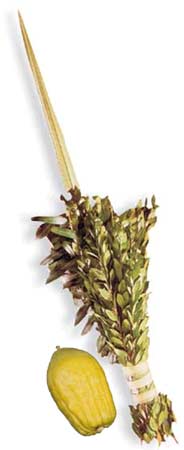
The Midrash (Vayikra Rabbah 30:12) teaches that the four kinds that we “shake” on Sukkos are symbolic of the four different types of Jews, taste representing Torah knowledge and a pleasant aroma representing good deeds:
  • Esrog (unusual citrus fruit): has taste and a pleasant aroma, and thus represents those who are both accomplished Torah scholars and doers of good deeds;
  • Lulav (a frond from a palm tree): has tasty dates, but no aroma, representing dedicated Torah scholars;
  • Haddasim (myrtle branches): only has a pleasant aroma, representing those who excel in good deeds but not in Torah study;
  • Arovos (willow branches): have neither taste nor fragrance, which represents the simple Jews who, though lacking distinction through Torah scholarship or good deeds, serve Hashem with simple faith.
(It should be noted that everyone should (and is obligated to!) study Torah, but only some can be said to excel in Torah study. Similarly, everyone should engage in good deeds, but only some are meant to do so in an exceptional manner.)

After explaining this teaching to a beginner, he commented: “So we should all become
Esrogim!”

I responded that according to my understanding, this is incorrect. Although the combination of Torah study and good deeds is clearly a special quality, it may also have a drawback. Those Jews who lack excellence in Torah knowledge but are dedicated to helping others typically (but not always) excel in their good deeds more than those who engage in both Torah study and good deeds. The same goes for dedicated Torah scholars who do not engage in good deeds vis-a-vis those who do not. Likewise, as mentioned, those who lack other qualities but serve
Hashem with simple faith excel in the purity of their faith. Thus, each Jew should excel in the area/s in which s/he is gifted.

The Midrash says that the act of bringing together the four kinds represents creating unity between the four different types of Jews.

Most of the time we have little difficulty realizing our own talents and skills. However, recognizing and appreciating the good qualities of others, especially when their areas of excellence differ radically from one’s own, is not so easy. It requires the humility to understand that as great as one may (or may not!) be, one is only a part of the whole, a whole that is fundamentally lacking without the vital contributions of everyone. Even the
Esrog Jew needs to unite with the other kinds through recognizing their respective virtues, which in a sense he lacks (as explained).

When each person both maximizes his own individual potential, and recognizes that he is an integral part of a whole, then he can truly complement others, and together they can attain the special common goal that can only be reached through this process of uniting through complementing.

This post was dedicated by Dan Schechter and family as a merit for Moshe ben Yehuda.

Like what you read? The articles I write take a lot of time and effort. Please contact me to sponsor an article for $36 in honor of the birthday, wedding anniversary, or yarhtzeit of a loved one, or for a refuah shleimah or the like. Also, see here concerning the tremendous merit of supporting the dissemination of Chassidus, and the blessings that one receives for doing so.

Monday, May 23, 2011

Ahavas Yisrael: Not just a slogan

It appears to me that Ahavas Yisrael (the Mitzvah to love one’s fellow Jew) has become a slogan, and not of the positive kind. The purpose of a slogan is to remind us of something, but at the same time it causes us to forget, because the constant repetition of the idea makes it so routine that the opposite happens—we forget what it actually means and why it was so important to emphasize in the first place.

Ahavas Yisrael, on the most basic level, means being really nice to another Jew. Friendly. Warm. Welcoming. Accepting. Kind. Sensitive. Respectful. Genuinely interested in his or her welfare.

To accomplish this, we need to
develop empathy. We need to be able to pull ourselves out of our own natural box and try to to consider another Jew’s feelings and needs. And not out of a dry sense of obligation to Hashem (although this is indeed an obligation), but out of a true feeling that since this Jew is my brother or sister, I should care about him or her and unite with him or her as much as possible.

But by nature we are so distant from other people and so attached to ourselves. We don’t stop thinking about ourselves. I, me. And even when we do (albeit rarely) think about others, most of the time, we only think about how they can somehow benefit us. S
ubconsciously, each person thinks that the entire universe revolves around him or her.

Developing empathy means learning that other people really and truly matter. In fact, they matter just as much as oneself, if not more. And therefore they deserve the same amount of respect and caring that one would want for oneself.

Of course, since developing this feeling means changing one
’s innate emotions, it doesn’t come naturally. It requires strenuous, sustained effort. In the parlance of Chabad literature, this effort is termed avodah.


As the Alter Rebbe explains in Tanya ch. 32, the key to
ahavas Yisrael is bringing the Neshama (soul) to dominate in the body. For it is the Neshama that truly unites us, for all Neshamos stem from Hashem, just like all siblings, no matter how different they are from one another, stem from the same parents.

Thus, when a Jew exerts the effort necessary to attune himself to the needs of his
Neshama, then ahavas Yisrael will come naturally. Then Ahavas Yisrael will no longer be a slogan; rather, it will be a normal part of life.

Monday, November 29, 2010

Holy vs. unholy kindness

Holy vs. unholy kindness

Rabbi Y. Oliver

According to Chassidus, no emotion is inherently good or bad. Not all severity is bad, and not all kindness is good (see here). This article will discuss Chessed (kindness), and show how to differentiate between Chessed of holiness and Chessed of Kelipah.

Chessed of Kelipah is driven by self-interest. It may stem from a lust for honor, power, influence, fame, or praise. Yishmael epitomized this kind of Chessed.

In contrast, Chessed of holiness stems from a feeling of bittul (humility). A humble person feels completely unworthy of his prosperity, and thus feels an urge to give away his possessions to others, whom he regards as far more notable and deserving of having such resources than he.


Hence Avraham, who epitomized Chessed of holiness (see here), declared of himself, “I am but dust and ashes.”[1] It was this feeling that drove him to be kind to everyone, even the primitive pagan desert nomads.

This difference also manifests itself in the source of the kindness. Since Chessed of Kelipah is selfish, it will only motivate one to give when it is convenient. Once all one’s own needs and desires have been provided for, if excess funds remain, the person may be willing to donate them to charitable causes instead of using the money to indulge in a life of luxury (and even then, only with a selfish intent, as mentioned).

In contrast, one who operates according to the Chessed of Kedushah is not only willing to forgo luxuries; he is even willing to give up his own necessities, if he sees that others desperately need them.

One should constantly introspect and examine one’s motives in sharing with others to determine whether they are truly worthy, and stem from Kedushah, or they are spurred by self-interest, and stem from Kelipah.

Charity need not involve the physical; one can also give spiritual charity, as our sages say: 
“The only rich person is one wealthy in [Torah] knowledge; the only poor person is one poor in [Torah] knowledge.”[2]This is when the more spiritually “wealthy” and blessed person shares his or her knowledge of Torah and Mitzvos, Chassidus, and proper conduct with others.

But unfortunately, spiritual charity can also be driven by ulterior motives. Although one is conveying spirituality, one may be motivated, at least on the external, conscious level, by an unworthy desire. 


Likewise, one can give in a selfish manner, with a feeling of superiority to the recipient, and/or with the intent of some kind of personal gain. Or one can give in the opposite way, out of a sense of humility and unworthiness, and a sense that others deserve this wisdom more than oneself.

Here, too, one’s motives will be reflected in the way in which one gives. A selfish giver of the spiritual will only ever be willing to share with others once he has satisfied his own legitimate spiritual needs. If he then finds that some time and energy remain that he can devote to assisting others, he is willing to do so. However, he will never help others at the expense of his personal growth.

Needless to say, it is foolish to take this concept to an extreme and completely neglect one’s personal growth because one is so preoccupied with helping others. This is analogous to a philanthropist who gives away all his money to charity and must then turn to becoming a beggar. Rather, it means that the person is willing, from time to time, as needed and appropriate under the circumstances, to forgo his own spiritual necessities when he sees that others desperately need his guidance.

_________________
[1] Bereishis 18:27.
[2] Nedarim 41a.

Based on Toras Menachem 5712, Vol. 4, pp. 183-185.


~~~~~~~~~~~~~~~~~~~~
Like what you read? The articles I write take a lot of time and effort. Please contact me to sponsor an article for (at least) $36 in honor of the birthday, wedding anniversary, or yarhtzeit of a loved one, or for a refuah shleimah or the like. Also, see here concerning the tremendous merit of supporting the dissemination of Chassidus, and the blessings that one receives for doing so.

Wednesday, October 6, 2010

Tolerance is Contempt


The Rebbe teaches:
Although the flood was approaching, Noach prayed only for himself and his family, and ignored the entire generation. Only when approached and asked why he was constructing an ark would he tell them that G–d would imminently bring a flood upon the world, and he rebuked them. However, he waited until they approached him, and didn’t approach them, and of this the Zohar says harsh words. [Zohar 1:106a states that the flood was attributed to Noach, for had he prayed for the members of his generation, the flood could have been averted—see here. Cf. Likutei Sichos, Vol. 2, pp. 452-453.] ...

Abraham, in contrast, did not wait until he was approached. Rather, as it is written, “There he [Abraham] proclaimed the Name of G–d, L–rd of the world” [
Bereshis 21:33]—for Abraham approached everyone and publicized G–dliness in the world.


Likkutei Sichos, Vol. 2, p. 322.
One of the chiddushim (novelties) that the Rebbe introduced is the concept of mivtza’im, the Mitzvah campaigns. The core of this idea is that individual Jews, of their own initiative, should approach other Jews and encourage them to observe a Mitzvah.

At first glance, the idea of walking up to a total stranger (on the outside, at least) and after saying a brief hello, suggesting that he do a Mitzvah, violates western social norms. One who does this may even be accused of being disrespectful, rude (G–d forbid), and worst of all, “intolerant.” In contrast, the modern-day secularist society regards the person who is “tolerant” and blissfully ignores the sinful behavior of others despite his ability to influence them as praiseworthy and virtuous.

However, in fact the opposite is often the case. The “live and let die” attitude demonstrates the ultimate contempt and inhumanity. G–d gave this person the privilege to know that He exists, that He commanded us to abide by certain laws, and that this is the only way to fulfill the purpose of one’s creation, and thereby find true happiness and fulfillment in life (see here). This creates a moral obligation for him to share this knowledge with those less fortunate than he whom he has the opportunity to influence. Obviously, one should exert influence appropriately, in a way that will most likely be effective, through gentle persuasion, and so on. But one may not sit idly by when he is in a position to save others from spiritual death.

Because if you wait until they come to you, in the meantime they may well drown.

Monday, October 4, 2010

Loving rebuke


The Rebbe teaches:
The Zohar explains the difference between Noach and his righteous successors: Noach “did not pray for the world,” for the members of his generation, and therefore the waters of the flood are called “the waters of Noach,”[1] i.e., the flood is attributed to him.[2]

In contrast, Moses displayed self-sacrifice by demanding that G–d forgive the Jewish people for the sin of worshipping the Golden Calf.[3]

However, the Midrash tells us that Noach
rebuked the people and encouraged them to repent, implying that he did care about the state of his generation. If so, why didn’t he pray for them and plead to G–d to have mercy upon them?

The explanation: Noach
’s rebuke did not stem from an altruistic desire to help the people, but solely from the desire to relieve himself of G–d’s command.

As
Chassidus says, “Noach did not devote himself in his rebuke and warnings to inspire them to repent,”[4] because the main purpose of his rebuke was to fulfill the command that he had been commanded. This explains why he didn’t act with Moses’ self-sacrifice by going to the trouble to pray for them.


Likutei Sichos, Vol. 15, pp. 40-41.

[1] Yeshaya 54:9.
[2] Zohar 1:106a.
[3]
Shemos 32:32.
[4]
Sefer HaMa’amarim 5705, p. 29.
In my own words, with some explanation:

It is written, “You shall surely rebuke your fellow Jew” (
Vayikra 19:17). We are obligated to rebuke our fellow Jews (see Erchin 16b for a discussion of just how far this obligation extends) and encourage them to do the right thing. And yet this means far more than simply speaking words of rebuke to them. The main thing is that the rebuke stem from a genuine concern for their welfare.

When Hashem told Noach to rebuke the people, He meant to do so with true concern and persistence. But Noach only followed “the letter of the law.” He rebuked, but his rebuke stemmed only from a desire to obey Hashem, and not from a true concern for the people, and so it fell on deaf ears. The consequences of this lack of proper concern for his fellow humans were so far-reaching that Noach is considered partly responsible for the tragedy of the flood, and this is why its waters are called “the waters of Noach.”

The same is true concerning the task of spreading
Yiddishkeit and Chassidus to our fellow Jews. Although activities to disseminate these teachings are obligatory (and especially for Chabad chassidim, who have been charged to do so countless times by the Rebbe), they will only bear fruit when they stem from a true love and concern for our fellow Jew and a desire to help him—and not merely the wish to “do our duty.” If we neglect to refine ourselves and develop our love for our fellow Jew (see further explanation of this here), and the result is that our efforts to teach others meet with failure, then we are partly responsible for the ongoing non-observance of those whom we were in a position to inspire.


Noach’s lack of true concern for others was demonstrated in his neglect to davven (pray) for them. Thus, perhaps one way of discerning whether our efforts to teach others stem from true love is whether we feel moved to take some time to davven for them, seeing that they are not yet privileged to know about the vast, rich treasures of Yiddishkeit and Chassidus that are the heritage of every single Jew.

Moreover, it is explained in the
HaYom Yom of 3 Adar 1 that one should love every Jew, even one whom one has never met, and all the more so a member of one’s own community, i.e., those whom one knows well. Based on this principle, it would seem that we should davven in particular for those whom we know personally.

Monday, July 19, 2010

"A Jew Doesn't Expel A Jew"

“A Jew Doesn’t Expel A Jew”

Rabbi Y. Oliver


Jewish hothouses in Gush Katif, may it be speedily rebuilt.


We know that throughout history, the Jewish people suffered mass tragedies in one form or another around the time of the three weeks and the month of Av. We are now marking six years since the euphemistically-termed “disengagement”—the expulsion of 10,000 Jews from their homes, the mass devastation of dozens of Jewish villages, and the surrender of Jewish land to our arch-enemies. 

In contrast, it was Jews who initiated, organized, and implemented the mass expulsion of their fellow Jews from their homes and land, to knowingly hand over their land to our sworn enemies—the Nazis of today, the PLO and Hamas—knowing full well that this act would empower and embolden them. There was not even any political pressure from the US at the time to make such a move (not that such pressure would in any way have justified the expulsion, of course, but its absence makes the expulsion all the worse).

Now, we were sent into golus, and thus it stands to reason that we are still in golus, because of sinas chinam, baseless hatred. The Gemara tells us that there was a specific event that so exemplified sinas chinam that it precipitated the entire exile. This was the episode in which a Jew in Jerusalem expelled another Jew by the name of Bar Kamtza, thus humiliating him. The relevance of this story is clear.

Let us increase in our love for our fellow Jew, which includes our zeal to defend our fellow Jew from harm—even harm inflicted by another Jew.


Although all the pain and suffering that the Jewish people have suffered throughout the ages is very difficult to digest, in a way, I personally find this tragedy worse than others, and thus representative of the nadir of the golus.


In earlier tragedies—such as the Crusades, the Inquisition, the pogroms, the Holocaust, and so on—it was always goyim who initiated their attacks against Jewish life and property. Even the Judenrat, the European Jews who collaborated with the Nazis in sending Jews to be slaughtered in the gas chambers, did not initiate their actions, as despicable as they were. Rather, they acted as they did for fear of their own lives.


And yet a group of Jews, very stubborn and organized, supposedly sworn to the noble task of leading and serving the Jewish people, initiated and carefully planned a mass expulsion of their fellow Jews on a scale so grand that it simply has no parallel in Jewish history.


Now, surely you will say, quite possibly with outrage, how dare I make such comparisons? No, I am not saying that Mr. Sharon is equal or worse than Torquemada. What I am saying is that I am much more troubled and outraged by a Jew’s callousness than a goy’s.


Because all Jews are brothers. And we are one family. And brothers shouldn’t treat one another like this. In the words of the cry that many of the Jews of Gush Katif and their sympathizers chanted as they were being expelled, “A Jew doesn’t expel a Jew.”


To the extent that we, the Jewish people, allowed this vile event to take place, we are responsible for it, and for the prolongation of the exile that it surely caused.


But this is not merely a matter of feeling sincere remorse for this collective sin, necessary though that is.


Concessions lead very predictably to ever-greater concessions, so ever since the Gush Katif expulsion, there have been various small-scale expulsions, and constant talk of another mass-scale expulsion. Only this time, the threat involves not the expulsion of 10,000 Jews, but 250,000 Jews, G–d forbid—all the residents of the Shomron and Yehuda, and the surrender of their land—our land, the Land of every single Jew—to the Hamas and the PLO, G–d forbid.


Every Jew should shudder with dread at the thought of this unspeakably evil act being inflicted upon our brethren in the Holy Land, and pour out his heart to Hashem that this evil plot be completely and forever forgotten, and do everything in his power to avert it.

Sunday, October 18, 2009

Bridging the chasm between us

Many of us are so “stuck” in ourselves—in our routines, our personal lives, our family, and our immediate daily concerns—that, as legitimate and even necessary as it may be for us to pursue these things, they naturally become a rut from which we can barely see out of. We have boxed ourselves into ourselves, and we have great difficulty simply relating to others who are not part of our little world.

The Alter Rebbe addresses this concern in the book of
Tanya, chapter 32, the chapter famously devoted to explaining the Mitzvah of ahavas Yisrael, loving one’s fellow Jew. There it states that at the core all Jews are one, and yet “the bodies are separate”: The body and the concomitant drive to satisfy one’s selfish material needs (never mind controlling or channeling the urge to indulge one’s more sensual desires) create a tremendous division between us.

The Mitzvah of
ahavas Yisrael obligates us to engage in the lifelong struggle to overcome this distance. This begins with striving for inner self-improvement, by curbing one’s material passions and thereby transcending one’s bodily limitations. In this way one makes the Neshama and its interests and aspirations dominant in one’s life, which sensitizes one to the souls of fellow Jews regardless of the bodily separation.

But how can one tell whether efforts at sensitizing oneself have borne fruit, and have produced a feeling of true love for one’s fellow Jew? Practically speaking, one way of measuring how far one has progressed is to consider whether one eagerly fulfils the Mitzvah to rejoice in the celebrations of fellow Jews, and whether one is genuinely pained when other Jews are in distress or grieving. As
Rabeinu Yona writes:
If your fellow is in distress, feel pained for them ... and rejoice in their prosperity. If you hear about the distress of Jews who live far away, groan and pray for them, and all the more so for those who are close.

Sefer Ha’yira l’Rabeinu Yona, sec. beg. ve’im yovo’u.
Thus, not only should we share in the joys and sorrows of a member of our own community, but those of every single Jew in the world that comes to our knowledge.

It sounds noble and holy, but sadly, if we are to be honest with ourselves, it is very far from reality. When we hear of a child born, how much do we rejoice? When we hear of the passing of an elderly Jew, how much do we mourn? When we hear of a Jew losing his job, how much is our compassion and concern aroused? Indeed, these are very sobering questions.

Nowhere are the material pains of our fellow Jews as obvious as they are today in
Eretz Yisroel, where Jews suffer from rockets, suicide bombings, kidnappings, sniper fire, and the trauma of constant fear of such attacks.

Then there is the perhaps even more painful phenomenon of Jew against Jew:
  • Jews knowingly endangering Jews by handing over guns, land, and money to our sworn enemies (as in Oslo and its follow-up deals), by removing checkpoints, by releasing terrorists with blood on their hands, or who wanted to have blood on their hands, in ridiculous exchanges, and so on;
  • Jews expelling Jews from their homes—“because they had no choice but to follow orders” (as in Gush Katif and Northern Shomron, and more recently in Chevron and other places);
  • Jews mercilessly beating those who simply protest against destruction of Jewish property (as in Amonah, and on other occasions);
  • Jews preventing Jews from building their property, forcing them to live in ghetto-like conditions (as is currently the case in Yehuda and Shomron);
  • ... and the list goes on.
When we hear that our fellow Jews are abused, discriminated against, victimized, demonized, expelled, dispossessed, betrayed, traumatized, injured, or slain, by strangers and even by brothers, it ought to make a difference to us. Not only should we not come up with transparent, pathetic excuses to look the other way (such as “we don’t get involved in politics” or “people will be turned off if we speak about such topics”), but it ought to matter to us, bother us, shake us up, outrage us.

As the Rebbe said many times concerning such events, “When it hurts, you scream!” If we’re not screaming, then it means we’re not hurting. If we’re not hurting, then our love for our fellow Jew is clearly lacking. And this stems from the fact that we fall short spiritually. Although we davven with a Minyan, study Torah, and so on, our heart is not in it. It’s difficult to say it, but we’ve succumbed to a self-centered lifestyle.

Perhaps we need to review
Tanya, chapter 32, and reflect upon its message persistently. Until, with the help of Hashem, it truly sinks in.

Wednesday, June 10, 2009

Careful Love

Careful Love

Rabbi Yehoishophot Oliver

In the Chabad world we talk so much about the importance of loving our fellow Jew, every Jew, that sometimes we forget that there are limits.

The Previous Rebbe writes:
We should invest as much energy as we can to have a positive impact on a Jew and revive his inner self. This should be accomplished by drawing him close. However, one should remember that this closeness requires great caution, so that one does not befriend him too much. For just as one influences the other person, so does the other person exert influence on him.

There are several levels [of influence that the other person exerts]. At first one feels pity for the other person, and this leads to finding a
limmud zechus [an attempt to judge favorably someone who appears to be acting unconscionably]. So it should be; one should find a limmud zechus for the other person’s actions. However, the other person should not know about it. Rather, one should do so in private. One should weep profusely and recite a chapter of Tehillim [Psalms] for him, and beg Hashem to have mercy on him.

This is the meaning of love for one’s fellow Jew: Every Jew should do [what is necessary to help] his good friend, but be careful not to become overly close with him until, with
Hashem’s help, the other person reaches a good, upright level, such that it is appropriate to befriend him.

Likkutei Dibburim, Vol. 1, pp. 11-12.
In my own words: Although one should love every Jew ad mitzui hanefesh (“to the very core of life itself”—HaYom Yom 18 Av), this means that one should assist him, do him favors, and truly feel a deep bond with him as one’s brother and sister. However, it does not mean that it is appropriate to befriend every Jew equally. A truly close relationship is always two-way, with each member of the relationship having an impact on the other. Thus, if another Jew behaves inappropriately, one should keep a distance from him, because one is liable to be influenced.

Yet this does not mean that one may not have any contact with the one who is unfit for a close friendship; on the contrary, one should relate to every Jew with warmth and affection. However, one should be careful not to come close to him as one does to a friend who is one’s equal, for then one is susceptible to being adversely affected.[1] Also, one expresses love for the Jew whom one fears may negatively influence him by pleading Hashem to have mercy on him and help guide him to Teshuvah (on this topic, see here). This is the true way to express love for this Jew.

Exactly how one puts this into practice needs to be determined in each case individually.

Comments:

1. The reason that one should not tell the other person of one’s limmud zechus on him or her seems clearly to be that he may regard it as an endorsement of his inappropriate behavior (on this topic, see here). However, when speaking to others, and to Hashem, one should seek a limmud zechus for that person’s behavior.

2. This teaching conforms with the general principle taught in Chassidus that each middah (character trait) in Kedushah, holiness, always involves a balance with its opposite. Thus, Chessed, kindness, must be balanced and complemented by Gevurah, strictness (see here).

______________________________________
[1] Cf. Mishneh Torah, Laws of Teshuvah, 4:24—
"
והמתחבר לרשע, מפני שהוא לומד ממעשיו והן נרשמים בלבו הוא שאמר שלמה ורועה כסילים ירוע."