"Moshiach is ready to come now-our part is to increase in acts of goodness and kindness" -The Rebbe

Showing posts with label individuality. Show all posts

Sunday, October 9, 2011

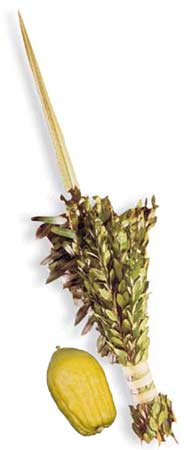
The four kinds: Individuality, complementarity, and unity

The Midrash (Vayikra Rabbah 30:12) teaches that the four kinds that we “shake” on Sukkos are symbolic of the four different types of Jews, taste representing Torah knowledge and a pleasant aroma representing good deeds:
  • Esrog (unusual citrus fruit): has taste and a pleasant aroma, and thus represents those who are both accomplished Torah scholars and doers of good deeds;
  • Lulav (a frond from a palm tree): has tasty dates, but no aroma, representing dedicated Torah scholars;
  • Haddasim (myrtle branches): only has a pleasant aroma, representing those who excel in good deeds but not in Torah study;
  • Arovos (willow branches): have neither taste nor fragrance, which represents the simple Jews who, though lacking distinction through Torah scholarship or good deeds, serve Hashem with simple faith.
(It should be noted that everyone should (and is obligated to!) study Torah, but only some can be said to excel in Torah study. Similarly, everyone should engage in good deeds, but only some are meant to do so in an exceptional manner.)

After explaining this teaching to a beginner, he commented: “So we should all become
Esrogim!”

I responded that according to my understanding, this is incorrect. Although the combination of Torah study and good deeds is clearly a special quality, it may also have a drawback. Those Jews who lack excellence in Torah knowledge but are dedicated to helping others typically (but not always) excel in their good deeds more than those who engage in both Torah study and good deeds. The same goes for dedicated Torah scholars who do not engage in good deeds vis-a-vis those who do not. Likewise, as mentioned, those who lack other qualities but serve
Hashem with simple faith excel in the purity of their faith. Thus, each Jew should excel in the area/s in which s/he is gifted.

The Midrash says that the act of bringing together the four kinds represents creating unity between the four different types of Jews.

Most of the time we have little difficulty realizing our own talents and skills. However, recognizing and appreciating the good qualities of others, especially when their areas of excellence differ radically from one’s own, is not so easy. It requires the humility to understand that as great as one may (or may not!) be, one is only a part of the whole, a whole that is fundamentally lacking without the vital contributions of everyone. Even the
Esrog Jew needs to unite with the other kinds through recognizing their respective virtues, which in a sense he lacks (as explained).

When each person both maximizes his own individual potential, and recognizes that he is an integral part of a whole, then he can truly complement others, and together they can attain the special common goal that can only be reached through this process of uniting through complementing.

This post was dedicated by Dan Schechter and family as a merit for Moshe ben Yehuda.

Like what you read? The articles I write take a lot of time and effort. Please contact me to sponsor an article for $36 in honor of the birthday, wedding anniversary, or yarhtzeit of a loved one, or for a refuah shleimah or the like. Also, see here concerning the tremendous merit of supporting the dissemination of Chassidus, and the blessings that one receives for doing so.

Tuesday, June 28, 2011

Refining the sparks: An individual mission

We are told, “All your deeds should be for the sake of Heaven,”[1] and “In all your ways, you shall know Him.”[2]

The Rambam explains,[3] “One should attune all one’s actions to recognizing Hashem alone. One’s resting, rising, speaking, and everything else, should be for this end. How so? When one conducts business deals, or works for payment, one’s intention should not only be to amass money; rather, one should do business or work for payment in order to be able to obtain the things that the body needs, such as food, drink, a house, and a wife.”

There are no exceptions to this rule. We are obligated to treat all our mundane involvements, all our wealth, and every single object that we own, as items to be used to serve Hashem.[4]

Why is it so necessary to have the proper intention in all one’s mundane involvements?

The reason is that the mission of refining the sparks is not purely collective; if it were, although only Jews could refine these sparks, it would be irrelevant which Jews would refine which sparks. Rather, the purpose of the descent of each individual Jew’s soul into a body is to refine specific sparks, a task with which he alone has been charged.

This is the meaning of the statement of our sages, “One person cannot encroach upon that which has been designated for his fellow.”[5] The true reason that our income comes from one source and not another is not the whim of mere mortals, but divine decree alone.

Likewise, Hashem orchestrates our lives such that we live in a specific place, come into contact with specific people, undergo certain experiences, and earn our living in a particular way, in order to enable us to refine our specific quota of sparks. Even if one tries, G–d forbid,[6] one cannot rob another person of the opportunity to refine the sparks that have been predestined for that person to refine.


Thus, the Talmud teaches: "Forty days before the child is formed, a Heavenly voice proclaims that the daughter of so-and-so will be his wife, that a certain house will be his home, and that a certain field will be his field."[7]

This also explains the fact that one may notice an important task that needs to be done that is being overlooked by everyone else, even scholars and leaders far greater than oneself.[8] Hashem is deliberately preventing them from noticing this breach, because it is not their personal task. Instead, Hashem brings someone else, even one of lesser stature, to notice the need because he is meant to accomplish this task. This is the reason that Hashem hid even from Moshe Rabeinu the Halacha concerning how to act when one sees a Jew publicly engaging in relations with a gentile woman, and only Pinchas remembered it—even though Moshe Rabeinu was the one to teach it! Hashem put this thought in Pinchas’ mind because he was meant to carry out this task so that he would acquire the status of a Kohen.[9]


This, the Baal Shem Tov teaches, is also the reason that some people have a natural strong liking for one thing, while another person despises that thing, and has a strong liking for something else.[10]

When you eat, it is not only about satisfying your body’s desires or maintaining its survival; when you sleep, it’s not only about resting your body; when you do business, it’s not about amassing money, whether out of a desire for wealth, or even simply to pay the bills. And the same goes for your possessions: Your cabinet, dining table, pillows, alarm clock—and even apparent luxury items, such as your tennis racket, iPod, and chess set—they all contain sparks of holiness that belong to you and you alone.

This is also the meaning of “Everything is in the hands of Heaven except the fear of Heaven.”[11] You think that you chose the décor of the lounge room because it looks pretty, that you bought your chess set because you like the marble it’s made of, that you chose to live in the city because you like the hustle and bustle. Think again. The only decision we can truly make is whether to do a Mitzvah or not, or whether to sin or not. And the reason that Hashem is deciding the course that the person takes in the physical world is in order to direct him along the path in which he will have the opportunity to refine the specific sparks of holiness that belong to his soul.

____________________________________
[1] Avos 2:12.
[2] Mishlei 3:6.
[3] Mishneh Torah, Hilchos Dei’os, 3:2.
[4] Likkutei Sichos, Vol. 12, p. 118.
[5] Yoma 38b; cf. Rashi there.
[6] Hisva’aduyos 5749, Vol. 2, p. 480.
[7] Sotah 2a.
[8] Likkutei Sichos, Vol. 2, pp. 342-343.
[9] Bamidbar Rabba 20:24.
[10] Tzavaas Harivash §109.
[11] Berachos 33b.

________________
Dedicated by Menachem Kovacs in honor of the Rebbe and Rebbetzin's arrival in New York on 28 Sivan 1941 (70 years ago), which began their countless accomplishments based in the USA.

Like what you read? The articles I write take a lot of time and effort. Please contact me to sponsor an article for $36 in honor of the birthday, wedding anniversary, or yarhtzeit of a loved one, or for a refuah shleimah or the like. Also, see here concerning the tremendous merit of supporting the dissemination of Chassidus, and the blessings that one receives for doing so.

Monday, December 13, 2010

"It depends on your feeling"

I often hear it asked, “Do we recite tachanun on Hei Teves?” The question is understandable, as one needs to know what to do in practice.

Reb Michoel Seligson related to me (also printed in Otzar Minhagei Chabad, Elul p. 23) that in 5749, he davvened as the chazan on Gimmel Tammuz, and did not recite tachanun. After several people protested, he wrote a letter to the Rebbe asking whether his conduct had been acceptable, and added that he wishes to know the same concerning whether to recitetachanun on Chai Elul. Next to the words “Gimmel Tammuz and Chai Elul,” the Rebbe wrote: “בענינים התלויים ברגש — אין לשאול כיון שזוהי הוכחה שאין רגש”—“In areas that are dependent upon feeling, one does not ask, because asking demonstrates that one does not have the feeling.”

This seems to mean: “True, the Rebbeim never declared it our official custom to recite tachanun on Chai Elul, nor have chassidim kept such a tradition. After all, Chai Elul was a day of celebration carefully hidden until the Previous Rebbe revealed it, and as much as he extolled it, the Previous Rebbe never instructed that one should abstain from reciting tachanun on this day. Likewise, Gimmel Tammuz, the day on which the Previous Rebbe was released from prison (but then exiled), was never formally declared a day of celebration on which chassidim collectively refrained from reciting tachanun.

“However, the halachic exemption from reciting tachanun depends upon your feeling. If you feel truly inspired about the day, and indeed feel it to be a tremendous day of simcha, then you won’t recite tachanun. But if you don’t feel this way, and if you are even unsure about whether you do, then you should recite tachanun as you do normally.”


Perhaps the same principle can also be applied to Hei Teves and other similar days. On the one hand, Hei Teves is a relatively new day on the chassidishe calendar, so there’s a certain resistance to creating “new customs.” After all, “anyone who deviates [from the established custom] has the lower hand” (Bava Metzia 76a). But its recentness is also its greatness. Hei Teves happened with our own Rebbe, the Rebbe of our generation, and this makes it special in a way not found by the Yomei Depagra (chassidishe days of celebration) associated with the earlier Rebbeim.

So, do we recite tachanun on Hei Teves? In this case, the custom is not prescribed. Don’t look inside a book to find the answer, as holy as the book may be—look inside your heart. If you don’t feel filled with joy and elation at his victory and the victory of the Chabad community, then you have no reason not to recite tachanun. (Even for the less emotive types, some simple ways of discerning whether they find the day profoundly meaningful is by seeing whether they enthusiastically fulfill the Rebbe’s directive to purchase seforim on this day, and whether they make a point of attending a farbrengen.) And while you’re reciting tachanun, along with your teshuvah for other things, add to the list the fact that you lack the feeling of joy that a chossid should feel in rejoicing in the Rebbe’s simcha. And hopefully by next year you’ll have grown enough in your avodah that you will indeed rejoice as a chossid should, with a tangible, deeply-felt joy, such that refraining from reciting tachanun will indeed be justified.

Some postscripts:

1. If you derive your joy on Hei Teves from the very opportunity not to recite tachanun, because you donoot find the avodah of teshuvah burdensome, or simply because you want to skip some of the prayers so you can leave shul sooner, may Hashem save us, then it would seem clear that on a day about which we have received no explicit instruction to recite tachanun, you should davka recite tachanun—for that very feeling.

2. Choosing to recite tachanun is not in itself a proof that one is truly joyful. As in all matters of avodah, one must be thoroughly honest with oneself. As the Mitteleh Rebbe so pointedly said, “If you fool yourself, what have you accomplished by fooling a fool?”

3. Obviously, on days like Yud-Tes Kislev in which the Rebbeim have explicitly declared that we do not recite tachanun, one who considers himself a chossid should not recite tachanun even if he knows that unfortunately he is lacking the proper feeling. (Of course, he should do everything possible to prepare for such days so that he will indeed experience the appropriate feeling when they arrive.)

4. I have heard some say that personal “hergeshim” (conduct based on strong feelings), are all very well, but they should be kept in private. I find it significant that the written response above was addressed to a chazan. When the chazan does not recite tachanun, then the minyan should go along, and the minyan in this case was clearly not necessarily feeling this way. Despite this, the Rebbe implies that if the chazan feels this way, it is legitimate not only for him to abstain from reciting tachanun, but also for the entire minyan to follow his lead. I am not drawing any practical conclusions from this, as that would be the province of a Rov moreh hora’ah, which I do not presume to be; I simply note it as significant.

5. This is just one example of the concept of “tolui behergesh,” but there are numerous other applications. One such instance can be found in connection with singing the Alter Rebbe’s niggun, which chassidim are careful only to sing at certain prescribed times. The Rebbe was asked (Igros Kodesh, Vol. 16, p. 222) whether one may sing this niggun on a certain day of rejoicing—the Rebbe does not specify which—that was not a day in which the niggun was traditionally sung. The Rebbe responded that if the questioner feels that for him, the day in question has the same significance as the days in which this niggun was permitted to be sung, then it would be appropriate for him to sing it. As a precedent for this, the Rebbe mentioned that some chassidim would sing the Alter Rebbe’s niggun on Yud-Beis Tammuz, the day in which they celebrated the release of the Previous Rebbe from exile, because they considered it an extension of the liberation of Yud-Tes Kislev.


Saturday, November 28, 2009

Standard and individualized medicines

The Previous Rebbe explains:
In general, there are two types of medicines:
  • A standard medicine that is already prepared, that the doctor can prescribe for a more wide-ranging or common disease. For example, there is a standard medicine prescribed for a person with a very high temperature or a very low temperature.

  • A medicine prescribed for a specific illness only after the doctor has carefully examined the patient and determined his specific illness. This medicine must be prepared according to specific requirements, which takes time.
The same holds true of spiritual cures:
  • There are spiritual sicknesses of a more typical nature, such as an intense desire for material indulgence, or a coldness and apathy to the holiness of Torah and Mitzvos. These conditions have certain standard cures, as described in the holy books of Mussar and Chassidus, and they can even be prescribed by a non-expert.

  • Other spiritual sicknesses need to be correctly diagnosed by an expert spiritual guide, who will then prescribe the appropriate medicine. For those who suffer from these sicknesses, standard medicines will be ineffective.
Adapted from Igros Kodesh Admur HaRayatz, Vol. 4, pp. 28-29.
For some types of sicknesses, there is no need to visit the doctor. The symptoms are known, and the treatment is known—e.g., the common cold. However, an ailment that has unusual symptoms demands that one consult with a specialist, for otherwise not only will one not recover, but his state will steadily worsen.

Likewise, not every type of spiritual sickness requires that one consult with a spiritual mentor for guidance; although such consultation may well be advisable (but see note below), it is not necessarily crucial. If one is suffering from a clear-cut “textbook case” spiritual sickness, one can treat it oneself through using clearly defined spiritual prescriptions written in holy books.

For example, if forbidden thoughts enter one’s mind, one should not attempt to explain to oneself why such thoughts are detrimental; rather, one should simply distract oneself by focusing on other things, and especially thoughts of Torah (see
here).

However, if one sees that one’s spiritual condition is in some way unusual, or one realizes that the “textbook advice” isn’t working, this indicates that one’
s spiritual malady is more complex, and one must obtain an individualized prescription by consulting with an expert in spiritual healing—or, in Chassidic parlance, a mashpia.

However, it should be emphasized that a doctor and a
mashpia are different in that in general, a doctor will diagnose the illness and prescribes the medicine, but will not give the patient a pep-talk about the importance of taking it. In contrast, a mashpia may well need to goad the one who has approached him for advice to actually implement that advice—see here.

Also, it is important to mention that, just as is the case with physical health, one may well be suffering from a spiritual sickness of which one is unaware, and which one needs intensive study of
Chassidus under the guidance of a mashpia to discern, as explained here.

In summary, one should consult with a mashpia on a regular basis in order to receive inspiration, but if one’s spiritual illness is more “standard,” and one is sufficiently motivated to rectify the situation, although it is definitely worthy and advisable to consult with one’s mashpia, and one should do so in due course, one need not do so urgently. However, as soon as one realizes that the situation is more complex, such consultation is vital and cannot be delayed.