Rabbi Yehoishophot Oliver
At first glance, both Kabbalah and Chassidus explain Hashem’s greatness. And yet, since Kabbalah was revealed before Chassidus, Chassidus must have come to add something new and more. What?This is a broad topic, and of course, an article of this length cannot do it justice, but I will discuss one aspect of it below.
Although Kabbalah offers wondrous explanations of G–dliness, when these ideas are examined, the explanations it gives are incomplete. The wisdom of Kabbalah is so lofty that it does not truly descend into human intellect, and so a regular person cannot properly grasp it, even if he is highly intelligent. Who then can grasp it? One who is somehow attuned to a certain level of spirituality that transcends intellect. This exalted spiritual state “fills in the gaps,” enabling one to“decipher the code,” and properly grasp these rarefied concepts.
There are two ways of possessing this level of spiritual sensitivity.
From above: A Jew who is born with a particularly lofty neshamah may be endowed with the power to grasp these lofty concepts.
From below: A Jew who has invested tremendous effort to rectify all his sins and failings and has succeeded, and has then gone still further and reached an advanced level of self-refinement, may manage to elevate himself to this level.
Until Chassidus was revealed, one who aimed to truly grasp the explanations of the sublime levels of G–d’s greatness found in Kabbalah had to be a fit “vessel” by fulfilling at least one of the above requirements. The revelation of Chassidus, however, made it possible for any Jew to grasp Hashem’s greatness, even without satisfying either of these requirements.
But what is so different and special about Chassidus? What quality does it have that Kabbalah lacks, making it accessible to every Jew? The answer: Chassidus in general, and Chassidus Chabad in particular, brings Hashem’s greatness down into sechel enoshi, human understanding.
How does it do this? It is written, “From my flesh I see Hashem.”[1] This verse encapsulates the entire goal of Chassidus—to explain in great depth and in great detail the faculties of the soul, and how they interact with one another. Since the Jew’s soul descends from the higher spiritual worlds,[2] everything in his or her inner self parallels the higher realms, and can thus be used to understand them. Chassidus therefore uses as its mashal (analogy, pl. meshalim) the soul’s faculties—“my flesh”—in all their intricacies, through which we are able to “see Hashem”—to understand the nimshal (concept being explained by the analogy) of sublime levels of Hashem’s greatness.
Although Kabbalah also employs analogies from the soul to explain G–dliness, it never explains exactly which aspect of them corresponds to the nimshal in what way; it merely states the analogies, no more. If any explanation is provided, it is minimal.
This is one reason that it is considered dangerous to study Kabbalah without being truly a vessel for it. The lack of down-to-earth explanation makes one liable to fall into the trap of construing the analogies in Kabbalah literally.
This misconception is called hagshamah—lit., “making material,” or “corporealization.” Its opposite is hafshatah, literally, “divestiture,” or “abstraction.” Hafshatah is the ability to “see through” the details of the mashal to the nimshal of the sublime levels of G–dliness that it is coming to inform us of. Since this is a requirement for studying Kabbalah, we find that the Baal Shem Tov instructed those whom he saw as susceptible to hagshamah—apparently, the vast majority of people—not to study Kabbalah.
Now, let’s explain hagshamah further. On the lowest level of hagshamah, one believes that Hashem literally has a hand or foot, or the like, G–d forbid. A less coarse, but still forbidden level of hagshamah is to believe that Hashem is some kind of limited entity, albeit a very sublime one, such as one of the Sephiros (divine attributes), and to pray to a Sephirah, G–d forbid, instead of to Hashem Himself.[3]
An even more abstract kind of hagshamah, but hagshamah nonetheless, is an incomplete understanding of an analogy, applying aspects of it to Hashem that were not meant to be applied, and neglecting to apply aspects of it to Hashem that were meant to be applied; this is in itself hagshamah, G–d forbid.
And when one “coarsens” Hashem, G–d forbid, while studying Kabbalah, this in turn greatly “coarsens” the student of Kabbalah; in other words, it has a very detrimental spiritual effect upon him (along the lines of the words of our Sages that if one learns Torah inappropriately, it becomes a “potion of death”[4] for him). And this is indeed tragic, for his intention in his studies was surely to become more refined.
This explains further what was quoted earlier that to learn Kabbalah one must either have a lofty neshamah or be very refined, for only then can we be confident that the person will not fall into hagshamah.
In contrast, the analogies offered in Chassidus are always accompanied with explanations[5] that make clear that not only does Hashem in His Essence (“Atzmus”) have no physical form, but He has no spiritual form either. Likewise, these explanations make clear which aspects of the analogies are relevant, and which are not.
Now, let’s explain hagshamah further. On the lowest level of hagshamah, one believes that Hashem literally has a hand or foot, or the like, G–d forbid. A less coarse, but still forbidden level of hagshamah is to believe that Hashem is some kind of limited entity, albeit a very sublime one, such as one of the Sephiros (divine attributes), and to pray to a Sephirah, G–d forbid, instead of to Hashem Himself.[3]
An even more abstract kind of hagshamah, but hagshamah nonetheless, is an incomplete understanding of an analogy, applying aspects of it to Hashem that were not meant to be applied, and neglecting to apply aspects of it to Hashem that were meant to be applied; this is in itself hagshamah, G–d forbid.
And when one “coarsens” Hashem, G–d forbid, while studying Kabbalah, this in turn greatly “coarsens” the student of Kabbalah; in other words, it has a very detrimental spiritual effect upon him (along the lines of the words of our Sages that if one learns Torah inappropriately, it becomes a “potion of death”[4] for him). And this is indeed tragic, for his intention in his studies was surely to become more refined.
This explains further what was quoted earlier that to learn Kabbalah one must either have a lofty neshamah or be very refined, for only then can we be confident that the person will not fall into hagshamah.
In contrast, the analogies offered in Chassidus are always accompanied with explanations[5] that make clear that not only does Hashem in His Essence (“Atzmus”) have no physical form, but He has no spiritual form either. Likewise, these explanations make clear which aspects of the analogies are relevant, and which are not.
Therefore, the student who has acquired a broad knowledge in Chassidus may be equipped to study Kabbalah as well and understand it properly.[6] Conversely, in our time, Chassidus is vital to protect one from misunderstanding concepts in Kabbalah. So for someone to learn Kabbalah without the explanations of Chassidus and “make his own way” in Kabbalah is presumptuous—he would be presuming himself not in the category of those whom the Baal Shem Tov warned against learning works of Kabbalah lest they commit hagshamah and thereby become greatly coarsened.[7] Moreover, it is not enough to learn texts that explain the deeper meaning of these Kabbalistic concepts briefly; one must also study Chassidus, which explains them in depth.[8] Thus, learning Chassidus before Kabbalah is vital.[5]
___________________________
[1] Iyov 19:26.
[2] Tanya, ch. 3, beg.
[3] Derech Mitzvosecha, Shoresh Mitzvas HaTefillah, 115b. Cf. Shivchei HaBesht, p. 250.
[4] Yoma 72b.
[5] Igros Kodesh, Vol. 22, pp. 58-59. See also Likkutei Sichos, Vol. 30, p. 292, where the Rebbe warns that only one who has actually attained expertise in Chassidus by studying it diligently for many years is fit to issue a ruling on whether Chassidus is similar or different from Kabbalah with regard to the various restrictions on the study of Kabbalah.
[6] Likkutei Sichos, Vol. 35, p. 295.
[7] Igros Kodesh, Vol. 8, p. 223. Also, see ibid. Vol. 13, p. 403.
Based on Kuntres Inyanah Shel Toras HaChassidus, p. 1.
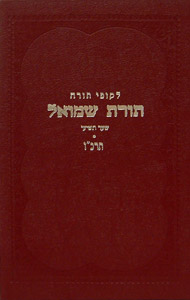
Toras Sholom, pp. 113, 185. See also the article on p. 20 here.
Toras Sholom, pp. 113, 185. See also the article on p. 20 here.
[1] Iyov 19:26.
[2] Tanya, ch. 3, beg.
[3] Derech Mitzvosecha, Shoresh Mitzvas HaTefillah, 115b. Cf. Shivchei HaBesht, p. 250.
[4] Yoma 72b.
[5] Igros Kodesh, Vol. 22, pp. 58-59. See also Likkutei Sichos, Vol. 30, p. 292, where the Rebbe warns that only one who has actually attained expertise in Chassidus by studying it diligently for many years is fit to issue a ruling on whether Chassidus is similar or different from Kabbalah with regard to the various restrictions on the study of Kabbalah.
[6] Likkutei Sichos, Vol. 35, p. 295.
[7] Igros Kodesh, Vol. 8, p. 223. Also, see ibid. Vol. 13, p. 403.
[8] Likkutei Sichos, Vol. 20, p. 594.
This post was written by the author in honor of the third birthday of his daughter, Shaina bas Atarah Arielle, on 22 Tammuz. It was also dedicated by Rivkah Katz and family, so that it be a merit for the refuah sheleimah of HaRav Meir HaKohen ben Rochel Dilkah. Lastly, this post was dedicated by Ephraim Tunick in honor of his mother, Miriam Shaina bas Asher ע"ה.
Like what you read? The articles I write take a lot of time and effort. Please contact me to sponsor an article for $36 in honor of the birthday, wedding anniversary, or yarhtzeit of a loved one, or for a refuah shleimah or the like. Also, see here concerning the tremendous merit of supporting the dissemination of Chassidus, and the blessings that one receives for doing so.