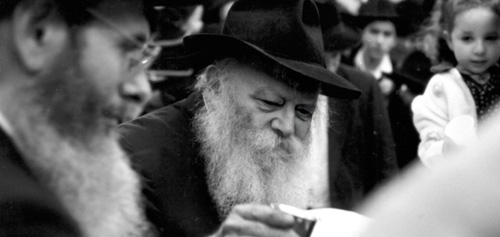
"Moshiach is ready to come now-our part is to increase in acts of goodness and kindness" -The Rebbe

Showing posts with label the Rebbe's teachings. Show all posts

Sunday, July 31, 2022

The Significance of Seventy

The Significance of Seventy 
by Rabbi Yehoishophot Oliver

in honor of the seventieth birthday of my mother,
Zipporah Oliver (Chana Feiga bas Reizel)


Seventy is a very significant age, for it represents the full span of a lifetime, as David Hamelech says in Tehillim: “Our days are seventy years”.[1]

But how does this fit with the fact that some people lived for much longer? In particular, the Avos—Avraham, Yitzchak, and Yaakov—lived for far longer than seventy years. It would seem clear that David included all mankind in his statement, including the Avos, so why did they live for so long?

The answer is that in fact, this emphasis on the age of seventy is not referring to a physical age but to a spiritual age. As is known, the number seven represents the seven middos, the emotional character traits. Seventy represents perfection in each of these traits, as they each contain ten, corresponding to the three levels of intellect and the seven emotional traits as they exist within each trait.

We find a similar expression of perfection within the seven traits in the custom of counting the forty-nine days of the Omer, when we specifically mention how each day corresponds to one of the seven traits within each of the seven traits.

Seventy represents an even higher level of perfection, because it includes the three levels of intellect within each emotion as well.

Thus, the reason that a lifespan lasts for seventy years is that our task is to refine our character traits and reach the spiritual level of seventy, which represents perfection in the refinement of one’s character traits.

Thus, the greatness of the Rambam is expressed in his lifetime of seventy years, which emphasized that he reached perfection in his self-refinement and this perfection also expressed itself on the physical level, in the length of his lifetime in this world.

But since this number represents spiritual accomplishments, it could also be accomplished by someone who is not seventy. Indeed, we find that in the Hagadah, Rabbi Elazar ben Azarya says “I am like someone who is seventy years”, which means that spiritually he had reached the age of seventy even though he was physically a young man.

But if this level of perfection can be reached in seventy years and even less, why did the Avos live for longer?

The answer is that even after a person has reached perfection in his divine service, that does not necessarily mean that one’s life needs to come to an end. One may be given the opportunity to rise to an even higher level of perfection, by involving oneself in a completely new endeavor, one that is higher than his previous form of divine service.

Although this task is based on his previous divine service, it is far superior to it, and it adds further perfection to his previous divine service.

All human life is divided into stages and each stage has its own task. When one stage is complete, because one completed one’s mission in that stage, then a new stage begins with a new task. As the Mishnah puts it: “At five, one studies Chumash; at ten, Mishnah”,[2] and so on. The same applies to the end of the age of preparation for mitzvos, at 12 for a girl and at 13 for a boy.

Likewise, at the end of a period of seventy years, corresponding to the seven character traits, comes a new level of divine service in order to reach an even higher level of perfection.

We find this also regarding Torah study, and Hashem “looked into Torah and created the world”.[3] Torah study comes in stages: Chumash, and then Mishnah, and then Gemara. Each stays follows and builds on the accomplishment of the previous stage or stages. So after one has study Chumash well, then one progresses to studying Mishnah, and so on.

But on the other hand, the study of Mishnah adds to the understanding one reached at the previous stage, when one had only studied Chumash, and so is it with all the further dimensions of Torah that one learns.

So those who have been blessed by Hashem with a life longer than seventy years have merited to be able to open a new page and start a new form of divine service.

As mentioned, we find this in the case of the Avos, who lived for longer than seventy years. Once they reached the age of seventy, they began a new kind of divine service.

“The deeds of the forefathers are a sign for the sons”[4]: Every single Jew is granted the ability, through the Avos, to complete the divine service of seventy years and then to start a new, higher form of divine service.

Conversely, one can attain this perfection before the age of seventy and then start a whole new level of divine service, and then another, and so on.

We see this in the age of the Rambam, who lived for seventy years. Although he lived for exactly seventy years, he managed to accomplish many different tasks during this time, which would have taken a lot more time for someone else.

The lesson is that everyone should constantly grow and increase in their divine service, and with renewed vigor, in all the three areas of Torah study, prayer, and charity.

____________                                      

[1] 90:10.
[2] Avos 5:21.
[3] Zohar 1:134:1
[4] Tanchuma, Lech Lecha 9.

Adapted from the Rebbe's Hisvaduyos 5749, vol. 2, pp. 163-165.


Wednesday, July 22, 2015

The Different Origins of Bodies and Souls


The Different Origins of Bodies and Souls

Rabbi Yehoishophot Oliver

The body and the soul—not only those of medaber, but of domem, tzomei’ach, and chai as well—stem from completely different levels in the supernal realms.

Chomer vs. tzurah

Some necessary background: Everything that exists possesses both chomer and tzurah. chomer, “matter,” is the raw substance of the entity, while tzurah, “form,” refers to the specific shape and properties that the chomer assumes.

In terms of the relationship between body and soul, chomer corresponds to the body, while tzurah corresponds to the soul.

Memalei vs. Sovev

Memalei Kol Almin:  This is the G–dliness that sustains Seder Hishtalshelus. The energy of Memalei descends in a gradual, systematic manner known as “ilah ve’alul”—“cause and effect.” The cause begets the effect, which in turn acts as the cause to a level further down, and so on.

The tzurah, the individual properties of each and every level within Seder Hishtalshelus, stems from the life-force of Memalei.

Sovev Kol Almin:  Also referred to as Ohr Ein Sof, Hashem’s infinite light. This kind of G–dliness completely transcends the vast, complex series of limited levels in Seder Hishtalshelus.

Sovev is endowed with the power to create “yesh mei’ayin”—ex nihilo. In Chassidus, creation ex nihilo does not mean that the created being came literally from nowhere, for Hashem is the source of everything. Rather, it stands in contradistinction to ilah ve’alul, where it is obvious how the effect evolves from the cause. In the case of yesh mei’ayin, however, one sees no comparison whatsoever between the level below and the level above it, and thus no way in which the lower level could have emerged from the higher one.

The reason that Sovev is the only force with the power to create something from nothing is that Hashem’s very Essence is vested in it. As the Alter Rebbe famously states, only Hashem’s very Essence, which has no previous cause, can create physicality, an entity that feels as if it has no previous cause.

The chomer, the raw matter of all the levels within Seder Hishtalshelus, was created yesh mei’ayin from Sovev.

Memalei: The source of souls

All souls stems from Memalei, and more specifically, from the four “faces” of the Divine Chariot,[1] located in the world of Beriyah. Each “face” is the origin of a different kind of soul in our world: [2]

  • “The face of the ox, to the left”[3]: The origin of the souls of all domesticated animals. Like oxen, domesticated animals possess the quality of raw strength, and so “Much grain [can be produced] with the power of an ox.”[4] However, domesticated animals may lack the quality of agility and keenness that wild animals possess. This is also the source of the Jew’s Nefesh HaBehamis.
  • “The face of the lion, to the right”[5]: The origin of the souls of all wild animals. Like lions, wild animals in general have the quality of zerizus—they are much more energetic. This is the reason that wild animals are called chayos, which is related to the word chayus, vitality and energy.[6] However, wild animals may lack the quality of raw strength that domesticated animals possess.
  • “The face of the eagle”: The origin of the souls of all fowl.
  • “The face of the man”: The origin of the souls of all humans, i.e., the Nefesh HaSichlis, the intellectual soul that both Jews and non-Jews possess.

Above them is the “man” who is “sitting” astride the “chariot”: “On the likeness of the throne was the form of the likeness of a man.”[7] This level is the origin of the Nefesh HoElokis. Thus it is written, “You are man,”[8] which is interpreted to mean “You [the Jewish people] are called man”[9]—“because you resemble the Supernal Man”[10]—the “Supernal Man” that sits astride the Divine Chariot.

The Jew’s 248 limbs correspond to the 248 “limbs” of the Supernal Man from whence his soul is derived. He connects his limbs to the G–dliness within the 248 “limbs” of the Supernal Man by observing the 248 Positive Mitzvos of the Torah, which are also compared to a man—“This is the Torah of man.”[11]

Sovev: The source of bodies

The above describes the origin of the souls within our world. However, bodies cannot stem from the higher spiritual realms in Seder Hishtalshelus.

To explain this, we must define the difference between the physical and the spiritual: In the higher spiritual realms, one naturally senses the presence of a Higher Force to which one must submit to some degree. In the physical world, however, one does not sense this reality naturally and automatically; only through inquiry and contemplation can one reach that awareness (as in the famous story of Avraham, who deduced logically at age three that a single Creator must exist).

This fundamental difference between the physical and the spiritual makes the gap between them so vast that no matter how far down spiritual levels evolve and descend in a manner of ilah ve’alul, they can never develop into a physical entity, even an exceedingly refined one. A spiritual entity can only ever beget another spiritual entity.

This gap between the physical world and the higher spiritual realms means that the former can only come forth from the latter by a process of yesh mei’ayin. As we explained, it is the G–dliness of Sovev that brings something forth yesh mei’ayin.

So since souls are spiritual entities, the souls in this world can descend in a systematic, gradual manner from higher spiritual levels. The bodies, however, since they are physical, cannot, and they must be formed yesh mei’ayin from the spiritual.

Since the neshamah stems from the divine energy of Memalei, while the body stems from that of Sovev, and Sovev is higher than Memalei, it emerges that although in our world, the soul is higher than the body, in the higher realms, it is the reverse.

The power of food

Since body and soul are so different, they need an external force to bring them to unite, to join the physical and the spiritual. This is known as “the power that performs wonders,”[12] and this is the power vested in food.

The main purpose of food in joining body and soul is not to give vitality to the soul per se, but to enable the soul to give vitality to the body. The soul has vitality independently, for before the soul becomes vested in the body, it exists in the higher spiritual realms in a constant state of love and fear of Hashem. This is alluded to in the verse, “By the life of Havayeh, the G–d of Yisrael in front of Whom I stood,”[13] and “standing indicates prayer.”[14] This alludes to the way that the neshamah prayed to Hashem Above, before it descended into a body. Likewise, when the soul departs from the body, it rises to Gan Eden and takes delight in the G–dliness that it evoked through its Torah study in this world.

Since the soul can exist without the body, while the body depends totally upon the soul, the main purpose of food in binding body and soul together is for the body’s sake.

The reason for this is that both the body and the food (i.e., the physical matter of the food) stem from Sovev.

But how then can the food help the body, if their source is identical? Because although they both stem from Sovev, there are numerous levels within Sovev, and food stems from an even more sublime level in Sovev than that from which the body stems.

This also explains the fact that food must lose its life before it may be eaten—an animal must be slaughtered and a plant must be severed from the soil. For it is the raw chomer of the food that holds the Sovev energy that combines the physical and the spiritual; in order to reveal this Sovev energy, the external Memalei energy of the animal soul in the animal, or the plant soul in the plant, must first be removed.


Toras Menachem, Vol. 33, p. 372 ff.

[1] Rav Chaim Vital, Ta’amei HaMitzvos, Vayikra s.v. Mitzvas korbanos.
[2] Sefer HaMa’amarim Admur HaZakein 5566, p. 395.
[3] Yechezkel 1:10.
[4] Mishlei 14:4.
[5] Yechezkel 1:10.
[6] Ohr HaTorah Devarim, Vol. 5, p. 2131.
[7] Yechezkel 1:26.
[8] Ibid. 34:31.
[9] Yevamos 61a, beg.
[10] Asarah Ma’amaros, sec. eim kol chai, 2:33.
[11] Bamidbar 19:14.
[12] In Hebrew, “ko’ach hamafli la’asos.” Based on the Asher Yatzar prayer. Cf. Ramo on Shulchan Aruch, Orach Chaim 6:1. Cf. Sefer HaMa’amarim 5649, p. 233.
[13] I Melachim 17:1.
[14] Berachos 6b.


Dedicated by Zvi Rona and family l'ilui nishmas Shlomo ben Pesach, whose yahrtzeit was on 8 Tammuz.

Dedicated in the merit of a speedy release for Yonasan ben Malka (Jonathan Pollard) and Sholom Mordechai Halevi ben Rivka (Sholom Rubashkin).


~~~~~~~
Like what you read? The articles I write take a lot of time and effort. Please contact me to sponsor an article for (at least) $36 in honor of the birthday, wedding anniversary, or yarhtzeit of a loved one, or for a refuah shleimah or the like. Also, see here concerning the tremendous merit of supporting the dissemination of Chassidus, and the blessings that one receives for doing so.

Sunday, July 13, 2014

On Marital Harmony II


On Marital Harmony II

(See On Marital Harmony I here)

Impact of Awareness of the Imminence 
of Moshiach on Relating to One’s Wife

When one considers the fact that we find ourselves at the end of the age of exile, close to the true and complete redemption (may it happen speedily in our days) when the feminine aspect will be dominant over the masculine, this very awareness fosters respect and care towards one’s wife.

Igros Kodesh, Vol. 6, p. 202.

Exerting a Positive Influence on One’s Husband

When it seems—sometimes perhaps with justification—that one’s husband could be “on a higher level,” one should take into consideration that Hashem has already decided upon this match long ago. Thus, just as when one detects a fault in oneself, the solution is not to cause oneself pain, but to seek painless ways to rectify the fault, so should it be—and to an even greater degree—between husband and wife. For ultimately it is hard to know what the other person is going through, and the difficulties that he went through in past years.

However, when he sees his wife’s softness and firm sense of trust in Hashem, the husband will then regard the entire world in a different light, and see that Hashem is the master of the entire world, and of their personal home in particular, and its environs. This will then put one in a good, joyful mood.

Experience shows how worthwhile this approach would be even for your own sake, for this approach brings warmth and calmness to a degree that far outweighs the effort required to compromise and forgive. 

Igros Kodesh, Vol. 9, pp. 119-120.

Torah Observance Bolsters Peace in the Home

You must found your home on true foundations of Torah. This is not only important for the neshamah to succeed, but also for the body to succeed, and it makes no difference whether you understand this. This is comparable to one who obeys the directives of a great professor, and the person benefits from doing so even if he doesn’t know the reason behind the directives. This applies all the more to instructions from the Creator, Who is the Healer of all flesh.  ... You should not forget the main point—that you must bring peace between the soul and the body, for this will immensely facilitate peace in the home.

Igros Kodesh, Vol. 5, p. 224-225.


Differences of Opinion between Husband and Wife

Our sages say that everyone has a different way of thinking.[1] This implies that despite this, true peace is attainable and necessary between every single Jew, and all the more so between husband and wife, for when they act according to Torah and mitzvos, our sages say that the Divine Presence rests in their midst.[2]

Only after the couple is blessed with children who reach the age of education does the concern that the couple may disagree about how best to educate their children become practically relevant—in other words, only after a number of years. But by this time their opinions will certainly have changed. Likewise, children bring tremendous emotional intimacy between their parents, and one cannot know at the outset the nature of this change and the extent of this intimacy. Based on our faith, one should harbor strong hope that this intimacy will occur to a great degree. Even if differences of opinion remain, they can reach a compromise between themselves, and their house will be an “everlasting edifice.”

Likkutei Sichos, Vol. 24, p. 467.

Conditions for Proper Family Life

A proper family life demands from the man, and even more so from the woman, more attention to be devoted and refined, which most cost much time and energy. ...

A proper family life according to Torah requires understanding, effort, devotion, patience, a good heart, cleanliness, calmness, an orderly appearance, a happy mood, a smiling face and friendly behavior. This is the way that both the husband and wife should behave, but in the majority of cases, this depends upon the woman, for “The wisdom of women built her home”[3]—the woman builds the home.

Igros Kodesh Admur HaRayatz, Vol. 5, pp. 57-59.


Willingness to Compromise

We find that Rochel was ready to compromise [and give up being buried with Yaakov Avinu in the Me’aras Hamachpelah] in order to be of assistance to her children. This is the main quality that every proper Jewish woman should have, whose role is to serve as the “main part of the home.”

Likkutei Sichos, Vol. 30, p. 239.

One Who Encounters Many Obstacles Knows: 
This is One of His Main Tasks

The very fact that you encounter so many obstacles to maintaining peace in the home demonstrates that this is one of your main tasks in life. It is implicit in the words of the Arizal, and explained in Chassidus, that the souls of these generations were already in this world, and they are coming back in a reincarnation, with the main purpose of rectifying areas that were lacking in the observance of the 613 mitzvos in previous incarnations.

Obviously, these souls are also obligated to follow all the 613 mitzvos, even those in which they did not fall short in a previous incarnation. The difference is that when it comes to mitzvos in which they did not fall short the previous time, the evil inclination does not mount as much opposition. It only presents enough difficulties so that free choice will remain, for in these matters, the person has already been refined in previous incarnations. In contrast, in areas in which they were lacking on previous occasions—i.e., in which their portion in this world and in the part of the soul connected to these worldly matters was not refined—the evil inclination fights with maximum force.

Igros Kodesh, Vol. 5, p. 39.

Considering the Similarity of One’s
Wife to the Jewish People

When one thinks about one’s wife, one should always keep in mind that the entire Jewish people and every individual Jew is referred to as the wife of the King of all kings, the Holy One, blessed be He. When we offer requests from Hashem that He relate to the Jewish people—whom he refers to as “My beloved one”—by fulfilling their requests for the good, we should know that an “arousal from above” depends upon an “arousal from below.” Thus, this is also the way that one should treat one’s wife—as the Talmud says,[4] one should honor one’s wife more than oneself.

Igros Kodesh, Vol. 6, pp. 201-202.

Opposition to Marital Harmony is
Much Greater at the End of Exile

I would imagine that you will encounter the most obstacles [in the area of self-rectification] in the realm of peace in the home, for it is known that peace is great, and the ways of the entire Torah are pleasant, and all its paths are peace. This opposition is particularly great in this final exile, which, as mentioned in the Gemara[5] befell us because of lack of peace. The closer we approach the time of the end of exile, the greater the opposition of the other side to prevent peace in the world in general, and between husband and wife in particular, for they are comparable to G–d and the Jewish people, respectively. However, “the load is according to the camel,” and G–d surely grants one the strength to overcome this test.

Igros Kodesh, Vol. 4, pp. 422.


________________
[1] Berachos 58a.
[2] Sotah 17a.
[3] Yeshayah 44:13.
[4] Yevamos 62b.
[5] Yoma 9b.

Friday, August 30, 2013

"Sharing the Burden" Through Torah Study

“Sharing the Burden”
Through Torah Study

Rabbi Yehoishophot Oliver

Complementary Roles

The Gemara states:[1]
Rabbi Abba bar Kahana said: Were it not for David, Yoav would not have done battle, and were it not for Yoav, David would not have engaged in Torah. As it is written, “David performed justice and righteousness for all his people, and Yoav ben Tzeruya was in charge of the army.” What does it meant that “David performed justice and righteousness for all his people?” [He was able to,] because Yoav was taking care of the army. And what is the meaning of “Yoav was in charge of the army?” So that David could perform justice and righteousness for all his people.
Yoav and David HaMelech were partners who each valued the other’s contribution. David HaMelech knew that since the Jewish people had enemies, and since Torah instructs us “We do not rely on a miracle,”[2] he needed an army of soldiers led by a mighty general to lead the battles against the enemies of the Jewish people. This general was Yoav.

But David HaMelech himself did not go to war, although he was fully capable of doing so. He chose, instead, to remain behind in order to study Torah and teach it to the people.

Yet Yoav had no complaints. He knew that David HaMelech’s contribution was indispensable. “Were it not for David, Yoav would not have done battle.” He did not view David HaMelech’s choice as shirking responsibility, never mind as cowardice, G–d forbid. He knew that most fundamental principle of the Jewish faith: Success at any endeavor comes not from one’s efforts, intelligence, and strength, but from divine blessings—“it is the blessing of Hashem that gives us wealth.”[3]

Yes, accomplishment require a human investment, for Hashem created the natural order and desires that we follow its laws. But one who relies on his own power and does not combine reasonable efforts with prayers for divine assistance denies the existence of Hashem as “the One Who sustains the entire world with His goodness, grace, kindness, and compassion”[4]—as the Provider of all our needs. The Torah warns us against this: “And you may come to say in your heart that your strength and the might of your hand made you this wealth, but remember that it is Hashem, your G–d  Who endows you with strength to perform deeds of valor.”[5] In particular, “war does not belong to the mighty.”[6]

So Yoav knew that in order to triumph over his foes, he needed divine blessings, and that this depends upon Torah study. But not the Torah study of the soldiers, for a soldier must focus his attention on the technicalities of warfare and cannot simultaneously analyze intricate Talmudic debates. Rather, the material efforts of the soldiers must be complemented by the spiritual efforts of the full-time Torah scholars, for “Torah protects and saves”[7]—Torah study brings protection and safety not only to those who study it, but to the Jewish people as a whole, and therefore to its protectors in particular.

Foolish Bravery

An analogy for this division of roles can be drawn from the army itself. Consider the chief general who sits calmly in his protected headquarters, poring over one classified intelligence report after another, calculating how the war ought to be fought—with what tactics, with which weapons, when to attack, how many soldiers to deploy, and countless other complex considerations. In the course of his duties, he instructs that others be dispatched to the battlefront, while he remains hard at work.

One day, his son and best friend approach him in outrage and accuse him of hypocrisy and cowardice: “How can you do this?! You send us and many others to face mortal danger, while you remain far from harm’s way in your cushy office chair, reading all day? Shame on you! As the verse puts it, ‘Will your brothers go to war while you sit here?’”[8]

Filled with guilt, the general concedes to the pressure, considering himself guilty of reprehensible double standards. He bows his head, clears away all the classified documents, closes down the headquarters, dons army fatigues and a gun, goes to the front, and fights.

Not only would no one benefit from this “sacrifice,” but it would lead to certain defeat and horrendous loss of life, may G–d save us, for both the soldiers and the civilians whom they are protecting.

So, too, on the broader, national level, in order for the army, the general, and everyone else involved in the material war effort to succeed, spiritual war efforts are necessary—devoted, full-time, G–d-fearing Torah scholars.

Spiritual Desertion

But when the Torah scholar lacks fear of Hashem and forgets what his Torah study accomplishes, he can become so captivated with awe for the heroic soldier that he desires to quit learning. He wants to let everyone know that he, too, can wield a gun, earn a medal, and perform daring feats of military prowess.

Just as one who is assigned to the front and abandons it is termed a deserter, so are Torah scholars assigned with the mission of studying Torah day and night who abandon their post, don army fatigues and a gun, and go to fight, also deserters. Since Jewish military victory depends upon the merit of Torah study, instead of benefiting the war effort, these young men jeopardize it and bring disaster upon the Jewish people, may G–d save us.

Unsung Heroism

In a sense, the Torah scholar is faced with a more difficult challenge than the soldier. Soldiers are lionized. They are given honorable mentions in the newspaper, awarded with marks of distinction, and their exploits and victories are publicly recounted and rhapsodized. They are national heroes.

But far away from the action of the battlefield, the Torah scholar sits and learns without fanfare. His efforts to protect the Jewish people (studying Torah all day is very difficult, as anyone who has done so, or attempted to do so, can testify) confer upon him no elevated status and glory; he goes unknown.

If anything, he is punished for his choice, subjected to constant insults and condemnation by his less religious brethren, who scream at him in self-righteous indignation: “Will your brothers go to war while you sit here?” And not only doesn’t his vital contribution earn him an honorable mention in the media, but the media regularly spews vitriol against the full-time Torah scholar and incites the populace to despise him, branding him a leech and a drain upon society, one who selfishly refuses to “share the burden.”

An Invisible Lifeline

There is a response to their complaint, albeit one that some don’t appreciate because they don’t want to.

The Torah is a “Torah of light”[9] in which Hashem reveals sublime, perfect teachings that illuminate our daily lives with moral clarity and direction. The Torah tells us: Look beneath the material reality.

Even the soldier himself depends upon others whose involvement is not visible. For the soldier to stand and shoot, many other army personnel and others are required to assist the war effort from the sidelines by providing food, technical know how, logistical direction, discipline, funding, and so on.

Likewise, the soldier needs spiritual help from behind the scenes in order to be alive. After all, all his training and weaponry will be of no avail if he is not alive. And the true source of life and safety is Hashem, Who grants us life through His holy Torah, which is “our life and the length of our days.”[10] So for the soldier to be alive, he must be infused with life through the life-giving studies of the Torah scholar.


______________________________
[1] Sanhedrin 49a.
[2] Toras Kohanim on Vayikra 22:32.
[3] Mishlei 10: 22.
[4] Grace After Meals liturgy.
[5] Devarim 8:17,18.
[6] Koheles 9:11.
[7] Sotah 21a.
[8] Bamidbar 32:6.
[9] Mishlei 6:23.
[10] Evening prayer liturgy.

Addendum:

See also this letter of the Rebbe posted here, which touches on the topic:
You ask why Lubavitch Chassidim do not serve in Tzahal. Obviously you are misinformed, for many do and many have attained high rank in the defense forces on active duty; and not only in the Chaplaincy, as you thought. As for those who serve in the Chaplaincy, clearly that is where they contribute most to Tzahal and the security of the country, since keeping the morale of the defense forces on the highest level is of primary importance. It would be a poor judgment on the part of Tzahal  to press one who is qualified to be a Chaplain into service as a private, as it would be to force one who is qualified to be a colonel to serve as private instead.

While on this subject, let me mention a further point, though you do not refer to it explicitly, namely, the exemption of yeshivah students from military service. As you may know, this exemption was recognized and agreed to by the founder of Tzahal, the late D. Ben Gurion. It is based on the fact that a yeshivah student can accomplish more to the security of the country by continuing his Torah learning than by military duty. Anyone who is familiar with the Sedra Bechukosai and is not prejudiced can see this clearly.

~~~~~~~
Like what you read? The articles I write take a lot of time and effort. Please contact me to sponsor an article for (at least) $36 in honor of the birthday, wedding anniversary, or yarhtzeit of a loved one, or for a refuah shleimah or the like. Also, see here concerning the tremendous merit of supporting the dissemination of Chassidus, and the blessings that one receives for doing so.

Tuesday, August 20, 2013

Teshuvah: Regaining Our Passion for Truth

Teshuvah: Regaining
Our Passion for Truth

Rabbi Yehoishophot Oliver

The greatness of youth is its idealism. A resolute, unremitting, unashamed refusal to compromise one’s standards and principles, even in the face of tremendous hardship and opposition—nay, specifically in such circumstances.

There are two kinds of compromise.
1.       Externally-imposed compromise. This is when one is apparently forced into a compromise. He would never act this way otherwise, he says, but what can he do? He is left with no choice. His circumstances dictate that he lower his standards, cut corners, settle for less. Life is not a fantasy and he can’t live in the clouds. He must grow up and live in the real world, which means that sometimes he must do things that he finds objectionable for the sake of some purportedly greater cause.
2.       Self-imposed compromise. As time goes by, he starts slipping. He used to be careful to observe every single custom meticulously, even a relatively minor one, but now it seems like so many ... minutiae. Of course, he’s still frum, but it no longer seems so crucial to be so ... farfrumt (excessively religious) and farchnyokt (extreme) as it did back when he was young, headstrong, and naïve. After all, almost no one else truly lives like that their whole lives, except for a handful of social outcasts, people who never grew up. He’s matured steadily over time, and maturity means mellowing out, being more “chill,” not taking yourself so seriously, and learning to have a little fun. And if it means cutting a corner, then no harm is done. No one else cares, nor will they find out anyway. And as for Hashem? He’s all-forgiving, so He won’t mind either, surely.
Even in the first case, when the compromise was externally imposed, the person adjusts to his compromised state, and comes to feel that compromise is no big deal, and perhaps not even shameful. In any case, he learns to accept compromise as a normal part of life. And then, over the course of time, it is very likely that he will decline from the first kind of compromise to the second, G–d forbid.

When we live a life in which we are ever-cautious not to fall prey to all-too-human weakness, and persist in maintaining our personal standards courageously regardless of how others around us are acting, and the direct or indirect pressures that they may be placing upon us, then we are truly alive.

This is much more attainable when a person is physically young, because he has not yet gone out into the “real world” and had to spend all day in the company of spiritual sellouts, in external circumstances that test him, that play with his mind and wear him down until he starts to truly believe the lie that the materialistic society sells him from every direction that he has no choice but to compromise—to sin “just a little.”

But there is no such thing. You can’t sin “in moderation.” Nor can you compromise “in moderation.” No, once you start down that road, know that you’re making deals with terrorists, dancing with the devil, and inevitably “one sin brings another in its wake.”[1]

So then the relentless downward spiral—yes, the slippery slope—begins, and you go from being tainted to becoming slowly but surely corrupted. Our sages warn, “When one sins once, and again, he comes to feel as if [sin] is permissible.”[2] What he earlier recognized as a sin, he starts to view as a mere compromise, and then what he had previously viewed as a compromise becomes completely acceptable. And then he becomes even further desensitized, so that from feeling “as if it is permissible,” he comes  to feel that it is outright permissible, until it even becomes a Mitzvah! (See also here and here.)

Don’t fall into this trap.

But if you are no longer in your early twenties, chances are that you have, and that your idealism has declined (assuming you were fortunate enough to go through a stage of youthful idealism in the first place).

So now you need to uncorrupt yourself. Start with some brutal honesty. Idealism and truth-seeking always demand it, and honesty with oneself is needed first and foremost.

Stop living in denial. Admit it, you sinned. You didn’t merely “compromise” or “make mistakes” due to “circumstances beyond your control.” You’re not a passive victim, a helpless object, a leaf blown by the wind. That’s nonsense. Hashem gave you free choice. You were tested, and you failed. Yes, the test may have been very, very difficult. But so what? You’re still fully responsible for your conduct. And when you compromised, you corrupted, debased, and dehumanized yourself.

Now that’s not to say that everything you do is wrong; on the contrary, it is quite possible that most of your behavior is worthy. But that is neither here nor there. Grow up. Mitzvos don’t excuse aveiros.
Once you have truly accepted that you sinned (see here), then you can do Teshuvah, be cleansed, and change your ways. Then idealism—and its corollary, unapologetic disdain for compromise in all its ugly and insidious manifestations—can return.

Then your age no longer matters (as much). Passion for the absolute truth of the Torah of truth, and a willingness to fight for it, to sacrifice for it, to die for it and to live for it, to surrender oneself to it with every fiber of one’s being, to do everything in one’s power to live up to it and disseminate it to one and all with confidence and conviction—all these youthful feelings can then thrive again.

And when you translate this truth into your personal life, you are also able to lead and inspire others, to serve as a shining role model, a beacon of truthfulness, integrity, and joyful sacrifice for your family and community, filled with the enthusiasm and vigor of youth.

Adapted from the sicha of 13 Tammuz 5732.

____________________________
[1] Avos 4:2.
[2] Yalkut Shimoni, Vayikra 25:661.


Dedicated in honor of the birthday of my dear son, Shneur Zalman ben Atarah Arielle, 
on 29 Av.


___________________________________
Like what you read? The articles I write take a lot of time and effort. Please contact me to sponsor an article for (at least) $36 in honor of the birthday, wedding anniversary, or yarhtzeit of a loved one, or for a refuah shleimah or the like. Also, see here concerning the tremendous merit of supporting the dissemination of Chassidus, and the blessings that one receives for doing so.

Wednesday, August 7, 2013

Overcoming the Dangers of Intense Religiosity (pt. 4)


Overcoming the Dangers of
Intense Religiosity (pt. 4)

Rabbi Yehoishophot Oliver

(This is the last installment of a four-part series. The previous posts: pts. 1, pt. 2, pt. 3.)

We can also observe the phenomenon of well-meaning but misplaced religious feeling in a contemporary context, and on a far more basic level than was described in the previous installments of this essay.

Secular attitudes combined with ignorance of and sometimes outright disrespect for Jewish law have led many to follow practices that are in violation of the traditions of our holy Torah. And although they outright reject the tenets, laws, and customs of the Judaism of their ancestors, they bizarrely claim to be following it.

E.g., some people become enthusiastic about prayer—which is, indeed, a very sublime Mitzvah—but then pray in a mixed service without a mechitzah, or pray using a liturgy that they made up themselves while rejecting the divinely-inspired, required liturgy formulated millennia ago by the Anshei Knesses HaGedolah.

“Why do the fine points matter so much?” they protest. “The main thing is that we’re inspired in serving Hashem, and Hashem isn’t so petty—He loves us and hears us whether we follow a prescribed text or not!”

One recent high-profile example of this may be the “Women of the Wall,” who insist on their “right” to violate the traditional synagogue laws adhered to at Judaism’s holiest site, the Kosel. (My hesitation in including them in this category is that it seems that for many of them, their fervor is in fact political, not religious.)

This is comparable to approaching a human king or a prime minister with an impassioned plea that he spare one’s life, but with the qualification:
I know that your majesty has issued certain edicts, but I’ve decided to flout them: For instance, although I know that you’ve declared that when we come before you, we should follow the dress code that you prescribe, I don’t care—I’ll dress as I please when I come to ask you for a favor. I also know that you’ve explicitly stated that you want us to present our requests to you using a prescribed text, but I insist on expressing my individuality, and asking you for what I want in my own way. Yet I expect your highness to grant my heartfelt request regardless, because after all, you are so very merciful indeed.
How outrageous. What human king would tolerate such a request, never mind accede to it? How much more so is such an attitude completely inappropriate when one approaches the King of all kings, Hashem.[1]

In conclusion, on every level, the Jew should be careful to ensure that his spiritual, inspired feelings for Hashem are not expressed inappropriately, whether in the form of somehow mistreating others, or violating Jewish law. He attains this by strengthening his acceptance of Hashem’s absolute sovereignty and authority—kabolas ol Malchus Shomayim. Then not only will these feelings not result in inappropriate behavior, but they will inspire one to much more careful observance of halacha and much more sincere devotion towards one’s fellow Jew.

Adapted from Sichos Kodesh 5723, p. 54.

____________________
[1] A truly courageous rabbi will find the words to make sure his congregants are aware of this. See a letter of the Rebbe on the responsibility of a congregational rabbi to object to changes in Judaism here.

Read this essay in full on Scribd here!

Dedicated in honor of the ninth birthday of beni bechori, Shneur Zalman ben Atara Arielle, on 29 Av. May he grow lTorah, l'Chupah, ulemaasim tovim, and become a chossid, yerei Shomayim, and lamdan!

Dedicated by Reb Yisrael Meir Raphael and family.

___________________________________
Like what you read? The articles I write take a lot of time and effort. Please contact me to sponsor an article for (at least) $36 in honor of the birthday, wedding anniversary, or yarhtzeit of a loved one, or for a refuah shleimah or the like. Also, see here concerning the tremendous merit of supporting the dissemination of Chassidus, and the blessings that one receives for doing so.

Sunday, August 4, 2013

Overcoming the Dangers of Intense Religiosity (pt. 3)


Overcoming the Dangers of
Intense Religiosity (pt. 3)

Rabbi Yehoishophot Oliver

Earlier (pts. 1 and pt. 2), we explained the phenomenon of well-meant, otherwise worthy religious feelings being “hijacked” and being expressed in a counter-productive, even harmful manner.

Now for the big question: How does one avoid falling into this trap?

One root cause of spirituality going awry is the lack of the proper foundation of one’s service of Hashem.

To serve Hashem properly it is not enough to eschew hedonism, to think constantly about Hashem, to be spiritual, and to love Hashem. It is not even enough to fear Him. The same goes for fulfilling the Mitzvos that relate to the sphere of interactions with other people: It is not enough for a religious person to be generous and hospitable, to be humble and forgiving, to be devoted and tireless in serving one’s community. 

Yes, these are all important and even vital elements of a deep, personal relationship with Hashem. Yet all of them can go awry, so none of them comprise the very foundation of one’s relationship with Hashem.

The beginning and foundation of serving Hashem is very (and perhaps even deceptively) simple: Kabolas ol Malchus Shomayim, submission to the yoke of the kingdom of Heaven.[1] This means that one is in a state of constant submission, such that all one’s behavior is part of serving Hashem, and is done with the intention of following His wishes.

With regard to emotional expression, this means that no emotion or desire, however worthy it may otherwise be, should be expressed exclusively because one feels that way.

Rather, even if the emotion coursing through one’s heart is fully appropriate, one should be conscious of its inner core. This very emotion is part of serving Hashem, for through it one fulfills a divine command—the command to feel certain feelings.

For Torah and halacha direct us not only in our actions, but also in proper thoughts and feelings, in “chovos halevavos—duties of the heart.” In this case, not only is it worthy to love and fear Hashem, but in so doing, we fulfill explicit divine commands[2] (which are, in fact, Biblical obligations no less binding than the obligation to keep Shabbos or kosher): “Love Hashem, your G–d”[3] and “Fear Hashem, your G–d.”[4]

This holds true not only for spontaneous, gut feelings (which are much more likely to be hijacked in the manner described above), but even for feelings that emerged, as they should, from a process of study, comprehension, and hisbonenus (“contemplation” or “meditation”). For intellect, emotions, and the (very worthy) process of intellect producing emotions all depend upon the firm foundation of Kabolas ol Malchus Shomayim for their success.

When a Jew’s life is based on this foundation, his entire relationship with Hashem is stable and strong, and then he is able to attain success in his spiritual strivings in all areas and on all levels[5]—intellect, emotions, and thought, speech, and action. Moreover, it ultimately also paves the way for Hashem’s blessings for material prosperity.

If, however, one gets carried away with a passion for a holy pursuit (in whatever area), but lacks the awareness that this feeling is not just self-expression, but a part of serving Hashem and fulfilling a divine command, then no matter how worthy and holy the passion, this person is at high risk. This passion may well devolve into inappropriate feelings and behavior, as explained in the previous posts in this series.

Thus, we find how Nadav and Avihu, who yearned to serve Hashem on a high level, were so intent on their desire to offer up the incense in the Mishkan that they did so when they were not supposed to. They then “came too close to Hashem, and died.”[6] The reason this happened was that their passion to come close to Hashem lacked kabolas ol Malchus Shomayim, the simultaneous desire to submit to Him, and so it ended tragically. Let us not make the same mistake.

Adapted from the Rebbe's Sichos Kodesh 5723, p. 54.

Read this essay in full on Scribd here!
____________________
[1] Cf. Tanya beg. ch. 41.
[2] These are counted in the Six Constant Mitzvos binding on men and women equally, as enumerated in the introduction to Sefer HaChinuch.
[3] Devarim 6:5.
[4] Ibid. 6:13.
[5] Cf. Likkutei Sichos, Vol. 1, pp. 104-105.
[6] Vayikra 12:1; Ohr HaChaim ad loc.


Dedicated by Reb Yisrael Meir Raphael and family.


___________________________________
Like what you read? The articles I write take a lot of time and effort. Please contact me to sponsor an article for (at least) $36 in honor of the birthday, wedding anniversary, or yarhtzeit of a loved one, or for a refuah shleimah or the like. Also, see here concerning the tremendous merit of supporting the dissemination of Chassidus, and the blessings that one receives for doing so.

Friday, May 24, 2013

On Marital Harmony


On Marital Harmony

Rabbi Y. Oliver

Below is a compilation of translations of letters from the Rebbeim concerning marital harmony. 


One Should Only Rebuke One’s Wife with Soft Words

Don’t speak to your wife with harsh words. This will cause dispute and strife, and your goal will not be attained. Rather, speak with soft, calm words, as one speaks to his friend, and explain how one should not act in this manner, all in a soft manner, and then you will have an impact, and the goal will be fulfilled. This is crucial and very fundamental.

Sefer HaSichos 5703, p. 233.

Promoting Family Unity through Joint Shabbos Meals

One of the first steps toward promoting family unity is to strengthen the custom for the entire family to eat a joint meal on the night of Shabbos.

Letters from the Rebbe, Vol. 3, p. 135.


Benefit of Compromise in Marriage

I hope that over time you will you will reach the conclusion that [in marriage] sometimes one should compromise, and through a small compromise one can gain a great deal.

Igros Kodesh, Vol. 5, p. 81.

Don’t Emphasize Your Spouse’s Faults

Until Moshiach arrives, no one exists without faults. Thus, it is clear that just as one spouse has a fault, so does the other, and just as one would not want one’s own faults to be emphasized, so should one not emphasize and amplify the faults of the other. This is the way all Jews should relate to one another, but this applies all the more when relating to your husband, who is the father of your children.

My intent is not to criticize, but merely to draw your attention to the fact that your situation is not as forlorn as you present it, and it is not unusual, as it appears to you.

Each of you should ignore certain things, and it is preferable for each of you find ways to bring peace in the home. Once this is attained, this is the vessel through which Hashem will provide blessings and success, good health, livelihood, and nachas from children.

Igros Kodesh, Vol. 5, p. 61.


Tuesday, April 30, 2013

On Defying Anti-Torah Government Edicts


On Defying Anti-Torah
Government Edicts

Rabbi Yehoishophot Oliver

Since the Jew’s observance of the civil law stems from Torah alone, if there is ever a conflict between Torah law and civil law, the Jew follows Torah faithfully in all its minutiae and refuses to even consider doing otherwise. Although, as discussed in an earlier article, “The law of the land is [Torah] law,”[1] this only applies to matters such as “merchants’ customs,”[2] international relations, and the like,[3] which stem from the mazal, the constellation, and higher, the guardian angel, of each country.

However,[4] only the Jewish people were sent into exile, but the holy Torah itself was never subjected to exile, for “The Torah will never change.”[5] Hence, non-Jews have no right to issue laws that somehow interfere with the Jews’ observance of the Torah, and Jews need not and should not honor and obey such laws (see also here).


Not only are non-Jews and their legal system unauthorized to override matters of Jewish observance that are a strict obligation or prohibition, they may not even dictate to a Jew how to keep a minhag Yisrael (Jewish custom), or in any way detract from the observance of a minhag Yisrael. The Previous Rebbe made a daring public statement to this effect after he was released from prison and about to be sent into exile. He famously repeated the following timeless words of one of his predecessors:[6]
All the nations on the face of the earth must know that only our bodies have been sent into exile and the servitude of [foreign] rulers, but our souls have not been exiled or enslaved. We must declare openly before all that in all matters relating to our religion, the Torah, the Mitzvos, and Jewish customs, we Jews have no one who can dictate to us, nor may any pressure be brought to bear against us.
In the same vein, the Previous Rebbe once related[7] a powerful story of how the Tzemach Tzedek courageously stood up to the government when it attempted to interfere in Jewish observance:
...In the first session, the Minister of Haskalah instructed the secretary of the conference to present a plan for the curriculum of Jewish children that the minister and his assistants had devised, and he commanded the four who had been summoned—the Rebbe [the Tzemach Tzedek], Reb Itcheleh of Volozhin, Reb Yisrael Halperin, and the scholar, Betzalel Stern, to sign on the plan.

...When the Rebbe [i.e., the Tzemach Tzedek] saw that the situation was dangerous, he stood up and said:

“The government summoned us to hear our opinion, and not to sign on what others have prescribed. I refuse to sign, and resign from my participation in the meeting.”

Lilienthal, who stood next to the Minister, whispered something into his ear, and immediately the minister stood up in anger and said with great fury, “Doesn’t it say that ‘The law of the land is the [Torah] law’?”

The Tzemach Tzedek responded: “‘The law of the land is the [Torah] law’ applies only to monetary matters, such as taxes and property rates. While ‘A Jewish custom is Torah,’[8] and no one has the permission to nullify it.”

 “The custom of women to cover their faces with their hands when they light the Shabbos candles—is that also Torah?” asked the minister.

“Yes,” answered the Tzemach Tzedek, “that too is Torah, as the Talmud Yerushalmi states: ‘The custom of [Jewish] women is Torah.’”[9]
Of course, we have suffered such persecution time and again from various oppressors through the course of history, and in the Jewish calendar, most notably in the time of Chanukah (see here). 

This is of timely relevance in recent months and years, in which the age-old Jewish custom of metzitzah be’peh has come under attack.

_______________________________________________
[1] Gittin 10b.
[2] Cf. Mishneh Torah, Laws of Selling, 26:8.
[3] Shulchan Aruch, Choshen Mishpat, 369:18.
[4] Hisva’aduyos 5744, Vol. 2, pp. 612-613.
[5] Ninth of Maimonides’ 13 Principles of Faith. Mishneh Torah, Laws of the Foundations of the Torah, 9:1.
[6] 3 Tammuz, 5627. Printed in Likkutei Dibburim, Vol. 4, 692a-692b..
[7] Likkutei Dibburim (Ivrit), Vol. 3, p. 610.
[8] Menachos 20b, Tosafos, s.v. nifsal. Maharil, cited in Rema on Yoreh Dei’ah, 376:4. See Likkutei Sichos, Vol. 22, p. 56.
[9] Pesachim 4:1.


Dedicated by Menashe Fleisher. Dedicated by Mrs. Rivky Katz and family in memory of Reb Mordechai Meir haKohen z"l ben Chaim Elazar haKohen z"l. May he have aliyas haneshama and be a gutteh better for all of us, especially to "convince Hashem" that we need Moshiach down here, "l'mata m'asara t'fochim," immediately!!!


Dedicated in the merit of a speedy release for the captives Yonasan ben Malka (Jonathan Pollard), Sholom Mordechai Halevi ben Rivka (Sholom Rubashkin), Yaakov Yehuda ben Shaindel (Jacob Ostreicher), and Zeva Rochel bas Chaya (Wendy Weiner Runge).

___________________________________
Like what you read? The articles I write take a lot of time and effort. Please contact me to sponsor an article for (at least) $36 in honor of the birthday, wedding anniversary, or yarhtzeit of a loved one, or for a refuah shleimah or the like. Also, see here concerning the tremendous merit of supporting the dissemination of Chassidus, and the blessings that one receives for doing so.

Tuesday, April 23, 2013

Going Beyond the Letter of the Law of the Land


Going Beyond the
Law of the Land

Rabbi Yehoishophot Oliver

Our holy Torah instructs a Jew to be scrupulously honest in his or her business dealings, carefully avoiding the Torah prohibitions of stealing and of violating the law of the land. Moreover, since the Torah’s ways are “ways of pleasantness, and all its paths are peace,”[1] it follows that such conduct will affect one’s environment pleasantly and peacefully.

Moreover, a Jew must set a living example for Jews and non-Jews of proper moral conduct. The Talmud[2] explains:
“You shall love the L–rd your G–d”[3]: The name of Heaven should become beloved through you. One should read Scripture, learn Mishnah, and serve Torah scholars, and his dealings with people should be conducted pleasantly. What do people then say of him? “Fortunate is his father who taught him Torah. Fortunate is his teacher who taught him Torah. Woe unto people who do not learn Torah. This person who learned Torah, see how pleasant are his ways, how refined are his deeds.” Of him Scripture says:[4] “He [G–d] said to me, ‘You are My servant, Israel, through whom I am glorified.’”
Thus, when one deals honestly in business, he sanctifies Hashem’s name in the eyes of all.

Moreover, the Talmud tells of Rabbi Shimon ben Shatach,[5] who, upon finding a jewel hanging from a donkey he had bought from a gentile, returned the jewel to the gentile. His exceptional behavior created an unparalleled sanctification of Hashem’s name.

This teaches us that a Jew should not suffice with adhering scrupulously to the law of the land. Rather, as a Jew, it is proper for him to follow a higher standard than the minimum. He should treat others according to a standard beyond the letter of the civil law, and thereby sanctify Hashem’s name.

This incident occurred during the era of the Sanhedrin, when the Holy Temple stood. Rabbi Shimon ben Shatach had already returned from his exile in Egypt, and was himself a member of the Sanhedrin. Nevertheless, he saw fit to emphasize that one should even sanctify Hashem’s name in the eyes of a member of the nation of Yishma’el. This story also holds a lesson for us, for it is a part of the Torah, which is etymologically related to the word hora’ah, “lesson.”[6]

Moreover, stories have an advantage over other parts of Torah, for it is known that practical Halacha is not derived from the Mishneh and later halachic authorities, but only from an actual halachic ruling.[7] Thus, the very fact that this event occurred means that it serves as a very clear lesson.

In fact, one of the questions that the soul is asked after one’s passing is, “Did you deal faithfully in business?”[8] This implies that even conduct that appears appropriate and just is insufficient; the Torah urges the Jew to act “faithfully” by going above and beyond the law of the land. The importance of such conduct is highlighted by the fact that even after one is no longer able to make amends—after one passes away—one is still asked this question.

Based on the Rebbe’s Hisva’aduyos 5744, Vol. 2, pp. 612-613.

________________________________
[1] Mishlei 3:17.
[2] Yoma 86a.
[3] Devarim 6:5.
[4] Yeshayah 49:3.
[5] Talmud Yerushalmi, Bava Metzia 2:5.
[6] Gur Aryeh, Bereshis 1:1, in the name of Radak.
[7] In Jewish law, the involvement of a great sage in an actual incident has greater force than the issuance of a theoretical ruling (see e.g. Shabbos 21a, also Rashi loc. cit.).
[8] Shabbos 105a.


Dedicated on the occasion of the birthdays of Rebbetzin Elka Malka Feldman (13 Iyar) and Shamai Elimelech Cylich (12 Iyar) by their loving parents Pinchos Boruch and Feyge Matl Cylich. May they be blessed with a sh'nas brachah ve'hatzlachah be'gashmiyus u'veruchniyus!


Dedicated in the merit of a speedy release for the captives Yonasan ben Malka (Jonathan Pollard), Alan Gross (Aba Chonah ben Chava Chana), Sholom Mordechai Halevi ben Rivka (Sholom Rubashkin), and Zeva Rochel bas Chaya (Wendy Weiner Runge).


~~~~~~~~~~~~~~~~~~~~

Like what you read? The articles I write take a lot of time and effort. Please contact me to sponsor an article for (at least) $36 in honor of the birthday, wedding anniversary, or yarhtzeit of a loved one, or for a refuah shleimah or the like. Also, see here concerning the tremendous merit of supporting the dissemination of Chassidus, and the blessings that one receives for doing so.

Saturday, April 20, 2013

How to Relate to the Law of the Land


How to Relate to the Law of the Land

Rabbi Yehoishophot Oliver

When Hashem sent the Romans to banish the Jewish people into exile outside the Holy Land, they became the guests of foreign nations. These nations have legal systems that are different from halacha, Torah law, and so residing in these countries means submitting to their laws, just as a guest must follow the house rules. 

Torah itself recognizes civil law and even requires that a Jew abide by it when living in that country, as the Talmud rules: “The law of the land is [Torah] law.”[1] This[2] elevates secular law to a higher standard than it accords for itself, for according to this principle, secular law has divine authority, for by adhering to it, one adheres to a law in the Shulchan Aruch, the Code of Jewish Law. (This is comparable to the Torah’s words concerning a doctor’s instructions: Since the Torah prescribes that in circumstances of poor health one should consult with a doctor and obey his advice, it follows that by fulfilling the doctor’s instructions, one fulfills Torah law.[3])

However, this does not mean that the Jew submits absolutely to the civil law. On the contrary, the Jew’s Master and King is Hashem alone, and at Mount Sinai the Jew took a solemn oath to follow Hashem’s law—halacha.[4] Halacha is the only law that the Jew follows, it permeates every moment and aspect of his life, and he does not submit to any mortal king or ruler.

Yes, a Jew must follow the law of the land, but not in a way that is somehow detached from his absolute subservience to Hashem. His gentile hosts have no inherent power to dictate his behavior. Rather, he follows the law of the land because Torah itself requires that he follow it, as long as it does not contradict Torah, as part of Hashem’s decree that the Jew be in exile. 

On a basic and external level, the reason that Torah requires adherence to the law of the land is that this brings tranquility and peace in society. This is particularly relevant to Jews during their stay in gentile lands, because when gentiles are at peace, their Jewish guests can also live in peace, as the verse puts it, “Through its [the gentile city’s] peace, you [the Jewish people] will have peace.”[5]

Similarly, Torah requires gentiles themselves to follow the law of the land, in the context of their duty to observe the Noahide commandment of dinim, establishing a justice system.[6]

On[7] a deeper level, this is also related to the way that Torah views nature. The reason that the Jewish people need the assistance and hosting of gentiles during the exile, which is accompanied by the Torah obligation to adhere to the law of the land, is that Hashem requires that the Jew follow the natural order. However, this does not mean that the Jewish people are inherently subject to the rule of nature, G–d forbid. On the contrary, since the Jew’s Neshamah stems from supernatural G–dliness, a Jew has the power to control the nature of the world. Rather, the Jews’ dependence on non-Jews stems from Hashem’s desire that the Jewish people follow the natural order during the age of exile. Thus, by doing so, the Jewish people comply with the command and will of Hashem.


____________________________________
[1] Gittin 10b.
[2] Hisva’aduyos 5744, Vol. 2, pp. 612-613.
[3] Berachos 60a. See Taz, Yoreh Deah, beg. ch. 237.
[4] In the Hebrew, the Jew is “mushba ve'omed mei’Har Sinai” (Shavuos 22b).
[5] Yirmiyahu 29:7.
[6] Gentiles are “obligated to appoint judges ... to dispense judgment concerning these [other] six laws” (Mishneh Torah, Laws of Kings, 9:19). 
[7] Hisva’aduyos 5743, Vol. 1, p. 170-171.


Dedicated in honor of my own birthday, Yehoishophot Yisrael Yehuda Leib ben Chana Feigeh, on 10 Iyar.

Dedicated in the merit of a speedy release for the captives Yonasan ben Malka (Jonathan Pollard), Sholom Mordechai Halevi ben Rivka (Sholom Rubashkin), Yaakov Yehuda ben Shaindel (Jacob Ostreicher), and Zeva Rochel bas Chaya (Wendy Weiner Runge).

___________________________________
Like what you read? The articles I write take a lot of time and effort. Please contact me to sponsor an article for (at least) $36 in honor of the birthday, wedding anniversary, or yarhtzeit of a loved one, or for a refuah shleimah or the like. Also, see here concerning the tremendous merit of supporting the dissemination of Chassidus, and the blessings that one receives for doing so.