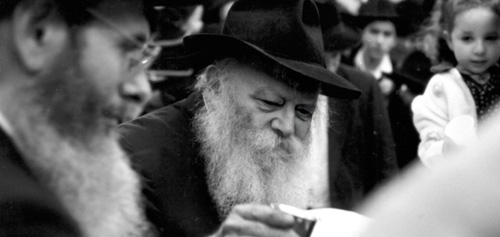
"Moshiach is ready to come now-our part is to increase in acts of goodness and kindness" -The Rebbe

Showing posts with label love of Hashem. Show all posts

Sunday, August 4, 2013

Overcoming the Dangers of Intense Religiosity (pt. 3)


Overcoming the Dangers of
Intense Religiosity (pt. 3)

Rabbi Yehoishophot Oliver

Earlier (pts. 1 and pt. 2), we explained the phenomenon of well-meant, otherwise worthy religious feelings being “hijacked” and being expressed in a counter-productive, even harmful manner.

Now for the big question: How does one avoid falling into this trap?

One root cause of spirituality going awry is the lack of the proper foundation of one’s service of Hashem.

To serve Hashem properly it is not enough to eschew hedonism, to think constantly about Hashem, to be spiritual, and to love Hashem. It is not even enough to fear Him. The same goes for fulfilling the Mitzvos that relate to the sphere of interactions with other people: It is not enough for a religious person to be generous and hospitable, to be humble and forgiving, to be devoted and tireless in serving one’s community. 

Yes, these are all important and even vital elements of a deep, personal relationship with Hashem. Yet all of them can go awry, so none of them comprise the very foundation of one’s relationship with Hashem.

The beginning and foundation of serving Hashem is very (and perhaps even deceptively) simple: Kabolas ol Malchus Shomayim, submission to the yoke of the kingdom of Heaven.[1] This means that one is in a state of constant submission, such that all one’s behavior is part of serving Hashem, and is done with the intention of following His wishes.

With regard to emotional expression, this means that no emotion or desire, however worthy it may otherwise be, should be expressed exclusively because one feels that way.

Rather, even if the emotion coursing through one’s heart is fully appropriate, one should be conscious of its inner core. This very emotion is part of serving Hashem, for through it one fulfills a divine command—the command to feel certain feelings.

For Torah and halacha direct us not only in our actions, but also in proper thoughts and feelings, in “chovos halevavos—duties of the heart.” In this case, not only is it worthy to love and fear Hashem, but in so doing, we fulfill explicit divine commands[2] (which are, in fact, Biblical obligations no less binding than the obligation to keep Shabbos or kosher): “Love Hashem, your G–d”[3] and “Fear Hashem, your G–d.”[4]

This holds true not only for spontaneous, gut feelings (which are much more likely to be hijacked in the manner described above), but even for feelings that emerged, as they should, from a process of study, comprehension, and hisbonenus (“contemplation” or “meditation”). For intellect, emotions, and the (very worthy) process of intellect producing emotions all depend upon the firm foundation of Kabolas ol Malchus Shomayim for their success.

When a Jew’s life is based on this foundation, his entire relationship with Hashem is stable and strong, and then he is able to attain success in his spiritual strivings in all areas and on all levels[5]—intellect, emotions, and thought, speech, and action. Moreover, it ultimately also paves the way for Hashem’s blessings for material prosperity.

If, however, one gets carried away with a passion for a holy pursuit (in whatever area), but lacks the awareness that this feeling is not just self-expression, but a part of serving Hashem and fulfilling a divine command, then no matter how worthy and holy the passion, this person is at high risk. This passion may well devolve into inappropriate feelings and behavior, as explained in the previous posts in this series.

Thus, we find how Nadav and Avihu, who yearned to serve Hashem on a high level, were so intent on their desire to offer up the incense in the Mishkan that they did so when they were not supposed to. They then “came too close to Hashem, and died.”[6] The reason this happened was that their passion to come close to Hashem lacked kabolas ol Malchus Shomayim, the simultaneous desire to submit to Him, and so it ended tragically. Let us not make the same mistake.

Adapted from the Rebbe's Sichos Kodesh 5723, p. 54.

Read this essay in full on Scribd here!
____________________
[1] Cf. Tanya beg. ch. 41.
[2] These are counted in the Six Constant Mitzvos binding on men and women equally, as enumerated in the introduction to Sefer HaChinuch.
[3] Devarim 6:5.
[4] Ibid. 6:13.
[5] Cf. Likkutei Sichos, Vol. 1, pp. 104-105.
[6] Vayikra 12:1; Ohr HaChaim ad loc.


Dedicated by Reb Yisrael Meir Raphael and family.


___________________________________
Like what you read? The articles I write take a lot of time and effort. Please contact me to sponsor an article for (at least) $36 in honor of the birthday, wedding anniversary, or yarhtzeit of a loved one, or for a refuah shleimah or the like. Also, see here concerning the tremendous merit of supporting the dissemination of Chassidus, and the blessings that one receives for doing so.

Tuesday, December 4, 2012

The Evil Inclination vs. the Bestial Soul

The Evil Inclination vs. the Bestial Soul

(Based on a maamar of the Alter Rebbe,
in honor of 19 Kislev)

Rabbi Y. Oliver

The Bestial Soul is also referred to as the Evil Inclination. In fact, in classical Torah sources, this soul is referred to as the Evil Inclination, and only at a later point did it also come to be known by the appellation of Bestial Soul.

An analogy for the place of the Evil Inclination in the Bestial Soul can be drawn from burning wood. Wood consists of a combination of the four elements of fire, air, water, and earth. Now, everything consists of a combination of two parts: chomer, the raw matter, and tzurah, the particular form that it assumes.

The primary chomer of a thing is the component that comes from the element of earth within it. This is the deeper meaning of the verse, “Everything came to exist from earth.”[1] In contrast, the tzurah stems primarily from the specific combination of three other elements—fire, air, and water.

In the wood, the chomer is the element of earth within it, while its tzurah is shaped by the specific combination of the other three elements. Since burning destroys the tzurah of a thing, when the wood is burned, the other three elements are separated from the wood, and only ashes—which come from the element of earth, which is the chomer—are left behind.

The distinction between chomer and tzurah also exists spiritually, and this sheds light on the nature of the Evil Inclination. This name is precise—the Evil Inclination, for this title refers specifically to the emotional expression and inclination toward selfish and even sinful desires, which, unless one exercises self-control, naturally culminates in the thought, speech, and action that consummate these desires.

In contrast, the essence of the Bestial Soul is beyond any inclination; it is not inclined to any particular, defined emotion, for by definition, an essence transcends particularities.[2] Rather, at the Bestial Soul’s essence lies the ko’ach hamis’aveh, the “faculty that desires,” which consists of an intense, primal, selfish desire as it exists in potential form—raw, simple, uncomplicated, and unformed.

Now, although an actual desire for the physical is unworthy, its core, the ko’ach hamis’aveh, is not fundamentally evil, for just as it was directed to physical pleasures, so can it be redirected to desire that which is good and holy—to yearn to connect with Hashem, as it is written, “My soul yearns for You.”[3]

This[4] is also the meaning of the verse, “You shall love Hashem bechol levavcha—with all your heart.”[5] Although normally translated in the singular, the literal meaning of bechol levavcha is “with all your hearts,” in the plural. What is the significance of this unusual expression?

Our sages explain[6] that this alludes to the two inclinations within—the good inclination and the evil inclination. The Jew should come to love Hashem not only with the good inclination—the Divine Soul, but even with the evil inclination—the Bestial Soul.

However,[7] in order to reach this love, one must first uproot the “filthy garments”—the selfish, indulgent desires for physical pleasure, permitted and forbidden, along with the thought, speech, and action to which they led. This is accomplished through genuine Teshuvah—sincere regret for one’s past behavior, and a firm resolution to change in the future. Teshuvah uproots one’s desires from materialism and redirects them to yearn for the realm of purity and holiness instead.


Based on Likkutei Torah, Chukas 56c-d.

________________________________________
[1] Koheles 3:20.
[2] Cf. Imrei Binah, Shaar HaKerias Shema, ch. 8. Toras Chaim, Vayeshev 68a.
[3] Yeshayah 26:9. Cf. Tanya, Chinuch Katan.
[4] Cf. Sefer HaMa’amarim 5717-5718-5719, p. 389.
[5] Devarim 6:5.
[6] Berachos 26a-b.
[7] Cf. Sefer HaMa’amarim ibid., p. 388.


Dedicated in the merit of a speedy release for the captives Yonasan ben Malka (Jonathan Pollard), Jacob Ostreicher (Yaakov Yehuda ben Shaindel), Alan Gross (Aba Chonah ben Hava Chana), Sholom Mordechai Halevi ben Rivka (Sholom Rubashkin), and Zeva Rochel bas Chaya (Wendy Weiner Runge).


Like what you read? The articles I write take a lot of time and effort. Please contact me to sponsor an article for (at least) $36 in honor of the birthday, wedding anniversary, or yarhtzeit of a loved one, or for a refuah shleimah or the like. Also, see here concerning the tremendous merit of supporting the dissemination of Chassidus, and the blessings that one receives for doing so.

Tuesday, July 24, 2012

Iskafya: Ploughing the inner soil


Iskafya: Ploughing the inner soil
Rabbi Yehoishophot Oliver


(For earlier articles on this topic, see here,  herehere, and here.)


(In this recent article, we discussed how tremendous effort is required to go from love for the physical to love for Hashem. This article develops that theme.)


What is IskafyaIskafya means that when your heart craves a material pleasure, you tell yourself “no.” You restrain yourself, and you don’t do it.


G–d forbid, there is no emotionally unhealthy, masochistic desire here to bring oneself to suffer for the sake of suffering. (If there is, such a person shouldn’t be engaging in Iskafya.) On the contrary, a Jew should serve Hashem with joy, and Chassidus rejects the approach of bringing afflictions (“siggufim”) upon oneself as an atonement for one’s sins.[1]


Rather, true Iskafya stems from a profound desire to bond with G–dliness, and the knowledge that in order to reach this goal, one must give up worldly pleasures to a significant degree.


The Torah instructs us, “All your actions should be for the sake of Heaven.”[2] This means that when a Jew engages in the material world, he shouldn’t do so in order to satisfy his physical desires, or even to provide for his basic needs and survive (although it is indeed necessary). Rather, he should do so for the sake of serving Hashem—e.g., he eats and drinks in order to have strength to study Torah and davven; he pursues a livelihood in order to provide his children with a pure Torah education, give charity to the poor, support Torah study, and so on.


Now, when one craves something physical, that means that he wants it for himself, for his own egotistical enjoyment and pleasure, and not for the sake of Hashem. And so giving into this desire will strengthen his ego, and make him that much less receptive to G–dliness. Conversely, by engaging in Iskafya and restraining oneself from indulgence, the Jew makes himself that much more receptive to G–dliness.


We can understand this from an analogy. In order for plants to grow, a farmer must plough the soil. This softens it so that the seeds deposited on the soil can germinate and grow into a plant. In contrast, a seed sown on hard soil cannot grow. The more the soil is ploughed, the softer it becomes, and the more easily the seed can take root, thrive, and produce fruit.


So, too, hidden in the heart of every Jew lies a priceless treasure: The ahavah mesuteres, a natural love for Hashem that stems from the Neshamah, which is “literally a part of Hashem above.”[3] But in most of us, it is deeply hidden by the negative spiritual forces of Kelipah, of concealment of the divine, and to be more specific, by the coarseness of the Bestial Soul within the person, which stems from Kelipah.


How do we break through this coarseness, this spiritual blockage, and enable the Neshamah to emerge? By working on the avodah of Iskafya. Each time we practice Iskafya, we weaken the Bestial Soul. Just as ploughing loosens the soil and enables the seeds to grow, so does Iskafya weaken the Bestial Soul so that the ahavah mesuteres can come to the fore. (On the topic of eliminating coarseness and removing spiritual blockages, see here. As for the way to approach Iskafya in practice, and which areas it is preferable to focus on, see here.)


However, Iskafya itself does not reveal the ahavah mesuteres. Rather, it humbles the person and prepares one’s heart so that during Tefillah, the heart will be truly receptive to the various steps in the process of Tefillah (see here), until one reaches love of Hashem.


To be sure, the Jew who engages in Iskafya probably already feels love for Hashem to a significant extent, for it was this desire to connect to G–dliness that motivated him to engage in Iskafya in the first place. However, by engaging in Iskafya and actually davvening with that extra sensitivity, with Hashem’s help, he will reach a far more sublime level of love for Hashem.


Adapted from Likkutei Torah, Masei 96d


_____________________________________
[1] Tanya, Igeres HaTeshuvah ch. 1. Cf. Hayom Yom 28 Shevat.
[2] Avos 2:12.
[3] Tanya ch. 2, beg.


Dedicated in the merit of a speedy release for the captives 
Yonasan ben Malka (Jonathan Pollard), Sholom Mordechai Halevi ben Rivka (Sholom Rubashkin), and Zeva Rochel bas Chaya (Wendy Weiner Runge).


Dedicated by avi mori, Reb Kasriel Oliver and family, as a merit for imi morosi, Chana Feigeh bas Reizel (aka "Zippi"), on the occasion of her 60th birthday, tzu langeh, gezunteh, zisseh yorn, filled with material and spiritual success and prosperity.


Like what you read? The articles I write take a lot of time and effort. Please contact me to sponsor an article for (at least) $36 in honor of the birthday, wedding anniversary, or yarhtzeit of a loved one, or for a refuah shleimah or the like. Also, see here concerning the tremendous merit of supporting the dissemination of Chassidus, and the blessings that one receives for doing so.

Monday, May 14, 2012

Spiritual Sickness


Spiritual Sickness

Rabbi Y. Oliver


During the weekday Amidah prayer, over the course of twelve blessings the Jew beseeches Hashem for his needs. This request presupposes a strong awareness that one is lacking and needy, and totally dependent upon Hashem to provide for one’s every need.


Moreover, in addition to the literal meaning of the requests, there is also a spiritual meaning.


For instance, in the Amidah prayer, we ask Hashem to heal the sick. Now, what is the true root of sickness? The frustration from unfulfilled expectations. This sickness can manifest itself both in unholiness and in holiness.


When one is lacking in “holy fire,” in passion in serving Hashem, he eventually becomes consumed with a “foreign fire”—a negative, self-destructive spiritual energy, that saps the person of refinement and spirituality and excites him or her with a craving for materialistic and forbidden pleasures, may G–d save us.


This then “weakens G–d,”[1] as it were, for it diminishes the divine revelation in one’s soul, and then in the cosmos in general.[2]


So when we beseech Hashem to heal the sick, we also mean to ask that He heal those who are spiritually sick by contamination with impure and unholy materialistic desires.


But then there is a positive, holy kind of sickness, of which it is written, “I am lovesick.”[3] This refers to a powerful, unconsummated love for Hashem.


To explain, there are fifty “gates of divine understanding.” Once one has climbed ever higher in levels of holiness until he has reached the forty-ninth level, he senses the intensity of the fiftieth and highest level, and aches and yearns to attain it, but he lacks the tools to do so. Thus, the Hebrew word choleh, sick person, has the numerical value of forty-nine,[4] alluding to the one who is lovesick for Hashem.


This is the second meaning of our plea to Hashem to heal the sick—that He heal those who are lovesick for Him by granting them the revelation for which they yearn.


These two kinds of yearning are extremes. They represent the two general categories of intense yearnings: for the spiritual and for the materialistic. We may all suffer from one of these at times, albeit to a lesser degree. May Hashem help us to be healed from the state of suffering or even being susceptible to the first kind of sickness, and merit to attain the second kind—along with its cure.


Adapted from Sefer HaMa’amarim 5713, p. 124 ff.


_______________________________
[1] Cf. Devarim 32:18.
[2] Cf. Eichah Rabbah 1:33.
[3] Shir HaShirim 2:5.
[4] Ta’amei HaMitzvos LehoArizal, Vayera. Likkutei Torah, Berachah 97b.


Like what you read? The articles I write take a lot of time and effort. Please contact me to sponsor an article for (at least) $36 in honor of the birthday, wedding anniversary, or yarhtzeit of a loved one, or for a refuah shleimah or the like. Also, see here concerning the tremendous merit of supporting the dissemination of Chassidus, and the blessings that one receives for doing so.

Wednesday, March 21, 2012

Matan Torah: Compelling Love


Matan Torah: Compelling Love

Rabbi Yehoishophot Oliver

The Divine Presence rests only in a place that is in a state of bittul, submission and self-nullification, to Hashem.[1]

This is true of any divine revelation, and so it applies all the more to the Giving of the Torah, which was the greatest divine revelation in history. In order to receive the Torah, the Jewish people had to be in a state of total bittul to Hashem.

Now, on one level, this bittul was accomplished through the suffering that the Jewish people underwent in the Egyptian exile, for suffering crushes a person’s ego, making him a vessel for Hashem’s infinite light.[2]

Likewise, we find that immediately before receiving the Torah, the Jewish people cried out collectively, “we will do.”[3] With this they dedicated themselves to Hashem from the very core of their beings, committing to obey Him regardless of what He might command (which they did not yet know, for He had not yet issued the Ten Commandments). They rose to a level of devotion and love for Hashem so intense and sublime that it was as if they had no wish of their own, for their only wish became to fulfill Hashem’s wish.

This is the level of bittul expressed in the analogy to an eved, a servant, who has no independent existence; his entire existence is devoted to obeying everything that his master commands him.[4]

After they reached the level of “we will do,” they merited “we will hear”—to “hear” and absorb the revelation of Hashem’s infinite light.

But how were the Jewish people able to attain such a lofty level of love for Hashem? Had they not only recently been delivered from Egypt, where they had in many respects assimilated with the Egyptians, and sunken to appalling depths of impurity? Indeed, the Zohar states[5] that they had sunken to the forty-ninth gate of impurity, and that when they were redeemed, they were on the brink of falling to the fiftieth and lowest gate of impurity, at which point they would have been irredeemable. At this point they were at the lowest level of divine service, and in a very spiritually immature state (see here concerning “mochin dekatnus”). How could they then “jump” spiritually from such depravity to such heights?

Moreover, how does the above explanation of “we will do” as meaning that the Jewish people received the Torah with total, unreserved eagerness fit with the Talmud’s statement that Hashem “forced the mountain upon their heads like a tub” and insisted that they accept the Torah?[6]

Chassidus reveals that although Hashem “forced” the Jewish people to receive the Torah, they did so not out of fear, but out of love.

Human nature is that “as water reflects a face to a face, so is one’s heart reflected back to him by another.”[7] The way feelings work is that we naturally reciprocate a feeling expressed to us.

Now, the more intense the feeling expressed, the harder it is to express a contrary feeling in return. This explains why an intense expression of love is usually reciprocated. However, at times one may express profound, heartfelt love to another, but still finds that it is rejected, or not sufficiently reciprocated. The reason for this is that for whatever reason, a certain part of the giver, and thus also of the recipient, was not involved in the love. However, if the expression of love is total and uncompromising, then it will be so powerful that it will “compel” the recipient to accept it, for it encompasses the recipient so utterly that he or she “cannot” reject it.

This might also be observed physically, when the one expressing love is overwhelmed with emotion to the point that he hugs his loved one so tightly that his entire back is embraced, and so the recipient of the hug is pinned in place, unable to move and turn his or her back to the lover.

This is the deeper meaning of the Talmud’s statement that Hashem “forced” the Jewish people to receive the Torah. Thus, of the Giving of the Torah it is written, “his right hand embraces me.”[8] Hashem “hugged” the Jewish people so tightly, as it were, that they could not turn their back to Him and reject Him. He revealed Himself to them with an ahavah rabah, a “great love”—a love so passionate that they were “forced” to respond in kind.

How did they respond in kind? They declared “we will do,” and thereby surrendered to Hashem with an absolute commitment, as explained.

This also explains how they could have “jumped” from the depths of impurity to the heights of holiness. As sublime as their love for Hashem was, it came through a revelation from Above, and not through their own efforts and merit. And so it didn’t matter that they had just emerged from Egypt; as they were, on their degenerate level, Hashem expressed His “great love” for them, and thereby elevated them to a sublime level of love towards Him.

Based on Torah Ohr, s.v. Chayav inish libsumi.

_________________________
[1] Tanya ch. 6; cf. ibid. ch. 35.
[2] Cf. Torah Ohr, Yisro 74a-b.
[3] See Shemos 24:7
[4] Tanya ch. 41 (57a).
[5] Zohar Chadash, Yisro, beg.
[6] Shabbos 88a.
[7] Mishlei 27:19.
[8] Shir HaShirim 2:6, 8:3.


This post is dedicated by Reb Kasriel Oliver and family as a merit for Rivka Reizel bas Hinda Zelda Bracha Tsap.


Like what you read? The articles I write take a lot of time and effort. Please contact me to sponsor an article for (at least) $36 in honor of the birthday, wedding anniversary, or yarhtzeit of a loved one, or for a refuah shleimah or the like. Also, see here concerning the tremendous merit of supporting the dissemination of Chassidus, and the blessings that one receives for doing so.

Wednesday, December 15, 2010

Where does our heart lie? I

The Talmud says[1] that the time for the Mitzvah of kindling the Chanukah lights is “from when the sun sets until passers-by cease from the marketplace.” The Talmud explains that this time extends “until the steps of the people of Tarmuda’i cease.” Rashi explains that the people of Tarmud, who would sell wood in the market-place, were always the last to leave. Every night they would wait until everyone else had gone home, in case they needed wood for their fires.

On a deeper level, the word Tarmudai is etymologically related to the word meridah, rebellion, and represents rebellion against Hashem (may He save us). This is analogous to the moredes, “insubordinate wife,” a woman who refuses to engage in marital relations. The husband-wife relationship is fundamentally one of giver and recipient; the husband is the giver, and the wife is the recipient or “vessel” for what the husband gives. In a proper marriage, through the first act of intimacy, the husband forges a deep emotional bond with his wife that makes the wife desire to act as a mekabel, a recipient from him. An insubordinate wife, however, does not desire to receive from her husband.

Likewise, the Jewish people are compared to Hashem’s wife (this is the basis of the entire book of Shir Hashirim). We are also referred to a vessel, as King David said, “I will lift a cup of salvation.”[2] The Jewish people are likened to a “cup” that receives Hashem’s blessings of salvation. This implies that they should yearn to receive from Hashem alone, from holiness, and that when they do, they are living as they ought to, as they were meant to.

This concept is not only true of the Jewish people as a collective; it also applies to each individual Jew. A Jew’s desire and yearning should be to receive only from Hashem. This means that the Jew’s bond with Hashem is not just about following the Shulchan Aruch, the Code of Jewish Law. It is about where his heart lies.

If a Jew fulfills the Shulchan Aruch meticulously, but sets his heart, dreams, and strivings elsewhere, his bond with Hashem is fundamentally lacking. Every desire that a Jew has for something independent of the framework of serving Hashem is a kind of inner rebellion against Hashem, a kind of subtle infidelity in this personal relationship with Hashem. Chanukah represents refining the inner self of the Jew to the point at which all his desires and yearnings are related to serving Hashem.
___________________________________
[1] Shabbos 21b.
[2] Tehillim 116:13.

Adapted from Sefer HaMa’amarim 5713, Misheteshka hachamah.
See also the follow-up post here.

Monday, September 20, 2010

Seraphim: Passionate Love for Hashem


Seraphim: Passionate Love for Hashem

Rabbi Y. Oliver

There are different types of angels, but the highest is the saraph (pl. seraphim). What are the seraphim?


The word saraph is etymologically related to the Hebrew word sereipha, burning up, for the seraphim are composed primarily of the element of fire. This means that their divine service involves becoming so heated up and passionate in their expression of love for Hashem that they burn up completely and cease to exist.


The reason that only the seraphim behave in this way is that they reside in the world of Beriah. Since in this world the Sefirah of Binah of Atzilus shines openly, all the levels in this world experience very profound Binah—intellectual grasp of Hashem’s greatness. This is also felt by the seraphim, and this causes them to become so excited that they burn up.


What do the seraphim comprehend, and why does it excite them? They grasp two levels, one after the other: The first is the divine light that shines into them in a way that they directly apprehend (“Hasogas HaMehus”). This light descends to their level, bringing them great pleasure, excitement, and joy, and sustains their existence, much as food sustains a person.


However, once the seraphim have enjoyed this divine revelation, they come to recognize that it is in fact severely limited and utterly incomparable to its source in Atzilus, which they comprehend in an indirect, abstract manner (“Yedias HaMetzius”).


The worlds of B’ya (Beriah, Yetzirah, and Asiyah, the three spiritual “worlds” below Atzilus) are created from Malchus of Atzilus, the lowest of the Sefiros of Atzilus. However, the light that shines from there into B’ya undergoes tremendous contractions (“tzimtzumim”) before it descends into B’ya, such that it morphs into a fundamentally different and inferior state.


One analogy for this radical change is from a name. A person only needs a name so that other people can refer to him or call to him. But when a person is alone, a name is useless. On a deeper level, the superficiality of one’s name stems from the fact that it is related to the more external part of his soul, the part vested in a body. The essence of the soul, however, transcends the level of one’s name. This is also the reason that one soul can descend into the world in multiple incarnations, each time vested in a different body with a correspondingly different name.


This analogy is associated with the Sefirah of Malchus because the word Malchus literally means royalty, and the quality of royalty is closely associated with the monarch’s name. The reason for this is that the bond between a king and his subjects depends upon the king’s name. Even if the nation has never seen the king, and they often haven’t, they identify themselves as his subjects, and are even willing to give up their lives for him, all on account of their identifying with his name.


Likewise, the light that emerges from the Sefirah of Malchus of Atzilus is similar to a name in that it is only an external light, which is incomparable to the intensity of the light of Atzilus in its own right.


The seraphim comprehend, albeit on an abstract level, the sublime loftiness of the light of Atzilus, and the abject inferiority of the diminished light that they receive. They grasp it so well that they become so intensely consumed with a desire to attach themselves to the superior light of Atzilus that they become burnt up and cease to exist.


By reflecting upon the seraphim (and all the angels)particularly during the blessings of Kerias Shema, in which the angels and their worship of Hashem is discussedwe are able to imitate their feelings of love for Hashem, albeit on our incomparably inferior level.


Based on the Rebbe Rashab’s Sefer HaMa’amarim 5670, p. 232 
Cf. Etz Chaim, Sha’ar Penimiyus v’Chitzoniyus 13, and Malbim on Yechezkel 1:1.

Wednesday, October 28, 2009

Love of Hashem


The Talmud (
Sanhedrin 74a) states:

Rabbi Eliezer asked (in reference to the verse (Devorim 6:5), “You shall love Hashem your G-d with all your soul and all your resources”): If it is stated “with all your soul (nafshecha),” why was it necessary to state “with all your resources (me’odecha)”? And if it is stated “with all your resources,” why was it necessary to state “with all your soul”? Rather, [the explanation is that] if there is a person whose life is more precious to him than his money, it says “with all your soul” [so that he be prepared to give up that which is most precious to him]. And if there is a person whose money is more precious to him than his life, it says “with all your resources” [so that he be prepared to give up that which is most precious to him].

Rashi comments:

This means that your love for Him should be more precious to you than everything else that is precious to you.

It would seem that this is not only a lesson about the importance of giving one’s life or resources for Hashemwhat one should be willing to give up. Here, the Talmud teaches us how important it is to love Hashem, and how central this focus should be in our lives. It should both act as a guideline for every single aspect of life, and as a goal to which a Jew should aspire: that his love of Hashem should reach the highest level possible.

Yes, as mere mortals we have natural desires, preferences, and inclinations. And these are not only desires for indulgence (along the lines of the one who values his money above all else), but for constructive things as well (along the lines of the one who values his life above all else). Nevertheless, since all these things are about what
I want, they should be relegated to second-class status. One’s love of Hashem should be the overriding concern in any and every aspect of life.

And here the emphasis is not fear, but love. Fear of
Hashem should precede love of Hashem, of course, as it is the foundation of one’s divine service (see the beginning of chapter 41 of Tanya). This means first and foremost strict adherence to the requirements of halacha. However, following halacha is merely step one. Fear is primarily about not violating the minimum, or, in other words, not sinning and rebelling.

In contrast, love implies going beyond the letter of the law and the call of duty. One who truly feels love does not constantly calculate
whether he is technically obligated to assist his loved onethat would show that love is lacking. Rather, he naturally, of his own initiative, volunteers to help out his loved one. He does not regard it as discharging an obligation, but as a privilege and a pleasure.

Likewise, loving
Hashem means naturally asking oneself: “What can I do to give Hashem pleasure? What will make Him rejoice and be proud that I am His child?” One who doesn’t feel the desire to ask oneself this should at least aim and strive to reach this level. In the meantime it would seem that one ought to at least ask himself this question in a somewhat more forced manner, for it accustoms oneself to this way of thinking.

This is the main thought that should
guide and dominate a Jew’s actions and choices—even if it means forgoing something he would otherwise very much prefer to have.

Sunday, July 5, 2009

The Rebbe: Sincerity and passion in teaching


One who first hears about the Rebbe is surprised. He learns that attending a farbrengen of the Rebbe, or standing in line to receive a dollar (or going to visit the Rebbe at the Ohel now) are people from all walks of life, from all types of background and social standing. Many of them certainly didn’t grasp much of the words of Torah that the Rebbe spoke. So what attracted them to him, and what continues to attract them?

Perhaps this can be explained based on the following excerpt from a
Ma’amar of the Previous Rebbe:
... Avraham our father explained G–dliness through explanation that was comprehensible even to simple-minded people. And even those who failed to understand felt that the truth was as he had said, and acknowledged what he said. His words had such enthusiasm and love for Hashem that even those who could not properly understand [his explanations] acknowledged [his words] because they sensed his enthusiasm and genuineness. ...


Sefer HaMa’amarim 5701, p. 13.
Those who came to the Rebbe, or who hear and see him speak today via audio and video, and read his words, sensed and sense:
  • Enthusiasm and love for Hashem: Real, almost inexhaustible enthusiasm and energy, passion and vigor for serving Hashem through Torah and Mitzvos.
  • Truth: No airs and pretension, no pomp and ceremony. Instead, total honesty, genuineness, sincerity, and authenticity.
This language speaks to everyone, from the most sophisticated to the most illiterate. May I suggest that as chassidim of the Rebbe, we should also derive from this that the key to success in spreading the Rebbe’s message is the manner in which it is delivered.

Even those who didn’t and don’t grasp the profound explanations in the Rebbe’s
maamarim and sichos can sense the passion and honesty that permeates them, and this alone uplifts and inspires. (Of course, this is only a beginning in what Chassidic parlance calls “makif,” encompassing and superficial in a certain sense, but it definitely makes a very real impact.) If the chassidim strive to emulate the Rebbe, and ensure that their words are permeated with a similar passion and honesty, at least on their level, then their words will surely be accepted.

Perhaps this is also one way to interpret the expression that one should teach “
be’ofen hamiskabel”—“in a way that will be accepted” (see, for example, Hisva’aduyos 5752, Vol. 1, p. 299 concerning teaching about geula and Moshiach). When we deliver the Rebbe’s message and we truly mean it and are excited about it, then we can be confident that it will be accepted.

But how does one change oneself, to reach true sincerity and passion in one’s devotion to
Hashem? One accomplishes this through prayer, as it it is written: “What is the service of the heart—it is prayer” (Sifri, Devarim 11:13). And a Chabad chossid has been granted the uniquely Chabad discipline of 
avodas haTefillah, which consists of learning Chassidus in depth (see here), reflecting at length on a concept in Chassidus, and then reciting the words of davvenen slowly and passionately.

Friday, May 1, 2009

Inner self: The true measure of religiosity

In this week’s parsha, Kedoshim, (Vayikra 19:14), it is written:
You shall not ... put a stumbling block before a blind person, and you shall fear your G–d; I am Hashem. Rashi: Before someone who is blind in that particular matter you shall not give advice that is unfair to him. Don’t say to him, “sell your field and buy a donkey,” when your intention is to deceive him and take it from him.”

And you shall fear your G–d. Rashi: Because it is not given to human beings to know whether his intention was for good or evil. He could therefore evade [responsibility] and say “I intended it for his benefit.” Therefore it says concerning it, “you shall fear your G–d,” Who knows your thoughts. Likewise, of every matter that is given over to the heart of the person who does the action and no one else could possibly know [his true intentions], it states, “fear your G–d.”
So often we measure religiosity by externals, both in ourselves and others. Here the Torah warns us that this is not the true measure of divine service.

For example, it’s true that someone who talks in
Shul lacks fear of Hashem, but that doesn’t necessarily mean that the one who doesn’t talk does fear Hashem. He may be quiet for other reasons—he is a shy person by nature, he wants people to think well of him, and so on.

Likewise, many
frum Jews feel that since in general they adhere to the basics of Halacha, this is sufficient, and their divine service is acceptable. What they don’t realize is that in fact Hashem has very little to do with motivating their observance, which (on the revealed level) is driven almost exclusively by other motives.

So although the external actions are important (and I’m certainly not suggesting that they be abandoned, G–d forbid), they often tell us little about the person. The true measure is in the person’s inner self, in his thoughts and feelings, and this is largely between him and Hashem, for “One does not know what is in the heart of one’s fellow” (
Pesachim 54b).

The same holds true for the way that the Jew views himself. Let’s say that on some basic level, he wants to serve
Hashem. The question that he needs to ask himself is: Is it for real? Is he truly G–d-fearing?

Well, that begs the question: What does it mean to fear
Hashem? It means that the person is always conscious that Hashem is watching, and careful to follow His will, even in private.

So is the person G–d-fearing? Well, what does he do in his spare time, when he is alone? Will he waste that time, or use it to learn Torah, or do something positive and constructive for others? What does he think about? Does he naturally think constructive, or holy thoughts? Does he control himself when he desires to think an inappropriate thought, whether about something forbidden, or about a fellow Jew?

The same applies concerning the person and his fellow. When he helps others, he needs to ask himself: What is going through his mind and heart? Does he truly desire to help them, out of
ahavas Yisrael (love of a fellow Jew), or is he doing it primarily for other motives—if not deceitful motives, at least selfish ones?

If the answer to some of these questions is in the negative, the person has to realize that despite his technical observance, he has a long way to go on the road to truly serving
Hashem. He has to davven to Hashem to help him on this path.

Purifying and rectifying one’s inner thoughts and feelings is what true service of
Hashem is all about. The external actions simply provide the necessary framework for accomplishing this goal. To quote the Arizal: “A Mitzvah without the proper intention is like a body without a soul.” For a Jew who is basically religious, the “body” is there—the observance of Halacha. The really hard work, which sadly seems to be widely neglected, is that of infusing the body with a “soul,” the holy feelings that a Jew should feel—true love and fear of Hashem, love of Torah, and love of one’s fellow Jew. And this inner emotional change is accomplished through Avodas HaTefillah, “The service of prayer” (Taanis 2a).