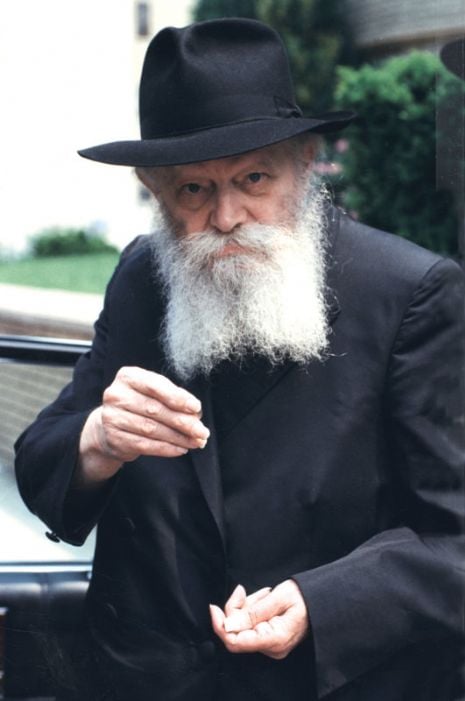
"Moshiach is ready to come now-our part is to increase in acts of goodness and kindness" -The Rebbe

Showing posts with label garb. Show all posts

Wednesday, November 7, 2012

Essential spiritual food and clothing

Essential spiritual food and clothing

Rabbi Yehoishophot Oliver

Generally speaking, livelihood includes two kinds of basic needs: food and clothing. These are both necessities for livelihood, i.e., physical survival, for a person must have some food and clothing to survive. However, they serve very different functions.

Food is an ohr pnimi, an “internal light”—an influence that comes down and adapts to the level of the recipient on its terms, who internalizes and unites with it. So when a person eats, he takes the food inside, and once it has been digested, it becomes one with his flesh and blood. This then enables one’s physical life to continue, for the food becomes converted into blood and other nutrients that spread throughout the body, strengthening it and making it a fit vessel for the soul to become fully vested in it, enabling the soul to continue giving life to the body.

In contrast, clothes represent an ohr makif, an “encompassing light,” an influence that does not descend to the level of the recipient, but encompasses him. Likewise, clothes do not actually become one with the wearer; rather, they surround him and benefit him by providing warmth, maintaining modesty, expressing his identity, and so on.

The same is true of spiritual livelihood and spiritual health, which depend upon the combination of two parallel kinds of divine service—Torah and Mitzvos.[1]

Torah is compared to eating, as it is written, “Come and partake of My bread,”[2] and “Your Torah is in my innards,”[3] for the Torah is an ohr pnimi that a Jew is obligated to intellectually “digest” and unite with.

In contrast, Mitzvos are compared to clothing, for they elicit upon the Jew an intense ohr makif, a sublime divine light, that descends upon the Divine Soul, the Bestial Soul, and the body, but does not permeate the Jew’s personality, which primarily constitute the intellect and emotions.[4]

So when Hashem instructs in the Torah to fix regular times for Torah study, to perform Mitzvos, davven with a minyan, and so on, these are not merely worthy actions that we do because we want to make Hashem happy, or the like. Nor are they merely a fulfillment of our duties to Hashem. Although they include all the above, we should realize that Torah and Mitzvos simply provide our soul—which constitutes the Jew’s true self (see here)—with the “food” and “clothing” that it needs in order to survive and thrive.

The Rebbe Rashab’s Sefer HaMa’amarim 5653, p. 262-263.

_____________________________
[1] Zohar 3:7b.
[2] Cf. Tanya ch. 5.
[3] Mishlei 9:5.
[4] Tehillim 40:9.
[5] Cf. Tanya chs. 5, 25, 46.


Dedicated in the merit of a speedy release for the captives Yonasan ben Malka (Jonathan Pollard), Jacob Ostreicher (Yaakov Yehuda ben Shaindel), Alan Gross (Aba Chonah ben Hava Chana), Sholom Mordechai Halevi ben Rivka (Sholom Rubashkin), and Zeva Rochel bas Chaya (Wendy Weiner Runge).

Dedicated by Dovid and Bracha Tsap as a merit for their daughter Sara Rachel bas Hinda Zelda Bracha, in honor of her birthday on 10 Cheshvan.


Like what you read? The articles I write take a lot of time and effort. Please contact me to sponsor an article for (at least) $36 in honor of the birthday, wedding anniversary, or yarhtzeit of a loved one, or for a refuah shleimah or the like. Also, see here concerning the tremendous merit of supporting the dissemination of Chassidus, and the blessings that one receives for doing so.

Thursday, June 23, 2011

Dressing Like a G-d-fearing Jew


The Rebbe relates:
A well-known story is told that once, in Lubavitch, a shochet was fired because he began to wear boots. How, then, was it that in later times, the Rebbe’im themselves wore boots?

The reason for this is simple. The shochet wasn’t fired because it is somehow forbidden to wear boots; rather, in that historical context, this act revealed that the shochet was loose and not G–d-fearing. During that period, only the impious would wear boots, while G–d-fearing Jews would not. So when that shochet deviated from the standard conduct of the G–d-fearing community, and began to wear boots, like empty people, this expressed that he was not G–d-fearing.*

However, once G–d-fearing Jews began wearing boots as well, then circumstances changed; obviously, there is nothing inherently wrong with wearing boots.

Hisva’aduyos 5743, Vol. 2, p. 759. Cf. Igros Kodesh, Vol. 9, p. 460.

*Elsewhere (Likkutei Sichos, Vol. 18, p. 460), the Rebbe adds: “In the time of this shochet, boots were a new thing, and only the Jews who dressed and acted like the pritzim [sing. poritz—the wealthy non-Jewish landowners], took part in their wild parties, and the like, would dress that way. If someone dressed like this, people knew that he had strayed from the proper path. In the end, it became known that this shochet and his family had indeed strayed from the proper path.”
In various times and places, G–d-fearing Jews wore various garments. What is important to consider is not the exact garment worn, but the simple fact that for whatever reason (and I don’t think that the superficial reason that this particular “fashion” was adopted really matters here), it has become accepted that in a particular time and place, a G–d-fearing Jew dresses in this particular way. So, as superficial as it sounds, one who fears Hashem naturally wants to conform to this way of dress, in order to make his identity as a G–d-fearing Jew known to others.

Conversely, if the person make a point of dressing differently from the way that G–d-fearing Jews typically dress in his particular cultural milieu, and davka imitating the dress of the non-Jews around him, he is making an unmistakeable statement about his degenerate values and low spiritual level. He lacks fear of Hashem, and therefore identifies with the goyishe culture of his time, instead of following the Torah’s mandate for the Jewish people to distance and distinguish themselves from non-Jews and their culture (see here).


Some further comments:

Despite the above, of course, one has the ability to be hypocritical, so although a pious person will dress the part, as above, pious dress does not in itself prove piety.

It should also be noted that nowadays, this principle may not always apply. This story occurred during an era in which the vast majority of Jews were Torah-observant, and the ones who abandoned observance were the exceptions, and moreover, they had been raised observing Torah and Mitzvos. However, the majority of Jews today are not yet Torah-observant, and they have been raised without Torah observance. In this context, those who are slowly finding their way back to their heritage from a world of secularism may continue to wear somewhat non-Jewish looking garments not because they are on the verge of leaving the fold, but because they are still in the process of entering it—a journey along which one must progress gradually, as explained here.


This post has been dedicated by the Weinberger family לעילוי נשמת Melech ben Mordechai Shmuel ע"ה, and by Menachem Kovacs in honor of the Yahrzeit of his father, Eliezer ben Shalom ע"ה, on 17 Sivan.

____________
Like what you read? The articles I write take a lot of time and effort. Please contact me to sponsor an article for $36 in honor of the birthday, wedding anniversary, or yarhtzeit of a loved one, or for a refuah shleimah or the like. Also, see here concerning the tremendous merit of supporting the dissemination of Chassidus, and the blessings that one receives for doing so.

Tuesday, October 5, 2010

Being a chossid is about inner change


Being a chossid is about inner change

Rabbi Yehoishophot Oliver

The Previous Rebbe once spoke very harshly against a trend toward superficiality that he observed:
Nowadays so-called young chassidic men (“chassidishe yungerleit”) are supposedly becoming chassidim on their own. They are educating themselves and guiding themselves, so alas, we can understand what sort of education it is, and what sort of guidance it is.


The young chassidic men of today have made peace with the enemies of Chassidus of old, such as hypocrisy, falsehood, talebearing, gossip, arrogance, insolence, and bad-heartedness. It is only that they wrap it up in superficial, supposedly chassidic garb.


Do not be offended that I describe all these things with their true names. Sometimes one must articulate the truth, and plead for divine compassion that [Hashem should help us to] have compassion upon ourselves, and see what sort of spiritually chaotic situation we are in.


The young chassidic men of today, and even those who learned in the chassidic Yeshivos, are also becoming dragged along by the trend toward the alien attitude of superficiality [“chitzoniyus”].


This is the attitude that one becomes a chossid through superficial Chassidic practices such as attending a farbrengen, participating in a Chassidic celebration, marking a Hillula [passing of a Rebbe], wearing Chassidic garb, and singing a Chassidic melody. This approach has, may G–d save us, destroyed many, many souls of Chabad chassidim, and caused many young chassidic men to unfortunately—it is bitter for me to say the sad truth—drown in the depths of evil.


It is difficult to speak and utter the truth, but nothing else will help; no matter how difficult it may be, the situation must be described as it is.


There are certain chassidic married men who were raised in a chassidic environment, in frum, chassidic homes, and were taught by chassidic teachers. This has brought their trappings to be chassidic; however, their inner selves are empty.


These men are empty of Torah, fear of Heaven, and fine character traits.


The reason for all this is the lack of obedience. From a very young age he did not accept the yoke of an educator and a guide. He educated himself and guided himself, and this “education” produced a wild fruit such as this, with a pleasant, shiny exterior, and a rotten interior.


Sefer HaSichos 5697, p. 182.
In my own words, with explanation:


Being a Chabad chossid is about inner change.


This inner change consists of learning and understanding Hashem’s greatness as explained at great length in Chassidus Chabad, and bringing that awareness to permeate one’s emotions with love and fear of Hashem, love of one’s fellow Jew, fine character traits, and devotion to the observance of Mitzvos (on the last point, see here).


A part, and a necessary part, of effecting that inner change is engaging in “the ways of Chassidus,” such as singing a chassidishe niggun, attending a farbrengen, wearing the chassidishe garb, and so on. These are all surely vital practices for every chossid (see here). However, the reason that they are effective is that the makif (“encompassing light”) is a preparation for the pnimi (“inner light”) (for explanation of this concept, see here; for another explanation along similar lines, see here).


When one approaches these practices with full awareness that they are a means to an end—facilitating the inner change demanded of a Chabad chossid—then they are able to have their desired effect, and then they in fact enable one to reach heights of spiritual sensitivity and greatness otherwise unattainable.


However, even very holy ideas and practices can be abused and taken out of context, and this may lead to very unfortunate results, may Hashem save us.


For many it is “easier” to engage in these more external practices (although some have the opposite problem, but here is not the place to elaborate) that require relatively less effort.


However, being a chossid is a “package deal.” So when one deliberately ignores some of the demands of Chassidus and dwells upon others that one finds personally more exciting, one is left with nothing. Perhaps this is along the lines of the rabbinic statement: “What does it mean, ‘He who keeps company with harlots forfeits his wealth’? Whoever says, this topic is pleasing and this one isn't pleasing, loses the wealth of Torah.” (Eruvin 64a)


If one would regularly seek chassidishe guidance and direction from a mashpia and an asei lecha rav, this phenomenon would not occur, for they would point out this neglect and demand that it be corrected.


It is my belief that the vast majority of problems in today’s generation of chassidim stem from a lack of awareness of this point.


(For other posts of mine along these lines, see here and here.)

Sunday, August 29, 2010

Don't dress like a chossid if you don't want to act like one!

A distinctive dress code identifies one as a member of a particular group throughout the world, and the world of religious Jewry is no exception. 


It is minhag Chabad to wear a kapoteh on Shabbos (as discussed earlier). Since a person is largely defined by his clothes, it has become communally accepted that by choosing to wear this garb, one is in effect declaring that one identifies as a Chabad chossid; conversely, by choosing not to wear such garb, one fails to truly identify himself as a Chabad chossid.


Now I’m not quite sure why this is the case, and moreover I question whether it’s correct to make this the measure of identification. However, what is clear is that it is popularly regarded as such. So someone who takes upon himself to wear a kapoteh, which is generally a distinctive Chabad garb, is viewed by others, rightly or wrongly, as someone who wants to be viewed as a Chabad chossid, and thus for all intents and purposes, is a Chabad chossid. 


Now, since the wearer of this garb knows that this is what others will think, even if he has some other intention in wearing this garb, that is irrelevant; he must consider the way he will be perceived by others. Thus, we find that according to Halacha one is considered to be desecrating Hashem’s name whenever one does something that others will perceive as wrong; even if one has a valid reason for doing so, it is a chillul Hashem, and one’s intentions are irrelevant.


So when someone who wears a kapoteh talks during the minyan, in addition to desecrating the name of Hashem, he is desecrating the name of the Rebbeim of Chabad, and the path in the service of Hashem that they have propounded. However, when he talks during the minyan and does not wear a kapoteh, he is desecrating the name of Hashem in general and his actions are of course wrong and indefensible, but he is not desecrating the name of the Rebbeim of Chabad. In this respect, his actions are less worse.


If you know that you’re going to talk in Shul, don’t come. And if you must come, at least don’t wear a kapoteh. Because if you show no respect for Shul, then your kapoteh and the declaration of affiliation that it signifies is meaningless and worse.


The same goes for those who trim their beards. Now, although many halachic authorities forbid trimming one’s beard, many using very harsh language, it is true that according to some, it is permitted when done in a certain way. However, those who have taken upon themselves to be chassidei Chabad are bound to follow the halachic rulings of the Rebbeim of Chabad, and since the Tzemach Tzedek maintains unequivocally that trimming one’s beard is forbidden min haTorah, one who identifies as a Chabad chossid and trims his beard violates a severe sin.


The same also goes for women who dress immodestly, and those who allow some of their hair to be exposed by wearing a tichel or the like, instead of following the Rebbe’s clear directive to wear a sheitel. And so on.


I am not claiming to be perfect myself, or claiming that all those who don’t fall short in these areas are perfect or anything approaching it. What I’m saying is simple—if you have chosen to openly, consistently, and most significantly, premeditatedly flaunt the minimum standards of observance of Shulchan Aruch expected of a Chabad chossid, then do yourself and everyone else a favor and don’t identify as one. 


Because by doing so, not only are you sinning more than if you had not so identified, you are causing others to sin. When the atmosphere in the community is such that talking in Shul, trimming, dressing immodestly, and so on, is acceptable, then those who are already weak follow the bad example of those individuals, some of those who are stronger are weakened, and in general, the entire community is dragged into the mud.


I’m sure many of you will brand me intolerant. So be it. But, I say to these flagrant violators, what about your intolerance? Your intolerance for the clear rulings of Shulchan Aruch, disrespect for the standards of the community that you so proudly claim to adhere to, and disrespect for the Rebbe and his teachings, to which you declare yourself to be so loyal? What about your selfish, stubborn refusal to consider the spiritual damage you wreak upon your environment? What about your insensitivity to the sincere religious feelings of those who truly want to serve Hashem in the community, and their desire to live and raise their children in a wholesome atmosphere of G-d-fearing Jews and devoted chassidim?


If you must do these things, please, I beg of you, stop identifying yourself as formal members of the Chassidic community. If you must, dub yourself a “friend of Chabad.” Come and learn Chassidus, attend farbrengens and the like, and grow at your own pace. If and when you reach the point in your spiritual growth at which you are ready to follow the required standards of behavior, then your choice to openly and proudly identify yourself as a chossid will elevate both yourself and the community. 


Until then ... leave the kapoteh at home.


(See also this letter of the Frierdiker Rebbe, which expresses a sentiment similar, and perhaps even stronger, than that in the above article.)

Tuesday, August 24, 2010

Wearing a kapoteh on Shabbos

On Shabbos Bereishis 5711 (1950), the Rebbe said to Rabbi Greenglass of Montreal:
It should become standard for married chassidim to wear silk kapotes on Shabbos and Yom Tov, and I wish to thank in advance those who will do so. The idea that one’s garments on Shabbos and Yom Tov should be silken is mentioned in a Ma’amar of the Rebbe Rashab [1].


In general, the behavior [of chassidei Chabad] should be distinctive, and this should express itself in the fact that on Shabbos and Yom Tov one wears a silk kapote.


I am surprised at those chassidim who do not wear silk kapotes on Shabbos and Yom Tov It appears that the reason for this [failure to observe this custom] is the poverty that prevailed in Russia, which meant that chassidim were not able to wear silk kapotes.


In any case, the time has come that people should start wearing silk kapotes, and over time all married chassidim will come to follow this practice.


Toras Menachem 5711, Vol. 1, p. 53. 
[1] The following sources are cited in the footnote to this sicha:

In
Sefer HaMa’amarim 5660-1-2, p. 231 the Rebbe Rashab cites from the works of Kabbalah that on Shabbos one’s garments are connected with the world of Beriah, which parallels chai, the animal world; thus, one’s garments should be made of silk, which comes from the category of chai. (To explain, the four spiritual worlds correspond to the four levels of creation: Atzilus—medaber, mankind; Beriah—chai, the animal kingdom; Yetzirah—tzomeach, plant life; Asiyah—domem, inorganic matter. Thus, since on Shabbos there is a revelation of the world of Beriah, it is fitting to wear garments made from animal kingdom.)


Likewise, in Sefer HaMa’amarim 5671, p. 247 the Rebbe Rashab mentions the same practice, and also explains that since on Shabbos the world receives from the level of Hashem’s thought, so to speak (the worlds of Beriah, Yetzirah, and Asiyah corresponding in Kabbalistic thought to thought, speech, and action respectively), on Shabbos one should wear garments made from chai, while during the week one should wear garments made from tzomeach, plant life.


In Sefer HaMa’amarim 5672, Vol. 2, pp. 872-873, the Rebbe Rashab cites this in the name of the Mikdash Melech (a classic commentary on the Zohar written by Rabbi Shlomo Bazuglo).
In addition to the point the Rebbe makes that on Shabbos chassidim ought to wear a silk kapoteh, it appears clear and self-evident that the Rebbe is also making an implied statement that ... on Shabbos chassidim ought to davka wear a kapoteh, and not suffice with a suit.