"Moshiach is ready to come now-our part is to increase in acts of goodness and kindness" -The Rebbe

Showing posts with label revelation at Sinai. Show all posts

Thursday, May 24, 2012

Jews and Non-Jews: Complementary Missions Given at Sinai

Jews and Non-Jews:
Complementary Missions Given at Sinai

Rabbi Yehoishophot Oliver

It may come as a surprise, but according to many opinions,[1] before the giving of the Torah at Sinai, the Jewish people had the halachic status of non-Jews. Their basic philosophical beliefs about the oneness of Hashem, His providence, and so on, were no different from those that Jews believe in today (on the contrary, we are continuing the mission to carry on these sacred beliefs, with the help of Hashem). Moreover, the Jewish people existed as a separate nation ever since the time of Yaakov, all of whose sons were Jews. We even knew Torah, for all the forefathers sat and studied Torah,[2] and passed it on to future generations. And yet the Torah tells us that they were not real Jews until much later on, when the Torah was given at Sinai. Why?

When Hashem chose us as a nation, He separated us from the nations around us by giving us the Torah and its Mitzvos.In other words, a Jew then ceased being merely a person—in essence, a non-Jew—with a belief system and practices (along with the distinguished lineage of the forefathers) that differed from those of the rest of mankind. The Jew’s fundamental being, core, and every aspect of his or her life, became irrevocably transformed.

Now, at first glance, some (especially those with, through no fault of their own, little Torah-true Jewish education, which is accompanied by the tendency to view everything in Judaism through the critical lens of the values and yardsticks of modern secular culture) may interpret this chosenness as somehow belittling non-Jews. As implying that they are somehow second-rate, unimportant, and even subhuman. As being what in our modern world is a cardinal sin—racist. But this is simply not so.

Let’s explain.[3] The natural order—and not only our physical world, but even the higher spiritual worlds—receive their sustenance from the divine name of Elokim. Thus, our sages say, “The name of Elokim is mentioned thirty-two times in the account of Bereshis (creation).” Now, this includes not only mankind, but even the awesome system of the sun, planets, and stars, which all possess intelligence and rotate constantly out of their excitement in singing the praise of Hashem—they too derive their existence from the name of Elokim. Even the incredibly pure and sublime beings known as angels, which reside in the higher spiritual realms—and not only the lower angels, such as the Ofanim, but even the highest of all, the Seraphim (see here)—they, too, derive their existence from the name of Elokim.

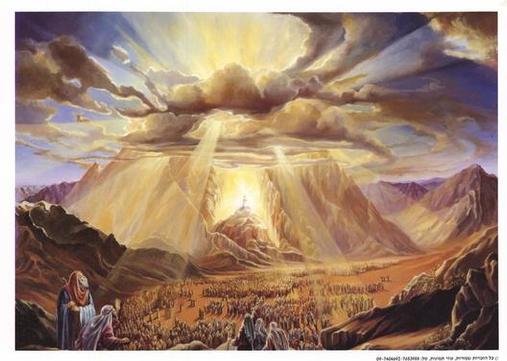
Then there is the name of Havayeh,[4] which represents a level of G–dliness that is supernatural and otherworldly. This is a level so lofty that until the Torah was given, no one had any access to it.[5] Until the giving of the Torah. At this unspeakably awesome, one-time occasion, Hashem chose to infuse the sublime level of Havayeh within every Jew.[6]

(This is the meaning of the Jew’s additional soul, the Nefesh HoElokis, the divine soul.[7] One might ask: Why is this soul is called a divine soul; after all, everything that exists has a soul that is divine, for Hashem created (and continually recreates) everything in existence? The answer is that the soul in all other beings comes from the name of Elokim, while the Jew possesses an additional soul that completely transcends the natural order, one that flows from Havayeh—the divine soul.)

However, this was only the beginning. Hashem then gave us a mission, a mission of the most unparalleled cosmic proportions. He charged us with the task of bridging the cosmic divide between Havayeh and Elokim, by revealing the name of Havayeh in the world.

To this end, He gave us the Torah, which is specifically called the Torah of Havayeh, and the Mitzvos, which are specifically called the Mitzvos of Havayeh. When we study the Torah and adhere to the Mitzvos, we reveal this level in the world around us, and to the gentile nations as well. This was in fact Hashem’s ultimate intent in creation, also known as “making a dwelling place for Hashem,”[8] for Havayeh, in the world and among the gentile nations, who stem from Elokim.

Since this is the ultimate purpose of creation, this mission carries the utmost responsibility and requires the utmost devotion and sacrifice. This is the meaning of Hashem’s statement that He made us “A kingdom of priests and a holy nation.”[9]

A Kohen, a priest, represents someone whose entire life, and every minute aspect of his life, is different from those of others. It is consecrated to Hashem.

And so Hashem gave us the Torah, which is related to the world hora’ah, guidance, for every single minute aspect of a Jew’s life, from the cradle to the grave, is guided by Torah. There is no area of life where Hashem does not provide guidance to his priests, the Jewish people, in His Torah.

This surely applies to the home, which the Jew is charged with making a Mikdash (sanctuary) for Hashem, regardless of where—in the kitchen, the living room, the bathroom, and the bedroom—the Torah guides the Jew how to bring the divine presence into all these places.

And it applies no less to the workplace, where a Jew is charged with the mission of setting an example of scrupulous honesty and integrity, and influencing his environment in a pleasant, peaceful manner, for of the Torah it is written, “Its ways are ways of pleasantness, and all its paths are peace.”[10] He should influence the Jews around him to adopt Torah observance, and the non-Jews around him[11] to believe in Hashem and Torah, and follow the Noahide Code—the eternal laws and principles of basic morality and decency incumbent upon all mankind.

This is not to say that non-Jews can’t connect to Hashem; on the contrary, they can and must, especially in light of the fact that they are created “in the image of Hashem.” However, the focus of their G–d-given mission is to abide by their Mitzvos, whose fundamental purpose is “yishuv ha’olam”—civilizing society, to settle the world physically and maintain a cohesive, peaceful, just, G–d-fearing social order, as it is written, “Not for chaos did He create it [the world, but rather] He formed it to be settled.”[12] It is this vital role for which non-Jews were assigned. Thus, non-Jews’ mission is related to the natural order, which stems from the name of Elokim, and this is the reason that the Noahide laws are rational laws that stem from the natural world. Thus, in order to accomplish this goal, non-Jews need not perform any of the Mitzvos specifically commanded to Jews.[13]

So Jews have a role—to reveal the name of Havayeh, and non-Jews have a very different role—to ensure the appropriate expression of the name of Elokim, through ensuring that the natural order follows the wishes of Hashem in His Torah.

Is this in a certain sense a lower mission than the mission given to the Jews? Yes. But so what—Hashem can do as He wishes—His will need not conform to the passing whims of the philosophical fads of mortals.

Moreover, every individual has a personal mission, one that differs from that of everyone else. Of these, Hashem clearly assigns different missions to different people—some receive more advanced, risky, responsible missions, and others, less challenging, more everyday ones.

Likewise, we find that only a Levi may sing in the Holy Temple, and only a Kohen may serve in it. I myself, for example, am not a Kohen, and as such I am barred from entering certain parts of the Holy Temple, and not allowed various Kohen privileges. But I am not bothered by that fact one bit, because since Hashem made me a non-Kohen, that role is clearly not what Hashem wants of me, and so I have been deprived of nothing.

Racism, in contrast, means refusing to treat someone with proper decency and respect simply because they belong to a group that one has some kind of animosity towards. However, the “Torah of light”[14] instructs clearly how one should view non-Jews: “Beloved is man, for he was created in the image [of Hashem].”[15] All mankind must be treated with the utmost respect, for they are beloved to Hashem by virtue of their special human intellect, which resembles the divine.

When a Jew assumes his role uncompromisingly and proudly, in addition to the inherent worth of this behavior, he also does a tremendous service for the world and all the gentile nations. He performs his role as priest, role model, and teacher to the nations, to illuminate and uplift them with the sublime spirituality of Havayeh for which he serves as a channel.

However, if the Jew chooses, may Hashem save us, to compromise his Torah observance and behave in inappropriate ways that conflict with Torah, behaviors typical of the secular culture, then not only does he harm himself grievously, but he also does a disservice to the nations by abdicating and thereby withholding from them his holy example, guidance, and the awesome revelation of Havayeh that they could have received through his unswerving allegiance to Torah.

____________________________________________________
[1] See at length Parashas Derachim, Rabbi Yehuda Rosanes.
[2] Yoma 48b.
[3] Cf. Likkutei Sichos, Vol. 25, pp. 186-192.
[4] Hashem has other names, but these are the primary ones, and the main ones relevant to this discussion.
[5] With some notable exceptions, such as Avraham, on a lower level, and Moshe, on a higher level. Further discussion of this is beyond the scope of this article.
[6] Likkutei Torah, Bamidbar 16d.
[7] See Tanya ch. 2, beg.
[8] Midrash Tanchuma, Naso 16. Explained in Tanya ch. 36.
[9] Shemos 19:6.
[10] Mishlei 3:17.
[11] As per Moshe Rabeinu’s instruction to the Jewish people at Sinai. Mishneh Torah, Laws of Kings, 8:10.
[12] Yeshayah 45:18.
[13] However, it is praiseworthy for non-Jews to adopt certain Jewish practices on a voluntary basis, such as daily prayer, blessings on food, and so on, while other Mitzvos, which were meant exclusively for Jews and would therefore be spiritually harmful for non-Jews, are therefore forbidden for them, such as observing the Shabbos (Cf. Mishneh Torah, Laws of Kings, 10:9. As explained in The Divine Code, Vol. I, Part I, Chapter 3, on “The Prohibition Against Making a New Religion or Adding a Commandment.”)
[14] Mishlei 6:23.
[15] Avos 3:14.


Like what you read? The articles I write take a lot of time and effort. Please contact me to sponsor an article for (at least) $36 in honor of the birthday, wedding anniversary, or yarhtzeit of a loved one, or for a refuah shleimah or the like. Also, see here concerning the tremendous merit of supporting the dissemination of Chassidus, and the blessings that one receives for doing so.

Monday, August 1, 2011

"Engrave" G-dliness Into Your Very Being


"Engrave" G-dliness Into Your Very Being

Rabbi Y. Oliver


In general, there are two kinds of letters:[1] written, as with the letters of a Sefer Torah; and engraved, as with the letters in the Luchos (Tablets).[2]

In written letters, ink is attached to the parchment in a way that forms holy letters. However, the ink is a substance foreign from the parchment, and so even as it unites with the parchment, it bonds only with the parchment’s surface, but remains separate from the parchment. This creates the possibility that the ink might somehow become erased and detached from the parchment.

In contrast, in the case of engraved letters, only one entity exists—the rock. The letters have no separate existence from the rock upon which they are engraved, and so the two are inseparable.

The Luchos had a further quality—one that was miraculous. They were carved all the way through to the other side.[3] This required a miracle, for in such a case, the centers of the round letters samech (ס) and the final mem (ם) could not otherwise have remained suspended in mid-air.[4] This is also why the Luchos were called “Luchos of the Testimony,” for the manner in which they were inscribed testified to their divine origin.[5]

This represents a further level of unification with G–dliness, for in regular engraving, only the surface of one side of the stone is engraved, while the other side remains untouched. But since the letters of the Luchos penetrated through to the other side, no part of the Luchos remained unaffected by the letters.

What is the deeper significance of this, especially in light of the principle that “Hashem never performs a miracle unnecessarily”[6]? The Luchos were the ultimate physical embodiment of the word of Hashem. Thus, they represent the Torah as it exists in its supernal source. On this level, “The Torah and Hashem are entirely one”[7]—the letters of Torah are utterly united with pure G–dliness.

However, when the Torah descends into our world, it becomes vested in the Written Torah—it becomes inscribed as ink on parchment. So although the letters of the Written Torah are very holy, once they descend into our lowly world, they do not retain the awesome holiness of their source.

This also teaches us how to study Torah. It is not enough to study Torah and unite with it by merely comprehending and remembering it well, for then the holiness of Torah is still superimposed on the person—akin to written letters.

Rather, just as engraved letters become one with the substance upon which they are engraved, so should the Torah one learns become one with his being. Moreover, just as the engraved letters in the Luchos cut all the way through to the other side, permeating every aspect of the Luchos, so should the Torah that one learns permeate every aspect of his being.

This is the deeper meaning of the verse, “If you go in my chukim [statutes],”[8] which Rashi interprets to mean “if you toil in Torah.” Since the word chukim is related to the word chakikah, engraving, on a deeper level, the verse is exhorting us to learn Torah in a way that it permeates our being, as discussed above.

When the Torah permeates us fully, we will naturally toil in our study of it, for when something permeates a person, he is willing and eager to exert effort for it, for he feels that it is his. But if the thing does not permeate him, he will only trouble himself to do as much as is technically required. This is along the lines of the difference between an employer and an employee—even the most devoted employee will not exert himself to the extent of the employer, for the employer knows that it is his business.

And from one’s toil in Torah study, this filters down into one’s observance of Mitzvos—that the Mitzvos are all kept in a way of “engraved letters”—they permeate the entire being of the Jew who performs them.

Adapted from Hisva’aduyos 5749, Vol. 3, pp. 184-185.

__________________________________
[1] Likkutei Torah 56a.
[2] “The Luchos were Hashem’s handiwork, and the script was the script of Hashem, engraved upon the Luchos” (Shemos 32:16).
[3] “ ... The Luchos were inscribed on both their sides; they were inscribed on one side and on the other” (ibid. 32:15).
[4] Rashi, ibid.
[5] Ohr HaChayim, ibid.
[6] Derashos HaRan, sec. 8.
[7] Zohar 3:73a.
[8] Vaykira 26:3.

This post was dedicated by Reb Kasriel ben Yehudis and Chana Feige bas Reizl (my parents, tzu langeh, gezunteh, zisseh yoren) in honor of their 36th wedding anniversary. This post was also dedicated by Reb Menachem Kovacs, who requested that this message be attached:
"Zachor: to mark the 6th anniversary of the expulsion of the Jews from Gush Katif and the Northern Shomron; we continue to pray and work for their restoration and for the Ge'ula Shlayma. Thank you."

Like what you read? The articles I write take a lot of time and effort. Please contact me to sponsor an article for $36 in honor of the birthday, wedding anniversary, or yarhtzeit of a loved one, or for a refuah shleimah or the like. Also, see here concerning the tremendous merit of supporting the dissemination of Chassidus, and the blessings that one receives for doing so.

Monday, November 22, 2010

How the Avos Prepared Us to Receive the Torah

How the Avos Prepared
Us to Receive the Torah

Rabbi Yehoishophot Oliver

Every child who learns Chumash knows the story of the beginnings of the Jewish people. The first Jew was Avraham, followed by Yitzchak and Yaakov, who altogether comprise the Avos, the forefathers, of the Jewish people. And yet despite their lofty status as our Avos, and despite their observance of the Torah even before it was commanded,[1] they did not receive the Torah at Mount Sinai. Why wasn’t the Torah commanded to them?


Now, our Sages state that “The Avos were a chariot [for Hashem].”[2] This is explained to mean that the light of Atzilus (the highest spiritual world) shone into our world through their souls, for their souls were souls of Atzilus. In particular, each of their souls acted as a conduit for a different Sefirah (divine attribute) of Atzilus, to the extent that in a sense (because of course, the Sefiros themselves are utterly spiritual entities), they personified these Sefiros:[3]
  • Avraham personified Chessed, kindness of Atzilus
  • Yitzchak personified Gevurah, severity of Atzilus
  • Yaakov personified Tiferes, beauty of Atzilus
uAlthough this sounds wondrous, what did it accomplish? Our sages compare the Torah and Mitzvos that the Avos observed to an insubstantial fragrance.[4] Although the Avos studied Torah before it was given and kept the entire Torah, all this was done of their own initiative, as an optional undertaking. Only later, when the Torah was given at Mount Sinai, did Torah observance (beyond the Seven Noahide Laws) become a strict obligation for every single Jew.


To explain further, let us digress to discuss a general concept in Chasidic philosophy. There are two directions of influence: When the initiative comes from below, and rises upward; and the opposite, when it comes from above, and descends downward.


Each of these modes of influence has both an advantage and a disadvantage.


When the one below strives to ascend, this refines him in a much deeper and more lasting manner. However, he is only able to rise as high as his limited strength can reach.


Conversely, when the higher one reveals himself to the lower one, since this revelation occurs on the terms of the higher one, the quality and intensity of the revelation is far more powerful. Yet for the very same reason, since the recipient has not truly earned the revelation, it does not last.


Likewise, the ultimate goal of all that came before the revelation at Sinai was for the Jewish people to serve Hashem “from below to above.” However, in order for this to succeed, it had to be preceded by a divine revelation “from above to below.”


This is comparable to the reaction of an average student when a world-class genius attempts to impart to him a phenomenally profound lesson. The student finds the concept so mind-blowing that he enters into a state of shock and speechlessness. Although at this time he is completely unfit to assimilate the concept, this experience does accomplish something. When the teacher repeats the lesson on another occasion, this time the student is no longer flabbergasted. With the novelty gone, the teacher can now go about the lengthy process of explaining the concept to the student.


The Avos represented the first stage in the process. They revealed G–dliness “from above to below,” and this began from the relationship of their souls to their bodies. They never needed to engage in the arduous task of refining their bodies, for their bodies were innately refined to the point that they were fit vessels for the intense divine light of Atzilus that shone in their souls.

In light of the above, we can understand the Alter Rebbe’s words concerning the above statement of our sages, “The Avos were a chariot [to Hashem].” On this he comments that “All their limbs were holy and distant from worldly matters, and they acted as a vehicle for Hashem’s will alone throughout their lives.”[5] This means that the souls of the Avos were so lofty that they illuminated their bodies from above.

The impact of the Avos on the outside world was of the same kind. The entire task of the Avos in the world was to shower G–dliness upon it from above, not to refine its gross physicality from below. Thus, they were not endowed with the capacity to infuse holiness into the physical, and so the G–dliness that the Avos brought into the world did not remain in it. This is the reason that they were not commanded to observe the Mitzvos.


However, their spiritual accomplishments paved the way for their descendants to receive the Torah. Through the Torah, the Jewish people were granted the ability to refine the world “from below to above” by their souls refining their bodies, and their performance of Mitzvos refining and infusing holiness into the world.

For further explanation of the topic of “paving the way,” see Our Rebbeim Paved the Way.


________________________________________
[1] Genesis 32:5
[2] Bereshis Rabba 47:6.
[3] Pardes 22:4. Sefer HaMa’amarim 5689, p. 97.
[4] Shir Hashirim Rabah 1:3.
[5] Tanya ch. 34.


Based on Sefer HaSichos 5688, pp. 18-21. Sefer HaMa’amarim 5678, pp. 168-169.