"Moshiach is ready to come now-our part is to increase in acts of goodness and kindness" -The Rebbe

Showing posts with label Shabbos. Show all posts

Friday, May 24, 2013

On Marital Harmony


On Marital Harmony

Rabbi Y. Oliver

Below is a compilation of translations of letters from the Rebbeim concerning marital harmony. 


One Should Only Rebuke One’s Wife with Soft Words

Don’t speak to your wife with harsh words. This will cause dispute and strife, and your goal will not be attained. Rather, speak with soft, calm words, as one speaks to his friend, and explain how one should not act in this manner, all in a soft manner, and then you will have an impact, and the goal will be fulfilled. This is crucial and very fundamental.

Sefer HaSichos 5703, p. 233.

Promoting Family Unity through Joint Shabbos Meals

One of the first steps toward promoting family unity is to strengthen the custom for the entire family to eat a joint meal on the night of Shabbos.

Letters from the Rebbe, Vol. 3, p. 135.


Benefit of Compromise in Marriage

I hope that over time you will you will reach the conclusion that [in marriage] sometimes one should compromise, and through a small compromise one can gain a great deal.

Igros Kodesh, Vol. 5, p. 81.

Don’t Emphasize Your Spouse’s Faults

Until Moshiach arrives, no one exists without faults. Thus, it is clear that just as one spouse has a fault, so does the other, and just as one would not want one’s own faults to be emphasized, so should one not emphasize and amplify the faults of the other. This is the way all Jews should relate to one another, but this applies all the more when relating to your husband, who is the father of your children.

My intent is not to criticize, but merely to draw your attention to the fact that your situation is not as forlorn as you present it, and it is not unusual, as it appears to you.

Each of you should ignore certain things, and it is preferable for each of you find ways to bring peace in the home. Once this is attained, this is the vessel through which Hashem will provide blessings and success, good health, livelihood, and nachas from children.

Igros Kodesh, Vol. 5, p. 61.


Wednesday, November 21, 2012

On Our Mission in the Mundane World


On Our Mission in the Mundane World

(in honor of 9-10 Kislev)
Rabbi Yehoishophot Oliver

The ultimate Truth of all is that Hashem is the one and only true, absolute reality. 

There is a lofty realm in which this truth is completely, undeniably real and obvious, akin to the experience of standing in the outdoors and basking in the sunlight directly. This is the supernal realm, or “world,” of Atzilus, a level in a state of constant, all-consuming bittul, nullification, to G–dliness; it has no sense of any independent existence from Him. This is known as bittul bi’metzius, “total nullification.”

But from the levels below, Hashem chooses to conceal His absolute reality and this enables them to become beings that are self-aware. They have a sense of yeshus, of independent existence from Hashem. (For more on the difference between Atzilus and the worlds below it, see here.)

There are various degrees in this concealment. The first general level, which we will discuss in this post, is expressed in the words of the Havdalah prayer, “to separate between the holy and the mundane.” Here Hashem conceals His light only partially. This is comparable to the beneficial effect produced when a curtain is placed in front of a window of bright sunlight. This concealment allows the light to illuminate the room in an acceptable, pleasant way.

Likewise, Hashem placed a “parsah” (lit. “curtain”) that conceals the awesome light of the world of Atzilus, where the absolute truth of Hashem’s reality shines openly. This enables the creation of the three lower worlds of Beriyah, Yetzirah, and Asiyah (known collectively by the acronym b’ya), which sense their own independent existence. Yet this concealment is only partial, for the “light shines through,” enabling the beings in these worlds, the angels, to sense Hashem’s reality enough that they can surrender themselves partially to Hashem. This is known as bittul ha’yesh, “nullification of ego.”

This is akin to the difference between Shabbos and the weekdays:

Shabbos is a time of open, transcendent divine revelation (see here), when the Jew rises completely above all worldly concerns and devotes himself exclusively to Hashem. This is comparable to the bittul bi’metzius in the world of Atzilus.

On the other hand, of the weekdays the Torah instructs: “For six days you shall work,”[1] for then one must pursue one’s livelihood (see here). This requires that one lower oneself spiritually into an environment of divine concealment that allows for one to feel selfishness. This is comparable to the divine concealment and yeshus that prevails in the worlds of b’ya.

The Jew’s mission, however, is bittul—to bring awareness of Hashem to illuminate this experience. Every morning, before he goes out into the world and falls into the preoccupations related to his livelihood, he should remind himself that the world can’t possibly exist on its own, and so its existence surely comes from G–dliness. Likewise, during prayer, and then afterward, even in the very midst of his grueling business dealings, he should remind himself that it is Hashem alone Who grants him “strength to perform deeds of might.”[2] This means that he should trust in Hashem alone, and not in any mortal. Moreover, he should remind himself, this trust itself is the key to his material success, for we are assured, “cast your burden upon Hashem, and He will sustain you.”[3]

Through this one breaks through the concealment, brings divine light even into the lowliness of the world (see here). Moreover, he elevates to Hashem all the energies that he had invested in his mundane matters, bringing them to assume the refined status of chullin shena’asu al taharas ha’kodesh, mundane matters that were performed in a pure and holy manner. He thereby performs bittul ha’yesh, fulfills the purpose of his creation, and merits a personal revelation of G–dliness.

Adapted from the Mitteleh Rebbe's
Ma’amarei Admur HaEmtza’i, Hanachos 5577, pp. 274-276; cf. p. 281.

________________
[1] Shemos 20:8.
[2] Devarim 8:18.
[3] Tehillim 55:23.


Dedicated in the merit of a speedy release for the captives Yonasan ben Malka (Jonathan Pollard), Jacob Ostreicher (Yaakov Yehuda ben Shaindel), Alan Gross (Aba Chonah ben Hava Chana), Sholom Mordechai Halevi ben Rivka (Sholom Rubashkin), and Zeva Rochel bas Chaya (Wendy Weiner Runge).


Like what you read? The articles I write take a lot of time and effort. Please contact me to sponsor an article for (at least) $36 in honor of the birthday, wedding anniversary, or yarhtzeit of a loved one, or for a refuah shleimah or the like. Also, see here concerning the tremendous merit of supporting the dissemination of Chassidus, and the blessings that one receives for doing so.

Monday, June 4, 2012

The weekdays and Shabbos—two levels of the heart

The weekdays and Shabbos—two levels of the heart

Rabbi Y. Oliver

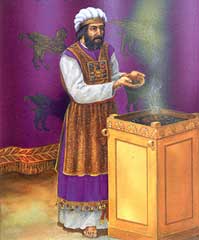
The altar represents the Jew’s process of “sacrificing” his or her inner self to Hashem. Thus, the Mishkan contained two altars, the outer and inner altar, representing the two general stages in the Jew’s service of Hashem.

On the outer altar, the Jew would offer up animal sacrifices. This represents the refinement of the Bestial Soul, and in our divine service, this corresponds to the Jew’s divine mission during the weekdays—to refine the body and the Bestial Soul. This gives Hashem pleasure, which is referred to anthropomorphically as “a pleasant fragrance.”[1]

The part of the heart that descends to vest itself in terms that will influence the Bestial Soul is merely the heart’s lower level, known as chitzoniyus ha’lev, the external aspect of the heart. This is the significance of the outer altar.

However, the inner altar was used only for incense offerings, for incense represents a higher form of divine service than animal sacrifices.

The purpose of incense is to produce a pleasant fragrance. We can understand the significance of fragrance from the Talmud: “Which is the thing that the soul enjoys, but the body does not enjoy? Fragrance.”[2] This represents a deeper form of divine service, one that involves the penimiyus ha’lev, the inner dimension of the heart. Of this it is written, “May the entire soul praise Hashem.”[3] This refers to the efforts of the soul itself to rise up to connect to Hashem, without having to lower itself to influence the body, the Bestial Soul, and its worldly environment.

Here the goal is not to refine the body and Bestial Soul, but for the Yechidah, the Neshamah’s essence, to bond and unite with the Essence of Hashem.

Although the animal sacrifices on the outer altar also produced a fragrance that brought pleasure to Hashem, as it were, this fragrance did not compare to that produced by the incense on the inner altar, for just as the entire purpose of the incense is to emit physical fragrance, so does it bring a much more sublime fragrance to Hashem.

This is the difference between the way we serve Hashem in the weekdays, and on Shabbos. On the weekdays (see also here) we refine the Bestial Soul through the chitzoniyus ha’lev, while on Shabbos, we transcend all involvement with the physical (which is the reason for the prohibitions of the thirty-nine categories of work on Shabbos) in order to reach a sublime unity of the penimiyus ha’lev and the Yechidah with Hashem's very Essence (see also here).

This is the deeper significance of the concept that the weekdays act as a preparation for Shabbos, for the more successful one is at refining the Bestial Soul through the chitzoniyus ha’lev during the weekdays, the higher the level of revelation of the penimiyus ha’lev that one merits on Shabbos.

Ma’amarei Admur HaEmtza’i, Shemos, Vol. 2, p. 674 ff.
________________
[1] Vayikra 6:14.
[2] Berachos 43b.
[3] Tehillim 150:6.

Dedicated by Reb Yisrael Meir Rafael and family.


Dedicated in the merit of a speedy release for the captives Yonasan ben Malka (Jonathan Pollard), Sholom Mordechai Halevi ben Rivka (Sholom Rubashkin), and Zeva Rochel bas Chaya (Wendy Weiner Runge).

Like what you read? The articles I write take a lot of time and effort. Please contact me to sponsor an article for (at least) $36 in honor of the birthday, wedding anniversary, or yarhtzeit of a loved one, or for a refuah shleimah or the like. Also, see here concerning the tremendous merit of supporting the dissemination of Chassidus, and the blessings that one receives for doing so.

Thursday, May 31, 2012

Why work?

Why work?
Or: The Deeper Significance of the Weekdays

Rabbi Yehoishophot Oliver

When we examine our mundane lives, it seems that the true spiritual experience is to be had on Shabbos, when we are able to withdraw from our mundane concerns and devote ourselves to Torah study and prayer. After all, what could be spiritual about the rat race of pursuing a livelihood and the numerous tasks of cooking, cleaning, and the like necessary to maintain a household?

Yet Chassidus, known as the “inner dimension of the Torah”, sheds light on this aspect of the inner dimension of our mundane lives. It explains that in fact, everything we do during the week, even the most mundane activity, has an underlying spiritual purpose.

The main purpose of our divine service during the weekdays is to create a birur, a spiritual separation and refinement, of the impure spiritual energy that permeates the physical world known as kelipas nogah. The Jew accomplishes this goal through engaging in various kinds of work, which are encompassed by the thirty-nine categories of work forbidden on Shabbos, known as melachos.

The melachos are closely related to eating, for, among other things, they encompass all the stages necessary in the process of preparing food—from the earliest stage of sowing the seeds, to the final stage of baking or cooking. And since the goal of all the efforts necessary to prepare the food is that it be eaten, eating food is the culmination of this step in refining Kelipas Nogah (albeit only the first stage; see below).

This parallels the process of refinement that takes place during physical eating, in which the stomach and the liver process the food. The higher-quality nutrients are extracted from the food’s inferior aspects and are absorbed into the body, even rising up to the level of the superior faculties of the mind and heart. The inferior aspects, however, are eliminated.

Likewise, when one eats in the proper way, the sparks of holiness that lie in the physical are extracted from the “shell” of the forces of the Kelipah, which is rejected.

The above is the first stage in the weekday birur of Kelipas Nogah. However, a further birur of Kelipas Nogah occurs when one uses the energy from the food one eats[1] to recite the weekday prayers.

Prayer is compared to eating, for just as eating involves birur, so does prayer.

The highlight of Tefillah is the Shema, in which one declares Hashem’s absolute unity, and that one is willing to give up one’s life for it.[2]

This creates a birur comparable to that of eating:

When the heart and mind of the Jew become inspired with the desire to become subsumed in the sublime G–dliness that lies at the source of the Jew’s soul,[3] this parallels the way that the energy of the food becomes absorbed in the body’s higher organs.

Likewise, Tefillah draws one closer to Hashem, and this experience humbles the person and impresses upon him just how distant he is from Hashem during the rest of the day. This realization crushes his ego and eliminates a significant amount of the Kelipas Nogah within his Bestial Soul.

This is the reason that Tachanun follows the earlier parts of the Tefillah, for once one has reached the sublime spiritual heights, he senses his lowliness all the more, and turns to Hashem and begs for forgiveness.

We can carry the comparison to digestion further. The more thoroughly the food is digested, the more nutrients are separated from the food for constructive use, and the more the waste matter that is eliminated is truly bereft of any beneficial components. Likewise, the more attention one devotes to Tefillah, the more one’s intellect and emotions become inspired to submit to Hashem, and the more one comes to realize one’s lowliness before Hashem.

This is the meaning of “The belly of the wicked is lacking”[4]: “The wicked” refers to the forces of Kelipah, which are “lacking” the sparks of holiness that were extracted through the Jew’s efforts to accomplish the weekday birurim.

Sefer HaLikkutim, Shin, pp. 93-94.
__________________________________________________
[1] Cf. Tanya, beg. ch. 8, “be’ko’ach achilah ha’hi.”
[2] In the original, “limsor nafsho be’echad.”
[3] In the original, “le’ishto’avo begufa de’Malko.”
[4] Mishlei 13:25.


Dedicated by Reb Yisrael Meir Rafael and family.

Like what you read? The articles I write take a lot of time and effort. Please contact me to sponsor an article for (at least) $36 in honor of the birthday, wedding anniversary, or yarhtzeit of a loved one, or for a refuah shleimah or the like. Also, see here concerning the tremendous merit of supporting the dissemination of Chassidus, and the blessings that one receives for doing so.

Thursday, May 10, 2012

Shabbos: Utterly transcending the world

Shabbos: Transcending the world
Rabbi Yehoishophot Oliver


Our sages say, “He who toils before Shabbos, will eat on Shabbos.”[1] On the simple level, this means that in order to eat a ready meal on Shabbos, one should toil to prepare the food before Shabbos. But on the deeper level, this alludes to the relationship between the divine service of the weekdays and of Shabbos. During the week we prepare ourselves spiritually for Shabbos, and so the more one toils to accomplish the divine service required during the week, the higher the level of the Shabbos experience that follows it.


The main theme of Shabbos is menuchah, rest, as our sages say, “What was the world lacking [after the completion of the six days of creation]? Menuchah. When Shabbos came, menuchah came.”[2] Thus, the verse tells us, “And Hashem completed [His work of creating the world] on the seventh day.”[3] But didn’t He complete the creation on the sixth day, as it states concerning the sixth day in the previous verse, “And He completed the heavens, the earth, and all their hosts”? No, for in a sense, Hashem did create something on Shabbosmenuchah.


This is related to the intense divine revelation on Shabbos, for Hashem is called menuchah.[4]


To explain, everything in the world is in a state of constant movement, for it is fundamentally bound by the limitations of time and space. Time is constantly changing—the future is becoming the present, and the present is becoming the past.[5] And space too, which is fundamentally intertwined with time, also involves movement.[6]


Hashem, however, is infinite, and so He completely transcends space—He does not move from one place to another—and He transcends time, a construct that He created. Thus, Hashem is called menuchah, for in His Essence, He is utterly unchanging—the epitome of true menuchah.


We mentioned the verse, “And He completed [“vayechulu”] the heavens, the earth, and all their hosts.” Vayechulu can also imply kilayon, yearning,[7] for after He finished creating the world, on the first Shabbos, Hashem revealed the level of menuchah associated with His Essence, and this inspired all His creations with a yearning to rise up and reach this level of menuchah.


This also explains the deeper meaning of the weekly cycle.[8] In the daily Shacharis liturgy, we speak of Sunday as being the “first day.”[9] Since everything in Torah is precise, if so much time has passed since the first day of Creation, why don’t we count by the number of days since creation, or use some other more precise phrase when counting?


The answer is that since on Shabbos the level of Hashem’s very Essence shines, this elevates the world completely beyond its mundane state. Thus, on the following Sunday, the mundane world is indeed new, both in space and time, and so we start the count anew.


Likewise, on every Shabbos, the Jew who keeps Shabbos as is required is given the privilege to “eat on Shabbos”—to personally experience a special revelation from Atzmus, Hashem’s very Essence. This comes as a reward for his or her divine service during the week—“He who toils before Shabbos,” and renews and invigorates him physically and spiritually in preparation for the coming week.


Based on Sefer HaMa’amarim 5722, s.v. Basi LeGani, pp. 132-133. 


______________________________________________________________________
[1] Avoda Zara 3a.
[2] Bereshis 2:2, Rashi.
[3] Bereshis ibid.
[4] Kesser Shem Tov §400-401. Likewise, Hashem is called Shabbos (Zohar 2:88b).
[5] Sha’ar HaYichud VehaEmunah ch. 7. Likkutei Torah, Berachah 98a.
[6] This is all the more so according to modern science, which teaches that nothing is truly stationary; everything in the universe is moving. Likewise, all matter consists of atoms and molecules that are in constant motion.
[7] Ohr HaTorah Bereshis 42b ff.
[8] Likkutei Torah, Shir HaShirim 25a. Ohr HaTorah, Berachah, p. 1891. ibid., p. 1897 ff.
[9] “Hayom yom rishon laShabbos.”


Like what you read? The articles I write take a lot of time and effort. Please contact me to sponsor an article for (at least) $36 in honor of the birthday, wedding anniversary, or yarhtzeit of a loved one, or for a refuah shleimah or the like. Also, see here concerning the tremendous merit of supporting the dissemination of Chassidus, and the blessings that one receives for doing so.

Tuesday, August 24, 2010

Wearing a kapoteh on Shabbos

On Shabbos Bereishis 5711 (1950), the Rebbe said to Rabbi Greenglass of Montreal:
It should become standard for married chassidim to wear silk kapotes on Shabbos and Yom Tov, and I wish to thank in advance those who will do so. The idea that one’s garments on Shabbos and Yom Tov should be silken is mentioned in a Ma’amar of the Rebbe Rashab [1].


In general, the behavior [of chassidei Chabad] should be distinctive, and this should express itself in the fact that on Shabbos and Yom Tov one wears a silk kapote.


I am surprised at those chassidim who do not wear silk kapotes on Shabbos and Yom Tov It appears that the reason for this [failure to observe this custom] is the poverty that prevailed in Russia, which meant that chassidim were not able to wear silk kapotes.


In any case, the time has come that people should start wearing silk kapotes, and over time all married chassidim will come to follow this practice.


Toras Menachem 5711, Vol. 1, p. 53
[1] The following sources are cited in the footnote to this sicha:

In
Sefer HaMa’amarim 5660-1-2, p. 231 the Rebbe Rashab cites from the works of Kabbalah that on Shabbos one’s garments are connected with the world of Beriah, which parallels chai, the animal world; thus, one’s garments should be made of silk, which comes from the category of chai. (To explain, the four spiritual worlds correspond to the four levels of creation: Atzilusmedaber, mankind; Beriahchai, the animal kingdom; Yetzirahtzomeach, plant life; Asiyahdomem, inorganic matter. Thus, since on Shabbos there is a revelation of the world of Beriah, it is fitting to wear garments made from animal kingdom.)


Likewise, in Sefer HaMa’amarim 5671, p. 247 the Rebbe Rashab mentions the same practice, and also explains that since on Shabbos the world receives from the level of Hashem’s thought, so to speak (the worlds of Beriah, Yetzirah, and Asiyah corresponding in Kabbalistic thought to thought, speech, and action respectively), on Shabbos one should wear garments made from chai, while during the week one should wear garments made from tzomeach, plant life.


In Sefer HaMa’amarim 5672, Vol. 2, pp. 872-873, the Rebbe Rashab cites this in the name of the Mikdash Melech (a classic commentary on the Zohar written by Rabbi Shlomo Bazuglo).
In addition to the point the Rebbe makes that on Shabbos chassidim ought to wear a silk kapoteh, it appears clear and self-evident that the Rebbe is also making an implied statement that ... on Shabbos chassidim ought to davka wear a kapoteh, and not suffice with a suit.

Saturday, March 6, 2010

Shabbos is not a day of rest!

The Rebbe Rashab writes:
In general, one should take great care with one’s time on the holy Shabbos to use it for Torah study, and not to turn to turn to foolish matters, G–d forbid. Even during the weekdays one should be careful to avoid this, but to a far greater extent on the holy Shabbos, for the day is holy, dedicated for Hashem our G–d. It was granted to the Jewish people so that they be satiated with and enjoy His goodness. Going for a stroll on the holy Shabbos is completely undesirable. We do not find that anything was permitted on this day other than sleeping a bit more than every day, and enjoying the day through [additional] food and drink.

However, this is provided that one’s intention is to honor the Shabbos. This means that one should feel that this is being done for the honor of Shabbos, and the Shabbos is not a day of rest of Shabbos, i.e., a sense of submission to Shabbos, should rest upon the person. ... However, idling away the time on Shabbos with foolish matters, G–d forbid, is a great sin, may G–d save us. It is especially objectionable to go for a stroll on Shabbos, for then everyone goes for a stroll, [and one will inevitably see women while strolling], and one will not emerge clean from evil, G–d forbid.

Kuntres Etz Chayim, p. 53.
Shabbos is an immensely holy time. Of course one should be happy and enjoy the day, but this happiness and pleasure should be permeated with a sense of deep reverence and love of Hashem that extends to everything one does on this day.

Thus, Shabbos is not a day of rest in the way it is normally understood—a time to take life easy. Indeed, it is a time when one can relax in the sense that he is exempted from his mundane worries. However, the purpose of this exemption is to free up time so that one can devote himself to spiritual pursuits. Shabbos is a day in which one should exert strenuous effort—if anything, even more effort than during the week—but in Tefillah and Torah study.

With this in light, the idea of spending one’s time on Shabbos discussing politics (whether community, state, or federal), current events, or the like, becomes completely repugnant. What a desecration and disgrace it is to indulge in such talk on Shabbos.

Let us go on a Shabbos campaign—a campaign not just to keep the technical laws of Shabbos (which is also necessary), but also to live with the spirit of Shabbos.

Tuesday, September 9, 2008

Shabbos flyers

We have a proliferation of “Shabbos flyers” inundating our shuls: Sichat HaShavua, L'Chayim, and so on, and so forth. Granted, these flyers do contain much material of merit, and material that everyone could learn from. Still, let us be honest here: to whom are they directed? Merurovim. Newcomers. Or perhaps baalei Teshuva who still haven’t learnt how to learn and, although being a part of our circle for many years, are in fact complete beginners.

Don’t get me wrong, I think this literature is great—for its intended audience. For them, it’s a significant step up. But for those who received the education of the Rebbeim, it’s largely a step down. Why does literature for mekurovim become standard reading for yungerleit who attended Tomchei Temimim for years, learning seven hours of Nigleh and three hours of Chassidus per day? Every single moment of the precious time of Shabbos needs to be spent in serious Torah study.