"Moshiach is ready to come now-our part is to increase in acts of goodness and kindness" -The Rebbe

Showing posts with label Sukkos. Show all posts

Wednesday, October 12, 2011

Sukkah: Unity through transcending all divisions

Unlike the Mitzvah of the Four Kinds, which creates a complementary unity from individuality and multiplicity (as discussed here), the Mitzvah of Sukkah fosters an almost opposite type of unity. This unity involves reaching to a level of G–dliness so sublime that it utterly transcends all distinctions between one Jew and another.

In Chassidic parlance such a level is known as an
Ohr Makif, an “encompassing light,” one that impacts upon the recipients and yet does not differentiate between the various levels they are on. This is comparable to a king’s edict, which is just as binding upon the greatest minister and the simplest subject.

This level shines in the
Sukkah, and Jews unite at this level through the simple act of sitting in the Sukkah with one another.

This quality is reflected in the very dimensions of the
Sukkah, which does not touch the person sitting in it, but surrounds his head, body, and feet equally. This is indicative of the nature of the divine revelation in the Sukkah, which does not relate to the unique individuality of each Jew at all. Instead, it transcends these (important but ultimately) external qualities. Likewise, all Jews who sit in the Sukkah, both the great scholar and the small child, are physically surrounded in the same manner; this symbolizes the nature of the spiritual unity that they accomplish with one another by sitting in the Sukkah.

This fits nicely with one of the opinions recorded in the Talmud (ibid. 11b)—which is also the way Rashi explains it in his commentary on
Chumash (Vayikra 23:43)—which maintains that the Sukkah is symbolic of the Clouds of Glory (which accompanied the Jewish people on their journey through the desert), which encompassed the entire Jewish people equally. This is also the deeper meaning of the Talmudic dictum: “All Jews are fit to sit in one Sukkah” (Sukkah 27b)—alluding to the fact that in the Sukkah we connect with a level at which all Jews are literally equal.

Based on Sefer HaMa’amarim Melukat, Vol. 4, p. 23, and ibid, Vol. 1, p. 166.

Dedicated by Menachem Shakulov in the merit of Menachem Mendel ben Sarah, and by Guillermo Eduardo Chinchilla Zúñiga as a merit for Kevin Esteban Chinchilla Montero.

Like what you read? The articles I write take a lot of time and effort. Please contact me to sponsor an article for $36 in honor of the birthday, wedding anniversary, or yarhtzeit of a loved one, or for a refuah shleimah or the like. Also, see here concerning the tremendous merit of supporting the dissemination of Chassidus, and the blessings that one receives for doing so.

Sunday, October 9, 2011

The four kinds: Individuality, complementarity, and unity

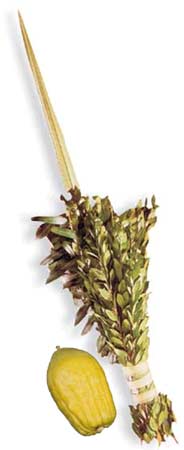
The Midrash (Vayikra Rabbah 30:12) teaches that the four kinds that we “shake” on Sukkos are symbolic of the four different types of Jews, taste representing Torah knowledge and a pleasant aroma representing good deeds:
  • Esrog (unusual citrus fruit): has taste and a pleasant aroma, and thus represents those who are both accomplished Torah scholars and doers of good deeds;
  • Lulav (a frond from a palm tree): has tasty dates, but no aroma, representing dedicated Torah scholars;
  • Haddasim (myrtle branches): only has a pleasant aroma, representing those who excel in good deeds but not in Torah study;
  • Arovos (willow branches): have neither taste nor fragrance, which represents the simple Jews who, though lacking distinction through Torah scholarship or good deeds, serve Hashem with simple faith.
(It should be noted that everyone should (and is obligated to!) study Torah, but only some can be said to excel in Torah study. Similarly, everyone should engage in good deeds, but only some are meant to do so in an exceptional manner.)

After explaining this teaching to a beginner, he commented: “So we should all become
Esrogim!”

I responded that according to my understanding, this is incorrect. Although the combination of Torah study and good deeds is clearly a special quality, it may also have a drawback. Those Jews who lack excellence in Torah knowledge but are dedicated to helping others typically (but not always) excel in their good deeds more than those who engage in both Torah study and good deeds. The same goes for dedicated Torah scholars who do not engage in good deeds vis-a-vis those who do not. Likewise, as mentioned, those who lack other qualities but serve
Hashem with simple faith excel in the purity of their faith. Thus, each Jew should excel in the area/s in which s/he is gifted.

The Midrash says that the act of bringing together the four kinds represents creating unity between the four different types of Jews.

Most of the time we have little difficulty realizing our own talents and skills. However, recognizing and appreciating the good qualities of others, especially when their areas of excellence differ radically from one’s own, is not so easy. It requires the humility to understand that as great as one may (or may not!) be, one is only a part of the whole, a whole that is fundamentally lacking without the vital contributions of everyone. Even the
Esrog Jew needs to unite with the other kinds through recognizing their respective virtues, which in a sense he lacks (as explained).

When each person both maximizes his own individual potential, and recognizes that he is an integral part of a whole, then he can truly complement others, and together they can attain the special common goal that can only be reached through this process of uniting through complementing.

This post was dedicated by Dan Schechter and family as a merit for Moshe ben Yehuda.

Like what you read? The articles I write take a lot of time and effort. Please contact me to sponsor an article for $36 in honor of the birthday, wedding anniversary, or yarhtzeit of a loved one, or for a refuah shleimah or the like. Also, see here concerning the tremendous merit of supporting the dissemination of Chassidus, and the blessings that one receives for doing so.
Sunday, October 10, 2010

Chassidic Customs: A Hiddur in Hiskashrus


In
Likkutei Sichos (Vol. 29, p. 211 ff.), the Rebbe explains that the reason that the Rebbeim of Chabad didn’t sleep in the Sukkah is that they felt the makifim deBina, the lofty divine light that shines in the Sukkah. Since it would have distressed them to sleep in such a holy environment, and “One who feels pain [by staying inside the Sukkah] is exempt from [the Mitzvah of] Sukkah” (Shulchan Aruch Orach Chaim 640:5), they were exempt from the Mitzvah of sleeping in the Sukkah.


Now, this is all very well for the Rebbeim themselves. As great and holy Tzaddikim who perceived spiritual realities, their distress at sleeping in the Sukkah was surely a tangible pain that justified their exemption from this otherwise obligatory practice. However, on what basis do their followers, regular people who do not sense sublime spiritual realities, choose to refrain from sleeping in the Sukkah? 


The Rebbe explains:
Chassidim, since they are bound up with the Rebbeim of Chabad, study their teachings (with the goal of implementing them) and follow in their ways—the customs of their Rebbeim.


This is along the lines of what the Gemara relates concerning Rav Acha, who would “beautify [the Mitzvah] with ‘two and one’”—by taking a myrtle branch with only “two leaves on one point and one leaf below, which rose up and covered the other two” (Sukkah 32b). This was consistent with the opinion of Rav Kahane [who had declared that it is permitted to use such a myrtle branch], despite the fact that Rav Kahane himself had only said that “one may even use [a myrtle branch of] ‘two and one’”; however, “three on one stem is certainly acceptable [i.e., the best manner of performing the Mitzvah].” However, “Since it went forth from the mouth of Rav Kahane,” his student regarded it as a hiddur [beatification] of the Mitzvah to make a point of acting according to Rav Kahane’s opinion. [The Rebbe goes on to explain an additional reason for not sleeping in the Sukkah.]
Chassidim feel a very intense natural bond with their Rebbe, and this brings them to naturally strive to emulate their Rebbe’s conduct, even when that conduct may appear, or may even actually be, a lower standard in the strict sense. Emulating their Rebbe or otherwise declaring their adherence to their Rebbe is a hiddur in Hiskashrus, a beautification of the Mitzvah of connecting to one’s Rebbe, that is so significant that it overrides other otherwise valid halachic considerations.


Elsewhere (Toras Menachem 5712, Vol. 5, p. 144 ff.), the Rebbe discusses this concept in connection with the Chabad custom on Pesach to avoid eating gebrochtz (Matzah mixed with water). On the first seven days of Pesach we are very particular not to let even the tiniest drop of water fall on Matzah in order to avoid even the smallest trace of gebrochtz. Yet on Acharon Shel Pesach (the last day of Pesach), not only did the Previous Rebbe not avoid gebrochtz, he would make a point of dipping the Matzah in every single dish.


“This conduct was surprising in my eyes,” the Rebbe says, until his attention was drawn to the above Talmudic statement concerning Rav Acha. Then, the Rebbe relates, he understood it: Since the Previous Rebbe had seen that his father, the Rebbe Rashab, would eat gebrochtz on Acharon Shel Pesach, he would make a point of eating gebrochtz on Acharon Shel Pesach as well—since it went forth from the mouth of his Rebbeim.


The Rebbe then stated that the above episode serves as a response to those who challenge various customs of chassidim, and cite various reasons for their arguments. Some examples are long farbrengens: Why waste so much time on a farbrengen? Why not toast L’Chaim, sing a niggun, finish the farbrengen in a half an hour, and sit down to learn Torah? Also, why do chassidim spend hours preparing for davvenen; why not prepare less, and davven at the proper time?


To this the Rebbe responded:
All the questions should be completely irrelevant, because we know that these are customs of chassidim [adopted because they were] either seen or heard from the Rebbeim.

It may appear to him that it will be better if he acts differently. For example, by davvenen in the proper time he will gain more time to learn Torah, and other such good things. Nevertheless, “Since it went forth from the mouth of Rav Kahane,” since he knows that this is the conduct of the Rebbeim, he should not seek [other] hiddurim. On the contrary, he should practice the hiddur of following their conduct—[as it says of Rav Acha, that] “He would beautify [the Mitzvah] with ‘two and one.’”

It is written, “According to the Torah that they will instruct you ... Do not stray from the thing that they tell you, to the right or to the left” (Devarim 17:11). This verse obligates us to follow the Beis Din of the generation (Mishneh Torah, beg. Laws of Mamrim) “even if they tells you about right that it is left, and about left that it is right” (Ibid. Sifri, Rashi). This applies to such an extent that even a student who has reached the point that he is worthy of ruling a matter of Jewish law, if he ruled that one should disregard the ruling of the Beis Din, he has the halachic status of a “rebellious elder” (Mishneh Torah, ibid. 3:4). 

A similar principle applies in this case. Following Chassidic customs as taught by the Rebbeim is in the category of the obligation to follow “According to the Torah that they will instruct you” and “Do not stray from the thing that they tell you.” Thus, one should not seek [other] ways of beautifying the Mitzvah. Rather, the beautification ought to be—following the instruction of the Rebbeim.