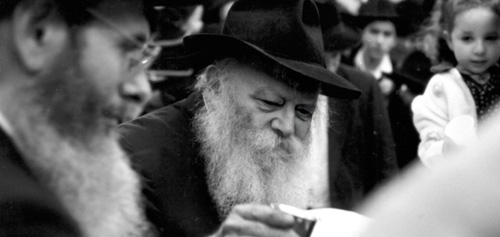
"Moshiach is ready to come now-our part is to increase in acts of goodness and kindness" -The Rebbe

Showing posts with label fear of Hashem. Show all posts

Sunday, August 4, 2013

Overcoming the Dangers of Intense Religiosity (pt. 3)


Overcoming the Dangers of
Intense Religiosity (pt. 3)

Rabbi Yehoishophot Oliver

Earlier (pts. 1 and pt. 2), we explained the phenomenon of well-meant, otherwise worthy religious feelings being “hijacked” and being expressed in a counter-productive, even harmful manner.

Now for the big question: How does one avoid falling into this trap?

One root cause of spirituality going awry is the lack of the proper foundation of one’s service of Hashem.

To serve Hashem properly it is not enough to eschew hedonism, to think constantly about Hashem, to be spiritual, and to love Hashem. It is not even enough to fear Him. The same goes for fulfilling the Mitzvos that relate to the sphere of interactions with other people: It is not enough for a religious person to be generous and hospitable, to be humble and forgiving, to be devoted and tireless in serving one’s community. 

Yes, these are all important and even vital elements of a deep, personal relationship with Hashem. Yet all of them can go awry, so none of them comprise the very foundation of one’s relationship with Hashem.

The beginning and foundation of serving Hashem is very (and perhaps even deceptively) simple: Kabolas ol Malchus Shomayim, submission to the yoke of the kingdom of Heaven.[1] This means that one is in a state of constant submission, such that all one’s behavior is part of serving Hashem, and is done with the intention of following His wishes.

With regard to emotional expression, this means that no emotion or desire, however worthy it may otherwise be, should be expressed exclusively because one feels that way.

Rather, even if the emotion coursing through one’s heart is fully appropriate, one should be conscious of its inner core. This very emotion is part of serving Hashem, for through it one fulfills a divine command—the command to feel certain feelings.

For Torah and halacha direct us not only in our actions, but also in proper thoughts and feelings, in “chovos halevavos—duties of the heart.” In this case, not only is it worthy to love and fear Hashem, but in so doing, we fulfill explicit divine commands[2] (which are, in fact, Biblical obligations no less binding than the obligation to keep Shabbos or kosher): “Love Hashem, your G–d”[3] and “Fear Hashem, your G–d.”[4]

This holds true not only for spontaneous, gut feelings (which are much more likely to be hijacked in the manner described above), but even for feelings that emerged, as they should, from a process of study, comprehension, and hisbonenus (“contemplation” or “meditation”). For intellect, emotions, and the (very worthy) process of intellect producing emotions all depend upon the firm foundation of Kabolas ol Malchus Shomayim for their success.

When a Jew’s life is based on this foundation, his entire relationship with Hashem is stable and strong, and then he is able to attain success in his spiritual strivings in all areas and on all levels[5]—intellect, emotions, and thought, speech, and action. Moreover, it ultimately also paves the way for Hashem’s blessings for material prosperity.

If, however, one gets carried away with a passion for a holy pursuit (in whatever area), but lacks the awareness that this feeling is not just self-expression, but a part of serving Hashem and fulfilling a divine command, then no matter how worthy and holy the passion, this person is at high risk. This passion may well devolve into inappropriate feelings and behavior, as explained in the previous posts in this series.

Thus, we find how Nadav and Avihu, who yearned to serve Hashem on a high level, were so intent on their desire to offer up the incense in the Mishkan that they did so when they were not supposed to. They then “came too close to Hashem, and died.”[6] The reason this happened was that their passion to come close to Hashem lacked kabolas ol Malchus Shomayim, the simultaneous desire to submit to Him, and so it ended tragically. Let us not make the same mistake.

Adapted from the Rebbe's Sichos Kodesh 5723, p. 54.

Read this essay in full on Scribd here!
____________________
[1] Cf. Tanya beg. ch. 41.
[2] These are counted in the Six Constant Mitzvos binding on men and women equally, as enumerated in the introduction to Sefer HaChinuch.
[3] Devarim 6:5.
[4] Ibid. 6:13.
[5] Cf. Likkutei Sichos, Vol. 1, pp. 104-105.
[6] Vayikra 12:1; Ohr HaChaim ad loc.


Dedicated by Reb Yisrael Meir Raphael and family.


___________________________________
Like what you read? The articles I write take a lot of time and effort. Please contact me to sponsor an article for (at least) $36 in honor of the birthday, wedding anniversary, or yarhtzeit of a loved one, or for a refuah shleimah or the like. Also, see here concerning the tremendous merit of supporting the dissemination of Chassidus, and the blessings that one receives for doing so.

Sunday, December 16, 2012

Chanukah: Hiskashrus cleanses from spiritual defilement


Hiskashrus cleanses from spiritual defilement

Rabbi Yehoishophot Oliver

“They found one flask of pure olive oil sealed with the imprint of the Cohen Gadol (the High Priest).”[1]

The physical defilement of the oil in the Beis HaMikdash was merely an external, physical manifestation of the inner malaise—the popularity that secular wisdom had gained among the Jewish people in general, and particularly among the Misyavnim, or Hellenists—the assimilationist Jews who had adopted Greek philosophy as their lifestyle.

This represents a certain kind of inner spiritual decline from which we can derive a lesson today.

Every Jew has a natural sensitivity to the refined spiritual explanations of G–d’s greatness, particularly as explained in the teachings of Kabbalah and Chassidus. This is found in the intellect of his Nefesh HoElokis, the Divine Soul.

A spiritually healthy Jew limits the intellect of the Nefesh HaSichlis, the Intellectual Soul (see here), and subjugates it to the ends of the Nefesh HoElokis.

However, when one becomes preoccupied with using one’s intellect in a way that lacks submission to the will of Hashem and of the Divine Soul, instead pursuing secular pursuits and studies for their own sake (as explained earlier here), the intellect of the Nefesh HaSichlis has become predominant.

This “defiles” the “pure olive oil”—the natural sensitivity to G–dliness of the intellect of the Divine Soul.[2] In this state, although the Jew is fully intellectually capable of grasping secular studies that discuss physical phenomena, he comes up against a dullness and resistance when he attempts to study spiritual concepts.

How can he possibly emerge from such a degenerate state? This is the lesson of Chanukah. There always remains “one flask of pure olive oil sealed with the imprint of the Cohen Gadol (the High Priest).”

To explain, it is stated of the Cohen Gadol: “His glory and beauty consist of sitting in the Beis HaMikdash all day. ... His house shall be in Yerushalayim, and he should never depart from there.”[3] Yerushalayim represents yirah shaleim,[4] complete fear of Hashem.

Thus, the Cohen Gadol represents the very core of the Jew’s soul, the Pinteleh Yid, the soul-level of Yechidah, a level that “never departs from Yerushalayim”—from complete fear of Hashem. This level is completely united with Hashem and can never be sullied by the person’s actions, although it can definitely be “asleep”—hidden and dormant in one who has fallen.

Now, the Yechidah may “wake up” when the Jew is faced with a test of faith, and inspire him to give up his life rather than deny Hashem. [5] However, that is an extreme circumstance. How does one awaken the Yechidah of oneself or others in the state described above, and bring it to fully illuminate the flame of the Neshamah[6]—which is compared to a flame, as it is written, “The Neshamah of a man is Hashem’s candle”—on all levels?

For this one must connect with the Cohen Gadol of the generation, a Jew who “sits all day in the Beis HaMikdash”—in an atmosphere of holiness and purity; moreover, he “never departs from Yerushalayim”—from a state of pure and complete fear of Hashem.

The Cohen Gadol, the Rebbe,[7] gives to all those who connect themselves with him a “flask of pure olive oil” with which to kindle and illuminate their own Neshamos despite its defilement and desecration.

However, just as on Chanukah, we are required to celebrate through both “Hallel vehoda’ah,” praise and acknowledgement, so is it with hiskashrus, bonding with the Rebbe. Hoda’ah, acknowledgement and faith are indeed necessary, but not sufficient. One must also engage Hallel, praise,[8] which represents investing intellectual effort to understand the greatness of Hashem (see here) as explained in Chassidus (which is compared to oil), thereby fulfilling the exhortation, “Know the G–d of your father”[9] until it illuminates every level of our souls with purity and holiness.

Adapted from the Rebbe’s Igros Kodesh, Vol. 2, pp. 277-278.

__________________________________________
[1] Shabbos 21b.
[2] For oil is compared to wisdom (Zohar 3:7b).
[3] Mishneh Torah, Hilchos K’lei HaMikdash, 5:7.
[4] Likkutei Torah, Rosh HaShanah 60b.
[5] Tanya ch. 19.
[6] Mishlei 20:27.
[7] Cf. Igros Kodesh, Vol. 5, p. 33.
[8] Shabbos ibid..
[9] I Divrei HaYomim 28:9.


  • Dedicated by Reb Yitzchak Kruk and family in the memory of Aryeh ben Yitzchak.
  • Dedicated by Yehoshua Solomon and family in the memory of Mrs. Molly Mitnick (Malah bas Elchanan).

Dedicated in the merit of a speedy release for the captives Yonasan ben Malka (Jonathan Pollard), Jacob Ostreicher (Yaakov Yehuda ben Shaindel), Alan Gross (Aba Chonah ben Hava Chana), Sholom Mordechai Halevi ben Rivka (Sholom Rubashkin), and Zeva Rochel bas Chaya (Wendy Weiner Runge).

~~~~~~~~~~~~~~~~~~~~
Like what you read? The articles I write take a lot of time and effort. Please contact me to sponsor an article for (at least) $36 in honor of the birthday, wedding anniversary, or yarhtzeit of a loved one, or for a refuah shleimah or the like. Also, see here concerning the tremendous merit of supporting the dissemination of Chassidus, and the blessings that one receives for doing so.

Friday, May 1, 2009

Inner self: The true measure of religiosity

In this week’s parsha, Kedoshim, (Vayikra 19:14), it is written:
You shall not ... put a stumbling block before a blind person, and you shall fear your G–d; I am Hashem. Rashi: Before someone who is blind in that particular matter you shall not give advice that is unfair to him. Don’t say to him, “sell your field and buy a donkey,” when your intention is to deceive him and take it from him.”

And you shall fear your G–d. Rashi: Because it is not given to human beings to know whether his intention was for good or evil. He could therefore evade [responsibility] and say “I intended it for his benefit.” Therefore it says concerning it, “you shall fear your G–d,” Who knows your thoughts. Likewise, of every matter that is given over to the heart of the person who does the action and no one else could possibly know [his true intentions], it states, “fear your G–d.”
So often we measure religiosity by externals, both in ourselves and others. Here the Torah warns us that this is not the true measure of divine service.

For example, it’s true that someone who talks in
Shul lacks fear of Hashem, but that doesn’t necessarily mean that the one who doesn’t talk does fear Hashem. He may be quiet for other reasons—he is a shy person by nature, he wants people to think well of him, and so on.

Likewise, many
frum Jews feel that since in general they adhere to the basics of Halacha, this is sufficient, and their divine service is acceptable. What they don’t realize is that in fact Hashem has very little to do with motivating their observance, which (on the revealed level) is driven almost exclusively by other motives.

So although the external actions are important (and I’m certainly not suggesting that they be abandoned, G–d forbid), they often tell us little about the person. The true measure is in the person’s inner self, in his thoughts and feelings, and this is largely between him and Hashem, for “One does not know what is in the heart of one’s fellow” (
Pesachim 54b).

The same holds true for the way that the Jew views himself. Let’s say that on some basic level, he wants to serve
Hashem. The question that he needs to ask himself is: Is it for real? Is he truly G–d-fearing?

Well, that begs the question: What does it mean to fear
Hashem? It means that the person is always conscious that Hashem is watching, and careful to follow His will, even in private.

So is the person G–d-fearing? Well, what does he do in his spare time, when he is alone? Will he waste that time, or use it to learn Torah, or do something positive and constructive for others? What does he think about? Does he naturally think constructive, or holy thoughts? Does he control himself when he desires to think an inappropriate thought, whether about something forbidden, or about a fellow Jew?

The same applies concerning the person and his fellow. When he helps others, he needs to ask himself: What is going through his mind and heart? Does he truly desire to help them, out of
ahavas Yisrael (love of a fellow Jew), or is he doing it primarily for other motives—if not deceitful motives, at least selfish ones?

If the answer to some of these questions is in the negative, the person has to realize that despite his technical observance, he has a long way to go on the road to truly serving
Hashem. He has to davven to Hashem to help him on this path.

Purifying and rectifying one’s inner thoughts and feelings is what true service of
Hashem is all about. The external actions simply provide the necessary framework for accomplishing this goal. To quote the Arizal: “A Mitzvah without the proper intention is like a body without a soul.” For a Jew who is basically religious, the “body” is there—the observance of Halacha. The really hard work, which sadly seems to be widely neglected, is that of infusing the body with a “soul,” the holy feelings that a Jew should feel—true love and fear of Hashem, love of Torah, and love of one’s fellow Jew. And this inner emotional change is accomplished through Avodas HaTefillah, “The service of prayer” (Taanis 2a).