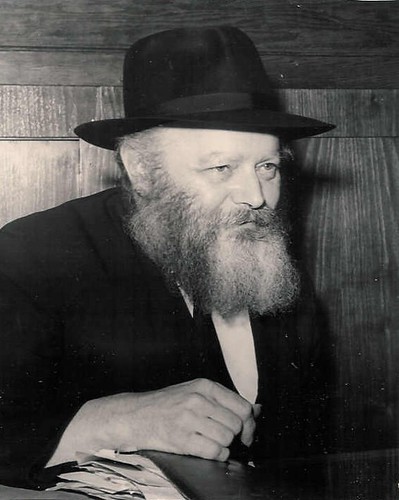
"Moshiach is ready to come now-our part is to increase in acts of goodness and kindness" -The Rebbe

Wednesday, June 10, 2009

Careful Love

Careful Love

Rabbi Yehoishophot Oliver

In the Chabad world we talk so much about the importance of loving our fellow Jew, every Jew, that sometimes we forget that there are limits.

The Previous Rebbe writes:
We should invest as much energy as we can to have a positive impact on a Jew and revive his inner self. This should be accomplished by drawing him close. However, one should remember that this closeness requires great caution, so that one does not befriend him too much. For just as one influences the other person, so does the other person exert influence on him.

There are several levels [of influence that the other person exerts]. At first one feels pity for the other person, and this leads to finding a
limmud zechus [an attempt to judge favorably someone who appears to be acting unconscionably]. So it should be; one should find a limmud zechus for the other person’s actions. However, the other person should not know about it. Rather, one should do so in private. One should weep profusely and recite a chapter of Tehillim [Psalms] for him, and beg Hashem to have mercy on him.

This is the meaning of love for one’s fellow Jew: Every Jew should do [what is necessary to help] his good friend, but be careful not to become overly close with him until, with
Hashem’s help, the other person reaches a good, upright level, such that it is appropriate to befriend him.

Likkutei Dibburim, Vol. 1, pp. 11-12.
In my own words: Although one should love every Jew ad mitzui hanefesh (“to the very core of life itself”—HaYom Yom 18 Av), this means that one should assist him, do him favors, and truly feel a deep bond with him as one’s brother and sister. However, it does not mean that it is appropriate to befriend every Jew equally. A truly close relationship is always two-way, with each member of the relationship having an impact on the other. Thus, if another Jew behaves inappropriately, one should keep a distance from him, because one is liable to be influenced.

Yet this does not mean that one may not have any contact with the one who is unfit for a close friendship; on the contrary, one should relate to every Jew with warmth and affection. However, one should be careful not to come close to him as one does to a friend who is one’s equal, for then one is susceptible to being adversely affected.[1] Also, one expresses love for the Jew whom one fears may negatively influence him by pleading Hashem to have mercy on him and help guide him to Teshuvah (on this topic, see here). This is the true way to express love for this Jew.

Exactly how one puts this into practice needs to be determined in each case individually.

Comments:

1. The reason that one should not tell the other person of one’s limmud zechus on him or her seems clearly to be that he may regard it as an endorsement of his inappropriate behavior (on this topic, see here). However, when speaking to others, and to Hashem, one should seek a limmud zechus for that person’s behavior.

2. This teaching conforms with the general principle taught in Chassidus that each middah (character trait) in Kedushah, holiness, always involves a balance with its opposite. Thus, Chessed, kindness, must be balanced and complemented by Gevurah, strictness (see here).

______________________________________
[1] Cf. Mishneh Torah, Laws of Teshuvah, 4:24—
"
והמתחבר לרשע, מפני שהוא לומד ממעשיו והן נרשמים בלבו הוא שאמר שלמה ורועה כסילים ירוע."

Tuesday, June 9, 2009

The Rebbe Forewarned Us


The Rebbe Forewarned Us 

Rabbi Y. Oliver

Some people ask: Since the Rebbe surely knew that Gimmel Tammuz was coming, why didn’t he issue guidance concerning the way that one should act after Gimmel Tammuz? Well, the first thing to recognize is that a Rebbe doesn’t abandon his chassidim, as the Rebbe says of the Previous Rebbe: “Those who knew the Rebbe in the course of the thirty years of his leadership know that the [Previous] Rebbe would not abandon his chassidim” (Toras Menachem 5710, Vol. 1, p. 16).  According to the principle of “he rules upon himself,” this surely holds true concerning the Rebbe as well.

And so it is understandable that, as the Rebbe says of the Previous Rebbe: “The [Previous] Rebbe prepared us in advance for the situation after his histalkus [passing]” (Toras Menachem, Vol. 10, p. 88).

One may, however, ask: But I don’t receive specific, explicit guidance from the Rebbe on how to approach the situation after his passing?

I believe the sicha below, delivered during the year after the Histalkus (passing of a Tzaddik) of the Previous Rebbe, provides the answer to this question.
As discussed earlier,[1] in the recent period the [Previous] Rebbe, my father-in-law, issued numerous instructions and forewarned many areas related to what behavior is appropriate in the later period [i.e., after Yud Shevat].

In the sicha of 13 Tammuz of last year[2] the [Previous] Rebbe, my father-in-law, said:

Every chossid should say a chapter of Tehillim [Psalms] daily in order that the merit of the Rebbeim should be drawn to them, and that they absorb the revelation of light [i.e., the spiritual revelation manifest via the Rebbeim] in an internal manner.
It may be asked: The flow of blessing from the Rebbeim has existed since the time of the Baal Shem Tov, yet the instruction to recite a chapter of Tehillim in order to elicit the merit of the Rebbeim and to internalize the light that they reveal in an internal manner was not issued until 12 Tammuz, 5709 [1949]!

Rather, the deeper intent of this was that every
chossid should continue to recite the chapter of the Rebbe in according with his age.[3]

Some
chassidim who would recite the Rebbe’s chapter of Tehillim (chapter seventy [according to the Previous Rebbe’s age]), began to doubt after 10 Shevat whether to continue doing so. Now, after 12 Tammuz [the Previous Rebbe’s birthday], they are unsure whether to continue reciting chapter seventy, or to begin reciting chapter seventy-one. I.e., they are not sure whether after the histalkus growth in age is possible.

The [Previous] Rebbe clarified this in advance by declaring on the last 13 Tammuz of his life in this world that every single
chossid should recite a chapter of Tehillim daily, the chapter of the Rebbe, for through this the merit of the Rebbe will be drawn to him, and he will absorb the revelation of light internally.

The [Previous] Rebbe issued this directive on 13
Tammuz of last year, but at the time not everyone knew of it. Only a handful of individuals possessed a transcript of the address, while the masses did not know of it. However, now it has been printed and publicized to all.

When the Rebbe, my father in law, said things that were intended to forewarn and provide guidance concerning the time after his passing, they were not said explicitly. The reason for this is, as it is written of Moshe, “in my entire house he is trusted.”[4] This trust is explained in the holy books.[5] How can one speak of trust, when it is not possible to take anything? This trust is expressed in the fact that one does not reveal everything that one sees.

There is a story of the
Maggid [of Mezeritch] ... that once one of his students entered to part with him before travelling home, and the Maggid told the Holy Society [i.e., his other students] to prevent him from travelling. They tried to stop him, and when they did not succeed, they told him that this was in fact an instruction of the Maggid himself. The chossid could not believe this, since the Maggid himself had parted with him. So he went to part with him again. The Maggid bade him farewell again, and when he left, he berated them as a chossid can, saying, “Don’t you see that the Maggid bade me farewell again?!” Then the Maggid returned and told the Holy Society again to stop the student from leaving. He went to the Maggid again to part with him, and they tried to stop him again, and this recurred several times. Finally he did not listen to them, and left, and when he arrived home, he had passed away. They went to the Maggid and asked him, if he knew, why didn’t he tell him explicitly not to travel? The answer was “in my entire house he is trusted”—not everything may be revealed.[6]


Toras Menachem 5710, Vol. 1, pp. 148, 149, 150.

[1]
Toras Menachem 5710, Vol. 1, pp. 120, 129.
[2]
Sefer HaMa’amarim 5710 p. 263 ff.
[3] See
Igros Kodesh Admur HaRayatz, Vol. 1, p. 31; Vol. 10, p. 53.
[4]
Shemos 12:7.
[5]
Maamarei Admur HaZakein—Es’halech Liozna p. 1.
[6] Cf.
Toras Menachem 5710, Vol. 1, p. 81.
In my own words: The Previous Rebbe issued directives in a hidden manner concerning the period after his Histalkus. The reason that he did not do so explicitly is that he was not given permission to do so from Above.

Lessons:

1. Again, according to the principle of “he rules upon himself,” just as the Previous Rebbe issued directives relevant to the period after his own passing, albeit in the form of hints, so did the Rebbe surely provide guidance to the chassidim in his sichos [talks] and maamarim [Chassidic discourses]. “Toil, and you will find!” In particular, see such guidance in this post.

2. Since everything we learn is by divine providence, and the Rebbe guides us and communicates with us after Gimmel Tammuz through his teachings, we should pay special attention to the particular sichos and maamarim that we are privileged to learn, because they are certainly very relevant to our personal circumstances, and that is why Hashem arranged circumstances such that we would come to learn them.

Thursday, June 4, 2009

True love for Torah

In the love for Torah there is no difference between the love one should have for Chumash Bereshis, Shemos, Vayikra, Bamidbar, and Devarim, than for Nevi’im and Kesuvim. The same applies to Mishnayos, Gemara of Bavli or Yerushalmi, Medrash, and Zohar.
Our sages comment on the verse, “Lest she walk the even path of life” (Mishlei 5:6): “Do not sit and weigh up the Mitzvos of the Torah. They were all given from one shepherd and said by one G–d” (Devarim Rabba, 6:2). Thus, all words and explanations of the Torah are the same for all Jews from the perspective of the feeling of his Neshama.

The difference that can and does indeed exist is in intellect, in the understanding of Torah and the explanations of the individual
Mitzvos. One person understands more, and another, less. However, this is only true of the comprehension of Torah and Mitzvos. However, in terms of the feeling of the Neshama, all Jews—those who comprehend and those who do not—are equal.

Likkutei Dibburim, Vol. 3, p. 1019.
People who like learning Torah often have certain areas of Torah that they prefer to study over others, in accordance with their intellectual preferences. Indeed, our sages say: “One should always learn in the place (i.e., the area of Torah study) that his heart desires" (Avoda Zara 19a). However, this can lead the person to study for the sake of satisfying his intellectual needs, rather than lishmoh, for the sake of performing a Mitzvah of Hashem.

One way of discerning whether one loves Torah because one feels that it is the word of
Hashem, or because one finds certain parts of it personally appealing, is to ask oneself how one feels towards the areas of Torah that one does not take to so easily. Does one still feel a sense of awe and reverence and a deep yearning to study them and thereby unite with Hashem? Or does one sort of casually dismiss them, saying: “That’s an interesting topic, but it’s not for me.”

Thursday, May 21, 2009

Yechidus: Words of affection


One of the central Chassidic practices (darkei haChassidus) is that Chassidim are to travel regularly to the Rebbe for a one-on-one meeting, which is known in Chassidic parlance as Yechidus. This meeting has classically been the cornerstone of the Rebbe-chossid relationship.

In the preface to
Tanya, the Alter Rebbe beautifully describes his special relationship with the chassidim who came to seek his advice in Yechidus: “Words of affection were common between us, and they revealed before me all the hidden aspects of their heart in matters of serving Hashem related to the heart.” See also the Alter Rebbe’s words in Mei’ah She’arim p. 58 (cited in Likkutei Sichos, Vol. 5, p. 334): “ ... One cries out in Yechidus at one’s distance from the living G–d.”

First, these sources show that although advice is sought in this meeting, it is much more than a patient visiting a doctor and receiving a prescription. It is a unity between souls in an awesomely deep, personal, and loving relationship, in which profound mutual love is expressed.

The explanation of this deep relationship is that a Rebbe is a
Neshamah Kelalis, a “general soul,” of which the chossid is an individual component. When the perat, the individual aspect, connects to its soul-origin directly, this is a very profound, personal experience.


There are so many beautiful stories in Chassidic lore of the deep relationship between
chossid and Rebbe, and how chassidim would yearn to go to Yechidus, and prepare for it for a long time, and regard it as the highest point in their lives.

We also see from these quotes that
Yechidus is a place for the chossid to express his deepest yearnings, viz., to perform Torah and Mitzvos with true love of Hashem and fear of Hashem, to reach true Teshuvah, and thus a truly intimate connection with G–dliness.


(For a Hebrew booklet on the concept of Yechidus, see here.)

Sunday, May 17, 2009

If you don’t believe ...

The following story took place during the first or second year of the Rebbe’s leadership:
A non-observant woman turned to the Rebbe in connection with her husband’s health. The Rebbe blessed her husband with a complete recovery and added that if until now she did not light Shabbos candles, she should begin to do so.

The woman contacted the secretariat and argued, “I don’t understand the connection between my husband’s health and my lighting
Shabbos candles.” The secretary relayed this to the Rebbe, who responded that the secretary should tell her as follows: “If you do rely on me, and this brought you to write to me, then believe me that lighting Shabbos candles will help your husband’s health. And if you don’t believe me, why did you turn to me in the first place?!”

Hiskashrus #704.
Lessons:

1.
Listening to an expert

The true reason one should obey the Rebbe’s instructions is that he has committed to be a
chossid, and the Rebbe is adoneinu, our master. A chossid must obey.

However, this degree of commitment is not necessary in order to realize that one should obey. If one thinks clearly, even one who unfortunately lacks a full sense of commitment as a
chossid can realize that he should obey the Rebbe, simply because he knows enough to know that he doesn’t truly know, while the Rebbe, who is a true Tzaddik, does. Moreover, the Rebbe is not issuing his instructions for his own benefit at all, but for our benefit, to refine and elevate us, to cleanse and rectify us so that we can serve Hashem in the best possible manner.

The Rebbe is a master spiritual doctor; thus, one who desires to become spiritually healthy and stay that way will follow the Rebbe’s prescription even if he is not a
chossid.

2.
Believing in the Tzaddik:

We “believe and don’t believe.”

Even of Noach, who is described by the Torah as “a righteous man” who “walked with G–d,” it is said that he “believed and didn’t believe,” for he did not enter the teiva (ark) until the last moment (Rashi, Bereishis 7:7).

Likewise, the Rebbe has issued numerous instructions. However, many
chassidim are only ready to obey in areas that they understand and appreciate, while in areas that they don’t relate to so well, they are lax. They have “selective hearing.”

However, in reality this demonstrates a lack of faith. One who truly believes will not allow his lack of understanding to detract from fulfilling the Rebbe’s instructions.

Moshiach is coming now. Let’s not wait any longer to “enter the teiva.”

Thursday, May 14, 2009

Creating a chassidishe environment

The Rebbe writes to Rabbi Y. Altein:
I am surprised that I only received the report of your and Rabbi Sholom Posner’s participation in the division of the Shas [Talmud]. After all the years living in your location have you not yet brought even one Jew under your influence?

If this is so [that chassidei Chabad have a responsibility to influence their environment] even of matters related to the revealed dimension of the Torah [promoting participation in the division of the Talmud amongst the community], it applies all the more to matters related to the inner dimension of Torah and Mitzvos, which the evil inclination opposes more and more, and is at the ready to invent excuses of all kinds.

When will you finally begin to do your part in disseminating the wellsprings of the Baal Shem Tov outward? Moshiach is waiting for the activities of each and every one of us in order that what Moshiach answered the Baal Shem Tov be fulfilled, that then he would come to redeem us from the exile, which is an exile both for the body and for the soul.

This is not a mere theoretical point, but the simple meaning of that which is written in the Igeres HaKodesh of the Baal Shem Tov [Kesser Shem Tov 1].

You, and every one of your colleagues where you live, should create an environment that will be a corner of Lubavitch that Hashem has planted for the meantime in your location. The Alter Rebbe, travelling the world and coming to your location should not feel like a stranger. Rather, he should find a community of his own, a house of study of his own, sheimos from chassidishe books on the floor, and an atmosphere filled with letters of Torah and yiras Shomayim [fear of Heaven] in general, and letters of Chassidus Chabad in particular. Although the letters have risen above, their impression remains forever, as is known that an impression remains of every holy thing.

Until when are you all delaying this Avodah? In the meantime the entire Jewish people are found in the doubled and redoubled darkness of the exile, and there is no day when the unfortunate events do not become even worse than those of the previous day (Sotah 49a). This is especially true now that they have begun to call darkness, light, and slavery, redemption.

Igros Kodesh, Vol. 3, pp. 48-49.
In my own words: A chossid has to create a chassidishe environment so much so that the Rebbeim will feel at home in his Shul and home. This will illuminate the darkness of exile, and therefore must not be delayed.

Along these lines it is written in HaYom Yom of 30 Adar I:
My father said: A chossid creates an environment. If he does not, he had better check his own baggage carefully, to see whether his own affairs are in order. The very fact that he fails to create an environment should make him as broken as a splinter. He must demand of himself: What am I doing in this world?

Wednesday, May 13, 2009

Uplifting toil

The Gemoro says that one of the reasons that the world was created was for the “toil of speech” (Sanhedrin 99b), which is prayer.

Thus, everyone should work at
davvenen (prayer), each person on their level.

Some people ask: How can you demand of me that I should
davven with concentration, and even meditate on G–dly concepts? I am struggling with maintaining basic behavior, and I often do not succeed at overcoming coarse temptations.

The answer is that 
Avodas HaTefillah, the service of prayer, will even help such a person.

One who tries to
davven realizes automatically that he shouldn’t get angry, gaze at things he shouldn’t and read things he shouldn’t, and so on, because these behaviors coarsen him and render him unreceptive to the refinement and spiritual sensitivity that he aims to acquire through davvenen. Like any productive member of society, he doesn’t want to waste his time, so this awarentess naturally leads him to be more careful in the way he behaves in general. So although the person is not truly fit to davven, the very effort to davven elevates him.

Monday, May 11, 2009

False comparisons

“What’s mine is yours, and what’s yours is mine—this one is a man of the earth” (Pirkei Avos 5:13)

The
Medrash Shmuel interprets this as follows: Some people always want to switch what they have with others, imagining that then they will be happy. The Mishnah is teaching us that this is a foolish trait.

The same applies to spiritual aspirations. Often, one of the reasons that a person feels that “it’s too late” to develop spiritually is that he falls into the trap of comparing himself to others. “How does the other guy manage to make friends so easily,” he asks himself, “while for me it’s so difficult? Why does he manage to rise early, while for me it’s always a struggle? How come he understands what he learns the first time, while I don’t understand even after reviewing it several times? And why can’t I have a brilliant memory like him?”

By drawing such comparisons, the person comes to look down on himself and feel like a loser and a failure. This is exactly what the evil inclination wants, because once the person is in this low state, he is far more susceptible to succumbing to temptation (see
Tanya ch. 26).

But in reality, all that
Hashem wants of a Jew is that he fulfill his own personal potential.

Once Reb Mendel Futerfas sat at a
farbrengen where a group of students were discussing what
Hashem expects of a Jew. Reb Mendel took a jug of water, and poured it into a cup. “Which is better,” he asked, “the jug or the cup?” “The jug,” everyone responded. “Which is better,” he repeated, “the jug or the cup?” Finally, someone responded: “It depends. In terms of quantity, the jug is better, but in terms of fullness, the cup is better.” “Exactly!” he exclaimed. “That’s what Hashem expects of us, to be full.”

There is no use comparing oneself to someone else, because his success at his personal mission depends upon only one thing—his effort to fulfill his personal potential. To the extent that his “cup” is “full,” that he maximizes his potential, he is accomplishing what
Hashem wants of him. If he falls short of this high standard, even if he accomplishes a great deal, he is falling short in Hashem’s eyes. But a person of average talent who serves Hashem with sincere devotion, brings Hashem tremendous pleasure.

Thus, it’s completely inappropriate to compare oneself to others, because serving
Hashem is not about talents and accomplishments, but “how you play the cards that you’re dealt.”

Tuesday, May 5, 2009

Hiskashrus: Yes, We Can!

Hiskashrus: Yes, We Can!

Rabbi Y. Oliver


Of course, receiving direct attention from the Rebbe, especially in Yechidus, is far preferable to receiving guidance from the Rebbe via a personal rav (see this post). It’s a much more uplifting feeling and powerful experience.

Yet despite the genuine advantages to a
chossid receiving direct attention from the Rebbe, this is not what defines the Rebbe-chossid relationship. There were many chassidim imprisoned for decades 
in Russian gulags who maintained their devotion as chassidim (on the contrary, their Chassidic warmth was so great that it kept them Torah-observant even under cruel Communist oppression, and in a time when vast numbers of non-chassidim had abandoned outward Torah observance due to the danger it posed to their lives). Obviously it poses challenges, but the fact that it was done demonstrates that it is possible.

The same is true in our current situation; although the Rebbe is certainly leading us just as before, we do not connect with him physically. Now, too, we witness many people who succeed at staying devoted
chassidim after Gimmel Tammuz just as much as before, and with even greater devotion. Moreover, we see people becoming chassidim, such as younger people who never saw the Rebbe, or only saw the Rebbe as small children, and even total newcomers. One cannot argue with the facts. This proves that this level of bonding with the Rebbe, and the passionate inspiration that this bond evokes, is attainable even today.

So although after
Gimmel Tammuz in a very real sense it’s harder to maintain the Rebbe-chossid relationship, this is a challenge we can overcome. Although it may be necessary to reach into a deeper part of our souls to come to that level of inspiration, we have surely been endowed with the full ability and the tools with which to do so (see also this post.)

Monday, May 4, 2009

Birthday: Cause for Celebration


The Rebbe initiated a campaign that a birthday be celebrated with a joyous farbrengen [chassidic gathering], to which one should invite one’s friends.

Some may ask: Why set up a farbrengen to celebrate a birthday? What’s so special about a birthday of any individual, and an individual such as myself in particular? What are my great accomplishments? If anything, what I have left to accomplish is much greater than what I’ve accomplished.

One answer is that if this is what the Rebbe says, as
chassidim, we should obey out of Kabbolas Ol. (May I add that the Rebbe directed this campaign to all Jews. However, a chossid must obey the Rebbe’s words, while a non-chossid is not bound by the Rebbe’s words in the same way; it would be more accurate to say that the Rebbe’s directives are something he is encouraged to do.)

We may be uncomfortable doing this, and on the contrary, we
should feel that way; if it’s uncomfortable, that’s a good sign. For after all, who are we, that we should make a big fuss over ourselves, especially considering all our faults, which each of us knows better than anyone else?


Yet from another perspective, we should not feel uncomfortable at all.

What are we celebrating on a birthday—the body? The Bestial Soul? No, we’re celebrating the
Neshamah (the Divine Soul), and the very fact that we have a Neshamah. And that the Neshamah is “a part of Hashem above” (Tanya ch. 2). The meaning of a birthday is that we do have a better self, and it’s time to get in touch with it. And it’s a time to think about the potential of this better self, and how much of this potential has been actualized thus far, and how to bring out more of this potential. This is the purpose of a birthday farbrengen.

To understand further why the
Neshamah is so crucial, let us quote from the Rebbe’s explanation here in Kuntres Inyanah Shel Toras HaChassidus:

Physical life is also very important, and especially that of a human being. Nevertheless, all Jews are princes, and the life of a prince is intrinsically dependent upon his bond with his father, the king. Thus, if he is given life but severed from his father, the king, and cast into a dung heap to live the life of an animal, not only will he not enjoy this life, but he will despise it.

[Along these lines,] there is the known story of the
chossid, Reb Yekusiel Liepler (see HaYom Yom of 6 Cheshvan). When the Alter Rebbe wanted to bless him with long life, he responded: “But not with peasant years, who have eyes, but don’t see, and ears, but don’t hear; they don’t see G–dliness, and they don’t hear G–dliness.”

This appears surprising. When one is given a gift, and all the more so when one is given a great gift, how can he refuse to accept it unless the gift is even greater? A long life has great intrinsic value (and especially since the pleasure of living includes all the pleasures of the world), how could Reb Yekusiel have made conditions in the blessing?

The explanation is that Reb Yekusiel’s condition was not that the blessing be increased, but that the long life be true life. He felt with certainty that the entire existence of life was to see and hear G–dliness. Thus, he stipulated, “but not with peasant years,” for he considered days and years in which one does not see and hear G–dliness completely worthless; on the contrary, he despised such days and years.
Thus, the Rebbe explains that when a Jew recites Modeh ani, he is not thanking Hashem that he is alive, as one might think. Rather, he declares “I thank you ... for returning my soul to me”—i.e., the special Neshamah of a Jew. For without the Neshamah, life is not worth living.

The same applies to a birthday. The true significance of a birthday is not that on this day the person was born, but that on this day he became a Jew—one who possesses a
Neshamah. (Moreover, the Rebbe says that since the Neshamah does not fully enter the person until the Bar/Bas Mitzvah, the birthday is also the anniversary of the person’s Bar/Bas Mitzvah.)


Since from the perspective of the
Neshamah every Jew is a prince, and this fact infuses the Jew’s life with invaluable inherent significance, the anniversary of the day on which one was endowed with the Neshamah is definitely cause for joyous celebration.


Adapted from a farbrengen heard from
Rabbi Yaakov Winner, shlita, of Melbourne, Australia.

Sunday, May 3, 2009

Birthday wishes

Today is my birthday, a day on which one’s mazal (the source of one’s Neshama in the higher spiritual realms) is dominant and assists him (Talmud Yerushalmi, Rosh Hashanah 3:8). Thus, it is appropriate to give and receive good wishes.

I would like to wish all my dear readers from all over the world much success both materially and spiritually. I thank you for taking the time to read my writings, and I hope that you have gained from them. For those of you who have linked to me or otherwise passed on the word of my blog, I thank you for doing so.

I davven to Hashem that He be with my keyboard, such that I only write that which is pleasing in His eyes, in accordance with His pure Torah, specifically as taught by the Rebbeim of Chabad.

I davven that all the thick darkness and horrendous suffering of the exile disappear immediately through the coming of Moshiach. However, if any brief moments remain until then, G–d forbid, may we succeed at using them to the utmost to prepare ourselves and the world around us for his arrival, with joy and enthusiasm.

Friday, May 1, 2009

Inner self: The true measure of religiosity

In this week’s parsha, Kedoshim, (Vayikra 19:14), it is written:
You shall not ... put a stumbling block before a blind person, and you shall fear your G–d; I am Hashem. Rashi: Before someone who is blind in that particular matter you shall not give advice that is unfair to him. Don’t say to him, “sell your field and buy a donkey,” when your intention is to deceive him and take it from him.”

And you shall fear your G–d. Rashi: Because it is not given to human beings to know whether his intention was for good or evil. He could therefore evade [responsibility] and say “I intended it for his benefit.” Therefore it says concerning it, “you shall fear your G–d,” Who knows your thoughts. Likewise, of every matter that is given over to the heart of the person who does the action and no one else could possibly know [his true intentions], it states, “fear your G–d.”
So often we measure religiosity by externals, both in ourselves and others. Here the Torah warns us that this is not the true measure of divine service.

For example, it’s true that someone who talks in
Shul lacks fear of Hashem, but that doesn’t necessarily mean that the one who doesn’t talk does fear Hashem. He may be quiet for other reasons—he is a shy person by nature, he wants people to think well of him, and so on.

Likewise, many
frum Jews feel that since in general they adhere to the basics of Halacha, this is sufficient, and their divine service is acceptable. What they don’t realize is that in fact Hashem has very little to do with motivating their observance, which (on the revealed level) is driven almost exclusively by other motives.

So although the external actions are important (and I’m certainly not suggesting that they be abandoned, G–d forbid), they often tell us little about the person. The true measure is in the person’s inner self, in his thoughts and feelings, and this is largely between him and Hashem, for “One does not know what is in the heart of one’s fellow” (
Pesachim 54b).

The same holds true for the way that the Jew views himself. Let’s say that on some basic level, he wants to serve
Hashem. The question that he needs to ask himself is: Is it for real? Is he truly G–d-fearing?

Well, that begs the question: What does it mean to fear
Hashem? It means that the person is always conscious that Hashem is watching, and careful to follow His will, even in private.

So is the person G–d-fearing? Well, what does he do in his spare time, when he is alone? Will he waste that time, or use it to learn Torah, or do something positive and constructive for others? What does he think about? Does he naturally think constructive, or holy thoughts? Does he control himself when he desires to think an inappropriate thought, whether about something forbidden, or about a fellow Jew?

The same applies concerning the person and his fellow. When he helps others, he needs to ask himself: What is going through his mind and heart? Does he truly desire to help them, out of
ahavas Yisrael (love of a fellow Jew), or is he doing it primarily for other motives—if not deceitful motives, at least selfish ones?

If the answer to some of these questions is in the negative, the person has to realize that despite his technical observance, he has a long way to go on the road to truly serving
Hashem. He has to davven to Hashem to help him on this path.

Purifying and rectifying one’s inner thoughts and feelings is what true service of
Hashem is all about. The external actions simply provide the necessary framework for accomplishing this goal. To quote the Arizal: “A Mitzvah without the proper intention is like a body without a soul.” For a Jew who is basically religious, the “body” is there—the observance of Halacha. The really hard work, which sadly seems to be widely neglected, is that of infusing the body with a “soul,” the holy feelings that a Jew should feel—true love and fear of Hashem, love of Torah, and love of one’s fellow Jew. And this inner emotional change is accomplished through Avodas HaTefillah, “The service of prayer” (Taanis 2a).